Page 320 of 420

Headlamp Aiming
Your vehicle has a visual optical headlamp aiming
system which may be equipped with horizontal aim
indicators. The aim has been preset at the factory and
should need no further adjustment. This is true even
though your horizontal aim indicators (if equipped) may
not fall exactly on the “0” (zero) marks on their scales.
If your vehicle is damaged in an accident, the headlamp
aim may be affected. Aim adjustment to the low beam
may be necessary if it is difficult to see lane markers
(for horizontal aim), or if oncoming drivers ash
their high beams at you (for vertical aim). If you believe
your headlamps need to be re-aimed, we recommend
that you take your vehicle to your dealer for service.
However, it is possible for you to re-aim your headlamps
as described in the following procedure.Adjustment screws can be turned with an E8 Torx
®
socket or T15 Torx®screwdriver.
Notice:To make sure your headlamps are aimed
properly, read all the instructions before beginning.
Failure to follow these instructions could cause
damage to headlamp parts.
The vehicle should be properly prepared as follows:
The vehicle should be placed so the headlamps are
25 ft. (7.6 m) from a light colored wall or other at
surface.
The vehicle must have all four tires on a perfectly
level surface which is level all the way to the wall
or other at surface.
The vehicle should be placed so it is perpendicular
to the wall or other at surface.
The vehicle should not have any snow, ice or mud
attached to it.
The vehicle should be fully assembled and all other
work stopped while headlamp aiming is being done.
The vehicle should be normally loaded with a
full tank of fuel and one person or 160 lbs (75 kg) on
the driver’s seat.
Tires should be properly inated.
5-48
Page 334 of 420

(D) Construction Code:A letter code is used to
indicate the type of ply construction in the tire. The letter
R means radial ply construction; the letter D means
diagonal or bias ply construction; and the letter B means
belted-bias ply construction.
(E) Rim Diameter:Diameter of the wheel in inches.
(F) Service Description:These characters represent
the load range and speed rating of the tire. The load
index represents the load carry capacity a tire is certied
to carry. The load index can range from 1 to 279. The
speed rating is the maximum speed a tire is certied
to carry a load. Speed ratings range from A to Z.
Tire Terminology and Denitions
Air Pressure:The amount of air inside the tire pressing
outward on each square inch of the tire. Air pressure
is expressed in pounds per square inch (psi) or
kilopascal (kPa).
Accessory Weight:This means the combined weight
of optional accessories. Some examples of optional
accessories are, automatic transmission, power steering,
power brakes, power windows, power seats, and air
conditioning.Aspect Ratio:The relationship of a tire’s height to
its width.
Belt:A rubber coated layer of cords that is located
between the plies and the tread. Cords may be made
from steel or other reinforcing materials.
Bead:The tire bead contains steel wires wrapped by
steel cords that hold the tire onto the rim.
Bias Ply Tire:A pneumatic tire in which the plies are
laid at alternate angles less than 90 degrees to the
centerline of the tread.
Cold Ination Pressure:The amount of air pressure in
a tire, measured in pounds per square inch (psi) or
kilopascals (kPa) before a tire has built up heat
from driving. SeeInation - Tire Pressure on page 5-65.
Curb Weight:This means the weight of a motor
vehicle with standard and optional equipment including
the maximum capacity of fuel, oil and coolant, but
without passengers and cargo.
DOT Markings:A code molded into the sidewall of a
tire signifying that the tire is in compliance with the
U.S. Department of Transportation (DOT) motor vehicle
safety standards. The DOT code includes the Tire
Identication Number (TIN), an alphanumeric designator
which can also identify the tire manufacturer, production
plant, brand and date of production.
5-62
Page 337 of 420

Ination - Tire Pressure
Tires need the correct amount of air pressure to operate
effectively.
Notice:Do not let anyone tell you that
under-ination or over-ination is all right. It is not.
If your tires do not have enough air (under-ination),
you can get the following:
Too much exing
Too much heat
Tire overloading
Premature or irregular wear
Poor handling
Reduced fuel economy
If your tires have too much air (over-ination),
you can get the following:
Unusual wear
Poor handling
Rough ride
Needless damage from road hazardsA Tire and Loading Information label is attached to the
vehicle’s center pillar, below the driver’s door latch.
This label lists your vehicle’s original equipment
tires and shows the correct ination pressures for your
tires when they are cold. The recommended cold
tire ination pressure, shown on the label, is the
minimum amount of air pressure needed to support your
vehicle’s maximum load carrying capacity.
For additional information regarding how much weight
your vehicle can carry, and an example of the tire
and loading information label, seeLoading Your Vehicle
on page 4-30. How you load your vehicle affects the
vehicle handling and ride comfort, never load your
vehicle with more weight than it was designed to carry.
When to Check
Check your tires once a month or more. Do not forget to
check the spare tire. If your vehicle has a compact
spare tire, it should be at 60 psi (420 kPa). For additional
information regarding the compact spare tire, see
Compact Spare Tire on page 5-86.
5-65
Page 366 of 420

Tires
To clean the tires, use a stiff brush with tire cleaner.
Notice:Using petroleum-based tire dressing
products on your vehicle may damage the paint
nish and/or tires. When applying a tire dressing,
always wipe off any overspray from all painted
surfaces on your vehicle.
Sheet Metal Damage
If the vehicle is damaged and requires sheet metal
repair or replacement, make sure the body repair shop
applies anti-corrosion material to parts repaired or
replaced to restore corrosion protection.
Original manufacturer replacement parts will provide the
corrosion protection while maintaining the warranty.
Finish Damage
Any stone chips, fractures or deep scratches in the nish
should be repaired right away. Bare metal will corrode
quickly and may develop into major repair expense.
Minor chips and scratches can be repaired with touch-up
materials available from your GM dealer. Larger areas of
nish damage can be corrected in your GM dealer’s body
and paint shop.
Underbody Maintenance
Chemicals used for ice and snow removal and dust
control can collect on the underbody. If these are not
removed, corrosion and rust can develop on the
underbody parts such as fuel lines, frame, oor pan,
and exhaust system even though they have corrosion
protection.
At least every spring, ush these materials from the
underbody with plain water. Clean any areas where mud
and debris can collect. Dirt packed in close areas of
the frame should be loosened before being ushed.
Your dealer or an underbody car washing system can
do this for you.
Chemical Paint Spotting
Some weather and atmospheric conditions can create a
chemical fallout. Airborne pollutants can fall upon and
attack painted surfaces on the vehicle. This damage can
take two forms: blotchy, ring-shaped discolorations,
and small, irregular dark spots etched into the
paint surface.
Although no defect in the paint job causes this, GM will
repair, at no charge to the owner, the surfaces of
new vehicles damaged by this fallout condition within
12 months or 12,000 miles (20 000 km) of purchase,
whichever occurs rst.
5-94
Page 375 of 420
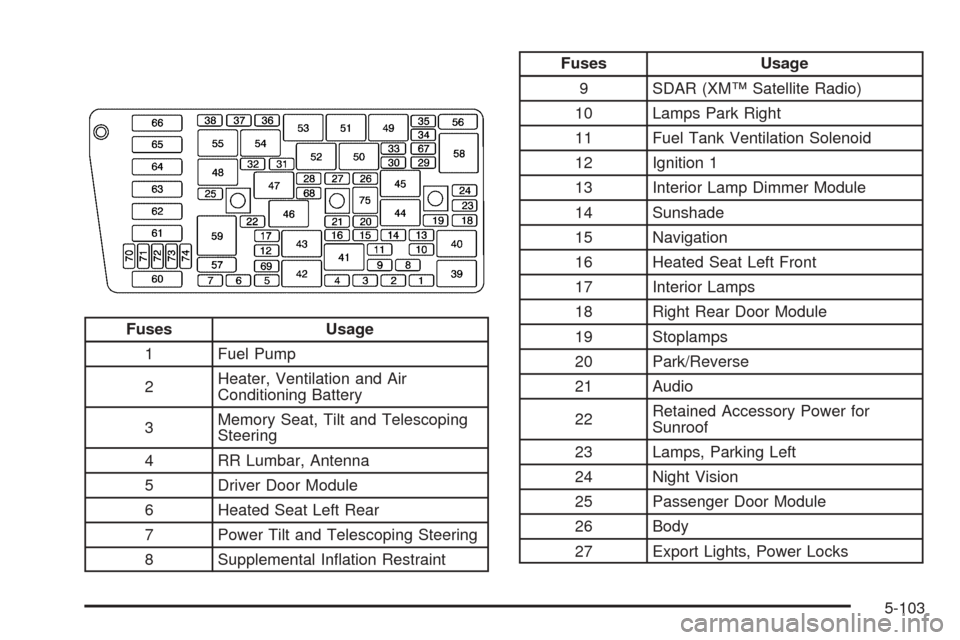
Fuses Usage
1 Fuel Pump
2Heater, Ventilation and Air
Conditioning Battery
3Memory Seat, Tilt and Telescoping
Steering
4 RR Lumbar, Antenna
5 Driver Door Module
6 Heated Seat Left Rear
7 Power Tilt and Telescoping Steering
8 Supplemental Ination Restraint
Fuses Usage
9 SDAR (XM™ Satellite Radio)
10 Lamps Park Right
11 Fuel Tank Ventilation Solenoid
12 Ignition 1
13 Interior Lamp Dimmer Module
14 Sunshade
15 Navigation
16 Heated Seat Left Front
17 Interior Lamps
18 Right Rear Door Module
19 Stoplamps
20 Park/Reverse
21 Audio
22Retained Accessory Power for
Sunroof
23 Lamps, Parking Left
24 Night Vision
25 Passenger Door Module
26 Body
27 Export Lights, Power Locks
5-103
Page 377 of 420
Relays Usage
39 Fuel Pump
40 Parking Lamps
41 Ignition 1
42 Not Used
43 Not Used
44 Park Shift Interlock
45 Reverse Lamps
46Retained Accessory Power for
Sunroof
47 Reverse Lockout
48 Suspension Dampers
49 Ignition 3
50 Fuel Tank Door Release
51 Interior LampsRelays Usage
52 Trunk Release
53 Not Used
54 Lock, Cylinder
55 Automatic Level Control Compressor
58 Not Used
59 Rear Defog
Circuit
BreakersUsage
56 Power Seats
57 Power Windows
The spare fuses and fuse puller are located in the
underhood fuse block. SeeUnderhood Fuse Block on
page 5-98.
5-105
Page 378 of 420
Capacities and Specications
The following approximate capacities are given in English and metric conversions. SeeRecommended Fluids and
Lubricants on page 6-12for more information.
ApplicationCapacities
English Metric
Air Conditioning Refrigerant R134a 2.2 lbs 1.0 kg
Cooling System 13.0 qt 12.3 L
Engine Oil with Filter 7.5 qt 7.1 L
Fuel Tank 18.5 gal 70.0 L
Transaxle 15.0 qt 14.2 L
Wheel Nut Torque 100 ft lb 140Y
All capacities are approximate. When adding, be sure to ll to the approximate level as recommended in this
manual. Recheck uid level after lling.
Engine Specications
Engine VIN Code Transaxle Spark Plug Gap
4.6L DOHC V8Y
DeVille, DHSAutomatic 0.050 inches (1.3 mm)
4.6L DOHC V89
DTSAutomatic 0.050 inches (1.3 mm)
5-106
Page 379 of 420
Maintenance Schedule......................................6-2
Introduction...................................................6-2
Maintenance Requirements..............................6-2
Your Vehicle and the Environment....................6-2
Using the Maintenance Schedule......................6-2
Scheduled Maintenance...................................6-4
Additional Required Services............................6-6
Maintenance Footnotes...................................6-7Owner Checks and Services............................6-9
At Each Fuel Fill............................................6-9
At Least Once a Month...................................6-9
At Least Once a Year...................................6-10
Recommended Fluids and Lubricants...............6-12
Normal Maintenance Replacement Parts..........6-13
Maintenance Record.....................................6-14
Section 6 Maintenance Schedule
6-1