2005 AUDI A6 door control
[x] Cancel search: door controlPage 61 of 92
Downloaded from www.Manualslib.com manuals search engine 63
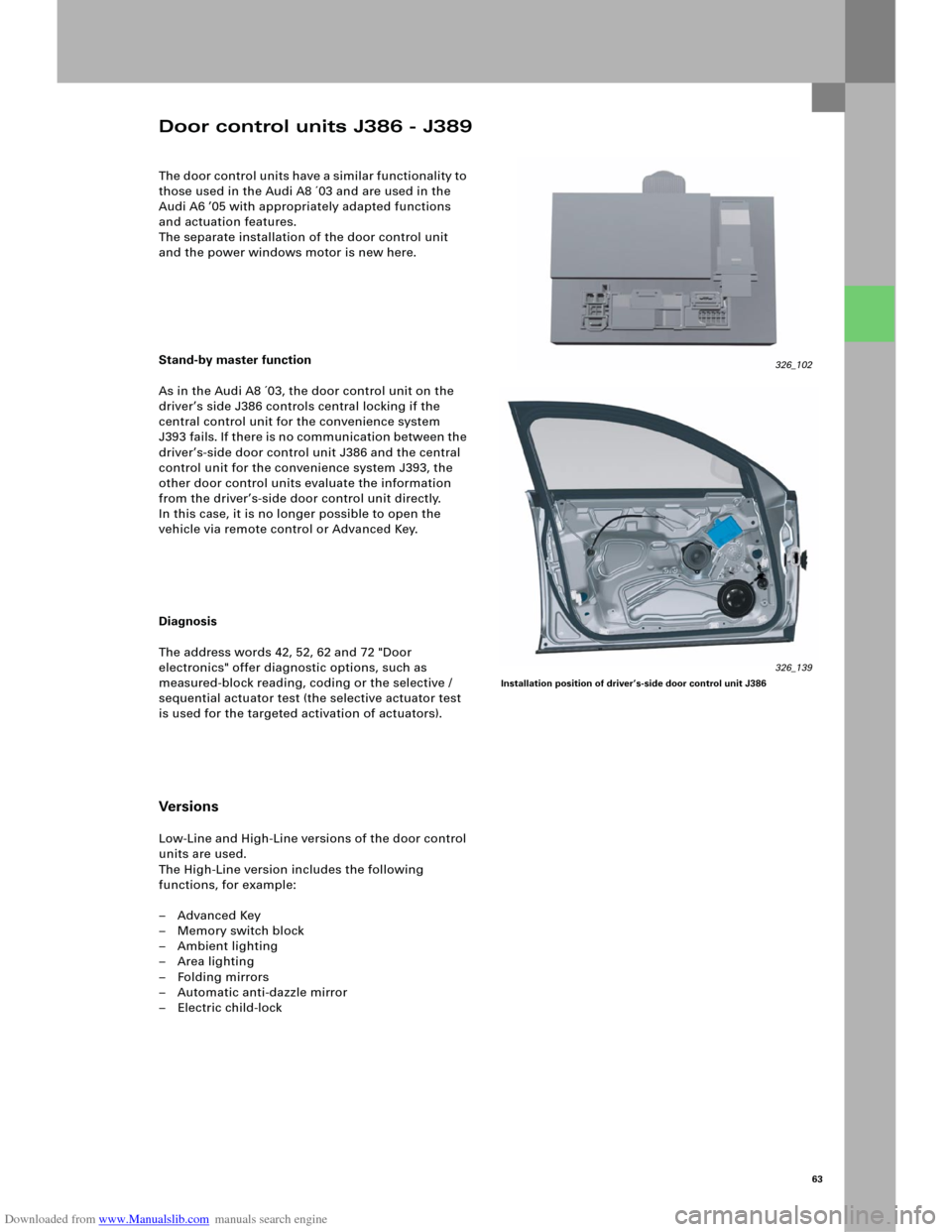
The door control units have a similar functionality to
those used in the Audi A8 ´03 and are used in the
Audi A6 ’05 with appropriately adapted functions
and actuation features.
The separate installation of the door control unit
and the power windows motor is new here.
Stand-by master function
As in the Audi A8 ´03, the door control unit on the
driver’s side J386 controls central locking if the
central control unit for the convenience system
J393 fails. If there is no co mmunic atio n b etw een the
driver’s-side door control unit J386 and the central
control unit for the convenience system J393, the
other door control units evaluate the information
from the driver’s-side door control unit directly.
In this case, it is no longer possible to open the
vehicle via remote control or Advanced Key.
Diagnosis
The address words 42, 52, 62 and 72 "Door
electronics" offer diagnostic options, such as
measured-block reading, coding or the selective /
sequential actuator test (the selective actuator test
is used for the targeted activation of actuators).
Versi on s
Low-Line and High-Line versions of the door control
units are used.
The High-Line version includes the following
functions, for example:
– Advanced Key
– Memory switch block
– Ambient lighting
–Area lighting
–Folding mirrors
– Automatic anti-dazzle mirror
– Electric child-lock
Installation position of driver’s-side door control unit J386326_139
Door control units J386 - J389
326_102
Page 62 of 92
Downloaded from www.Manualslib.com manuals search engine 64
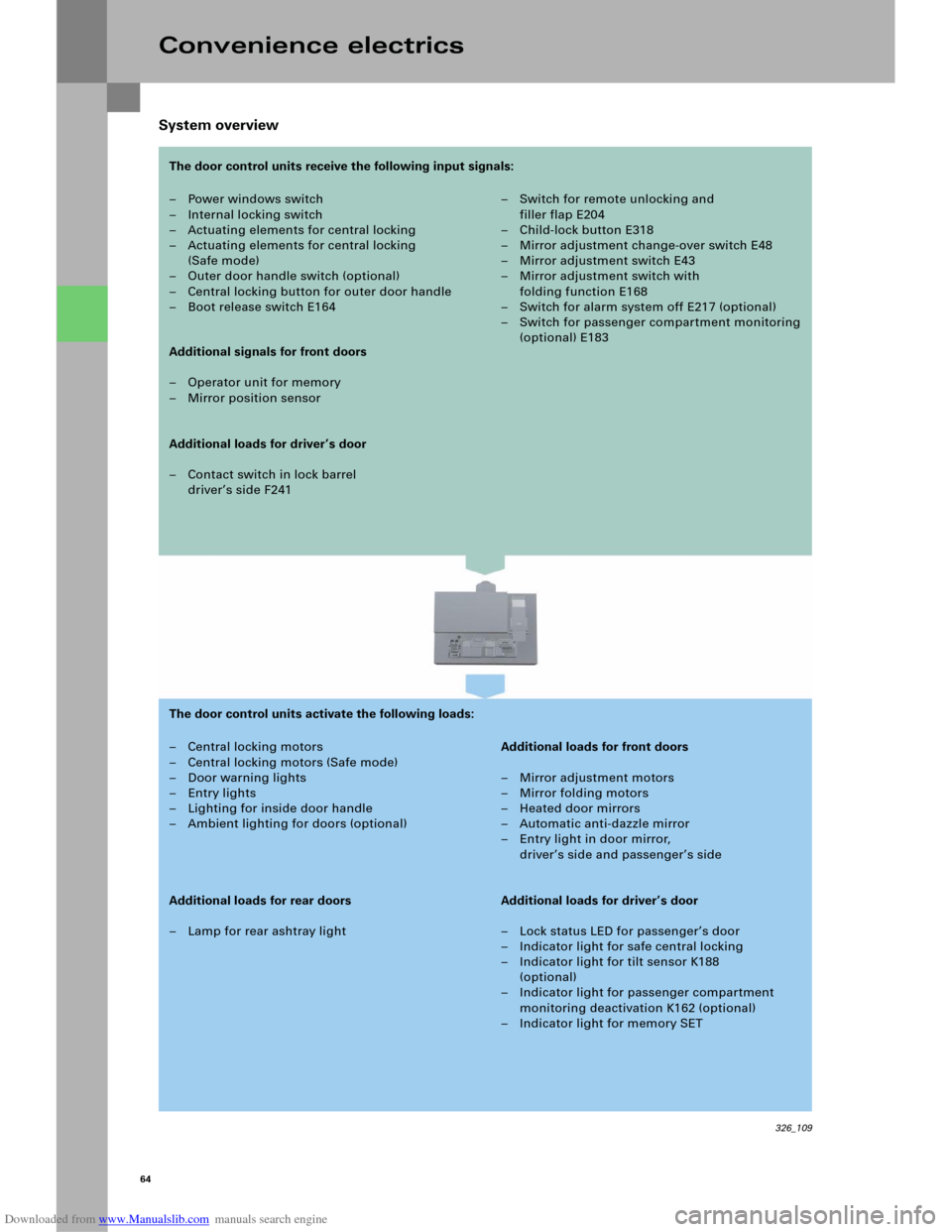
System overview
Convenience electrics
– Power windows switch
– Internal locking switch
– Actuating elements for central locking
– Actuating elements for central locking
(Safe mode)
– Outer door handle switch (optional)
– Central locking button for outer door handle
– Boot release switch E164– Switch for remote unlocking and
filler flap E204
–Child-lock button E318
– Mirror adjustment change-over switch E48
–Mirror adjustment switch E43
– Mirror adjustment switch with
folding function E168
– Switch for alarm system off E217 (optional)
– Switch for passenger compartment monitoring
(optional) E183
Additional signals for front doors
– Operator unit for memory
– Mirror position sensor
Additional loads for driver’s door
– Contact switch in lock barrel
driver’s side F241
– Central locking motors
– Central locking motors (Safe mode)
– Door warning lights
–Entry lights
– Lighting for inside door handle
– Ambient lighting for doors (optional)Additional loads for front doors
– Mirror adjustment motors
– Mirror folding motors
– Heated door mirrors
– Automatic anti-dazzle mirror
– Entry light in door mirror,
driver’s side and passenger’s side
Additional loads for rear doors
–Lamp for rear ashtray lightAdditional loads for driver’s door
– Lock status LED for passenger’s door
– Indicator light for safe central locking
– Indicator light for tilt sensor K188
(optional)
– Indicator light for passenger compartment
monitoring deactivation K162 (optional)
– Indicator light for memory SET
326_109
The door control units receive the following input signals:
The door control units activate the following loads:
Page 64 of 92
Downloaded from www.Manualslib.com manuals search engine 66
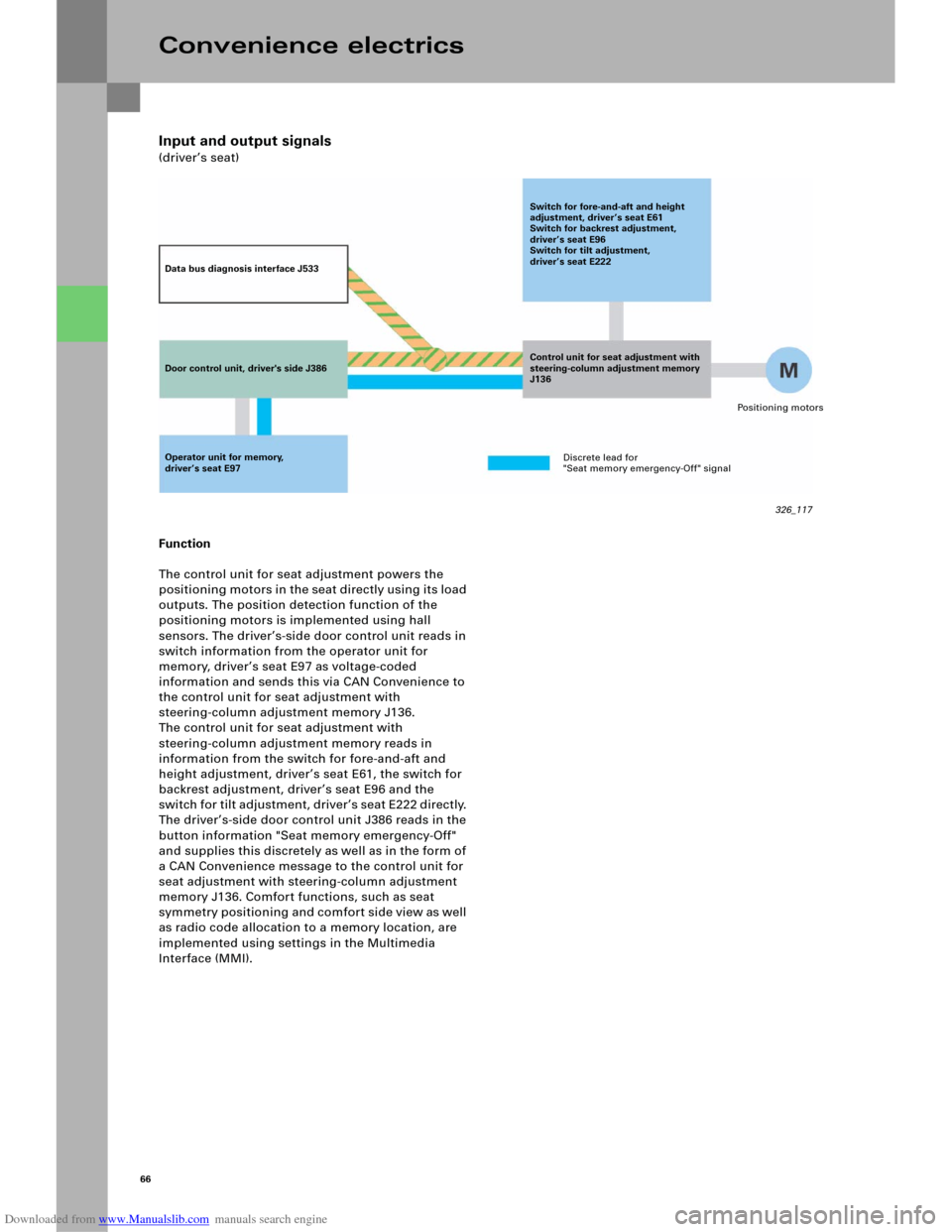
Input and output signals
(driver’s seat)
Convenience electrics
Function
The control unit for seat adjustment powers the
positioning motors in the seat directly using its load
outputs. The position detection function of the
positioning motors is implemented using hall
sensors. The driver’s-side door control unit reads in
switch information from the operator unit for
memory, driver’s seat E97 as voltage-coded
information and sends this via CAN Convenience to
the control unit for seat adjustment with
steering-column adjustment memory J136.
The control unit for seat adjustment with
steering-column adjustment memory reads in
information from the switch for fore-and-aft and
height adjustment, driver’s seat E61, the switch for
backrest adjustment, driver’s seat E96 and the
switch for tilt adjustment, driver’s seat E222 directly.
The driver’s-side door control unit J386 reads in the
button information "Seat memory emergency-Off"
and supplies this discretely as well as in the form of
a CAN Convenience message to the control unit for
seat adjustment with steering-column adjustment
memory J136. Comfort functions, such as seat
symmetry positioning and comfort side view as well
as radio code allocation to a memory location, are
implemented using settings in the Multimedia
Interface (MMI).
Data bus diagnosis interface J533
Door control unit, driver's side J386Switch for fore-and-aft and height
adjustment, driver’s seat E61
Switch for backrest adjustment,
driver’s seat E96
Switch for tilt adjustment,
driver’s seat E222
Control unit for seat adjustment with
steering-column adjustment memory
J136
Operator unit for memory,
driver’s seat E97Discrete lead for
"Seat memory emergency-Off" signalPositioning motors
326_117
Page 65 of 92
Downloaded from www.Manualslib.com manuals search engine 67
Seat symmetry positioning
The "Symmetry positioning, driver’s seat/
passenger’s seat" option, which is available in the
MMI, can be used to move the passenger’s seat into
a symmetrical position in relation to the driver’s
seat. The MMI sends a corresponding instruction to
the driver’s seat control unit via the
CAN Convenience bus. The control unit then sends
the current seat position and a control instruction to
the passenger’s seat control unit, which positions
its motors accordingly.
Comfort side view
The "Comfort side view" option moves the
passenger’s seat into a position that hides the
vehicle’s B-pillar, thereby ensuring that the driver
has the best possible view out of the vehicle.
The function can be selected via the MMI, where the
signal is transmitted in the same way as for the
"Seat symmetry positioning" function.
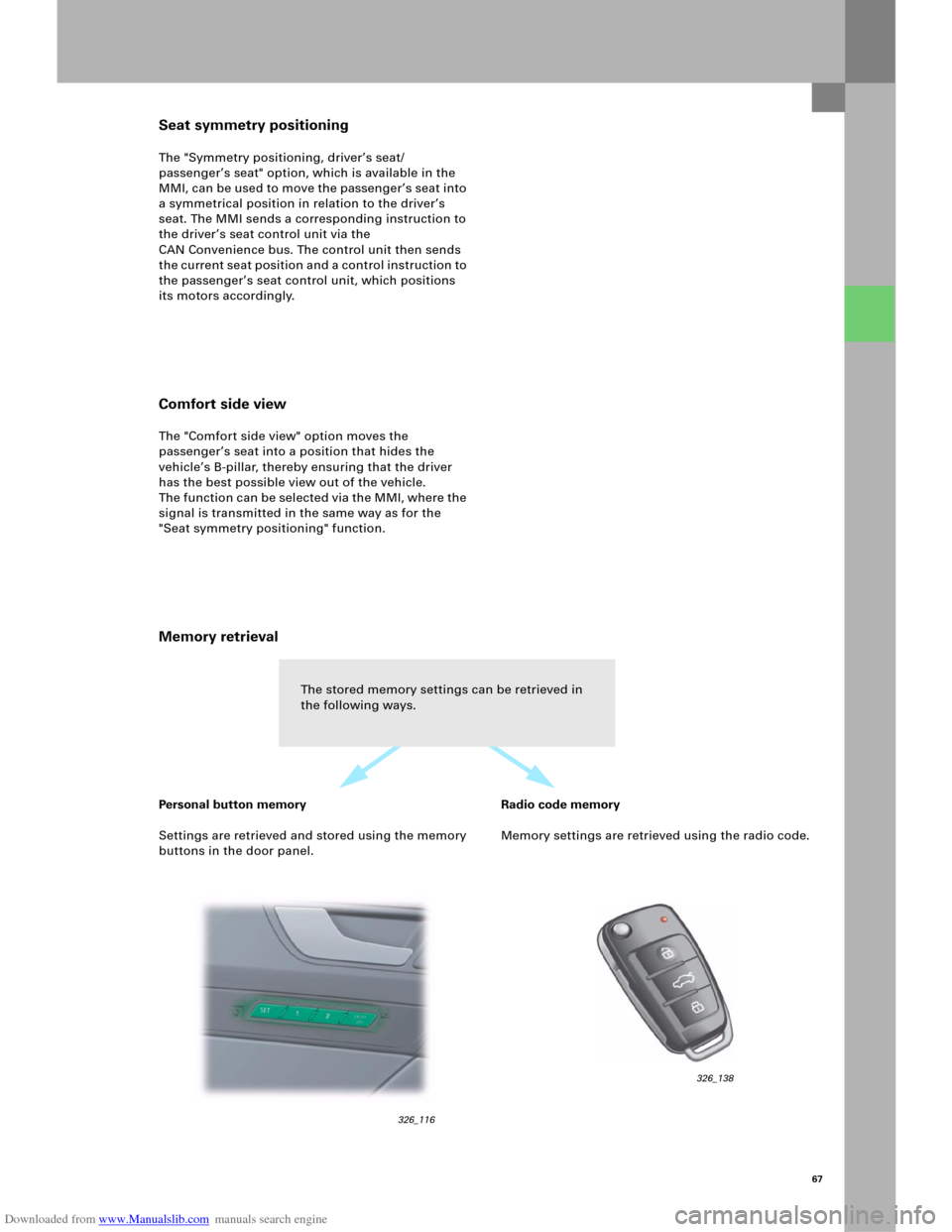
Memory retrieval
Radio code memory
Memory settings are retrieved using the radio code. Personal button memory
Settings are retrieved and stored using the memory
buttons in the door panel.
The stored memory settings can be retrieved in
the following ways.
326_138
326_116
Page 67 of 92
Downloaded from www.Manualslib.com manuals search engine 69
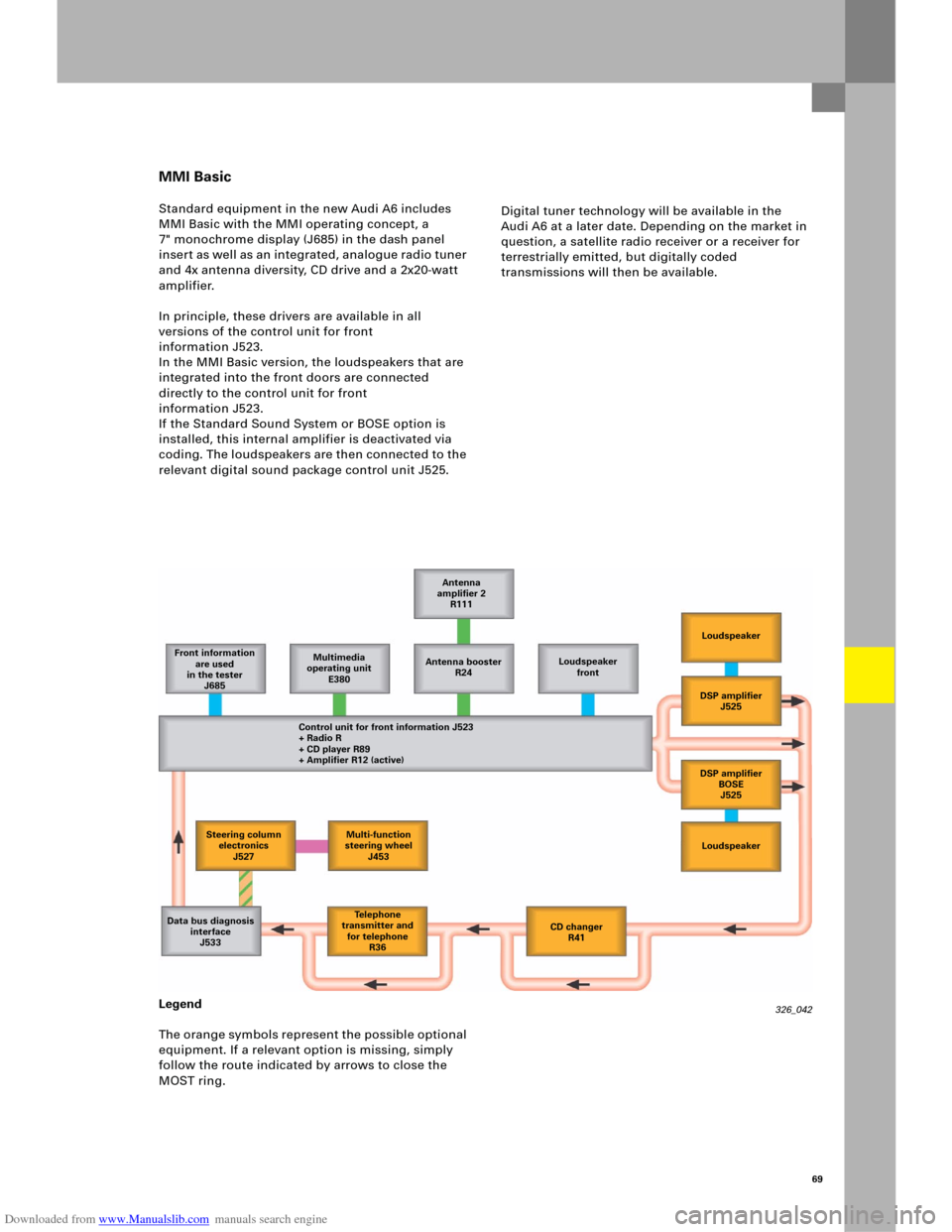
MMI Basic
Standard equipment in the new Audi A6 includes
MMI Basic with the MMI operating concept, a
7" monochrome display (J685) in the dash panel
inser t as well as an integrated, analogue radio tuner
and 4x antenna diversity, CD drive and a 2x20-watt
amplifier.
In principle, these drivers are available in all
versions of the control unit for front
information J523.
In the MMI Basic version, the loudspeakers that are
integrated into the front doors are connected
directly to the control unit for front
information J523.
If the Standard Sound System or BOSE option is
installed, this internal amplifier is deactivated via
coding. The loudspeakers are then connected to the
relevant digital sound package control unit J525.Digital tuner technology will be available in the
Audi A6 at a later date. Depending on the market in
question, a satellite radio receiver or a receiver for
terrestrially emitted, but digitally coded
transmissions will then be available.
Legend
The orange symbols represent the possible optional
equipment. If a relevant option is missing, simply
follow the route indicated by arrows to close the
MOST ring.
326_042 Front information
are used
in the tester
J685Multimedia
operating unit
E380Antenna booster
R24Loudspeaker
front
Control unit for front information J523
+ Radio R
+ CD player R89
+ Amplifier R12 (active)Loudspeaker
DSP amplifier
J525
DSP amplifier
BOSE
J525
Loudspeaker
CD changer
R41 Te l e p h o n e
transmitter and
for telephone
R36 Data bus diagnosis
interface
J533Antenna
amplifier 2
R111
Steering column
electronics
J527Multi-function
steering wheel
J453
Page 79 of 92
Downloaded from www.Manualslib.com manuals search engine 81
Sound systems
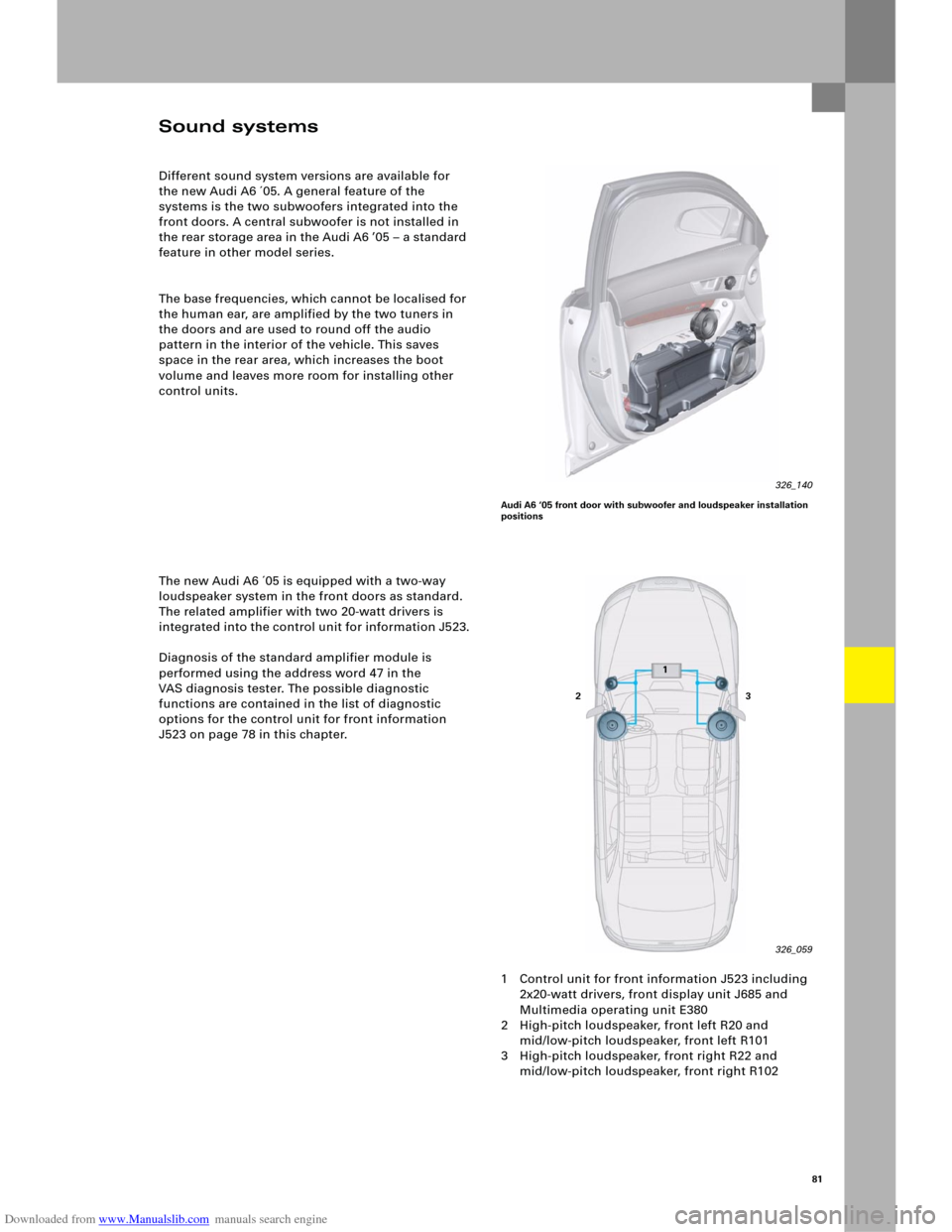
Different sound system versions are available for
the new Audi A6 ´05. A general feature of the
systems is the two subwoofers integrated into the
front doors. A central subwoofer is not installed in
the rear storage area in the Audi A6 ’05 – a standard
feature in other model series.
The base frequencies, which cannot be localised for
the human ear, are amplified by the two tuners in
the doors and are used to round off the audio
pattern in the interior of the vehicle. This saves
space in the rear area, which increases the boot
volume and leaves more room for installing other
control units.
326_059
The new Audi A6 ´05 is equipped with a two-way
loudspeaker system in the front doors as standard.
The related amplifier with two 20-watt drivers is
integrated into the control unit for information J523.
Diagnosis of the standard amplifier module is
performed using the address word 47 in the
VAS diagnosis tester. The possible diagnostic
functions are contained in the list of diagnostic
options for the control unit for front information
J523 on page 78 in this chapter.
326_140
Audi A6 ‘05 front door with subwoofer and loudspeaker installation
positions
1 Control unit for front information J523 including
2x20-watt drivers, front display unit J685 and
Multimedia operating unit E380
2 High-pitch loudspeaker, front left R20 and
mid/low-pitch loudspeaker, front left R101
3 High-pitch loudspeaker, front right R22 and
mid/low-pitch loudspeaker, front right R102
1
23
Page 80 of 92
Downloaded from www.Manualslib.com manuals search engine 82
Standard sound system
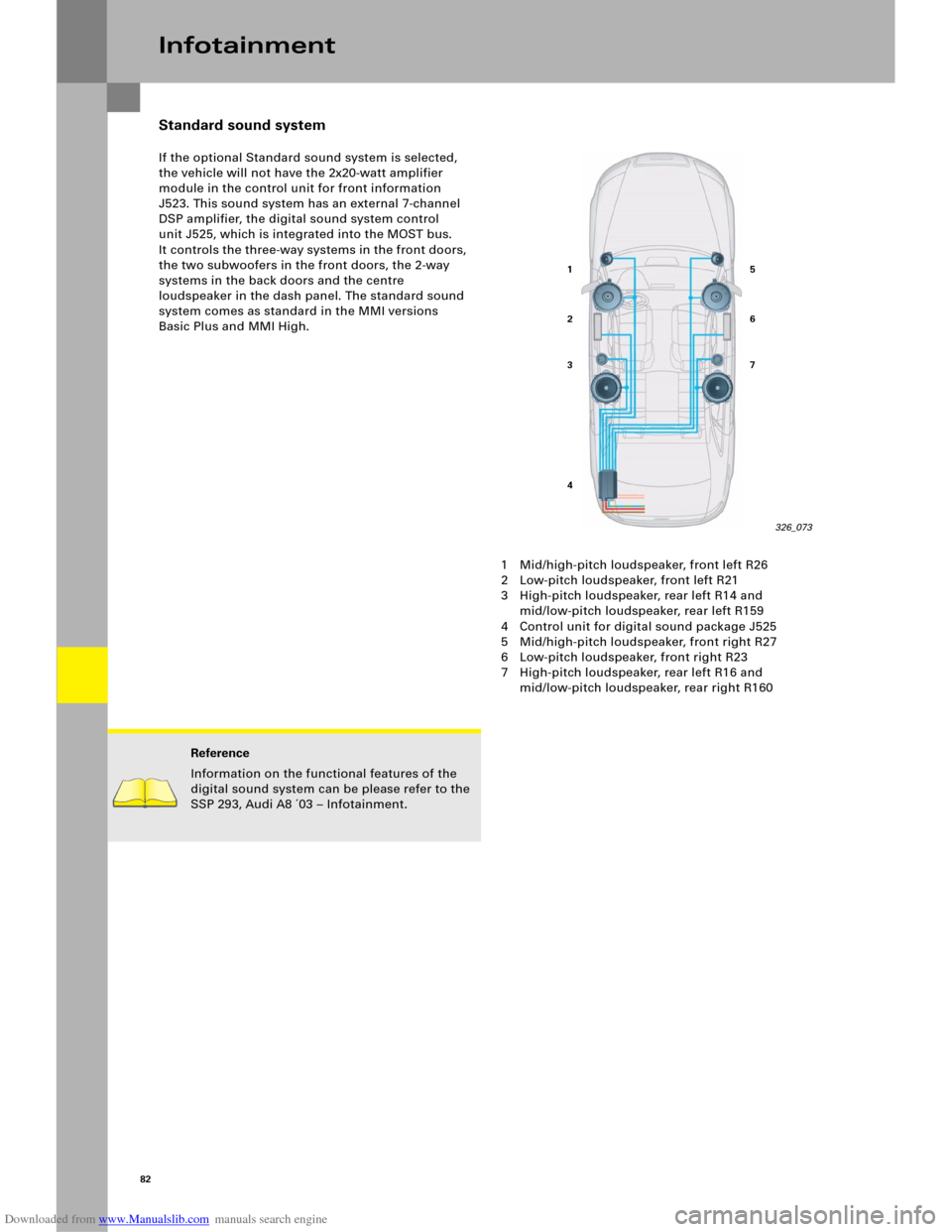
If the optional Standard sound system is selected,
the vehicle will not have the 2x20-watt amplifier
module in the control unit for front information
J523. This sound system has an external 7-channel
DSP amplifier, the digital sound system control
unit J525, which is integrated into the MOST bus.
It controls the three-way systems in the front doors,
the two subwoofers in the front doors, the 2-way
systems in the back doors and the centre
loudspeaker in the dash panel. The standard sound
system comes as standard in the MMI versions
Basic Plus and MMI High.
Infotainment
326_073
Reference
Information on the functional features of the
digital sound system can be please refer to the
SSP 293, Audi A8 ´03 – Infotainment.
1 Mid/high-pitch loudspeaker, front left R26
2 Low-pitch loudspeaker, front left R21
3 High-pitch loudspeaker, rear left R14 and
mid/low-pitch loudspeaker, rear left R159
4 Control unit for digital sound package J525
5 Mid/high-pitch loudspeaker, front right R27
6 Low-pitch loudspeaker, front right R23
7 High-pitch loudspeaker, rear left R16 and
mid/low-pitch loudspeaker, rear right R160
1
2
3
45
6
7
Page 82 of 92
Downloaded from www.Manualslib.com manuals search engine 84
BOSE sound system
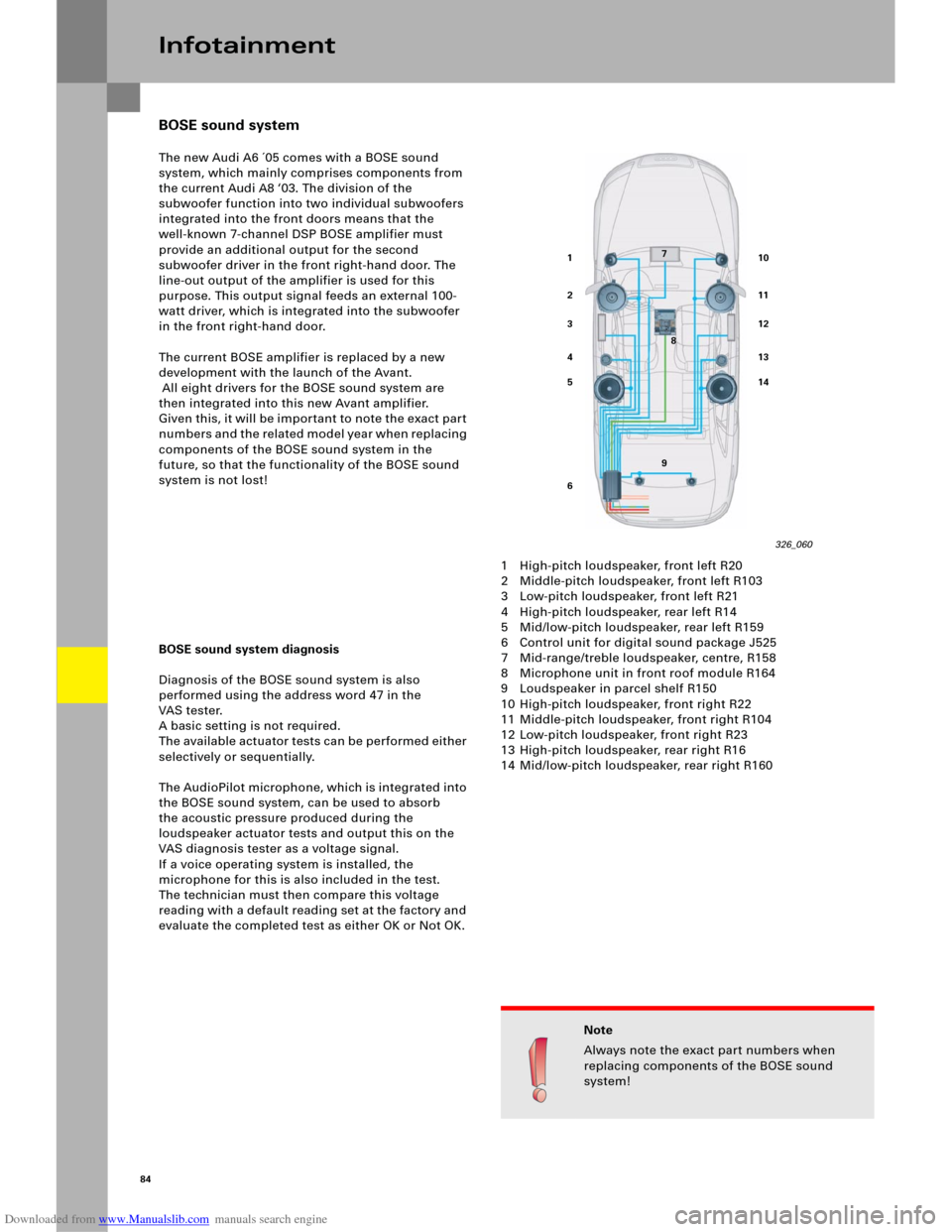
The new Audi A6 ´05 comes with a BOSE sound
system, which mainly comprises components from
the current Audi A8 ‘03. The division of the
subwoofer function into two individual subwoofers
integrated into the front doors means that the
well-known 7-channel DSP BOSE amplifier must
provide an additional output for the second
subwoofer driver in the front right-hand door. The
line-out output of the amplifier is used for this
purpose. This output signal feeds an external 100-
watt driver, which is integrated into the subwoofer
in the front right-hand door.
The current BOSE amplifier is replaced by a new
development with the launch of the Avant.
All eight drivers for the BOSE sound system are
then integrated into this new Avant amplifier.
Given this, it will be impor tant to note the exact par t
numbers and the related model year when replacing
components of the BOSE sound system in the
future, so that the functionality of the BOSE sound
system is not lost!
BOSE sound system diagnosis
Diagnosis of the BOSE sound system is also
performed using the address word 47 in the
VAS tester.
A basic setting is not required.
The available actuator tests can be performed either
selectively or sequentially.
The AudioPilot microphone, which is integrated into
the BOSE sound system, can be used to absorb
the acoustic pressure produced during the
loudspeaker actuator tests and output this on the
VAS diagnosis tester as a voltage signal.
If a voice operating system is installed, the
microphone for this is also included in the test.
The technician must then compare this voltage
reading with a default reading set at the factory and
evaluate the completed test as either OK or Not OK.
Infotainment
326_060
1 High-pitch loudspeaker, front left R20
2 Middle-pitch loudspeaker, front left R103
3 Low-pitch loudspeaker, front left R21
4 High-pitch loudspeaker, rear left R14
5 Mid/low-pitch loudspeaker, rear left R159
6 Control unit for digital sound package J525
7 Mid-range/treble loudspeaker, centre, R158
8 Microphone unit in front roof module R164
9 Loudspeaker in parcel shelf R150
10 High-pitch loudspeaker, front right R22
11 Middle-pitch loudspeaker, front right R104
12 Low-pitch loudspeaker, front right R23
13 High-pitch loudspeaker, rear right R16
14 Mid/low-pitch loudspeaker, rear right R160
5 4 3 17
2
98
614 13 12 10
11
Note
Always note the exact part numbers when
replacing components of the BOSE sound
system!