2005 Alfa Romeo 156 maintenance
[x] Cancel search: maintenancePage 106 of 357
GETTING TO KNOW YOUR CAR
104
Warning light Message
on display
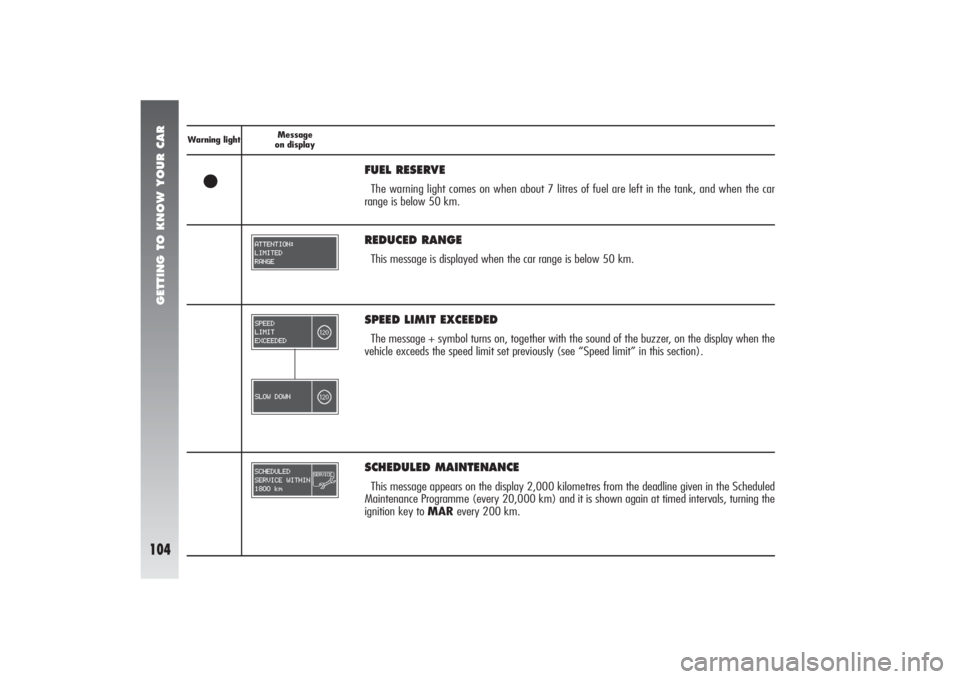
SPEED LIMIT EXCEEDED The message + symbol turns on, together with the sound of the buzzer, on the display when the
vehicle exceeds the speed limit set previously (see “Speed limit” in this section).
ç
FUEL RESERVEThe warning light comes on when about 7 litres of fuel are left in the tank, and when the car
range is below 50 km.REDUCED RANGE This message is displayed when the car range is below 50 km.SCHEDULED MAINTENANCEThis message appears on the display 2,000 kilometres from the deadline given in the Scheduled
Maintenance Programme (every 20,000 km) and it is shown again at timed intervals, turning the
ignition key to MARevery 200 km.
Page 175 of 357

GETTING TO KNOW YOUR CAR
173
– Press the safety lever (fig. 167) up-
wards.
– Raise the bonnet.
WARNINGBonnet raising is aided by
two gas springs. Do not tamper with these
springs and accompany the bonnet while
raising it.
fig. 167
A0B0576m
Before lifting the bonnet,
make sure that the wind-
screen wiper arms are not raised
from the windscreen.
WARNING
DANGER-SERIOUS INJURY.
When carrying out checks
or maintenance operations in the
engine compartment, take special
care not to bump the head on the
raised bonnet.
WARNING
If checks need to be carried
out in the engine compart-
ment when the engine is still
warm, keep away from the fan as
it could start up even when the key
is removed from the ignition. Wait
until the engine cools down.
WARNING
Scarves, ties and loose
clothing may be caught in
the moving parts.
WARNING
To close:
– lower the bonnet to approx. 20 cm from
the engine compartment, then let it drop.
Try lifting it to make sure that it is shut com-
pletely and not simply caught in the safety
position.
If the bonnet does not close properly, do
not push it down but open it again and re-
peat the above procedure.
For safety reasons the
bonnet shall always be
perfectly closed when travelling.
Always check for proper bonnet
locking. If the bonnet is left inad-
vertently open, stop the car im-
mediately and close the bonnet.
WARNING
Page 197 of 357

CORRECT USE OF THE CAR
195
DRIVING ON SNOW AND ICEHere are few suggestions for driving in
these conditions:
– Keep your speed down.
– On a snowy road, fit winter tyres or
snow chains; see the related paragraphs in
this section.
– Use exhaust brake where possible and
avoid abrupt braking.
– Avoid abrupt acceleration and changes
of direction.
– During cold weather even apparently dry
roads may be covered with occasional
patches of ice. Pay great attention therefore
when driving on roads which are in the
shade, or where rocks or trees line the road
and on which ice may persist.
– Keep further back from the vehicle in
front.
DRIVING WITH ABSThe ABS is a part of the braking system
which essentially offers two advantages:
1)It prevents wheel lock-up and conse-
quent skidding in emergency stops, partic-
ularly when the road does not offer much
grip;
2)It makes it possible to brake and steer
at the same time so you can avoid unex-
pected obstacles and direct the car where
you want while braking. The extent to which
this can be done will depend on the physi-
cal limits of the tyre’s sideways grip.
To make the most of the ABS:
– In emergency braking or when grip is
low, a slight pulsing can be felt on the brake
pedal: this means that the ABS has come
into action. Do not release the pedal, but
continue pressing it to give continuity to the
braking action.
– The ABS prevents the wheels from lock-
ing but it does not increase the physical lim-
its of grip between the asphalt and the road.
Therefore, also with a car fitted with ABS,
keep within a safety distance from the ve-
hicle in front and limit speed when ap-
proaching bends.
The ABS serves to increase car controlla-
bilty not to go faster.
REDUCING RUNNING
COSTS AND
ENVIRONMENT
POLLUTIONSome suggestions which may help you to
keep the running costs of your vehicle down
and lower the amount of toxic emissions re-
leased into the atmosphere are given below.GENERAL CONSIDERATIONSVehicle maintenance
The overalll state of the vehicle is an im-
portant factor which has a marked influence
over fuel consumption and driving comfort
and on the life span of your vehicle. For this
reason care should be taken to maintain
your vehicle by carrying out the necessary
checks and regulations in accordance with
specifications given in the “Scheduled Main-
tenance Programme” (see sections... spark
plugs, air cleaner, timing).
Page 200 of 357

CORRECT USE OF THE CAR
198
PROTECTING EMISSION
REDUCING DEVICESCorrect operation of the antipollution de-
vices not only guarantees respect for the en-
vironment but also influences car perfor-
mance. Keeping these devices in good con-
dition is therefore the first rule for both en-
vironment-friendly and economy driving.
The first precaution is to closely follow the
“Scheduled Maintenance Programme ”. For
petrol engines only use unleaded petrol (95
RON) (specification EN228), for diesel en-
gines only use fuel oil for motor vehicles
(specification EN590).
If difficulty with starting is experienced do
not insist with extended attempts. Especially
avoid bump, tow or coast starts: these may
all damage the catalyst. Only use an auxil-
iary battery to start the car in an emergency.If the engine is “not running smoothly”
when the vehicle is travelling, reduce the re-
quest for performance to a minimum and
contact Alfa Romeo Authorized Services as
soon as possible.
When the fuel reserve warning light comes
on fill up as soon as possible. A low fuel level
may cause an irregular supply to the engine
with inevitable increase of the exhaust gas
temperature; this would result in serious
damage to the catalyst.
Never run the engine, even as a test, with
one or more spark plugs disconnected. Do
not warm the engine at idle speed before
moving off, unless the outside temperature
is very low and, in this case too, for no more
than 30 seconds.
Do not install other heat
guards and do not remove
the existing ones on the catalyst
and exhaust pipe.
WARNING
Do not spray anything on
the catalyst, lambda sen-
sor and exhaust pipe.
WARNING
The failure to follow these
rules may cause a fire
hazard.
WARNING
During normal service the
catalyst reaches high tem-
peratures. Do not therefore park
the car over inflammable materials
(grass, dry leaves, pine needles,
etc.): fire hazard.
WARNING
Page 244 of 357

IN AN EMERGENCY
242
IN THE EVENT OF A FLAT BATTERYFirst of all, you are advised to refer to the
“Car maintenance” chapter for precautions
to be adopted in order to prevent the bat-
tery from getting flat and to ensure its long
durability.CHARGING THE BATTERYWARNINGThe description of the bat-
tery charging procedure is described only for
informative purposes. This operation should
be carried out by Alfa Romeo Authorized Ser-
vices.
Charging should be slow at a low amp rat-
ing for about 24 hours. Charging for a longer
time may damage the battery.Charge the battery as follows:
– Disconnect the terminal from the bat-
tery negative (–) pole.
– Connect the charger cables to the bat-
tery, respecting polarity.
– Turn on the charger.
– After charging turn off the charger be-
fore disconnecting it from the battery.
– Reconnect the terminal to the battery
negative (–) pole.
STARTING WITH AN AUXILIARY
BATTERYSee “Starting with an auxiliary battery” in
this chapter.
The fluid contained in the
battery is poisonous and
corrosive. Avoid contact with the
skin or eyes. The battery should be
charged in a well ventilated place
and kept away from naked flames
or sources of sparks: danger of ex-
plosion and fire.
WARNING
Never attempt to charge a
frozen battery before
thawing it, the danger of explosion
exists. If it has frozen, always
check that the inside elements are
not broken (risk of short circuit)
and that the body is not cracked,
with the risk of acid coming out
which is poisonous and corrosive.
WARNING
Page 250 of 357

CAR MAINTENANCE
248
It is however wise to remember that Pro-
grammed Maintenance does not complete-
ly cover all the car’s requirements: also in
the initial period before 20,000 km service
coupon and later, between one coupon and
another, ordinary care is still necessary such
as for example routinely checking and top-
ping up the level of fluids, checking the tyre
pressure, etc...
WARNINGThe Programmed Mainte-
nance coupons are specified by the Manu-
facturer. The failure to have them carried out
may invalidate the warranty.
The Programmed Maintenance service is
carried out by all Alfa Romeo Authorized Ser-
vices, at pre-established times.If during each operation, in addition to the
ones programmed, the need arises for fur-
ther replacements or repairs, these may be
carried out only with the explicit agreement
of the customer.
WARNINGYou are advised to contact
Alfa Romeo Authorized Services in the event
of any minor operating faults, without wait-
ing for the next service coupon.
PROGRAMMED
MAINTENANCECorrect maintenance is essential for en-
suring long car life under the best conditions.
This is why Alfa Romeo has programmed
a series of checks and maintenance opera-
tions every 20,000 km.
WARNINGAt 2000 km from the main-
tenance deadline, the Infocenter display will
show “SCHEDULED SERVICE WITHIN” which
is shown again turning the ignition key to
MAR, every 200 km. For further details,
see “Service” in the “Display Infocenter”
paragraph in “Getting to know your car”
chapter.
C C
A A
R R
M M
A A
I I
N N
T T
E E
N N
A A
N N
C C
E E
Page 251 of 357

CAR MAINTENANCE
249
SCHEDULED MAINTENANCE PROGRAMME
20 40 60 80 100 120 140 160 180
Thousands of km
●●●●●●●●●
●●●●●●●●●
●●●●●●●●●
●●●●●●●●●
●●●●●●●●●
●●●●
●●●●●●●●●
●●●●●●●●●
●●
●●
●●●●
●●●●●
●●●●
●●●●
●●
Check tyre conditions/wear and adjust pressure if necessary
Check operation of lighting system (headlights, direction indicators, hazard lights,boot lights, passenger compartment lights, glovebox light, warning lights, etc..)Check operation of windscreen wiper/washer system, adjust spray jetsCheck position/wear of windscreen/rearscreen wiper bladesCheck front disk brake pad wear indicatorCheck conditions of rear disk brake pads
Sight check for the conditions of: exterior bodywork, underbody protection,
pipes and hoses (exhaust - fuel - brakes), rubber parts (boots - sleeves - bushes - etc.)Check for bonnet and boot lock cleanness, lever cleanness and lubricationCheck condition of timing drive beltSight check for conditions of Poly-V accessory drive beltCheck/adjust handbrake lever strokeCheck/adjust valve clearance (1.9 JTD 8V versions)Check petrol engine exhaust emissionsCheck engine smoke (diesel versions)Check operation of antievaporation system (petrol engines)
Page 252 of 357

CAR MAINTENANCE
250
20 40 60 80 100 120 140 160 180
Thousand of km
Change fuel filter (diesel versions only)Change air cleaner cartridge (petrol engines)Change air cleaner cartridge (diesel versions only)
Check and if necessary top up fluid levels (brakes, hydraulic clutch, power steering, windscreen wiper, battery, engine coolant, etc..) Check and if necessary top up Selespeed oil level (2.0 JTS version)Replacement of timing drive belt (*) and Poly-V accessory drive beltReplacement of counter-rotating shaft drive belt (only 2.0 JTS)Replacement of spark plugs (T.SPARK 16V, 2.0 JTS and 2.5 V6 24V versions) Check operation of engine control systems (through diagnosis)Check gearbox and differential oil levelCheck automatic gearbox oil level (2.5 V6 24V version)Change engine oil and oil filterChange brake fluid (or every 2 year)Replacement of dust/pollen filter
●●●●●●●●●
●●●●
●●●●●●●●●
●●●●●●●●●
●●●●●●●●●
●
●
●
●●●●
●●
●●●●●●●●●
●●●●●●●●●
●●●
●●●●●●●●●
(*) Or every 3 years in harsh conditions (cold – hot climates, stop and go city traffic, dusty areas or roads covered with sand and/or salt)
Or every 5 years, regardless of the mileage.