Page 46 of 83

6-6
1. Engine oil filler cap
1. Maximum mark 2.Minimum mark
Engine oil
1. Oil level measurement
a. Place the motorcycle on a level place and hold it in an
upright position. Warm up the engine for several
minutes.
NOTE:
Be sure the motorcycle is positioned straight up when
checking the oil level. A slight tilt toward the side can result
in false readings.
b. With the engine stopped, with the engine stopped,
unscrew the oil filler cap/ dispstick and rest it on the
threads of the ok.
NOTE:
Wait a few minutes until the oil level settles before checking.
c. Remove the oil filler cap/ dispstick, clean it with a dry
cloth and check the oil level.
NOTE:
To check the oil level the oil filler cap/ dispstick can not be
screwed, just lightly seated in place.
d. The oil level should be between the maximum and
minimum marks. If the level is low, add oil to raise it to the
indicated level, check for oil leakage.
6-6
1. Engine oil filler cap
1. Maximum mark 2.Minimum mark
Engine oil
1. Oil level measurement
a. Place the motorcycle on a level place and hold it in an
upright position. Warm up the engine for several
minutes.
NOTE:
Be sure the motorcycle is positioned straight up when
checking the oil level. A slight tilt toward the side can result
in false readings.
b. With the engine stopped, with the engine stopped,
unscrew the oil filler cap/ dispstick and rest it on the
threads of the ok.
NOTE:
Wait a few minutes until the oil level settles before checking.
c. Remove the oil filler cap/ dispstick, clean it with a dry
cloth and check the oil level.
NOTE:
To check the oil level the oil filler cap/ dispstick can not be
screwed, just lightly seated in place.
d. The oil level should be between the maximum and
minimum marks. If the level is low, add oil to raise it to the
indicated level, check for oil leakage.
Page 47 of 83
6-7
2. Engine oil and filter replacement
a. Warm up the engine for a few minutes.
b. Stop the engine. Place an oil pan under the engine and
remove the dipstick.
c. Remove the drain plug and drain the oil.
d. Reinstall the drain plug, check if the gasket is damaged
and tighten it to the specified torque.
Tightening torque:
Drain plug:
20 N.m (2.0 kgf.m, 14.5 lbf.t)
1.Dipstick
1. Engine oil drain plug
6-7
2. Engine oil and filter replacement
a. Warm up the engine for a few minutes.
b. Stop the engine. Place an oil pan under the engine and
remove the dipstick.
c. Remove the drain plug and drain the oil.
d. Reinstall the drain plug, check if the gasket is damaged
and tighten it to the specified torque.
Tightening torque:
Drain plug:
20 N.m (2.0 kgf.m, 14.5 lbf.t)
1.Dipstick
1. Engine oil drain plug
Page 48 of 83

6-8 e.Fill engine with oil. Install the oil filter cap and tighten.
NOTE:
Recommended engine oil classification; API Service ìSHî
type or equivalent
Do not put in any chemical additives. Engine oil also
lubricates the clutch and additives could cause clutch
slippage.
Be sure no foreign material enters the crankcase.
f. Start the engine and warm up for a few minutes.
While warming up, check for oil leakage. If oil
leakage is found, stop the engine immediately, and
check for the cause.
g. Stop the engine and check the oil level.
After replacing the engine oil, be sure to check the oil
pressure.
Oil quantity:
Total amount:
1.2 L ( 0.264 Imp gal, 0.317 US gal)
Periodic oil change:
1.0 L ( 0.220 Imp gal, 0.264 US gal) Recommended oil:
Yamalube 4
CAUTION:
CAUTION:
CAUTION:
6-8 e.Fill engine with oil. Install the oil filter cap and tighten.
NOTE:
Recommended engine oil classification; API Service ìSHî
type or equivalent
Do not put in any chemical additives. Engine oil also
lubricates the clutch and additives could cause clutch
slippage.
Be sure no foreign material enters the crankcase.
f. Start the engine and warm up for a few minutes.
While warming up, check for oil leakage. If oil
leakage is found, stop the engine immediately, and
check for the cause.
g. Stop the engine and check the oil level.
After replacing the engine oil, be sure to check the oil
pressure.
Oil quantity:
Total amount:
1.2 L ( 0.264 Imp gal, 0.317 US gal)
Periodic oil change:
1.0 L ( 0.220 Imp gal, 0.264 US gal) Recommended oil:
Yamalube 4
CAUTION:
CAUTION:
CAUTION:
Page 49 of 83
6-9 Oil pressure
1. Remove the check bolt 1 in the cylinder head.
2. Start the engine and keep it idling until oil flows out
of the bleed hole. If no oil comes out after one
minute, turn off the engine immediately so it will
not seize. In such a case go to the nearest Yamaha
dealer or other qualified mechanic for repairs.
3. After checking, tighten the check bolt to the
specified torque.
Check bolt torque:
7 N.m (0.7 Kgf.m, 5.0 lbf.ft)
1. Check bolt
6-9 Oil pressure
1. Remove the check bolt 1 in the cylinder head.
2. Start the engine and keep it idling until oil flows out
of the bleed hole. If no oil comes out after one
minute, turn off the engine immediately so it will
not seize. In such a case go to the nearest Yamaha
dealer or other qualified mechanic for repairs.
3. After checking, tighten the check bolt to the
specified torque.
Check bolt torque:
7 N.m (0.7 Kgf.m, 5.0 lbf.ft)
1. Check bolt
Page 51 of 83
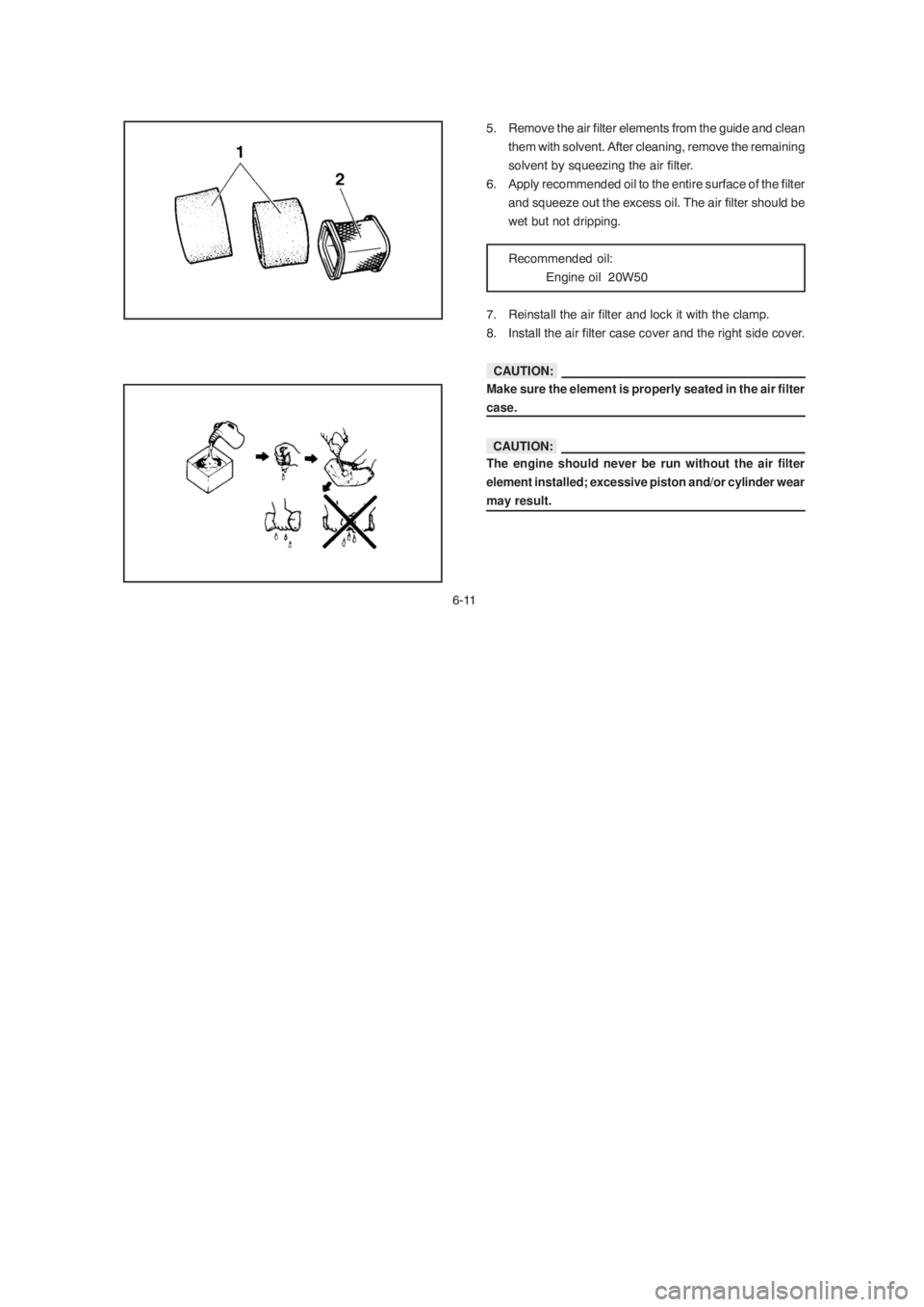
5. Remove the air filter elements from the guide and clean
them with solvent. After cleaning, remove the remaining
solvent by squeezing the air filter.
6. Apply recommended oil to the entire surface of the filter
and squeeze out the excess oil. The air filter should be
wet but not dripping.
Recommended oil:
Engine oil 20W50
7. Reinstall the air filter and lock it with the clamp.
8. Install the air filter case cover and the right side cover.
Make sure the element is properly seated in the air filter
case.
The engine should never be run without the air filter
element installed; excessive piston and/or cylinder wear
may result.
6-11
CAUTION:
CAUTION:
5. Remove the air filter elements from the guide and clean
them with solvent. After cleaning, remove the remaining
solvent by squeezing the air filter.
6. Apply recommended oil to the entire surface of the filter
and squeeze out the excess oil. The air filter should be
wet but not dripping.
Recommended oil:
Engine oil 20W50
7. Reinstall the air filter and lock it with the clamp.
8. Install the air filter case cover and the right side cover.
Make sure the element is properly seated in the air filter
case.
The engine should never be run without the air filter
element installed; excessive piston and/or cylinder wear
may result.
6-11
CAUTION:
CAUTION:
Page 52 of 83

Valve clearance adjustment
The correct valve clearance changes with use, resulting in
improper fuel/air supply or engine noise. To prevent this,
valve clearance must be adjusted regularly. This adjustment,
however, should be left to a professional Yamaha service
technician. Carburetor adjustment
The carburetor is a vital part of the engine. Adjusting should
be left to a Yamaha dealer who has the professional
knowledge, specialized data, and equipment to do so
properly. However, the following may be serviced by the
owner as part of routine maintenance.
The carburetor was set at Yamaha factory after many
tests. If the settings are changed, poor engine
performance and damage may result.
6-12
CAUTION:
Valve clearance adjustment
The correct valve clearance changes with use, resulting in
improper fuel/air supply or engine noise. To prevent this,
valve clearance must be adjusted regularly. This adjustment,
however, should be left to a professional Yamaha service
technician. Carburetor adjustment
The carburetor is a vital part of the engine. Adjusting should
be left to a Yamaha dealer who has the professional
knowledge, specialized data, and equipment to do so
properly. However, the following may be serviced by the
owner as part of routine maintenance.
The carburetor was set at Yamaha factory after many
tests. If the settings are changed, poor engine
performance and damage may result.
6-12
CAUTION:
Page 53 of 83

NOTE:
A diagnostic tachometer must be used for this procedure.
1. Attach the tachometer. Start the engine and warm it up
for a few minutes (normally, 1 or 2 minutes) at
approximately 1,000 to 2,000 r/min. Occasionally rev
the engine to 4,000 to 5,000 r/min. The engine is warm
when it quickly responds to the throttle.
2. Set the idle to the specified engine speed by adjusting
the throttle stop screw; turn the screw in to increase
engine speed and out to decrease engine speed.
NOTE:
If the specified idle speed cannot be obtained by performing
the above adjustment, consult a Yamaha dealer.
6-13
Standard idle speed:
1,300 ~ 1,400 r/min
1. Throttle stop screw
Idle speed adjustment
NOTE:
A diagnostic tachometer must be used for this procedure.
1. Attach the tachometer. Start the engine and warm it up
for a few minutes (normally, 1 or 2 minutes) at
approximately 1,000 to 2,000 r/min. Occasionally rev
the engine to 4,000 to 5,000 r/min. The engine is warm
when it quickly responds to the throttle.
2. Set the idle to the specified engine speed by adjusting
the throttle stop screw; turn the screw in to increase
engine speed and out to decrease engine speed.
NOTE:
If the specified idle speed cannot be obtained by performing
the above adjustment, consult a Yamaha dealer.
6-13
Standard idle speed:
1,300 ~ 1,400 r/min
1. Throttle stop screw
Idle speed adjustment
Page 54 of 83
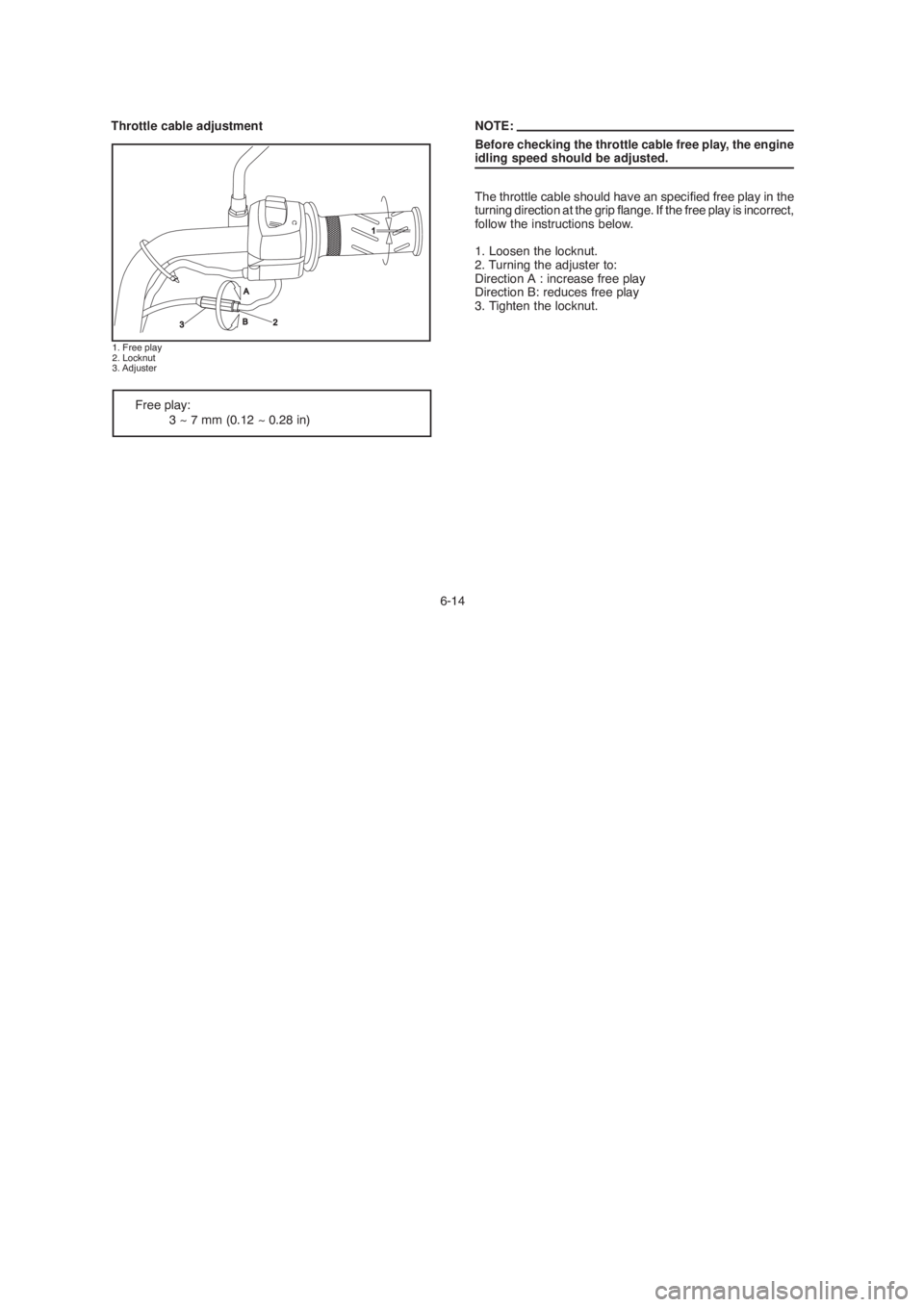
NOTE:
Before checking the throttle cable free play, the engine
idling speed should be adjusted.
The throttle cable should have an specified free play in the
turning direction at the grip flange. If the free play is incorrect,
follow the instructions below.
1. Loosen the locknut.
2. Turning the adjuster to:
Direction A : increase free play
Direction B: reduces free play
3. Tighten the locknut.
6-14
Free play:
3 ~ 7 mm (0.12 ~ 0.28 in) Throttle cable adjustment
1. Free play
2. Locknut
3. Adjuster
NOTE:
Before checking the throttle cable free play, the engine
idling speed should be adjusted.
The throttle cable should have an specified free play in the
turning direction at the grip flange. If the free play is incorrect,
follow the instructions below.
1. Loosen the locknut.
2. Turning the adjuster to:
Direction A : increase free play
Direction B: reduces free play
3. Tighten the locknut.
6-14
Free play:
3 ~ 7 mm (0.12 ~ 0.28 in) Throttle cable adjustment
1. Free play
2. Locknut
3. Adjuster

