2004 YAMAHA YBR125 service
[x] Cancel search: servicePage 48 of 83

6-8 e.Fill engine with oil. Install the oil filter cap and tighten.
NOTE:
Recommended engine oil classification; API Service ìSHî
type or equivalent
Do not put in any chemical additives. Engine oil also
lubricates the clutch and additives could cause clutch
slippage.
Be sure no foreign material enters the crankcase.
f. Start the engine and warm up for a few minutes.
While warming up, check for oil leakage. If oil
leakage is found, stop the engine immediately, and
check for the cause.
g. Stop the engine and check the oil level.
After replacing the engine oil, be sure to check the oil
pressure.
Oil quantity:
Total amount:
1.2 L ( 0.264 Imp gal, 0.317 US gal)
Periodic oil change:
1.0 L ( 0.220 Imp gal, 0.264 US gal) Recommended oil:
Yamalube 4
CAUTION:
CAUTION:
CAUTION:
6-8 e.Fill engine with oil. Install the oil filter cap and tighten.
NOTE:
Recommended engine oil classification; API Service ìSHî
type or equivalent
Do not put in any chemical additives. Engine oil also
lubricates the clutch and additives could cause clutch
slippage.
Be sure no foreign material enters the crankcase.
f. Start the engine and warm up for a few minutes.
While warming up, check for oil leakage. If oil
leakage is found, stop the engine immediately, and
check for the cause.
g. Stop the engine and check the oil level.
After replacing the engine oil, be sure to check the oil
pressure.
Oil quantity:
Total amount:
1.2 L ( 0.264 Imp gal, 0.317 US gal)
Periodic oil change:
1.0 L ( 0.220 Imp gal, 0.264 US gal) Recommended oil:
Yamalube 4
CAUTION:
CAUTION:
CAUTION:
Page 52 of 83
Valve clearance adjustment
The correct valve clearance changes with use, resulting in
improper fuel/air supply or engine noise. To prevent this,
valve clearance must be adjusted regularly. This adjustment,
however, should be left to a professional Yamaha service
technician. Carburetor adjustment
The carburetor is a vital part of the engine. Adjusting should
be left to a Yamaha dealer who has the professional
knowledge, specialized data, and equipment to do so
properly. However, the following may be serviced by the
owner as part of routine maintenance.
The carburetor was set at Yamaha factory after many
tests. If the settings are changed, poor engine
performance and damage may result.
6-12
CAUTION:
Valve clearance adjustment
The correct valve clearance changes with use, resulting in
improper fuel/air supply or engine noise. To prevent this,
valve clearance must be adjusted regularly. This adjustment,
however, should be left to a professional Yamaha service
technician. Carburetor adjustment
The carburetor is a vital part of the engine. Adjusting should
be left to a Yamaha dealer who has the professional
knowledge, specialized data, and equipment to do so
properly. However, the following may be serviced by the
owner as part of routine maintenance.
The carburetor was set at Yamaha factory after many
tests. If the settings are changed, poor engine
performance and damage may result.
6-12
CAUTION:
Page 61 of 83
6-21 Drive chain lubrication
The chain consists of many parts which work with each
other. If the chain is not maintained properly, it will wear out
quickly. Therefore, the chain must be serviced regularly.
This service is especially necessary when riding in dusty
areas.
1. Use Yamaha Chain and Cable Lube or any
brands of spray-type chain lubricant. First,
remove all dirt and mud from the chain with a
brush or cloth, then spray lubricant between both
rows of side plates and on all center rollers. The
chain should be lubricated every 500 km (300 mi).
2. To clean the chain, remove it from the machine,
dip it in solvent, and clean out as much dirt as
possible. Take the chain out of the solvent and
dry it. Immediately lubricate the chain to prevent
it from rusting.Cable inspection and lubrication
Damage to the outer housing of cables may allow
internal rusting and cause interfere with cable
movement. Replace damaged cables as soon as
possible to prevent unsafe conditions.
Lubricate the inner cable and the cable end. If it does not
operate smoothly, ask a Yamaha dealer to replace them.
RECOMMENDED LUBRICANT:
Engine oil SAE 20W50
WARNING:
6-21 Drive chain lubrication
The chain consists of many parts which work with each
other. If the chain is not maintained properly, it will wear out
quickly. Therefore, the chain must be serviced regularly.
This service is especially necessary when riding in dusty
areas.
1. Use Yamaha Chain and Cable Lube or any
brands of spray-type chain lubricant. First,
remove all dirt and mud from the chain with a
brush or cloth, then spray lubricant between both
rows of side plates and on all center rollers. The
chain should be lubricated every 500 km (300 mi).
2. To clean the chain, remove it from the machine,
dip it in solvent, and clean out as much dirt as
possible. Take the chain out of the solvent and
dry it. Immediately lubricate the chain to prevent
it from rusting.Cable inspection and lubrication
Damage to the outer housing of cables may allow
internal rusting and cause interfere with cable
movement. Replace damaged cables as soon as
possible to prevent unsafe conditions.
Lubricate the inner cable and the cable end. If it does not
operate smoothly, ask a Yamaha dealer to replace them.
RECOMMENDED LUBRICANT:
Engine oil SAE 20W50
WARNING:
Page 71 of 83

6-31
It is advisable to have a Yamaha dealer service the
wheel.
Securely support the motorcycle so there is no danger
of it falling over. Front wheel removal
1. Place the motorcycle on the centerstand.
2. Loosen the front brake cable by loosening the adjusting
bolt.
3. Remove the speedometer cable by loosening the cable
clip.
4. With the help of ar appropriete tool completely loose
the axle nut and remove it.
1. Lock nut 2. Clip 3. Axle nut
CAUTION:
6-31
It is advisable to have a Yamaha dealer service the
wheel.
Securely support the motorcycle so there is no danger
of it falling over. Front wheel removal
1. Place the motorcycle on the centerstand.
2. Loosen the front brake cable by loosening the adjusting
bolt.
3. Remove the speedometer cable by loosening the cable
clip.
4. With the help of ar appropriete tool completely loose
the axle nut and remove it.
1. Lock nut 2. Clip 3. Axle nut
CAUTION:
Page 72 of 83
6-32
Front wheel installation
When installing the front wheel, reverse the removal
procedures.
Pay attention to the following points: 2. Make sure the slot in the brake shoe plate fits overthe stopper on the front fork outer tube.
3. Make sure the axle nut is properly torqued.
Axle nut torque: 45 N.m (4,5 Kgf.m, 32,5 lbf.ft)
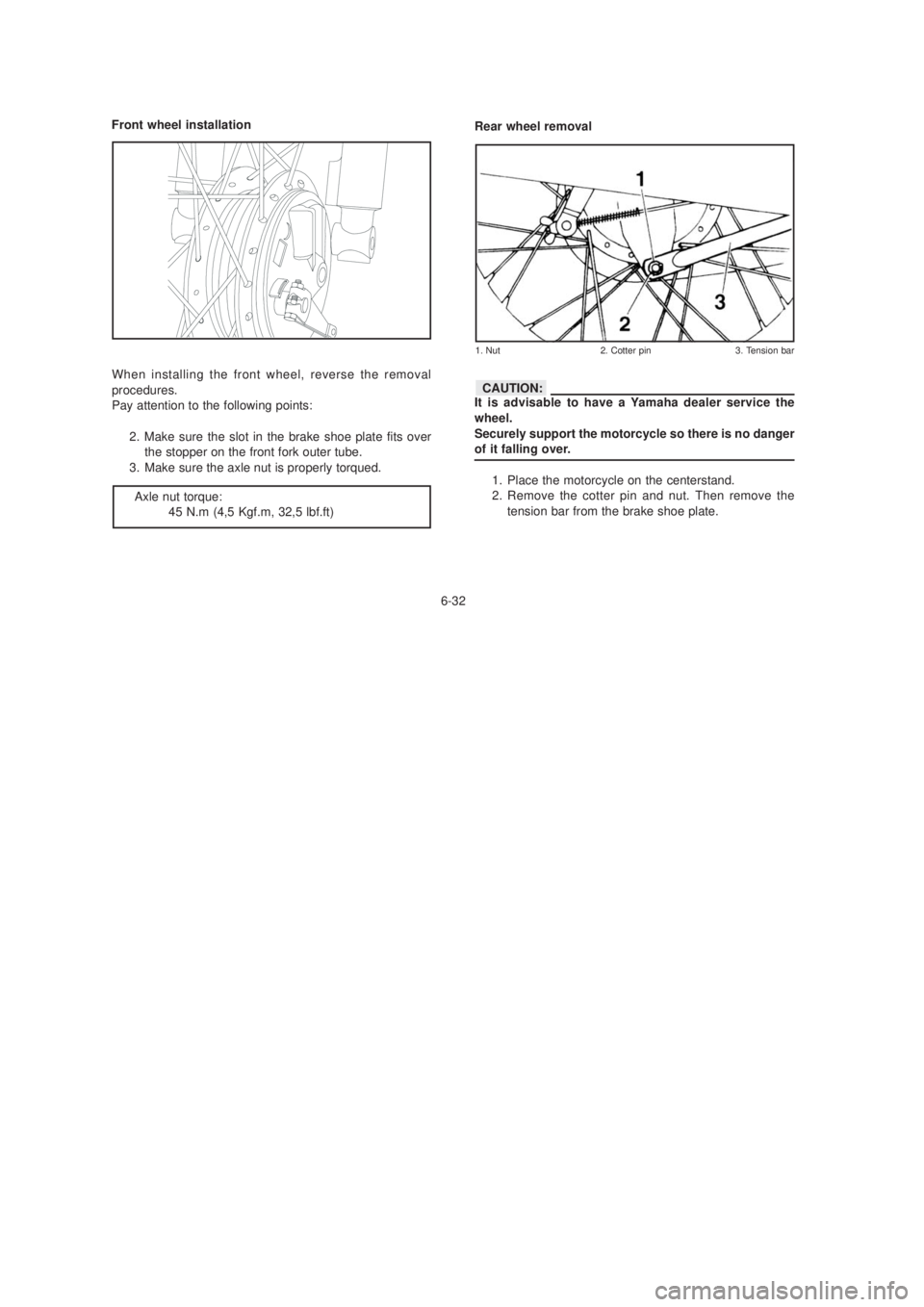
Rear wheel removal
It is advisable to have a Yamaha dealer service the
wheel.
Securely support the motorcycle so there is no danger
of it falling over. 1. Place the motorcycle on the centerstand.
2. Remove the cotter pin and nut. Then remove thetension bar from the brake shoe plate.
1. Nut 2. Cotter pin 3. Tension bar
CAUTION:
6-32
Front wheel installation
When installing the front wheel, reverse the removal
procedures.
Pay attention to the following points: 2. Make sure the slot in the brake shoe plate fits overthe stopper on the front fork outer tube.
3. Make sure the axle nut is properly torqued.
Axle nut torque: 45 N.m (4,5 Kgf.m, 32,5 lbf.ft)
Rear wheel removal
It is advisable to have a Yamaha dealer service the
wheel.
Securely support the motorcycle so there is no danger
of it falling over. 1. Place the motorcycle on the centerstand.
2. Remove the cotter pin and nut. Then remove thetension bar from the brake shoe plate.
1. Nut 2. Cotter pin 3. Tension bar
CAUTION:
Page 74 of 83

6-34 Troubleshooting
Although Yamaha motorcycles receive a rigid inspection
before shipment from the factory, trouble may occur during
operation. Any problem in the fuel, compression, or ignition
systems can cause poor starting and loss of power. The
troubleshooting chart describes a quick, easy, procedure
for making checks. If your motorcycle requires any repair,
bring it to a Yamaha dealer. The skilled technicians at a
Yamaha dealership have the tools, experience, and know-
how to properly service your motorcycle. Use only genuine
Yamaha parts on your motorcycle. Imitation parts may look
like Yamaha parts, but they are often inferior. Consequently,
they have a shorter service life and can lead to expensive
repair bills.
6-34 Troubleshooting
Although Yamaha motorcycles receive a rigid inspection
before shipment from the factory, trouble may occur during
operation. Any problem in the fuel, compression, or ignition
systems can cause poor starting and loss of power. The
troubleshooting chart describes a quick, easy, procedure
for making checks. If your motorcycle requires any repair,
bring it to a Yamaha dealer. The skilled technicians at a
Yamaha dealership have the tools, experience, and know-
how to properly service your motorcycle. Use only genuine
Yamaha parts on your motorcycle. Imitation parts may look
like Yamaha parts, but they are often inferior. Consequently,
they have a shorter service life and can lead to expensive
repair bills.