2004 SAAB 9-3 belt
[x] Cancel search: beltPage 15 of 288

15 Safety
Safety belts, rear seat
Safety belts rear seat, Convertible,
see page 67The three rear seats all have three-point
safety belts with inertia reels.
Fasten the belts by pulling the belt across
you and inserting the tongue into the buckle.
Check that it is securely fastened.
Grasp the shoulder belt close to the buckle
and pull the belt towards the shoulder to
tighten the lap belt part.
The belt must be as far in on the shoulder as
possible.Press the red button on the buckle to
release the belt.
See page 248 for the checking of belt func-
tion, cleaning, etc.
WARNING
Make sure that the belt does not
become trapped when the backrest is
folded down or raised (see page 134).
If a cargo has to be placed on a seat,
it must be properly secured with the
safety belt. This reduces the risk of the
cargo being thrown about during hard
braking or a crash, which could cause
personal injury.
Check that the belt is not twisted or
lying against sharp edges.
Make sure you use the correct safety
belt buckle. The buckles for the center
and left-hand rear seats are close
together.
Rear safety belts
Securing an item on the rear seat
ProCarManuals.com
Page 17 of 288

17 Safety
Legroom adjustmentLift the lever under the front of the seat and
slide the seat to the desired position.
Backrest rake angleTo find the most comfortable position, turn
the knob to provide stepless adjustment of
the backrest.
Lumbar support, Sport SedanAdjust the firmness of the lumbar support by
turning the knob.
WARNING
Check that the seat is locked in the new
position. If not, it may move while the car
is being driven and it could result in injury
to the occupant in the event of a crash.
WARNING
The backrest should be upright during
driving, so that the safety belt, airbag and
backrest can provide optimum protection
in the event of emergency braking or a
crash, in particular a rear-end crash.Adjusting the backrest
Adjusting the legroom Adjusting the lumbar support
ProCarManuals.com
Page 19 of 288
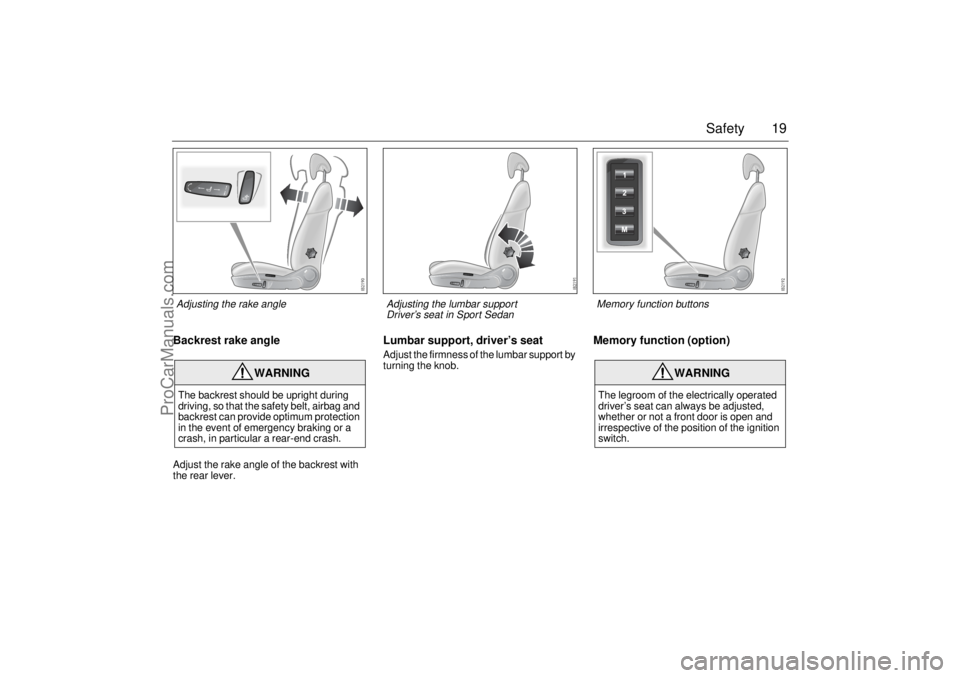
19 Safety
Backrest rake angleAdjust the rake angle of the backrest with
the rear lever.
Lumbar support, driver’s seatAdjust the firmness of the lumbar support by
turning the knob.
Memory function (option)
WARNING
The backrest should be upright during
driving, so that the safety belt, airbag and
backrest can provide optimum protection
in the event of emergency braking or a
crash, in particular a rear-end crash.
WARNING
The legroom of the electrically operated
driver’s seat can always be adjusted,
whether or not a front door is open and
irrespective of the position of the ignition
switch.
Adjusting the rake angle Adjusting the lumbar support
Driver’s seat in Sport SedanMemory function buttons
ProCarManuals.com
Page 21 of 288

21 Safety
Child safety
WARNING
Children must always be suitably
restrained in the car.
DEATH or SERIOUS
INJURY can occur
Children 12 and under or
shorter than 55 inches
(140 cm) can be killed by the
airbag
The BACK SEAT is the SAFEST place
for children
NEVER put a rear-facing child seat in
the front
Sit as far back as possible from the
airbag
ALWAYS use SAFETY BELTS and
CHILD RESTRAINTS
WARNING
Never leave children unattended in a
car, even for a shor t time.
– Children can suffer heat stroke,
perhaps die, in a matter of minutes.
– Children can put the car into gear and
hurt themselves or others.
At gas stations, take the remote
control out of the car while filling the
tank.
Never allow children to climb on top of
or under motor vehicles.
Always look for children before back-
ing your car out of a garage or drive-
way.
To avoid carbon monoxide poisoning,
never let a car idle in the garage.
Supervise young children around
buckets of water while washing your
car. Small children can drown in a
short time in less than an inch of water.
WARNING
Protect children from getting
trapped in the trunk of your car
Teach children not to play in or around
cars.
Watch children when loading or
unloading the car so they don´t get
locked in by mistake.
Always lock the doors and trunk of
your car, and keep the keys out of chil-
dren´s sight and reach.
Keep the rear fold-down seat closed to
help prevent children from getting into
the trunk from inside the car.
ProCarManuals.com
Page 22 of 288

22 SafetyGeneral information on child safetyThe same attention must be given to child
safety in the car as is given to adults.
Children travel most safely when properly
restrained. However, the type of restraint
must be appropriate for the size of the child.
Always consult your Saab dealer before
fitting a child seat, child restraint or booster
cushion.
Make sure you are acquainted with the
legal requirements for seating children
in the car.
Make sure that it is possible to fit a child
restraint in accordance with the manufac-
turer’s child restraint instructions.
When fitting child restraints in cars you
must always read the instructions sup-
plied by the child restraint manufacturer.
Saab recommends the use of a rear-
facing child seat for as long as this is
possible - a minimum for all children
under the age of 3 (approx. 15 kg). Use a
child seat approved for the weight of the
child.
Saab recommends the use of a booster seat
for children up to the age of 10.
LATCHLATCH (Lower Anchorages & Top tethers
for CHildren) is a US/Canadian safety stan-
dard for a uniform method of fitting child
restraints without using the standard safety
belts. Only certain child restraints are
equipped to utilize the LATCH system.
The LATCH system is installed in the car to
facilitate proper fitting of child restraints
designed for and equipped with LATCH
attachments. The LATCH system consists of top tether
and lower anchorages (also called ISOFIX).
In this vehicle, LATCH is installed at the two
outboard seating positions in the rear seat,
and there is a top tether on the rear center
position (not Convertible). The top tethers
are located on top of the parcel shelf
(Convertible: behind the head restraints),
see page 25. They are covered by a lid with
a child seat anchor symbol. The lower
anchorages are located where the seat
cushion and seat back come together.
There is a label above the inner lower
anchorage, see picture on next page. Label
consists of a symbol of a child restrained in
a seat inside a circle.
When fitting child restraints in cars you must
always read the instructions supplied by the
child restraint manufacturer.
If you have any questions regarding LATCH
please contact your Saab dealer.
ProCarManuals.com
Page 24 of 288

24 SafetyLATCH child seat installation
Before starting the installation, please read
through this instruction, and the child seat
installation instruction.
1 Place the child restraint on one of the
designated outboard rear seat cush-
ions.
2 Slide the attachment on the child
restraint in between the seat cushion
and backrest.
3 Press the child restraint down on the
seat, 1 in illustration.
4 Press the child restraint rearward, lining
up the inner restraint attachment arm
with the label, 2 in illustration.
5 Connect the restraint attachment arms
to the anchorages 3 in illustration.
6 Follow the child restraint instructions to
confirm that both restraint attachment
arms are properly attached to the bars.
7 Attach the top tether strap to the in-car
anchorage and tighten according to the
restraint instructions, see page 25 and
26.
8 Pull the child restraint to make a second
check that the restraint is securely
attached at both the lower anchorage
bars and the top tether strap.
Only use the belt supplied with the child
restraint.
For the top tether, only use the strap sup-
plied with the child restraint.
The availability of LATCH child restraints is
limited.When fitting child restraints in cars you
must always read the instructions sup-
plied by the child restraint manufacturer.
Rigid 2-point lower anchorage with top
tetherSemi-rigid 2-point lower anchorage with
top tether
ProCarManuals.com
Page 25 of 288

25 Safety
Child tether anchorages for forward
facing child seatsSport Sedan
Convertible, see page 26
Child restraints with a tether strap must be
attached according to Canadian and U.S.
safety standards.
If you have any questions regarding child
anchorages please contact your Saab
dealer.The car is provided with three top tether
anchorages. Use the one that is right behind
the child restraint and attach the restraint as
follows:
1 Open the cover that is right behind the
child restraint, 1 in illustration.
2 Place the child restraint in the rear seat.
3 Secure the lower part of the child
restraint by means of the lower anchor-
ages (ISOFIX) or the safety belts as
described in the child restraint installa-
tion instruction.
4 Lower the headrest and route the tether
over it.
5 Attach the tether to the anchorage, 2 in
illustration.
6 Close the cover to the middle position, 3
in illustration.7 Tighten the tether so that the back of the
child restraint is pressed hard against
the backrest.
8 Pull the child restraint to make a second
check that the restraint is securely
attached at both the lower anchorages
bars on the safety belts and the top
tether strap.
WARNING
Child top tether anchorages are designed
to withstand only those loads imposed by
correctly fitted child restraints.
Under no circumstances are they to be
used for adult safety belts.
Child tether anchorages in parcel shelf, Sport Sedan
ProCarManuals.com
Page 26 of 288

26 SafetyChild tether anchorages for forward
facing child seatsConvertible
Child restraints with a tether strap must be
attached according to Canadian and U.S.
safety standards.
If you have any questions regarding child
anchorages please contact your Saab
dealer.
The car is provided with two top tether
anchorages. Use the one that is right behind
the child restraint and attach the restraint as
follows:
1 Remove the head restraint on the seat-
ing position where the child restraint
shall be fitted.
2 Place the child restraint in the rear seat.
3 Secure the lower part of the child
restraint by means of the lower anchor-
ages (ISOFIX) or the safety belts as described in the child restraint installa-
tion instruction.
4 Attach the tether to the anchorage.
5 Tighten the tether so that the back of the
child restraint is pressed hard against
the backrest.
6 Pull the child restraint to make a second
check that the restraint is securely
attached at both the lower anchorages
bars on the safety belts and the top
tether strap.
7 Put the head restraint back on and make
sure it is sucure mounted. Adjust it in its
highest position.
WARNING
Child top tether anchorages are designed
to withstand only those loads imposed by
correctly fitted child restraints.
Under no circumstances are they to be
used for adult safety belts.
WARNING
If the size of the child restraint makes it
impossible to put the head reatraint back
on, place it in the trunk.
How to take away the head restraint1 Raise the head restraint
2 Push the catch forward and pull the head
restraint straight upward
Top tether anchorages in the rear seat
ProCarManuals.com