Page 27 of 320
ARMRESTS
To use the armrests on any seat, pull them down
to the resting position.
FLEXIBLE SEATING
Folding the 2nd row captain’s chair
s1To fold the 2nd row captain’s chairs to the
floor for maximum cargo hauling, remove the
head restraints. Remove the head restraints
by lifting up, then push and hold the release
knob and place them in the storage bag.
Make sure to secure the storage bag, see
“Head restraint storage” in the “Instrument
and controls” section of this Owner’s
Manual.
s2Lift up on the recline lever to fold the seat-
back forward on the seat base.
s3Push down on the small knob on the back of
the seat to release the base of the seat.
WRS0287WRS0288WRS0289
Safety—Seats, seat belts and supplemental air bags1-11
ZREVIEW COPY:Ð2004 Quest(van)
Owners Manual(owners)ÐUSA English(nna)
10/08/03Ðtbrooks
X
Page 28 of 320
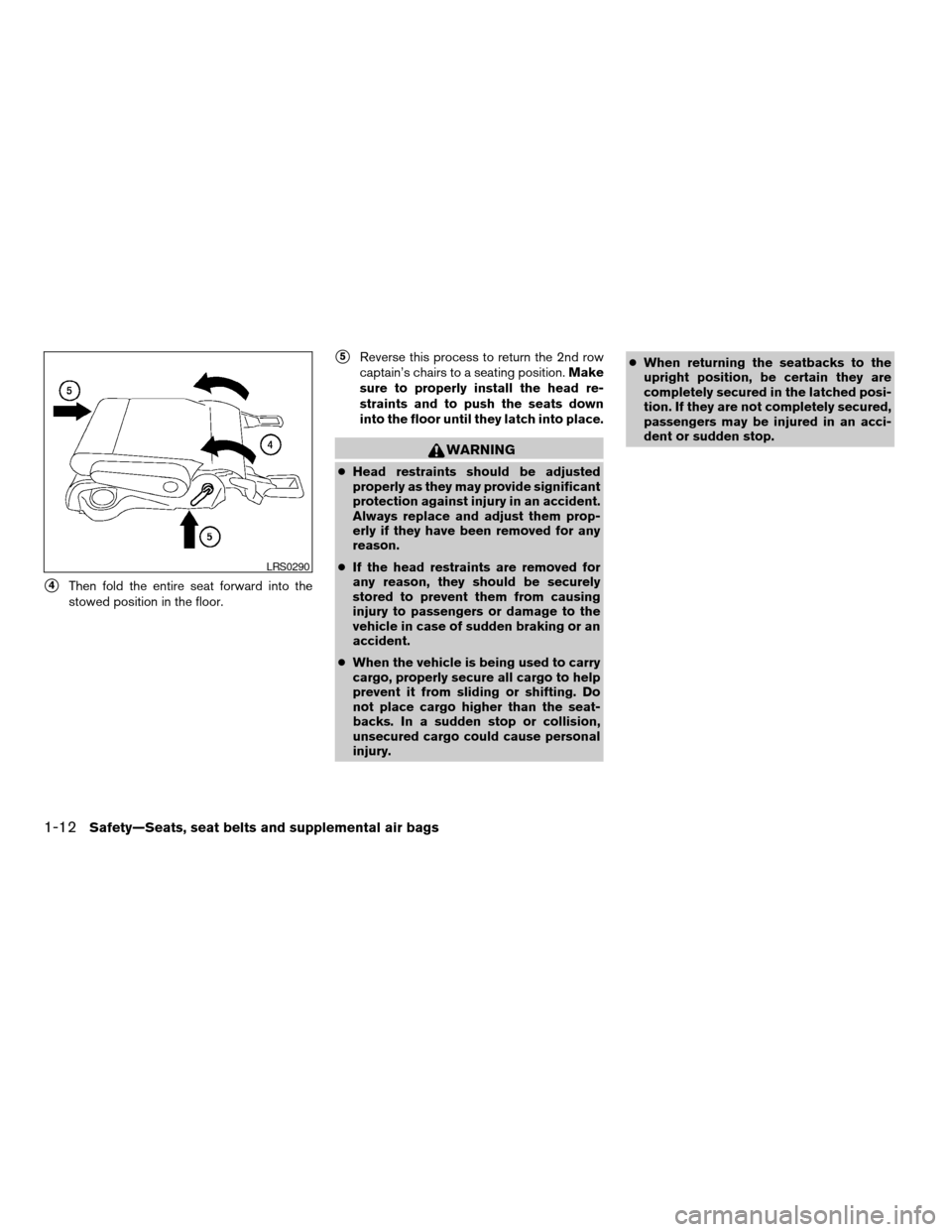
s4Then fold the entire seat forward into the
stowed position in the floor.
s5Reverse this process to return the 2nd row
captain’s chairs to a seating position.Make
sure to properly install the head re-
straints and to push the seats down
into the floor until they latch into place.
WARNING
cHead restraints should be adjusted
properly as they may provide significant
protection against injury in an accident.
Always replace and adjust them prop-
erly if they have been removed for any
reason.
cIf the head restraints are removed for
any reason, they should be securely
stored to prevent them from causing
injury to passengers or damage to the
vehicle in case of sudden braking or an
accident.
cWhen the vehicle is being used to carry
cargo, properly secure all cargo to help
prevent it from sliding or shifting. Do
not place cargo higher than the seat-
backs. In a sudden stop or collision,
unsecured cargo could cause personal
injury.cWhen returning the seatbacks to the
upright position, be certain they are
completely secured in the latched posi-
tion. If they are not completely secured,
passengers may be injured in an acci-
dent or sudden stop.
LRS0290
1-12Safety—Seats, seat belts and supplemental air bags
ZREVIEW COPY:Ð2004 Quest(van)
Owners Manual(owners)ÐUSA English(nna)
10/08/03Ðtbrooks
X
Page 29 of 320
Folding the 3rd row bench seat
WARNING
cThe 3rd row bench seat is heavy. Be
careful when folding and unfolding.
cTo avoid injury to yourself or others,
keep hands and body clear of floor
opening when folding.
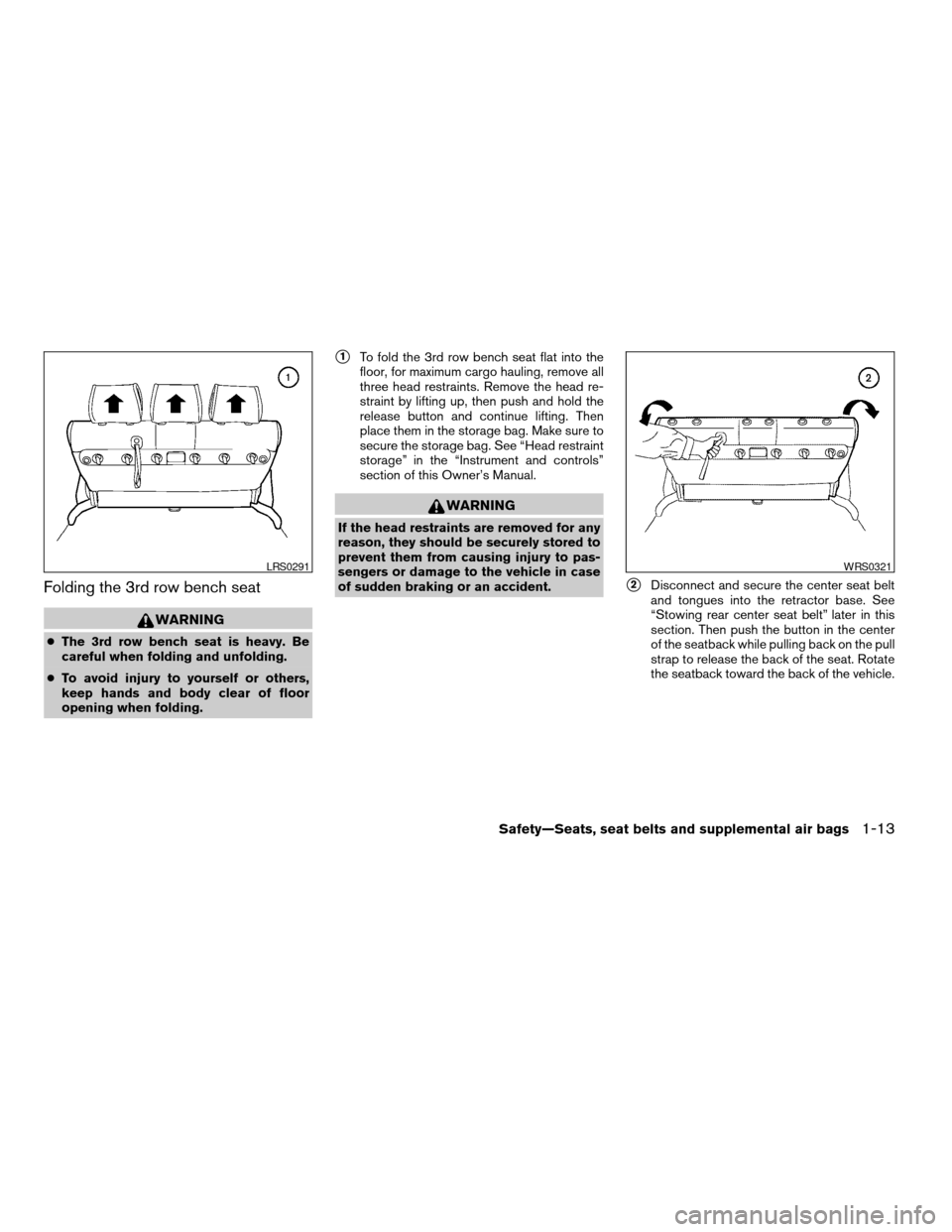
s1To fold the 3rd row bench seat flat into the
floor, for maximum cargo hauling, remove all
three head restraints. Remove the head re-
straint by lifting up, then push and hold the
release button and continue lifting. Then
place them in the storage bag. Make sure to
secure the storage bag. See “Head restraint
storage” in the “Instrument and controls”
section of this Owner’s Manual.
WARNING
If the head restraints are removed for any
reason, they should be securely stored to
prevent them from causing injury to pas-
sengers or damage to the vehicle in case
of sudden braking or an accident.
s2Disconnect and secure the center seat belt
and tongues into the retractor base. See
“Stowing rear center seat belt” later in this
section. Then push the button in the center
of the seatback while pulling back on the pull
strap to release the back of the seat. Rotate
the seatback toward the back of the vehicle.
LRS0291WRS0321
Safety—Seats, seat belts and supplemental air bags1-13
ZREVIEW COPY:Ð2004 Quest(van)
Owners Manual(owners)ÐUSA English(nna)
10/08/03Ðtbrooks
X
Page 30 of 320
s3Pull up on the lever located on the back of
the seat base. This will fold the seat base
toward the back of the vehicle.s4The entire seat will rotate toward you and
stow flat in the floor.s5The rear seat anchors are spring loaded and
can be folded into the side panels to maxi-
mize cargo space. The anchors are held in
the folded position by the items in the cargo
area. When the load is removed from the
cargo area, the rear seat anchors automati-
cally return to the unfolded position.
6. Reverse this process to return the bench
seat to a seating position.Make sure to
properly install the head restraints,
push the bench seat down into the
floor, and pull back on the seatback
until they latch into place.
LRS0292LRS0293LRS0285
1-14Safety—Seats, seat belts and supplemental air bags
ZREVIEW COPY:Ð2004 Quest(van)
Owners Manual(owners)ÐUSA English(nna)
10/08/03Ðtbrooks
X
Page 31 of 320
WARNING
cWhen the vehicle is being used to carry
cargo, properly secure all cargo to help
prevent it from sliding or shifting. Do
not place cargo higher than the seat-
backs. In a sudden stop or collision,
unsecured cargo could cause personal
injury.
cWhen returning the seatbacks to the
upright position, be certain they are
completely secured in the latched posi-
tion. If they are not completely secured,
passengers may be injured in an acci-
dent or sudden stop.
cHead restraints should be adjusted
properly as they may provide significant
protection against injury in an accident.
Always replace and adjust them prop-
erly if they have been removed for any
reason.
cNever allow anyone to ride in the cargo
area or on the rear seat when it is in the
fold-down position. Use of these areas
by passengers without proper restraints
could result in serious injury in an acci-
dent or sudden stop.
PRECAUTIONS ON
SUPPLEMENTAL RESTRAINT
SYSTEM
This Supplemental Restraint System (SRS) sec-
tion contains important information concerning
the driver and passenger supplemental front air
bags (NISSAN Advanced Air Bag System) ,
supplemental side air bags, curtain side-impact
air bags and pre-tensioner seat belts.
Supplemental front impact air bag system:
The NISSAN advanced air bag system can help
cushion the impact force to the head and chest of
the driver and front passenger in certain frontal
collisions.
Supplemental side-impact air bag system
(if so equipped):This system can help cushion
the impact force to the chest area of the driver
and front passenger in certain side impact colli-
sions. The supplemental side air bag is designed
to inflate on the side where the vehicle is im-
pacted.
Supplemental curtain side-impact air bag
system:This system can help cushion the im-
pact force to the head of occupants in front and
rear outboard seating positions in certain side
impact collisions. The curtain side-impact air
bags are designed to inflate on the side where
the vehicle is impacted.These supplemental restraint systems are de-
signed tosupplementthe crash protection pro-
vided by the seat belts and arenot a substitute
for them. Seat belts should always be correctly
worn and the occupant seated a suitable dis-
tance away from the steering wheel, instrument
panel and door finishers. See “Seat belts” later in
this section for instructions and precautions on
seat belt usage.
The supplemental air bags operate only
when the ignition switch is in the ON or
START position.
After turning the ignition key to the ON
position, the supplemental air bag warning
light illuminates. The supplemental air bag
warning light will turn off after about 7
seconds if the system is operational.
SUPPLEMENTAL RESTRAINT
SYSTEM
Safety—Seats, seat belts and supplemental air bags1-15
ZREVIEW COPY:Ð2004 Quest(van)
Owners Manual(owners)ÐUSA English(nna)
10/08/03Ðtbrooks
X
Page 32 of 320
WARNING
cThe supplemental front air bags ordi-
narily will not inflate in the event of a
side impact, rear impact, rollover, or
lower severity frontal collision. Also,
the front passenger air bag will not in-
flate if the passenger air bag status
light is lit. Always wear your seat belts
to help reduce the risk or severity of
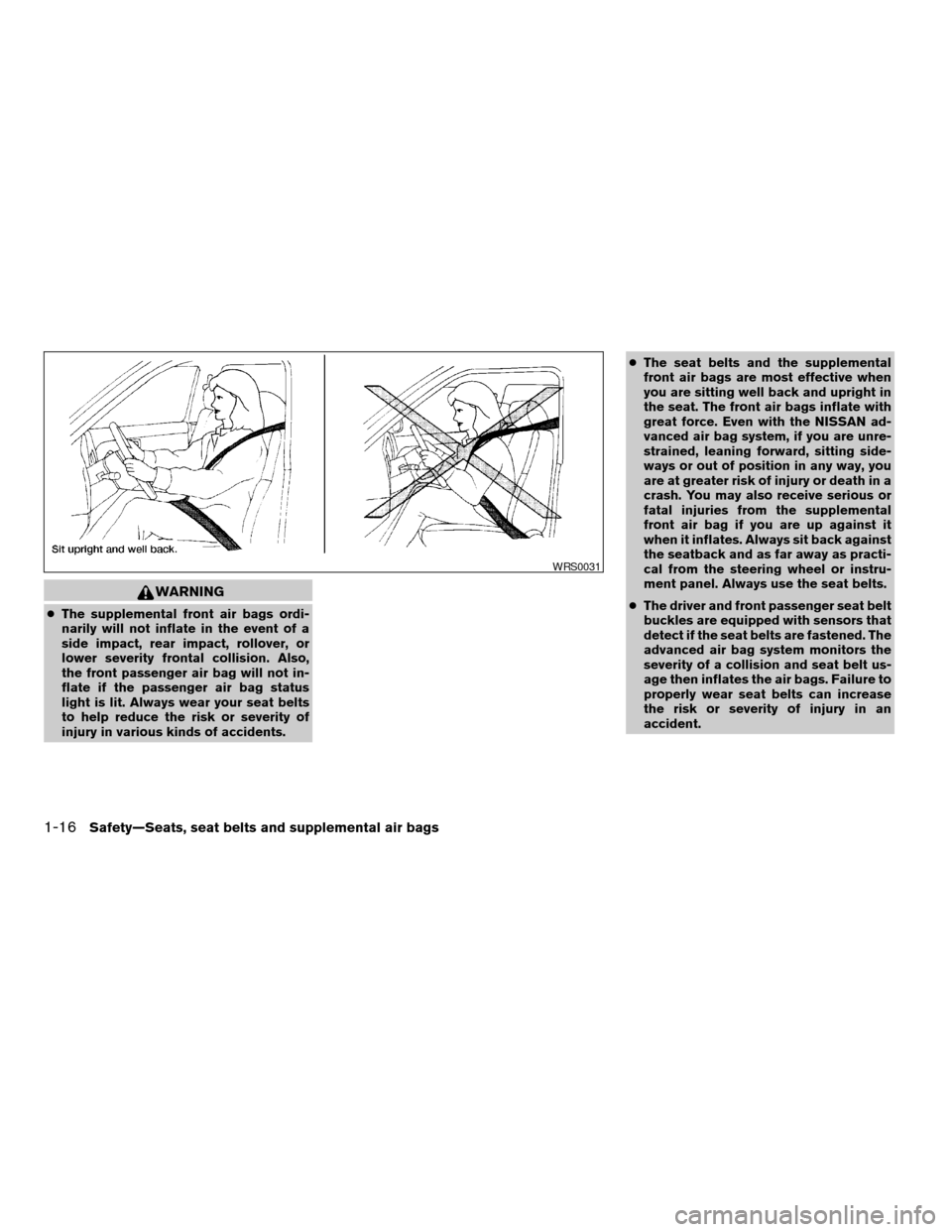
injury in various kinds of accidents.cThe seat belts and the supplemental
front air bags are most effective when
you are sitting well back and upright in
the seat. The front air bags inflate with
great force. Even with the NISSAN ad-
vanced air bag system, if you are unre-
strained, leaning forward, sitting side-
ways or out of position in any way, you
are at greater risk of injury or death in a
crash. You may also receive serious or
fatal injuries from the supplemental
front air bag if you are up against it
when it inflates. Always sit back against
the seatback and as far away as practi-
cal from the steering wheel or instru-
ment panel. Always use the seat belts.
cThe driver and front passenger seat belt
buckles are equipped with sensors that
detect if the seat belts are fastened. The
advanced air bag system monitors the
severity of a collision and seat belt us-
age then inflates the air bags. Failure to
properly wear seat belts can increase
the risk or severity of injury in an
accident.
WRS0031
1-16Safety—Seats, seat belts and supplemental air bags
ZREVIEW COPY:Ð2004 Quest(van)
Owners Manual(owners)ÐUSA English(nna)
10/08/03Ðtbrooks
X
Page 33 of 320
cThe front passenger seat is equipped
with an occupant classification sensor
(weight sensor) that turns the front pas-
senger air bag OFF under some condi-
tions. This sensor is only used in this
seat. Failure to be properly seated and
wearing the seat belt can increase the
risk or severity of injury in an accident.
See “Front Passenger air bag and sta-
tus light” later in this section.
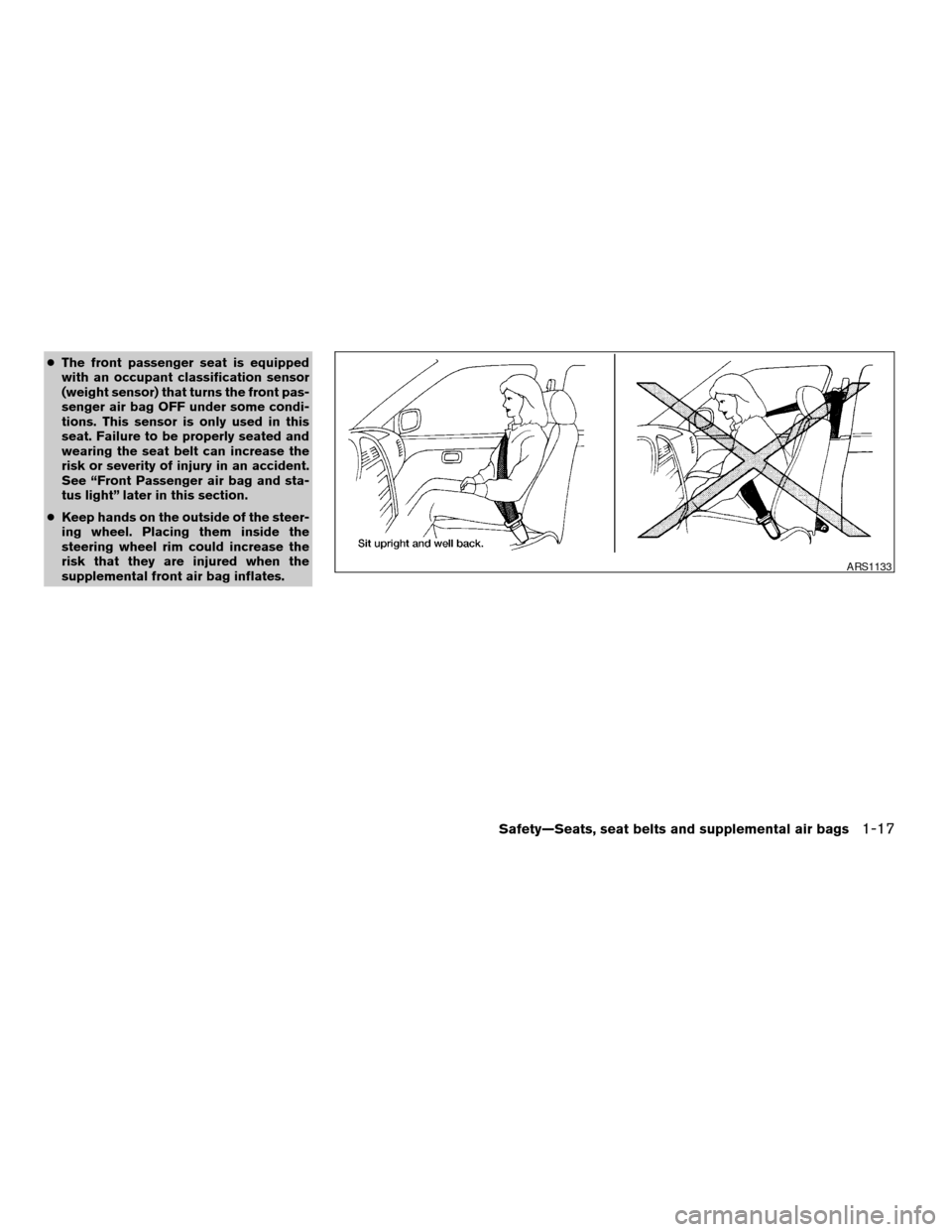
cKeep hands on the outside of the steer-
ing wheel. Placing them inside the
steering wheel rim could increase the
risk that they are injured when the
supplemental front air bag inflates.
ARS1133
Safety—Seats, seat belts and supplemental air bags1-17
ZREVIEW COPY:Ð2004 Quest(van)
Owners Manual(owners)ÐUSA English(nna)
10/08/03Ðtbrooks
X
Page 34 of 320
WARNING
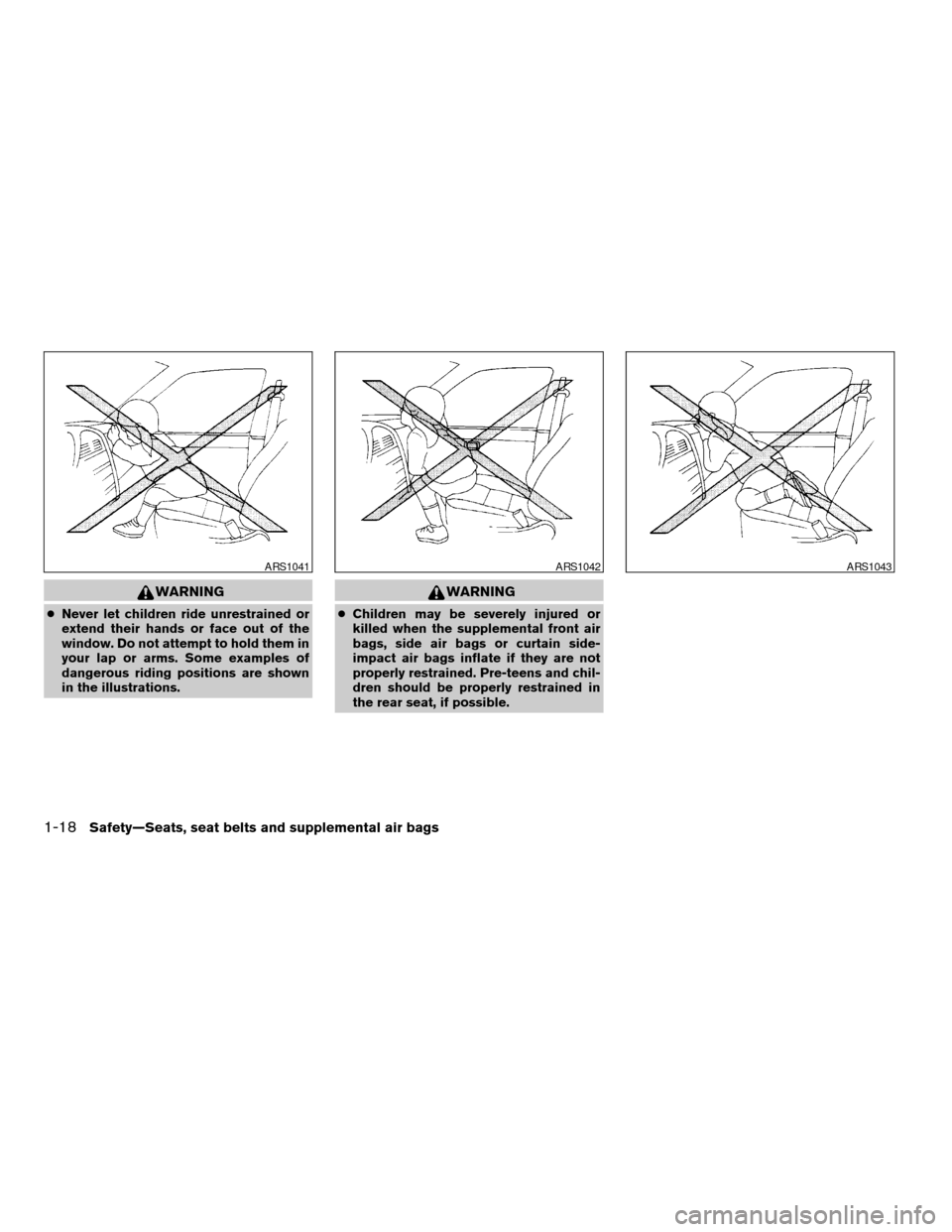
cNever let children ride unrestrained or
extend their hands or face out of the
window. Do not attempt to hold them in
your lap or arms. Some examples of
dangerous riding positions are shown
in the illustrations.
WARNING
cChildren may be severely injured or
killed when the supplemental front air
bags, side air bags or curtain side-
impact air bags inflate if they are not
properly restrained. Pre-teens and chil-
dren should be properly restrained in
the rear seat, if possible.
ARS1041ARS1042ARS1043
1-18Safety—Seats, seat belts and supplemental air bags
ZREVIEW COPY:Ð2004 Quest(van)
Owners Manual(owners)ÐUSA English(nna)
10/08/03Ðtbrooks
X