Page 238 of 306
Operating with insufficient amount of
oil can damage the engine, and such
damage is not covered by warranty.
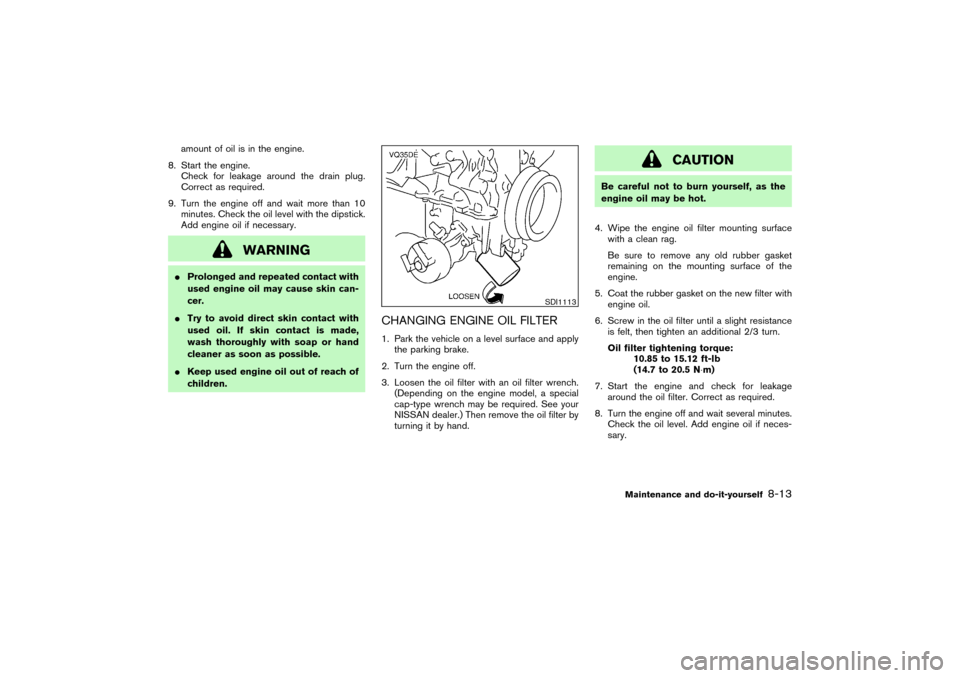
CHANGING ENGINE OIL1. Park the vehicle on a level surface and apply
the parking brake.
2. Warm up the engine until it reaches operat-
ing temperature, and then turn it off and wait
more than 10 minutes.
3. Place a large drain pan under the drain plug.
4. Remove the oil filler cap.
5. Remove the drain plug with a wrench and
completely drain the oil.
If the oil filter is to be changed, remove and
replace it at this time. See later in this sectionfor changing engine oil filter.
CAUTION
Be careful not to burn yourself, as the
engine oil is hot.
�Waste oil must be disposed of prop-
erly.
�Check your local regulations.
6. Clean and re-install the drain plug and new
washer. Securely tighten the drain plug with a
wrench. Do not use excessive force.
Drain plug tightening torque:
22 to 29 ft-lb (29 to 39 N⋅m)
7. Refill engine with recommended oil through
the oil filler opening, then install the oil filler
cap securely.
See “Capacities and recommended
fuel/lubricants” in the “9. Technical and con-
sumer information” section for drain and refill
capacity.
The drain and refill capacity depends on the
oil temperature and drain time. Use these
specifications for reference only. Always use
the dipstick to determine when the proper
SDI1594
8-12
Maintenance and do-it-yourself
�
04.3.9/R50-D/V5
�
Page 239 of 306
amount of oil is in the engine.
8. Start the engine.
Check for leakage around the drain plug.
Correct as required.
9. Turn the engine off and wait more than 10
minutes. Check the oil level with the dipstick.
Add engine oil if necessary.
WARNING
�Prolonged and repeated contact with
used engine oil may cause skin can-
cer.
�Try to avoid direct skin contact with
used oil. If skin contact is made,
wash thoroughly with soap or hand
cleaner as soon as possible.
�Keep used engine oil out of reach of
children.
CHANGING ENGINE OIL FILTER1. Park the vehicle on a level surface and apply
the parking brake.
2. Turn the engine off.
3. Loosen the oil filter with an oil filter wrench.
(Depending on the engine model, a special
cap-type wrench may be required. See your
NISSAN dealer.) Then remove the oil filter by
turning it by hand.
CAUTION
Be careful not to burn yourself, as the
engine oil may be hot.
4. Wipe the engine oil filter mounting surface
with a clean rag.
Be sure to remove any old rubber gasket
remaining on the mounting surface of the
engine.
5. Coat the rubber gasket on the new filter with
engine oil.
6. Screw in the oil filter until a slight resistance
is felt, then tighten an additional 2/3 turn.
Oil filter tightening torque:
10.85 to 15.12 ft-lb
(14.7 to 20.5 N⋅m)
7. Start the engine and check for leakage
around the oil filter. Correct as required.
8. Turn the engine off and wait several minutes.
Check the oil level. Add engine oil if neces-
sary.
SDI1113
Maintenance and do-it-yourself
8-13
�
04.3.9/R50-D/V5
�
Page 240 of 306
WARNING
�When engine is running, keep hands,
jewelry, and clothing away from any
moving parts such as fan and drive
belt.
�Automatic transmission fluid is poi-
sonous and should be stored care-
fully in marked containers out of the
reach of children.
TEMPERATURE CONDITIONS FOR
CHECKINGThe fluid level should be checked using the HOT
range (L & H marks) on the dipstick at fluid
temperatures between 122 and 176°F (50 and
80°C) after the vehicle has been driven approxi-
mately 5 minutes in urban areas after the engine
is warmed up. The level can be checked at fluid
temperatures between 86 and 122°F (30 and
50°C) using the COLD range on the dipstick for
reference, after the engine is warmed up but
before driving. However, the fluid level must be
rechecked using the HOT range.
1. Park the vehicle on a level surface and set the
parking brake.
2. Start the engine and then move the selector
lever through each gear range, ending in P.
3. Check the fluid level with the engine idling.
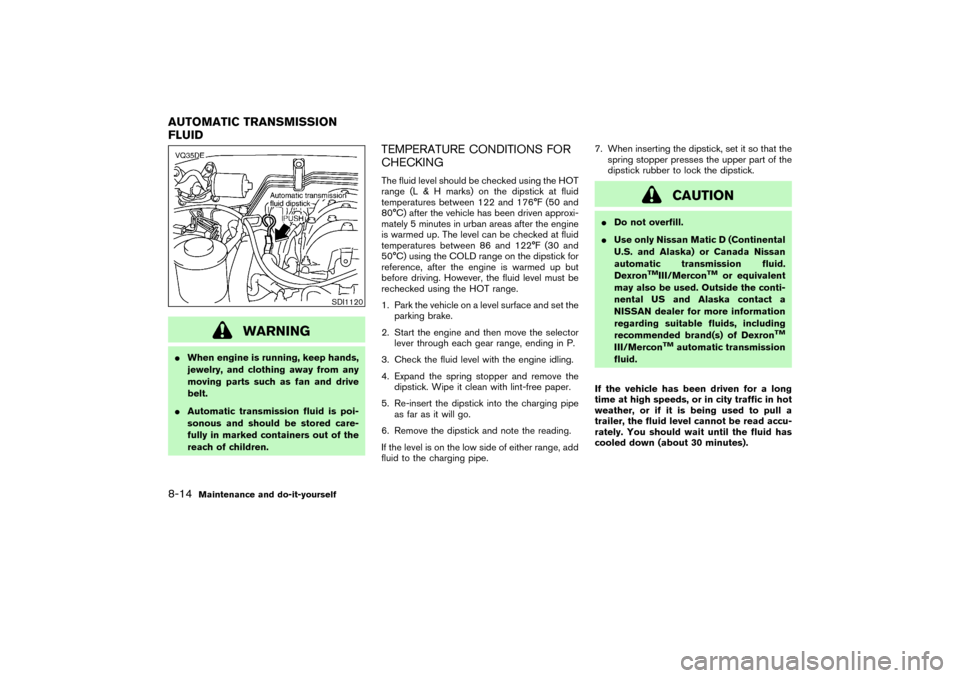
4. Expand the spring stopper and remove the
dipstick. Wipe it clean with lint-free paper.
5. Re-insert the dipstick into the charging pipe
as far as it will go.
6. Remove the dipstick and note the reading.
If the level is on the low side of either range, add
fluid to the charging pipe.7. When inserting the dipstick, set it so that the
spring stopper presses the upper part of the
dipstick rubber to lock the dipstick.
CAUTION
�Do not overfill.
�Use only Nissan Matic D (Continental
U.S. and Alaska) or Canada Nissan
automatic transmission fluid.
Dexron
TMIII/Mercon
TM
or equivalent
may also be used. Outside the conti-
nental US and Alaska contact a
NISSAN dealer for more information
regarding suitable fluids, including
recommended brand(s) of Dexron
TM
III/Mercon
TM
automatic transmission
fluid.
If the vehicle has been driven for a long
time at high speeds, or in city traffic in hot
weather, or if it is being used to pull a
trailer, the fluid level cannot be read accu-
rately. You should wait until the fluid has
cooled down (about 30 minutes).
SDI1120
AUTOMATIC TRANSMISSION
FLUID8-14
Maintenance and do-it-yourself
�
04.3.9/R50-D/V5
�
Page 242 of 306
WARNING
Use only new fluid from a sealed con-
tainer. Old, inferior or contaminated
fluid may damage the brake and clutch
systems. The use of improper fluids can
affect the vehicle’s stopping ability.
CAUTION
Do not spill the fluid on painted sur-
faces. This will damage the paint. If fluid
is spilled, wash the surface with water.
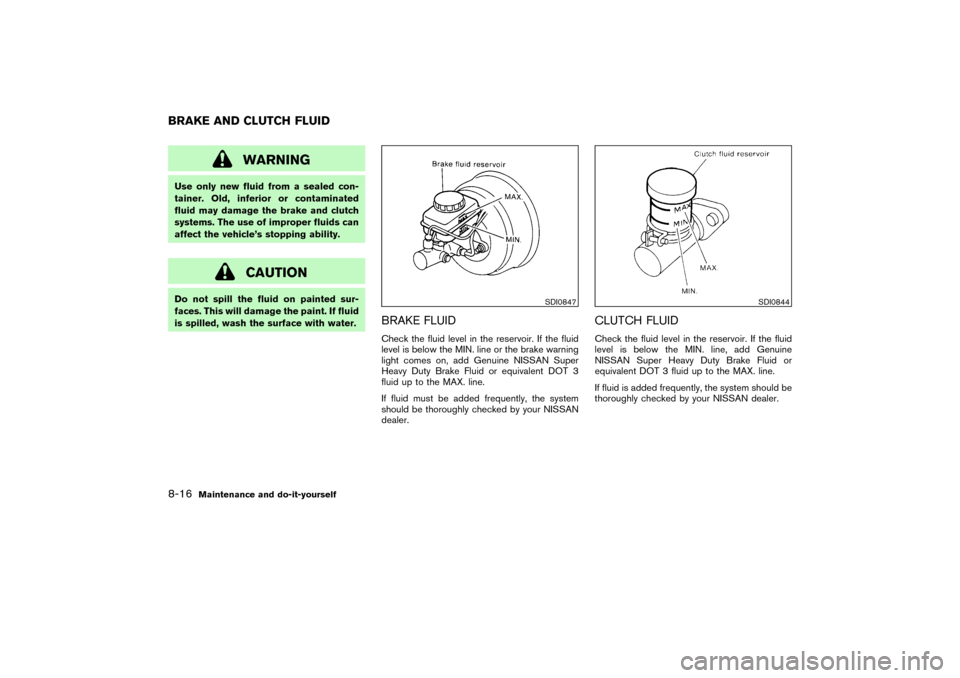
BRAKE FLUIDCheck the fluid level in the reservoir. If the fluid
level is below the MIN. line or the brake warning
light comes on, add Genuine NISSAN Super
Heavy Duty Brake Fluid or equivalent DOT 3
fluid up to the MAX. line.
If fluid must be added frequently, the system
should be thoroughly checked by your NISSAN
dealer.
CLUTCH FLUIDCheck the fluid level in the reservoir. If the fluid
level is below the MIN. line, add Genuine
NISSAN Super Heavy Duty Brake Fluid or
equivalent DOT 3 fluid up to the MAX. line.
If fluid is added frequently, the system should be
thoroughly checked by your NISSAN dealer.
SDI0847
SDI0844
BRAKE AND CLUTCH FLUID8-16
Maintenance and do-it-yourself
�
04.3.9/R50-D/V5
�
Page 246 of 306
REPLACING SPARK PLUGS
WARNING
Be sure the engine and ignition switch
are off and that the parking brake is
engaged securely.
CAUTION
Be sure to use the correct socket toremove the spark plugs. An incorrect
socket can cause damage the spark
plugs.
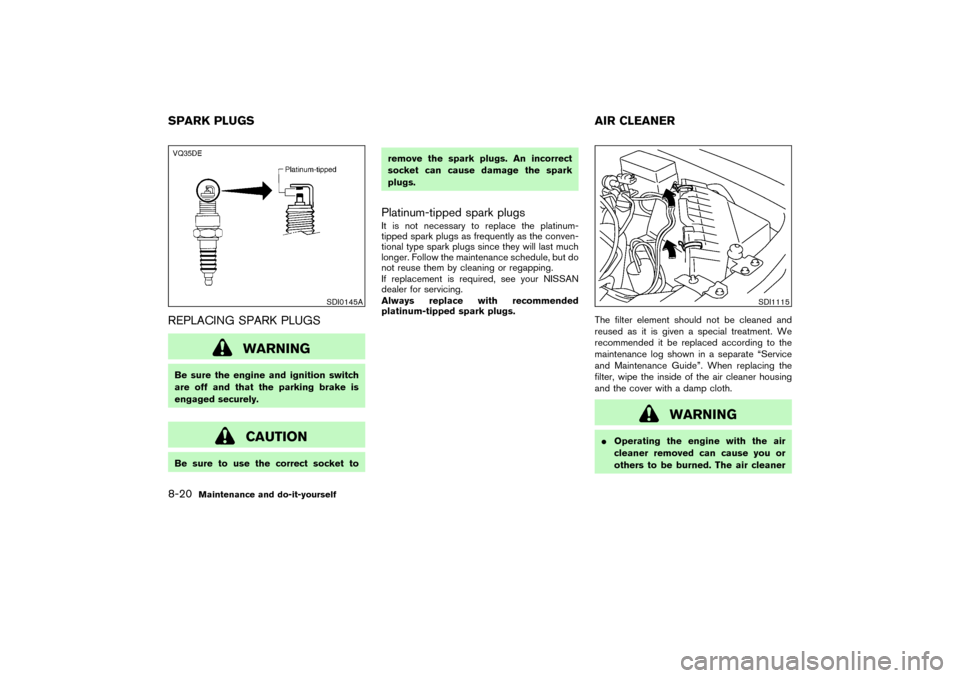
Platinum-tipped spark plugsIt is not necessary to replace the platinum-
tipped spark plugs as frequently as the conven-
tional type spark plugs since they will last much
longer. Follow the maintenance schedule, but do
not reuse them by cleaning or regapping.
If replacement is required, see your NISSAN
dealer for servicing.
Always replace with recommended
platinum-tipped spark plugs.
The filter element should not be cleaned and
reused as it is given a special treatment. We
recommended it be replaced according to the
maintenance log shown in a separate “Service
and Maintenance Guide”. When replacing the
filter, wipe the inside of the air cleaner housing
and the cover with a damp cloth.
WARNING
�Operating the engine with the air
cleaner removed can cause you or
others to be burned. The air cleaner
SDI0145A
SDI1115
SPARK PLUGS AIR CLEANER8-20
Maintenance and do-it-yourself
�
04.3.9/R50-D/V5
�
Page 248 of 306
CAUTION
After wiper blade replacement, return
the wiper arm to its original position;
otherwise it may be damaged when the
hood is opened.
Make sure the wiper blade contacts the
glass, otherwise the arm may be dam-
aged from wind pressure.
Worn windshield wiper blades can dam-
age the windshield and impair driver
vision.
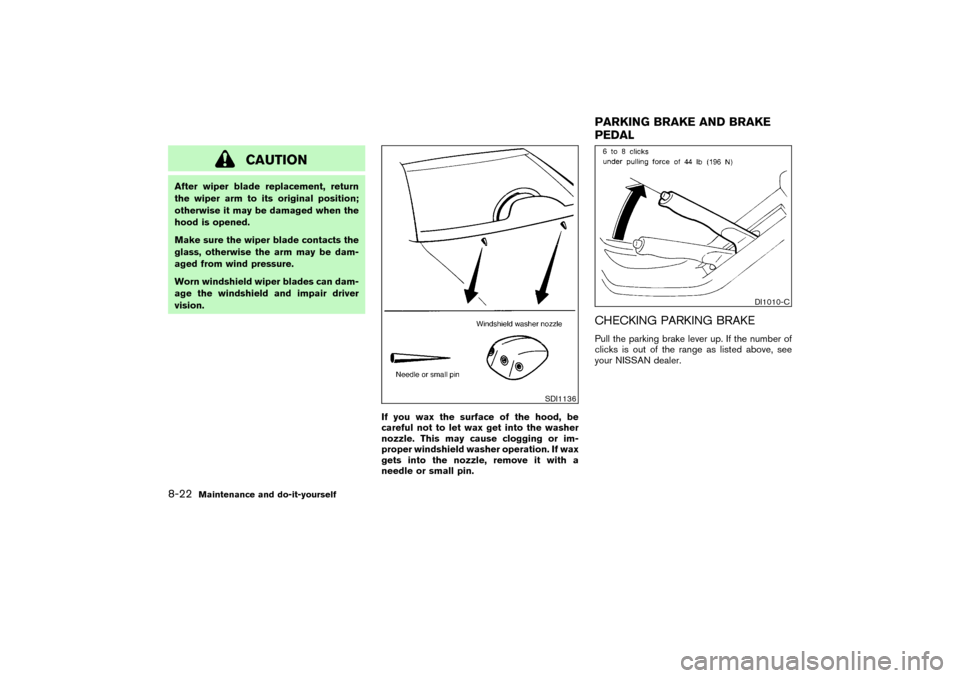
If you wax the surface of the hood, be
careful not to let wax get into the washer
nozzle. This may cause clogging or im-
proper windshield washer operation. If wax
gets into the nozzle, remove it with a
needle or small pin.
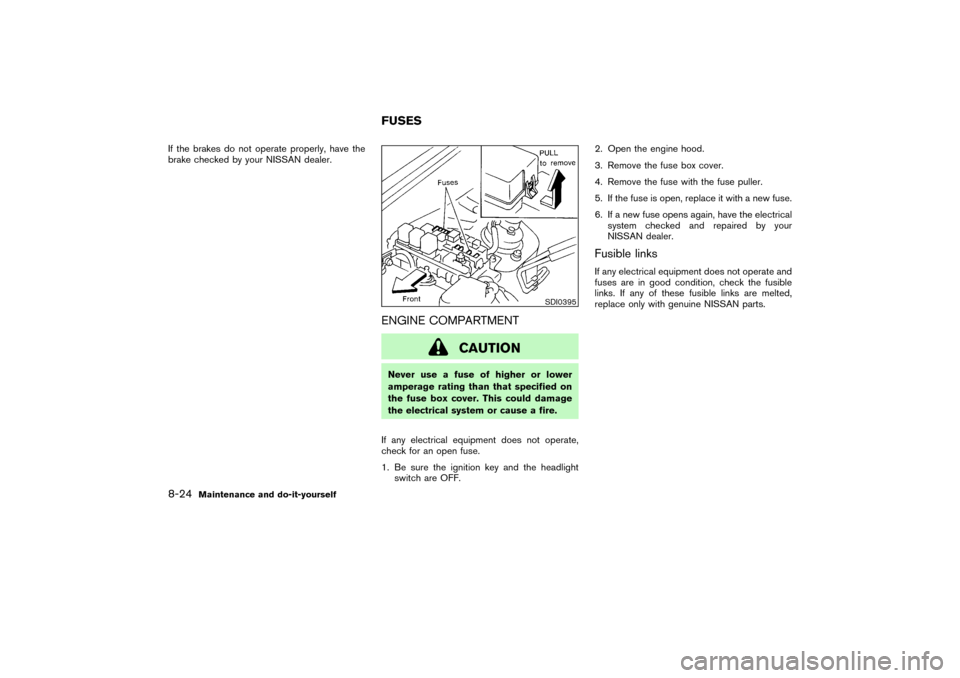
CHECKING PARKING BRAKEPull the parking brake lever up. If the number of
clicks is out of the range as listed above, see
your NISSAN dealer.
SDI1136
DI1010-C
PARKING BRAKE AND BRAKE
PEDAL
8-22
Maintenance and do-it-yourself
�
04.3.9/R50-D/V5
�
Page 249 of 306
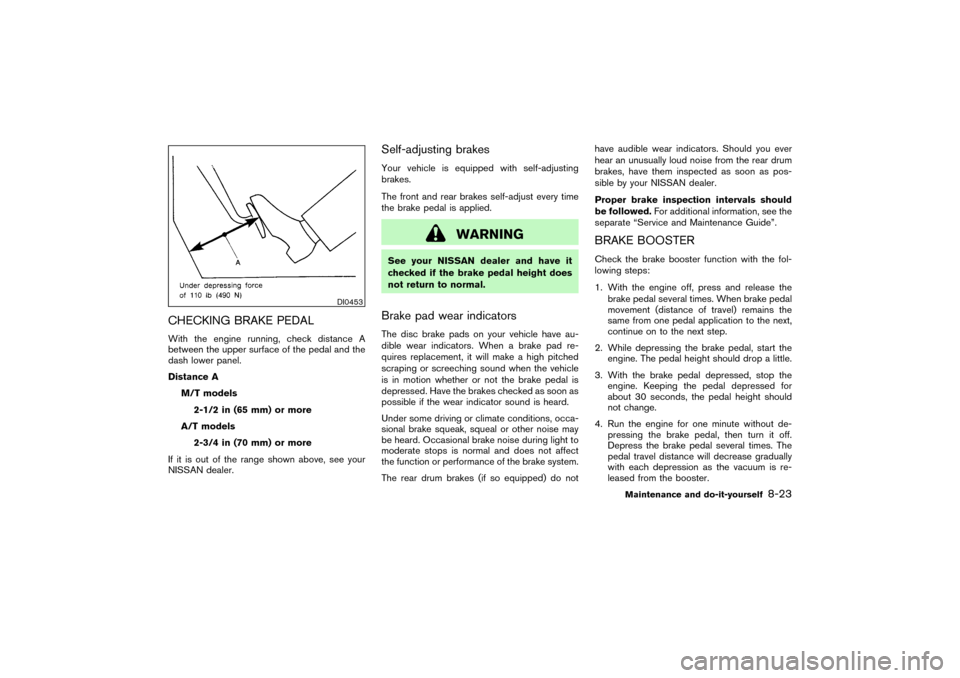
CHECKING BRAKE PEDALWith the engine running, check distance A
between the upper surface of the pedal and the
dash lower panel.
Distance A
M/T models
2-1/2 in (65 mm) or more
A/T models
2-3/4 in (70 mm) or more
If it is out of the range shown above, see your
NISSAN dealer.
Self-adjusting brakesYour vehicle is equipped with self-adjusting
brakes.
The front and rear brakes self-adjust every time
the brake pedal is applied.
WARNING
See your NISSAN dealer and have it
checked if the brake pedal height does
not return to normal.Brake pad wear indicatorsThe disc brake pads on your vehicle have au-
dible wear indicators. When a brake pad re-
quires replacement, it will make a high pitched
scraping or screeching sound when the vehicle
is in motion whether or not the brake pedal is
depressed. Have the brakes checked as soon as
possible if the wear indicator sound is heard.
Under some driving or climate conditions, occa-
sional brake squeak, squeal or other noise may
be heard. Occasional brake noise during light to
moderate stops is normal and does not affect
the function or performance of the brake system.
The rear drum brakes (if so equipped) do nothave audible wear indicators. Should you ever
hear an unusually loud noise from the rear drum
brakes, have them inspected as soon as pos-
sible by your NISSAN dealer.
Proper brake inspection intervals should
be followed.For additional information, see the
separate “Service and Maintenance Guide”.
BRAKE BOOSTERCheck the brake booster function with the fol-
lowing steps:
1. With the engine off, press and release the
brake pedal several times. When brake pedal
movement (distance of travel) remains the
same from one pedal application to the next,
continue on to the next step.
2. While depressing the brake pedal, start the
engine. The pedal height should drop a little.
3. With the brake pedal depressed, stop the
engine. Keeping the pedal depressed for
about 30 seconds, the pedal height should
not change.
4. Run the engine for one minute without de-
pressing the brake pedal, then turn it off.
Depress the brake pedal several times. The
pedal travel distance will decrease gradually
with each depression as the vacuum is re-
leased from the booster.
DI0453
Maintenance and do-it-yourself
8-23
�
04.3.9/R50-D/V5
�
Page 250 of 306
If the brakes do not operate properly, have the
brake checked by your NISSAN dealer.
ENGINE COMPARTMENT
CAUTION
Never use a fuse of higher or lower
amperage rating than that specified on
the fuse box cover. This could damage
the electrical system or cause a fire.
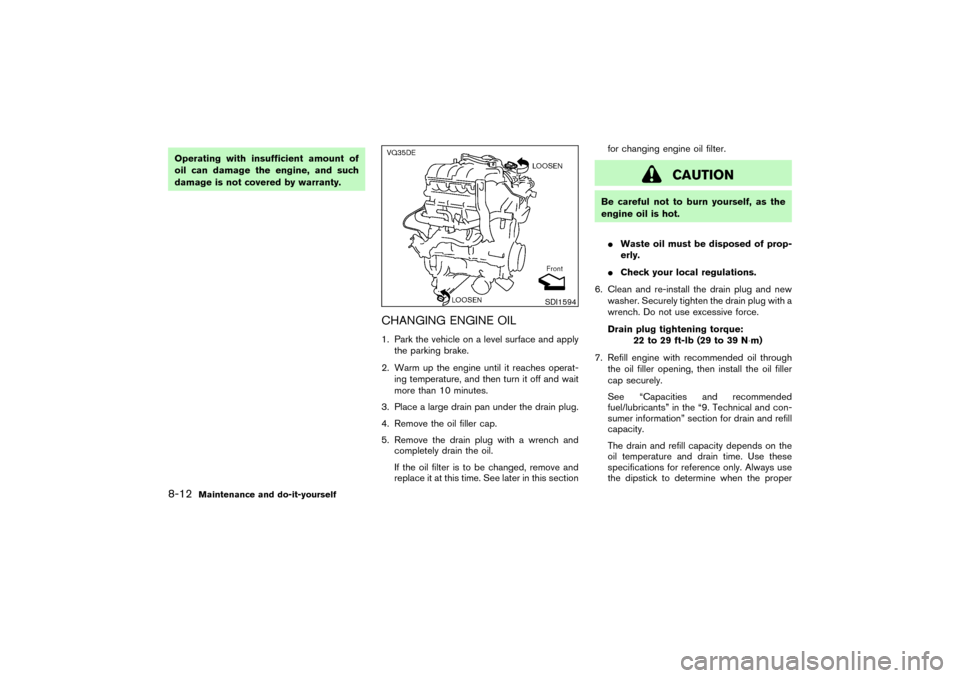
If any electrical equipment does not operate,
check for an open fuse.
1. Be sure the ignition key and the headlight
switch are OFF.2. Open the engine hood.
3. Remove the fuse box cover.
4. Remove the fuse with the fuse puller.
5. If the fuse is open, replace it with a new fuse.
6. If a new fuse opens again, have the electrical
system checked and repaired by your
NISSAN dealer.
Fusible linksIf any electrical equipment does not operate and
fuses are in good condition, check the fusible
links. If any of these fusible links are melted,
replace only with genuine NISSAN parts.
SDI0395
FUSES
8-24
Maintenance and do-it-yourself
�
04.3.9/R50-D/V5
�