LOADING TIPS�The GVW must not exceed GVWR or
GAWR as specified on the FMVSS Certifi-
cation Label located on the driver’s door
center pillar.
�Do not load the front and rear axle to the
GAWR. Doing so will exceed the GVWR.
�Loads should be spread out, and cargo
should be properly secured. Large or heavy
objects should be placed toward the front of
the cargo area to help prevent sliding or
shifting.
WARNING
�Properly secure all cargo to help pre-
vent it from sliding or shifting. Do not
place cargo higher than the seat-
backs. In a sudden stop or collision,
unsecured cargo could cause per-
sonal injury.
�Do not load your vehicle any heavier
than the GVWR or the maximum front
and rear GAWRs. If you do, parts on
your vehicle can break, or it can
change the way your vehicle handles.This could result in loss of control
and cause personal injury.
�Overloading not only could shorten
the life of your vehicle and the tires,
but also could lead to hazardous ve-
hicle handling and long braking dis-
tance. This may cause a premature
tire malfunction, which could result in
a serious accident and personal in-
jury. Malfunctions caused by over-
loading are not covered by your
NISSAN warranty.
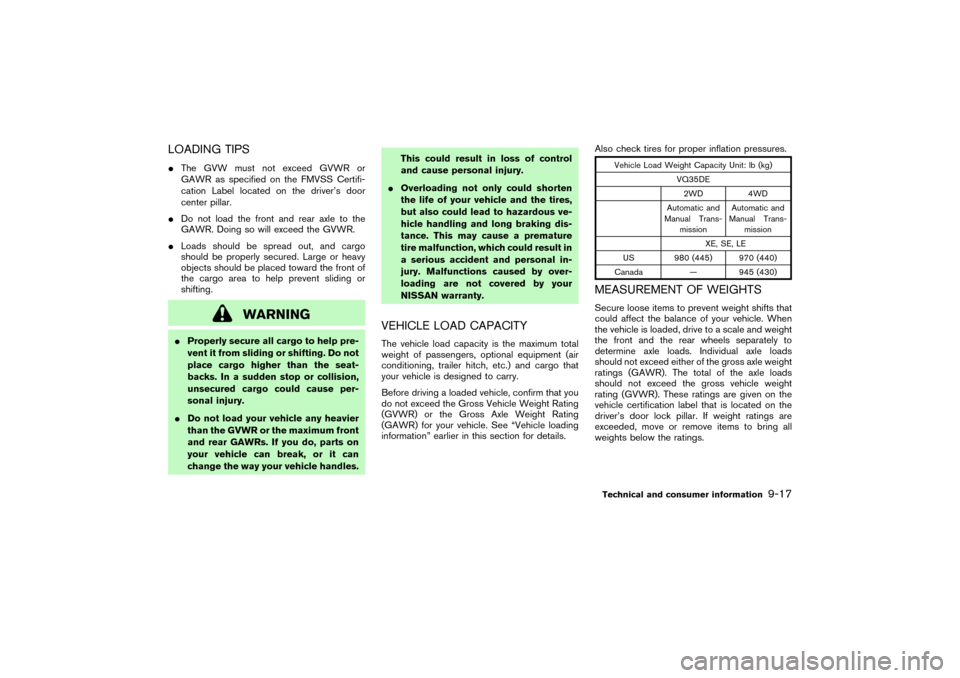
VEHICLE LOAD CAPACITYThe vehicle load capacity is the maximum total
weight of passengers, optional equipment (air
conditioning, trailer hitch, etc.) and cargo that
your vehicle is designed to carry.
Before driving a loaded vehicle, confirm that you
do not exceed the Gross Vehicle Weight Rating
(GVWR) or the Gross Axle Weight Rating
(GAWR) for your vehicle. See “Vehicle loading
information” earlier in this section for details.Also check tires for proper inflation pressures.
Vehicle Load Weight Capacity Unit: lb(kg)
VQ35DE
2WD 4WD
Automatic and
Manual Trans-
missionAutomatic and
Manual Trans-
mission
XE, SE, LE
US 980 (445) 970 (440)
Canada — 945 (430)
MEASUREMENT OF WEIGHTSSecure loose items to prevent weight shifts that
could affect the balance of your vehicle. When
the vehicle is loaded, drive to a scale and weight
the front and the rear wheels separately to
determine axle loads. Individual axle loads
should not exceed either of the gross axle weight
ratings (GAWR). The total of the axle loads
should not exceed the gross vehicle weight
rating (GVWR). These ratings are given on the
vehicle certification label that is located on the
driver’s door lock pillar. If weight ratings are
exceeded, move or remove items to bring all
weights below the ratings.Technical and consumer information
9-17
�
04.3.9/R50-D/V5
�