Page 40 of 283
“Child restraints” later in this section.
The automatic locking mode should be
used only for child restraint installation.
During normal seat belt use by a passen-
ger, the locking mode should not be acti-
vated. If it is activated it may cause uncom-
fortable seat belt tension.
WARNING
�When fastening the seat belts, be
certain that seatbacks are completely
secured in the latched position. If
they are not completely secured, pas-
sengers may be injured in an acci-
dent or sudden stop.
�When attaching the rear center seat
belt connector, be certain that the
seatbacks are completely secured in
the latched position and the rear cen-
ter seat belt connector is completely
secured.
�If the rear center seat belt connector
and the seatbacks are not secured in
the correct position, serious personal
injury may result in an accident or
sudden stop.
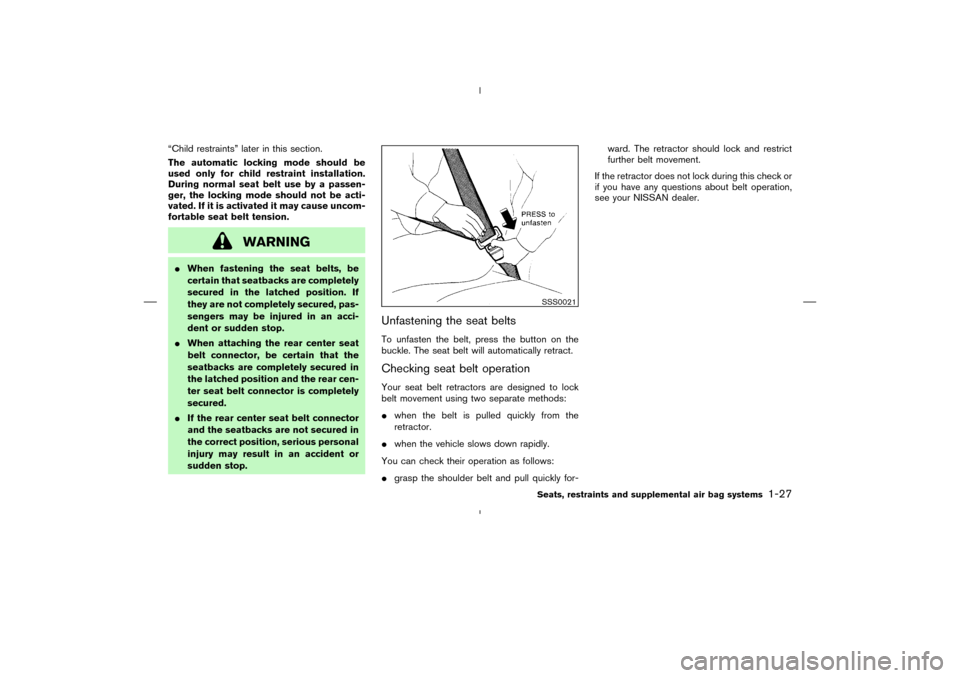
Unfastening the seat beltsTo unfasten the belt, press the button on the
buckle. The seat belt will automatically retract.Checking seat belt operationYour seat belt retractors are designed to lock
belt movement using two separate methods:
�when the belt is pulled quickly from the
retractor.
�when the vehicle slows down rapidly.
You can check their operation as follows:
�grasp the shoulder belt and pull quickly for-ward. The retractor should lock and restrict
further belt movement.
If the retractor does not lock during this check or
if you have any questions about belt operation,
see your NISSAN dealer.
SSS0021Seats, restraints and supplemental air bag systems
1-27
�
04.4.5/Z50-D/V5.0
�
Page 41 of 283
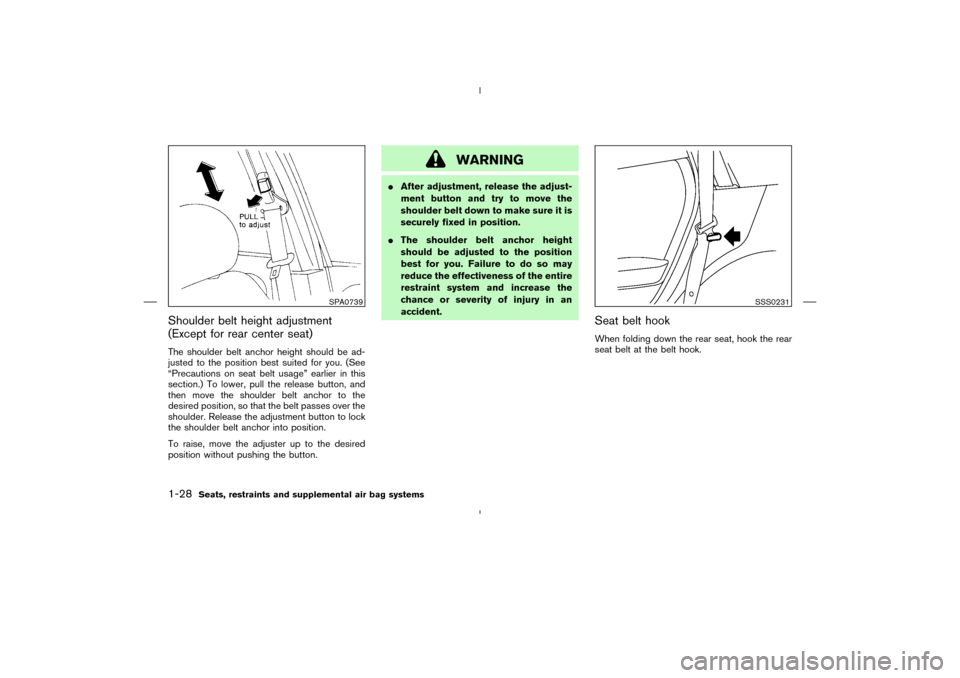
Shoulder belt height adjustment
(Except for rear center seat)The shoulder belt anchor height should be ad-
justed to the position best suited for you. (See
“Precautions on seat belt usage” earlier in this
section.) To lower, pull the release button, and
then move the shoulder belt anchor to the
desired position, so that the belt passes over the
shoulder. Release the adjustment button to lock
the shoulder belt anchor into position.
To raise, move the adjuster up to the desired
position without pushing the button.
WARNING
�After adjustment, release the adjust-
ment button and try to move the
shoulder belt down to make sure it is
securely fixed in position.
�The shoulder belt anchor height
should be adjusted to the position
best for you. Failure to do so may
reduce the effectiveness of the entire
restraint system and increase the
chance or severity of injury in an
accident.
Seat belt hookWhen folding down the rear seat, hook the rear
seat belt at the belt hook.
SPA0739
SSS0231
1-28
Seats, restraints and supplemental air bag systems
�
04.4.5/Z50-D/V5.0
�
Page 47 of 283
or neck. If it does, put the shoulder
belt behind the child restraint. If you
must install a front facing child re-
straint in the front seat, see instruc-
tions later in this section.
�When your child restraint is not in
use, store it in the trunk or keep it
secured with a seat belt to prevent it
from being thrown around in case of
a sudden stop or accident.
CAUTION
Remember that a child restraint left in a
closed vehicle can become very hot.
Check the seating surface and buckles
before placing your child in the child
restraint.
INSTALLATION ON REAR SEAT
CENTER OR OUTBOARD
POSITIONS
WARNING
�The three-point rear seat belts on
your vehicle are equipped with a
locking mode retractor which must
be used when installing a child re-
straint.
�Failure to do so will result in the child
restraint not being properly secured.
It could tip over or otherwise be un-
secured and cause injury to the child
in a sudden stop or collision.
�When installing a child restraint sys-
tem in the rear center position, both
the center seat belt connector tongue
and buckle tongue must be secured.
See “Attaching rear center seat belt”
earlier in this section.
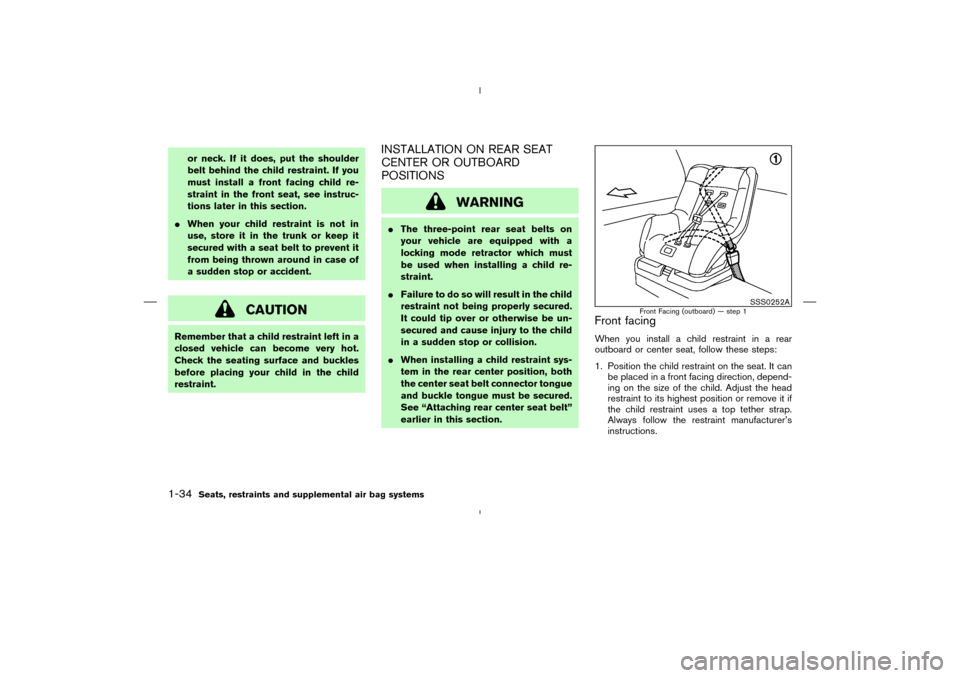
Front facingWhen you install a child restraint in a rear
outboard or center seat, follow these steps:
1. Position the child restraint on the seat. It can
be placed in a front facing direction, depend-
ing on the size of the child. Adjust the head
restraint to its highest position or remove it if
the child restraint uses a top tether strap.
Always follow the restraint manufacturer’s
instructions.
SSS0252A
Front Facing (outboard) — step 1
1-34
Seats, restraints and supplemental air bag systems
�
04.4.5/Z50-D/V5.0
�
Page 48 of 283
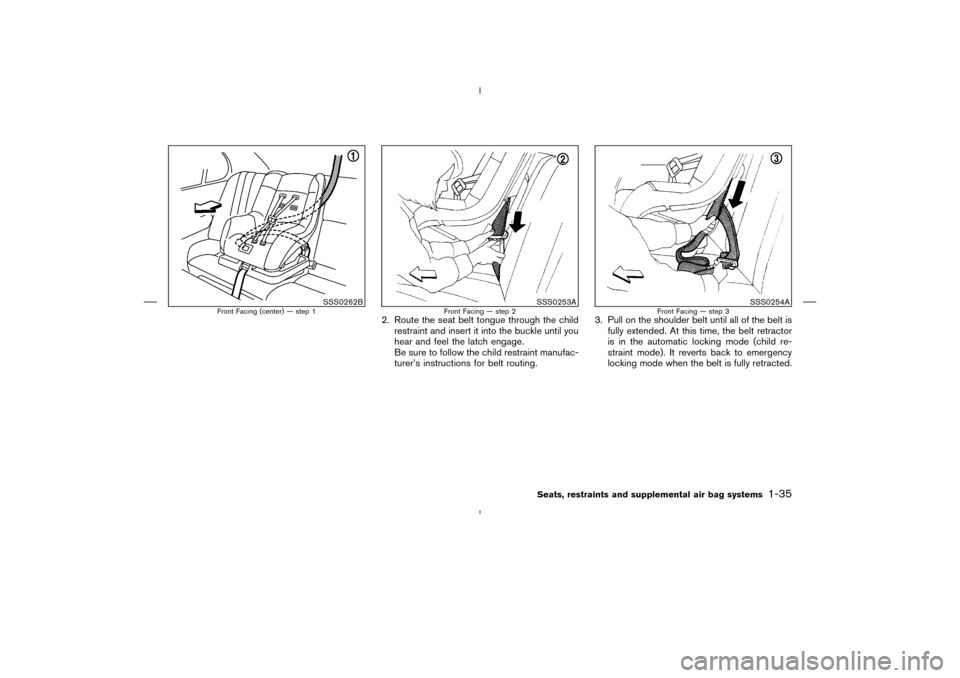
2. Route the seat belt tongue through the child
restraint and insert it into the buckle until you
hear and feel the latch engage.
Be sure to follow the child restraint manufac-
turer’s instructions for belt routing.3. Pull on the shoulder belt until all of the belt is
fully extended. At this time, the belt retractor
is in the automatic locking mode (child re-
straint mode). It reverts back to emergency
locking mode when the belt is fully retracted.
SSS0262B
Front Facing (center) — step 1
SSS0253A
Front Facing — step 2
SSS0254A
Front Facing — step 3
Seats, restraints and supplemental air bag systems
1-35
�
04.4.5/Z50-D/V5.0
�
Page 49 of 283
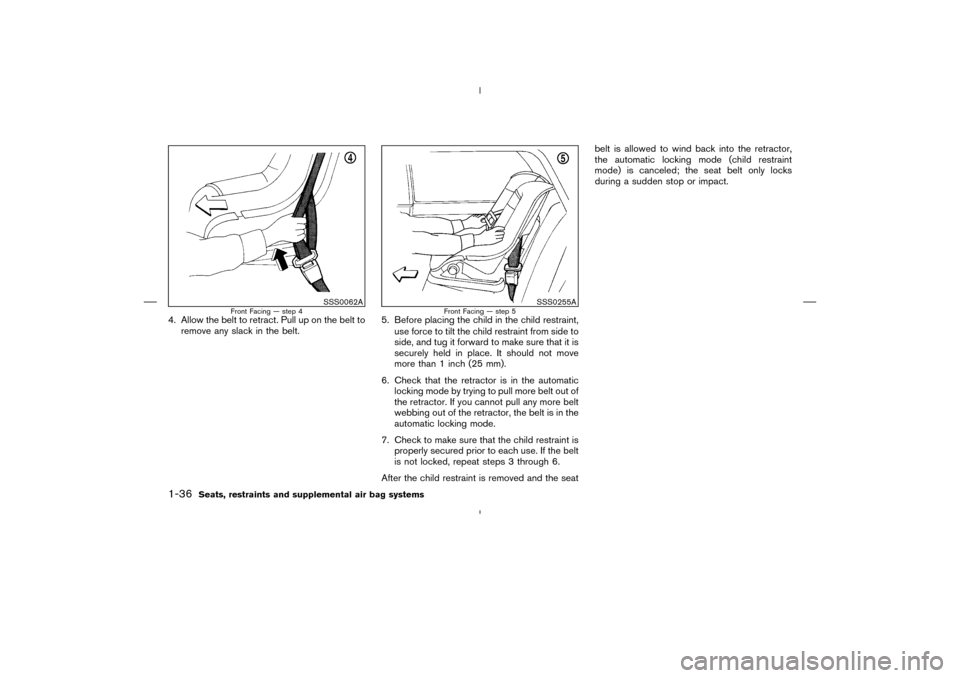
4. Allow the belt to retract. Pull up on the belt to
remove any slack in the belt.5. Before placing the child in the child restraint,
use force to tilt the child restraint from side to
side, and tug it forward to make sure that it is
securely held in place. It should not move
more than 1 inch (25 mm).
6. Check that the retractor is in the automatic
locking mode by trying to pull more belt out of
the retractor. If you cannot pull any more belt
webbing out of the retractor, the belt is in the
automatic locking mode.
7. Check to make sure that the child restraint is
properly secured prior to each use. If the belt
is not locked, repeat steps 3 through 6.
After the child restraint is removed and the seatbelt is allowed to wind back into the retractor,
the automatic locking mode (child restraint
mode) is canceled; the seat belt only locks
during a sudden stop or impact.
SSS0062A
Front Facing — step 4
SSS0255A
Front Facing — step 5
1-36
Seats, restraints and supplemental air bag systems
�
04.4.5/Z50-D/V5.0
�
Page 51 of 283
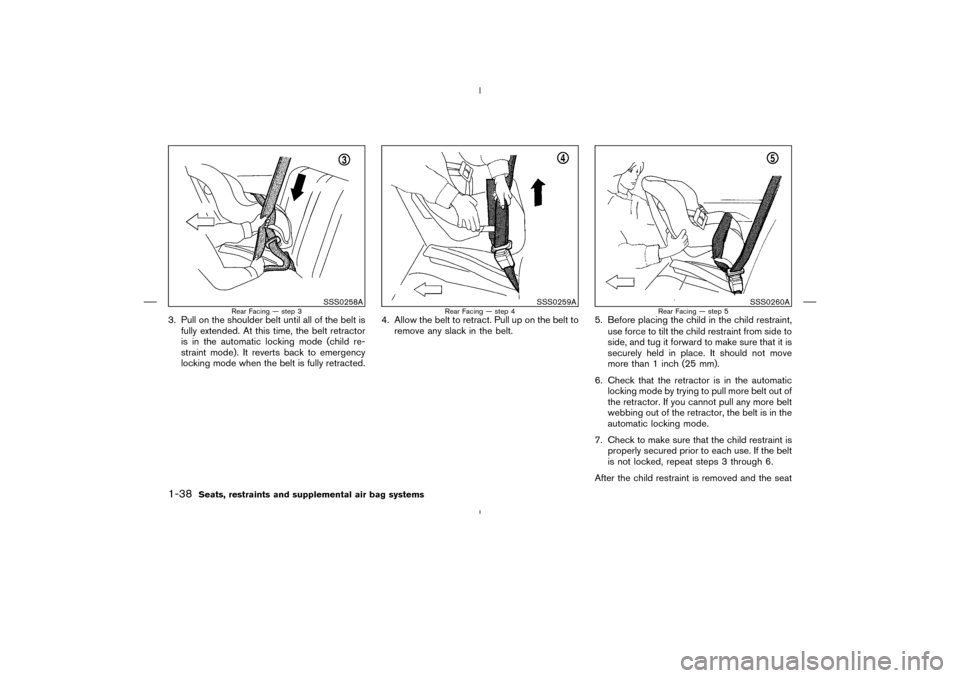
3. Pull on the shoulder belt until all of the belt is
fully extended. At this time, the belt retractor
is in the automatic locking mode (child re-
straint mode). It reverts back to emergency
locking mode when the belt is fully retracted.4. Allow the belt to retract. Pull up on the belt to
remove any slack in the belt.5. Before placing the child in the child restraint,
use force to tilt the child restraint from side to
side, and tug it forward to make sure that it is
securely held in place. It should not move
more than 1 inch (25 mm).
6. Check that the retractor is in the automatic
locking mode by trying to pull more belt out of
the retractor. If you cannot pull any more belt
webbing out of the retractor, the belt is in the
automatic locking mode.
7. Check to make sure that the child restraint is
properly secured prior to each use. If the belt
is not locked, repeat steps 3 through 6.
After the child restraint is removed and the seat
SSS0258A
Rear Facing — step 3
SSS0259A
Rear Facing — step 4
SSS0260A
Rear Facing — step 5
1-38
Seats, restraints and supplemental air bag systems
�
04.4.5/Z50-D/V5.0
�
Page 52 of 283
belt is allowed to wind back into the retractor,
the automatic locking mode (child restraint
mode) is canceled; the seat belt only locks
during a sudden stop or impact.
LATCH (LOWER ANCHORS AND
TETHERS FOR CHILDREN)
SYSTEM
WARNING
�Attach LATCH system compatible
child restraints only at the locations
shown. If a child restraint is not se-
cured properly, your child could be
seriously injured or killed in an
accident.�Do not secure a child restraint in the
center rear seating position using the
child restraint lower anchors. The
child restraint will not be secured
properly.
�The LATCH system anchors are de-
signed to withstand only those loads
imposed by correctly fitted child re-
straints. Under no circumstance are
they to be used for adult seat belts or
harnesses.
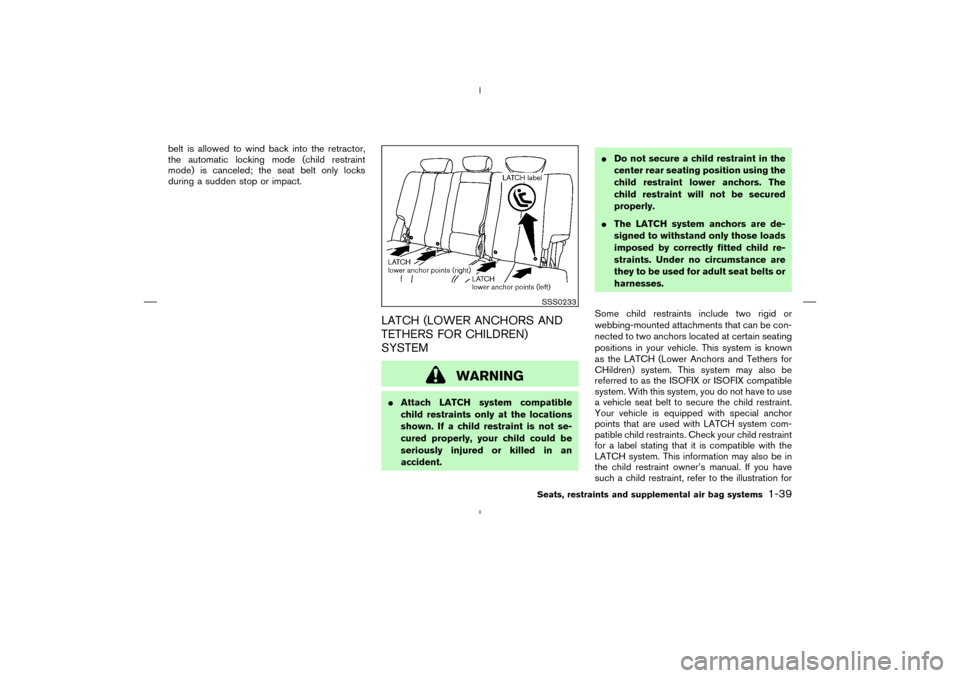
Some child restraints include two rigid or
webbing-mounted attachments that can be con-
nected to two anchors located at certain seating
positions in your vehicle. This system is known
as the LATCH (Lower Anchors and Tethers for
CHildren) system. This system may also be
referred to as the ISOFIX or ISOFIX compatible
system. With this system, you do not have to use
a vehicle seat belt to secure the child restraint.
Your vehicle is equipped with special anchor
points that are used with LATCH system com-
patible child restraints. Check your child restraint
for a label stating that it is compatible with the
LATCH system. This information may also be in
the child restraint owner’s manual. If you have
such a child restraint, refer to the illustration for
SSS0233Seats, restraints and supplemental air bag systems
1-39
�
04.4.5/Z50-D/V5.0
�
Page 55 of 283
INSTALLATION ON FRONT
PASSENGER SEAT
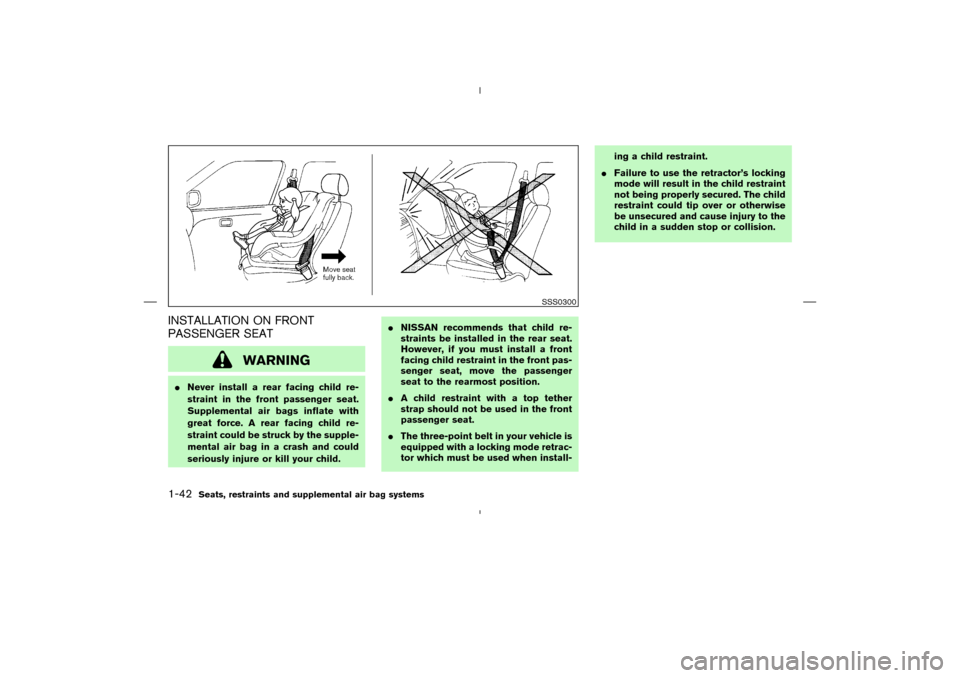
WARNING
�Never install a rear facing child re-
straint in the front passenger seat.
Supplemental air bags inflate with
great force. A rear facing child re-
straint could be struck by the supple-
mental air bag in a crash and could
seriously injure or kill your child.�NISSAN recommends that child re-
straints be installed in the rear seat.
However, if you must install a front
facing child restraint in the front pas-
senger seat, move the passenger
seat to the rearmost position.
�A child restraint with a top tether
strap should not be used in the front
passenger seat.
�The three-point belt in your vehicle is
equipped with a locking mode retrac-
tor which must be used when install-ing a child restraint.
�Failure to use the retractor’s locking
mode will result in the child restraint
not being properly secured. The child
restraint could tip over or otherwise
be unsecured and cause injury to the
child in a sudden stop or collision.
SSS0300
1-42
Seats, restraints and supplemental air bag systems
�
04.4.5/Z50-D/V5.0
�