Page 7 of 283
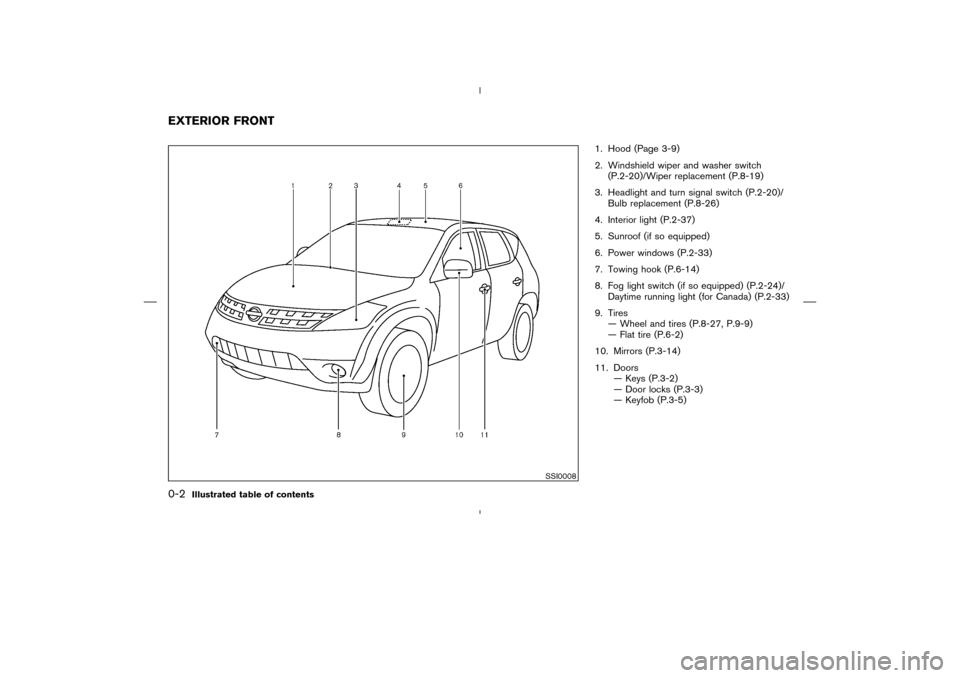
1. Hood (Page 3-9)
2. Windshield wiper and washer switch
(P.2-20)/Wiper replacement (P.8-19)
3. Headlight and turn signal switch (P.2-20)/
Bulbreplacement (P.8-26)
4. Interior light (P.2-37)
5. Sunroof (if so equipped)
6. Power windows (P.2-33)
7. Towing hook (P.6-14)
8. Fog light switch (if so equipped) (P.2-24)/
Daytime running light (for Canada) (P.2-33)
9. Tires
— Wheel and tires (P.8-27, P.9-9)
— Flat tire (P.6-2)
10. Mirrors (P.3-14)
11. Doors
— Keys (P.3-2)
— Door locks (P.3-3)
— Keyfob(P.3-5)
SSI0008
EXTERIOR FRONT0-2
Illustrated table of contents
�
04.4.5/Z50-D/V5.0
�
Page 9 of 283
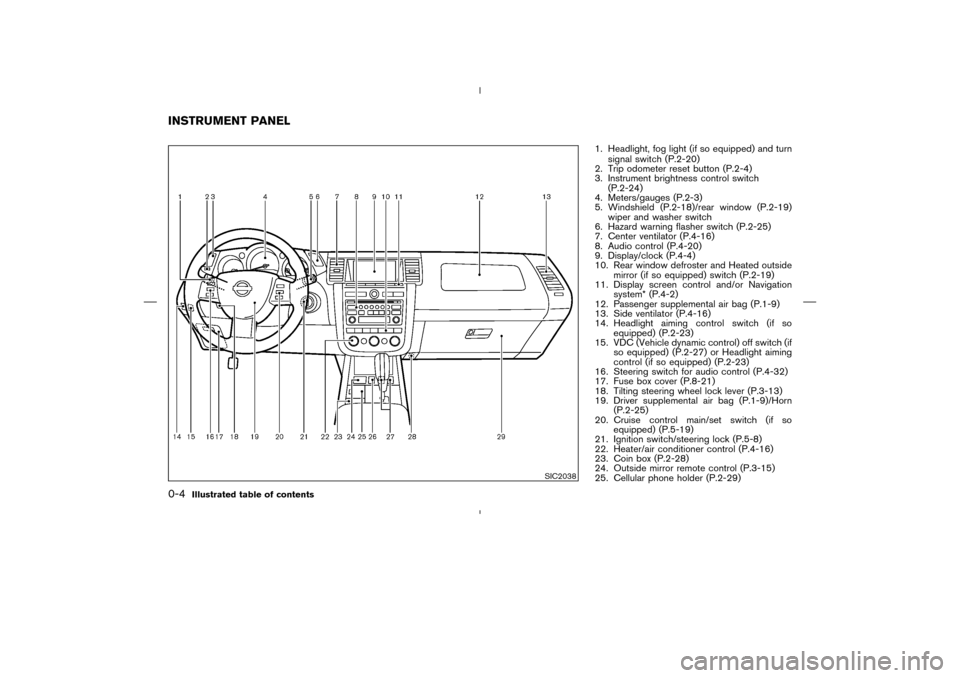
1. Headlight, fog light (if so equipped) and turn
signal switch (P.2-20)
2. Trip odometer reset button (P.2-4)
3. Instrument brightness control switch
(P.2-24)
4. Meters/gauges (P.2-3)
5. Windshield (P.2-18)/rear window (P.2-19)
wiper and washer switch
6. Hazard warning flasher switch (P.2-25)
7. Center ventilator (P.4-16)
8. Audio control (P.4-20)
9. Display/clock (P.4-4)
10. Rear window defroster and Heated outside
mirror (if so equipped) switch (P.2-19)
11. Display screen control and/or Navigation
system* (P.4-2)
12. Passenger supplemental air bag (P.1-9)
13. Side ventilator (P.4-16)
14. Headlight aiming control switch (if so
equipped) (P.2-23)
15. VDC (Vehicle dynamic control) off switch (if
so equipped) (P.2-27) or Headlight aiming
control (if so equipped) (P.2-23)
16. Steering switch for audio control (P.4-32)
17. Fuse box cover (P.8-21)
18. Tilting steering wheel lock lever (P.3-13)
19. Driver supplemental air bag (P.1-9)/Horn
(P.2-25)
20. Cruise control main/set switch (if so
equipped) (P.5-19)
21. Ignition switch/steering lock (P.5-8)
22. Heater/air conditioner control (P.4-16)
23. Coin box (P.2-28)
24. Outside mirror remote control (P.3-15)
25. Cellular phone holder (P.2-29)
SIC2038
INSTRUMENT PANEL0-4
Illustrated table of contents
�
04.4.5/Z50-D/V5.0
�
Page 10 of 283
26. AWD lock switch (AWD models) (P.5-23)
27. Heated seat switch (if so equipped)
(P.2-26)
28. Power outlet cover (P.2-27)
29. Glove box (P.2-30)
See the page indicated in parentheses for
operating details.
*: Refer to the separate Navigation System
Owner’s Manual.
Illustrated table of contents
0-5
�
04.4.5/Z50-D/V5.0
�
Page 15 of 283
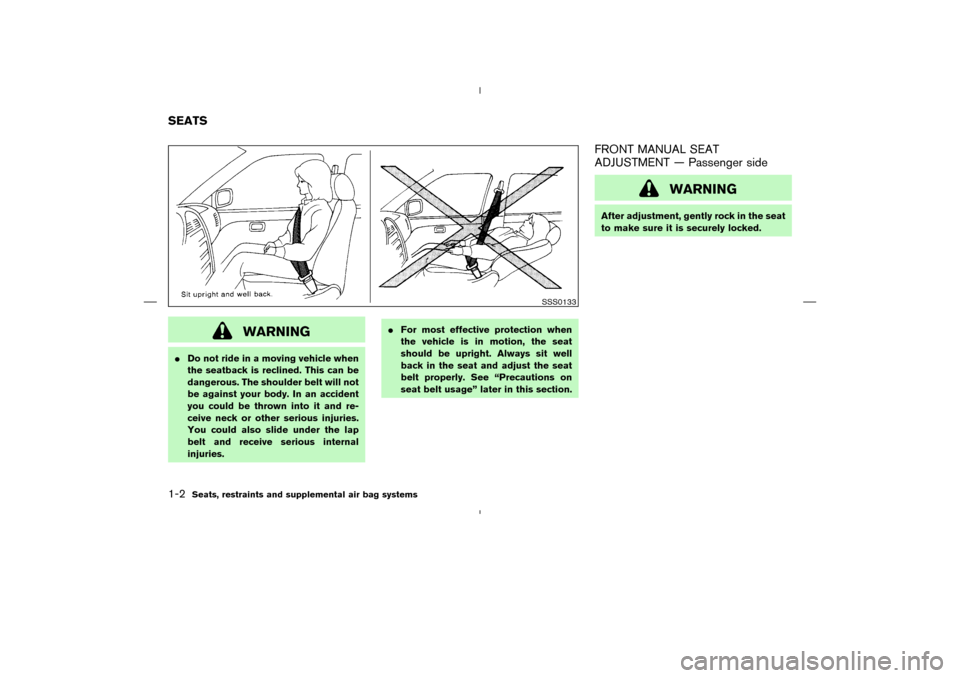
WARNING
�Do not ride in a moving vehicle when
the seatback is reclined. This can be
dangerous. The shoulder belt will not
be against your body. In an accident
you could be thrown into it and re-
ceive neck or other serious injuries.
You could also slide under the lap
belt and receive serious internal
injuries.�For most effective protection when
the vehicle is in motion, the seat
should be upright. Always sit well
back in the seat and adjust the seat
belt properly. See “Precautions on
seat belt usage” later in this section.
FRONT MANUAL SEAT
ADJUSTMENT — Passenger side
WARNING
After adjustment, gently rock in the seat
to make sure it is securely locked.
SSS0133
SEATS1-2
Seats, restraints and supplemental air bag systems
�
04.4.5/Z50-D/V5.0
�
Page 16 of 283
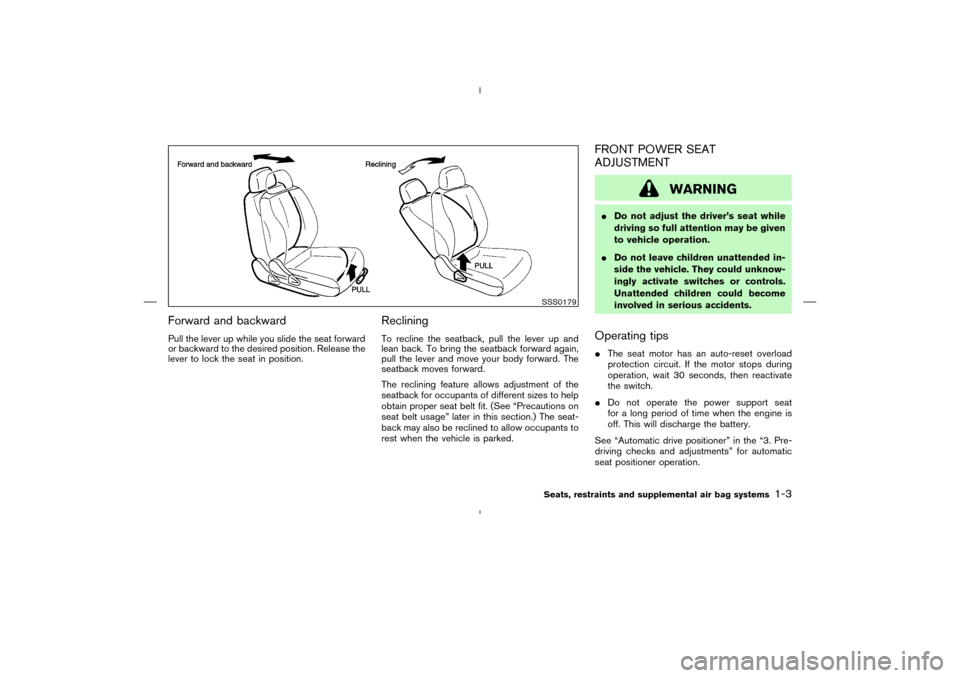
Forward and backwardPull the lever up while you slide the seat forward
or backward to the desired position. Release the
lever to lock the seat in position.
RecliningTo recline the seatback, pull the lever up and
lean back. To bring the seatback forward again,
pull the lever and move your body forward. The
seatback moves forward.
The reclining feature allows adjustment of the
seatback for occupants of different sizes to help
obtain proper seat belt fit. (See “Precautions on
seat belt usage” later in this section.) The seat-
back may also be reclined to allow occupants to
rest when the vehicle is parked.
FRONT POWER SEAT
ADJUSTMENT
WARNING
�Do not adjust the driver’s seat while
driving so full attention may be given
to vehicle operation.
�Do not leave children unattended in-
side the vehicle. They could unknow-
ingly activate switches or controls.
Unattended children could become
involved in serious accidents.Operating tips�The seat motor has an auto-reset overload
protection circuit. If the motor stops during
operation, wait 30 seconds, then reactivate
the switch.
�Do not operate the power support seat
for a long period of time when the engine is
off. This will discharge the battery.
See “Automatic drive positioner” in the “3. Pre-
driving checks and adjustments” for automatic
seat positioner operation.
SSS0179Seats, restraints and supplemental air bag systems
1-3
�
04.4.5/Z50-D/V5.0
�
Page 20 of 283
WARNING
�Do not ride in a moving vehicle when
the seatback is reclined. This can be
dangerous. The shoulder belt will not
be against your body. In an accident
you could be thrown into it and re-
ceive neck or other serious injuries.
You could also slide under the lap
belt and receive serious internal inju-
ries.
�For most effective protection when
the vehicle is in motion, the seat
should be upright. Always sit well
back in the seat and adjust the seat
belt properly. See “Seat belts” later
in this section for precautions on
seat belt usage.
�After adjustment, check to be sure
the seat is securely locked.
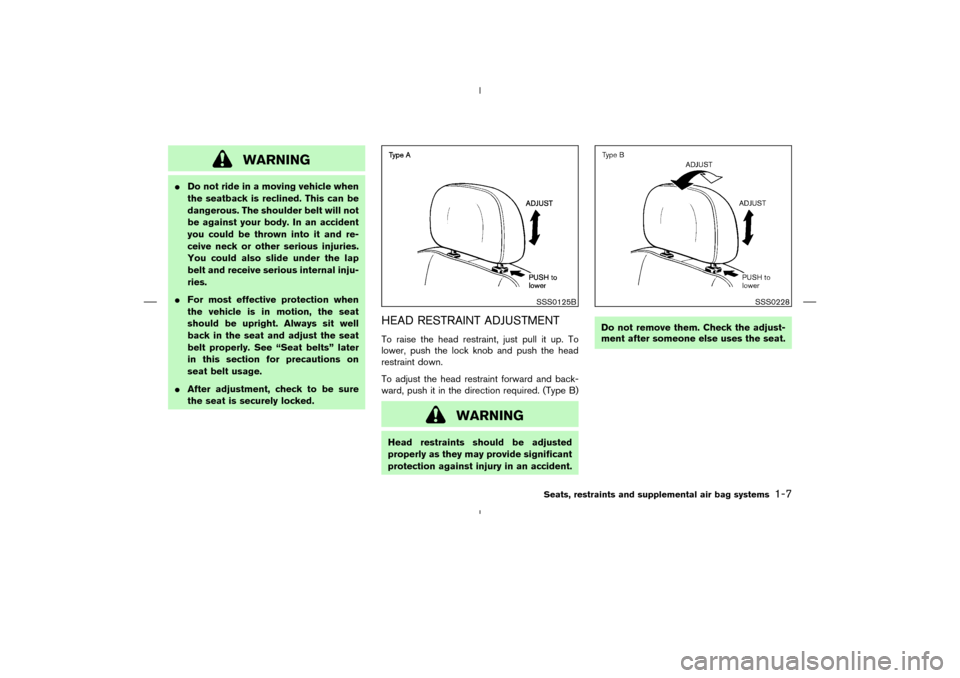
HEAD RESTRAINT ADJUSTMENTTo raise the head restraint, just pull it up. To
lower, push the lock knoband push the head
restraint down.
To adjust the head restraint forward and back-
ward, push it in the direction required. (Type B)
WARNING
Head restraints should be adjusted
properly as they may provide significant
protection against injury in an accident.Do not remove them. Check the adjust-
ment after someone else uses the seat.
SSS0125B
SSS0228
Seats, restraints and supplemental air bag systems
1-7
�
04.4.5/Z50-D/V5.0
�
Page 34 of 283
nates. The supplemental air bag warning light
will turn off after about 7 seconds if the system is
operational.
If any of the following conditions occur, the
supplemental front air bag, supplemental side air
bag and curtain side-impact air bag systems,
and pre-tensioner seat belt need servicing:
�The supplemental air bag warning light re-
mains on after approximately 7 seconds.
�The supplemental air bag warning light
flashes intermittently.
�The supplemental air bag warning light does
not come on at all.
Under these conditions, the supplemental front
air bags, supplemental side air bags, curtain
side-impact air bags and/or pre-tensioner seat
belt may not operate properly. They must be
checked and repaired. Take your vehicle to the
nearest NISSAN dealer.
WARNING
If the supplemental air bag warning
light is on, it could mean that the
supplemental front air bag, supplemen-
tal side air bag, curtain side-impact airbag systems and/or pre-tensioner seat
belt will not operate in an accident. To
help avoid injury to yourself or others,
have your vehicle checked by a NISSAN
dealer as soon as possible.
Repair and replacement procedureThe supplemental front air bags, supplemental
side air bags, curtain side-impact air bags and
pre-tensioner seat belt are designed to activate
on a one-time-only basis. As a reminder, unless
it is damaged, the supplemental air bag warning
light will remain illuminated after inflation has
occurred. Repair and replacement of these sys-
tems should be done only by a NISSAN dealer.
When maintenance work is required on the
vehicle, the supplemental front air bags, side air
bags, curtain side-impact air bags, related parts
and pre-tensioner seat belt should be pointed
out to the person conducting the maintenance.
The ignition key should always be in the LOCK
position when working under the hood or inside
the vehicle.
WARNING
�Once the supplemental front air bag,side air bag or curtain side-impact air
bag has inflated, the air bag module
will not function again and must be
replaced. Additionally, if any of the
supplemental front air bags inflate,
the activated pre-tensioner seat belt
must also be replaced. The air bag
module and pre-tensioner seat belt
system should be replaced by a
NISSAN dealer. The air bag modules
and pre-tensioner seat belt system
cannot be repaired.
�The supplemental front air bag and
side air bag, curtain side-impact air
bag systems and pre-tensioner seat
belt system should be inspected by a
NISSAN dealer if there is any damage
to the front end or side portion of the
vehicle.
�If you need to dispose of these
supplemental systems or scrap the
vehicle, contact a NISSAN dealer.
Correct disposal procedures are set
forth in the appropriate NISSAN Ser-
vice Manual. Incorrect disposal pro-
cedures could cause personal injury.
Seats, restraints and supplemental air bag systems
1-21
�
04.4.5/Z50-D/V5.0
�
Page 39 of 283
you could be thrown into it and re-
ceive neck or other serious injuries.
You could also slide under the lap
belt and receive serious internal inju-
ries.
�For most effective protection when
the vehicle is in motion, the seat
should be upright. Always sit well
back in the seat and adjust the seat
belt properly.
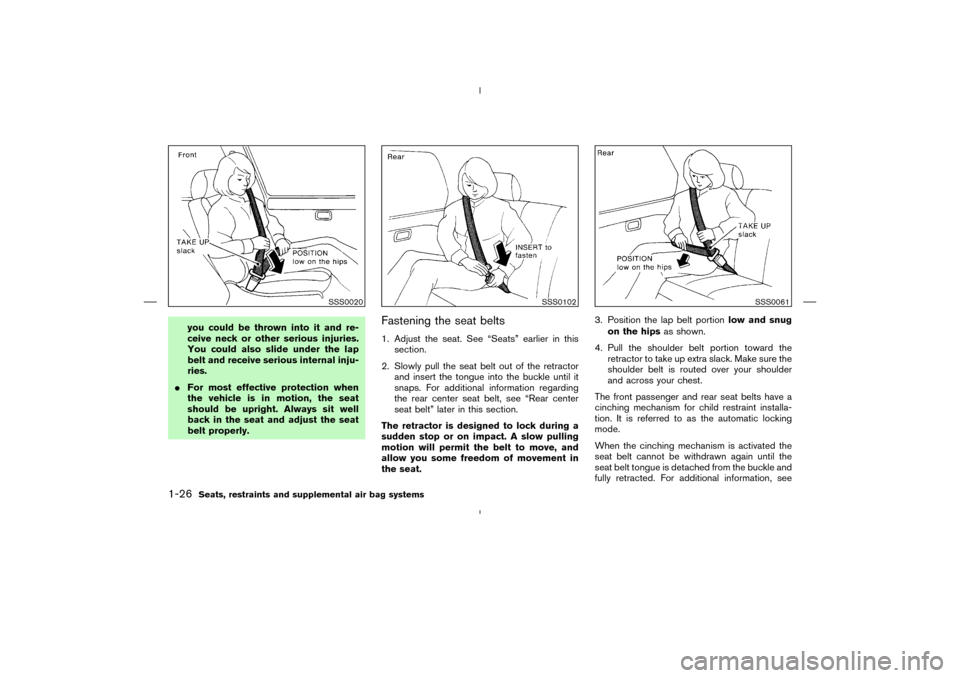
Fastening the seat belts1. Adjust the seat. See “Seats” earlier in this
section.
2. Slowly pull the seat belt out of the retractor
and insert the tongue into the buckle until it
snaps. For additional information regarding
the rear center seat belt, see “Rear center
seat belt” later in this section.
The retractor is designed to lock during a
sudden stop or on impact. A slow pulling
motion will permit the belt to move, and
allow you some freedom of movement in
the seat.3. Position the lap belt portionlow and snug
on the hipsas shown.
4. Pull the shoulder belt portion toward the
retractor to take up extra slack. Make sure the
shoulder belt is routed over your shoulder
and across your chest.
The front passenger and rear seat belts have a
cinching mechanism for child restraint installa-
tion. It is referred to as the automatic locking
mode.
When the cinching mechanism is activated the
seat belt cannot be withdrawn again until the
seat belt tongue is detached from the buckle and
fully retracted. For additional information, see
SSS0020
SSS0102
SSS0061
1-26
Seats, restraints and supplemental air bag systems
�
04.4.5/Z50-D/V5.0
�