2004 NISSAN FRONTIER warning light
[x] Cancel search: warning lightPage 34 of 296
PASSENGER SUPPLEMENTAL AIR
BAG ON/OFF SWITCH AND LIGHT
(except Crew Cab models)
WARNING
Air bags and seat belts are designed to
work as a unit. Do not switch the air bag
OFF unless you meet federal government
criteria. Switching off the air bag may in-
crease the risk of serious or fatal injuries
in a collision where the air bag would have
inflated.
In rare instances, some passengers are exposed
to serious injury risks from inflating air bags, es-
pecially if not properly restrained. The U.S. and
Canadian federal governments recognize other
limited circumstances in which an air bag could
reduce safety. The passenger air bag ON/OFF
switch is, therefore, allowed in models without full
rear seats. Because the overall benefits of air
bags are great, in most situations air bags should
not be switched off unless special government
criteria exist.
The passenger air bag ON/OFF switch is located
under the climate controls. It can be used to turn
the passenger supplemental air bag OFF.The ON/OFF switch should ONLY be used to
turn the passenger supplemental air bag OFF
when the following government criteria exists:
cInfants (less than 1 year old) in rear facing
child restraints MUST be placed in the front
passenger seat.
cChildren ages 1-12 years MUST be placed
in the front passenger seat.
cThe passenger has a medical condition
which, according to a physician, causes the
air bag to pose a special risk and makes the
potential harm from the air bag greater than
the potential harm from turning off the air
bag.
Seat belts and child restraints should always be
properly used. See “Precautions on seat belt
usage” and “Child restraints” later in this section
for details.
To turn the passenger supplemental air bag OFF,
insert the ignition key in the passenger supple-
mental air bag ON/OFF switch and turn the
switch clockwise to the OFF position. Then re-
move the key. When the ignition is turned to the
ON or START position the passenger air bag
OFF indicator light will illuminate to indicate the
air bag is OFF. To turn the passenger supplemen-
tal air bag ON, insert the ignition key in the
passenger supplemental air bag ON/OFF switchand turn the switch counter clockwise to the ON
position. Then remove the key. When the ignition
is turned to the ON or START position the pas-
senger air bag OFF indicator light will illuminate
for 7 seconds to indicate the system is working
properly and then go out to indicate that the
passenger supplemental air bag is ON.
1. Do not operate the passenger supplemental
air bag ON/OFF switch when the ignition is
ON.
2. Fully turn the passenger supplemental air
bag ON/OFF switch to either the ON or OFF
position.
3. Always remove the ignition key after using
the passenger supplemental air bag
ON/OFF switch.
4. The passenger air bag OFF indicator light
should illuminate for 7 seconds after the
ignition is turned to the ON or START posi-
tion. If not, the vehicle should be taken to a
NISSAN dealer.
Items 2 and 3 above are intended to prevent
improper use of the ignition key.
When the switch is turned to the ON position, the
passenger supplemental air bag is enabled and
could inflate in a frontal collision. When the
switch is turned to the OFF position, the passen-
ger supplemental air bag is disabled and will not
1-16Safety—Seats, seat belts and supplemental air bags
ZREVIEW COPY:Ð2004 Truck/Frontier(d22)
Owners Manual(owners)ÐUSA English(nna)
11/21/03Ðdebbie
X
Page 35 of 296
inflate in a frontal collision. The passenger
supplemental air bag OFF indicator light on the
instrument panel illuminates when the passenger
supplemental air bag ON/OFF switch is turned to
the OFF position. The driver’s side supplemental
air bag always remains enabled and is not af-
fected by the passenger supplemental air bag
ON/OFF switch.
The passenger supplemental air bag light, dis-
playing OFF in the center of the instrument panel,
monitors the position of the passenger supple-
mental air bag ON/OFF switch. When the igni-
tion key is in the ON or START position, the light
illuminates for about 7 seconds and then turns off
if the air bag ON/OFF switch is in the ON posi-
tion, or stays on if the passenger supplemental air
bag ON/OFF switch is in the OFF position.WARNING
cDo not switch the air bag OFF unless
you meet the federal government crite-
ria outlined previously. This vehicle (ex-
cept Crew Cab models) is equipped
with seat belts with a “load limiter” fea-
ture. The seat belts are designed to
work with the air bags to reduce the risk
of injury in a collision. The seat belts are
designed to release additional belt
webbing during some collisions to re-
duce the concentration of force on the
occupant’s chest area. In a collision
with the airbag turned OFF, the seat
belt may allow the occupant enough
forward movement to incur serious or
fatal injuries.cKeep the passenger supplemental air
bag ON/OFF switch turned ON unless arear-facing child restraint must be used
in the front seat, if children ages 1-12
must be placed in the front seat, or if the
passenger has a medical condition,
which, according to a physician, causes
the air bag to pose a special risk of
harm (the federal government criteria) .
If the switch is OFF, the air bag will not
inflate in a collision as designed and
the extra protection provided by the air
bag may be lost.
cBe sure to turn the passenger supple-
mental air bag ON/OFF switch OFF
when using a rear facing child restraint
in the front passenger seat. If it is not
OFF, the air bag may inflate in a colli-
sion. The force of the rapidly inflating
air bag could cause serious injury or kill
the child in the child restraint. Children
ages 1-12 and persons with special
medical conditions may also be at risk
from an inflating air bag.
Safety—Seats, seat belts and supplemental air bags1-17
ZREVIEW COPY:Ð2004 Truck/Frontier(d22)
Owners Manual(owners)ÐUSA English(nna)
11/21/03Ðdebbie
X
Page 36 of 296
cIf the supplemental air bag warning
light located in the instrument panel
next to the speedometer comes on
when the passenger supplemental air
bag OFF light is also illuminated, some-
thing may be wrong with the air bag
system. Infants, children ages 1-12 or
persons with special medical condi-
tions should not use the front passen-
ger seat until the system is checked by
your NISSAN dealer.
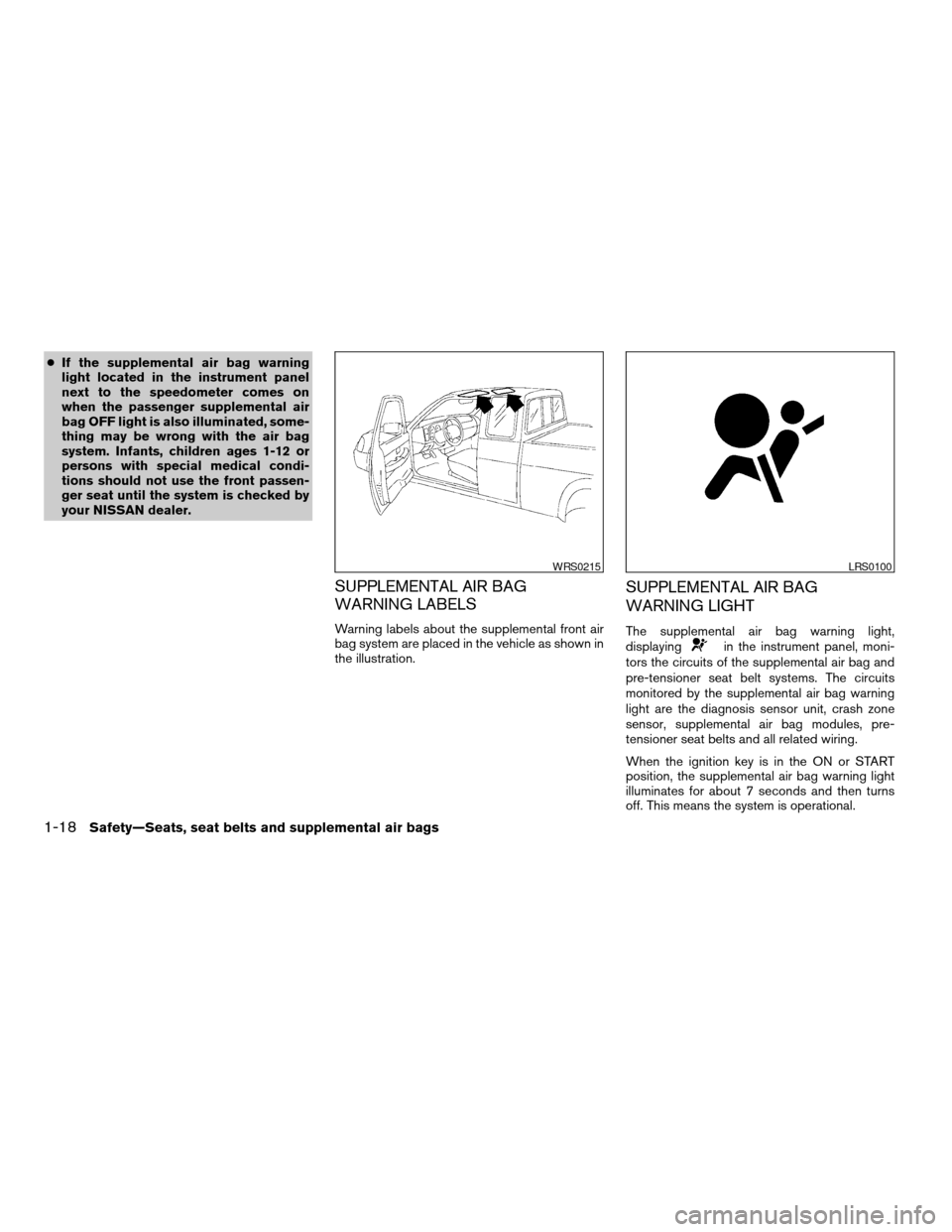
SUPPLEMENTAL AIR BAG
WARNING LABELS
Warning labels about the supplemental front air
bag system are placed in the vehicle as shown in
the illustration.
SUPPLEMENTAL AIR BAG
WARNING LIGHT
The supplemental air bag warning light,
displayingin the instrument panel, moni-
tors the circuits of the supplemental air bag and
pre-tensioner seat belt systems. The circuits
monitored by the supplemental air bag warning
light are the diagnosis sensor unit, crash zone
sensor, supplemental air bag modules, pre-
tensioner seat belts and all related wiring.
When the ignition key is in the ON or START
position, the supplemental air bag warning light
illuminates for about 7 seconds and then turns
off. This means the system is operational.
WRS0215LRS0100
1-18Safety—Seats, seat belts and supplemental air bags
ZREVIEW COPY:Ð2004 Truck/Frontier(d22)
Owners Manual(owners)ÐUSA English(nna)
11/21/03Ðdebbie
X
Page 37 of 296
If any of the following system conditions occur,
the supplemental air bag and pre-tensioner seat
belt systems need servicing:
cThe supplemental air bag warning light re-
mains on after approximately 7 seconds.
cThe supplemental air bag warning light
flashes intermittently.
cThe supplemental air bag warning light does
not come on at all.
Under these conditions, the Supplemental Re-
straint System (supplemental front air bag or
pre-tensioner seat belt systems) may not operate
properly. It must be checked and repaired. Take
your vehicle to the nearest NISSAN dealer.
WARNING
If the supplemental air bag warning light
is on, it could mean that the supplemental
front air bag or pre-tensioner seat belt
systems will not operate in an accident.
Repair and replacement procedure
The supplemental front air bag and pre-tensioner
seat belts are designed to inflate on a one-time-
only basis. As a reminder, unless it is damaged,
the supplemental air bag warning light remains
illuminated after inflation has occurred. Repairand replacement of these supplemental air bag
systems should be done only by a NISSAN
dealer.
When maintenance work is required on the ve-
hicle, the supplemental front air bags, pre-
tensioner seat belts and related parts should be
pointed out to the person performing the mainte-
nance. The ignition key should always be in the
LOCK position when working under the hood or
inside the vehicle.
WARNING
cOnce a supplemental front air bag has
inflated, the air bag module will not
function and must be replaced. Addi-
tionally, if any of the supplemental front
air bags inflate, the activated pre-
tensioner seat belts must also be re-
placed. The air bag module and pre-
tensioner seat belt system should be
replaced by a NISSAN dealer. The air
bag module and pre-tensioner seat belt
system cannot be repaired.
cThe supplemental front air bag system
and pre-tensioner seat belt system
should be inspected by a NISSAN
dealer if there is any damage to the
front end portion of the vehicle.cIf you need to dispose of the supple-
mental air bag, pre-tensioner seat belt
system or scrap the vehicle, contact a
NISSAN dealer. Correct supplemental
air bag and pre-tensioner seat belt sys-
tem disposal procedures are set forth in
the appropriate NISSAN Service
Manual. Incorrect disposal procedures
could cause personal injury.
Safety—Seats, seat belts and supplemental air bags1-19
ZREVIEW COPY:Ð2004 Truck/Frontier(d22)
Owners Manual(owners)ÐUSA English(nna)
11/21/03Ðdebbie
X
Page 40 of 296
WARNING
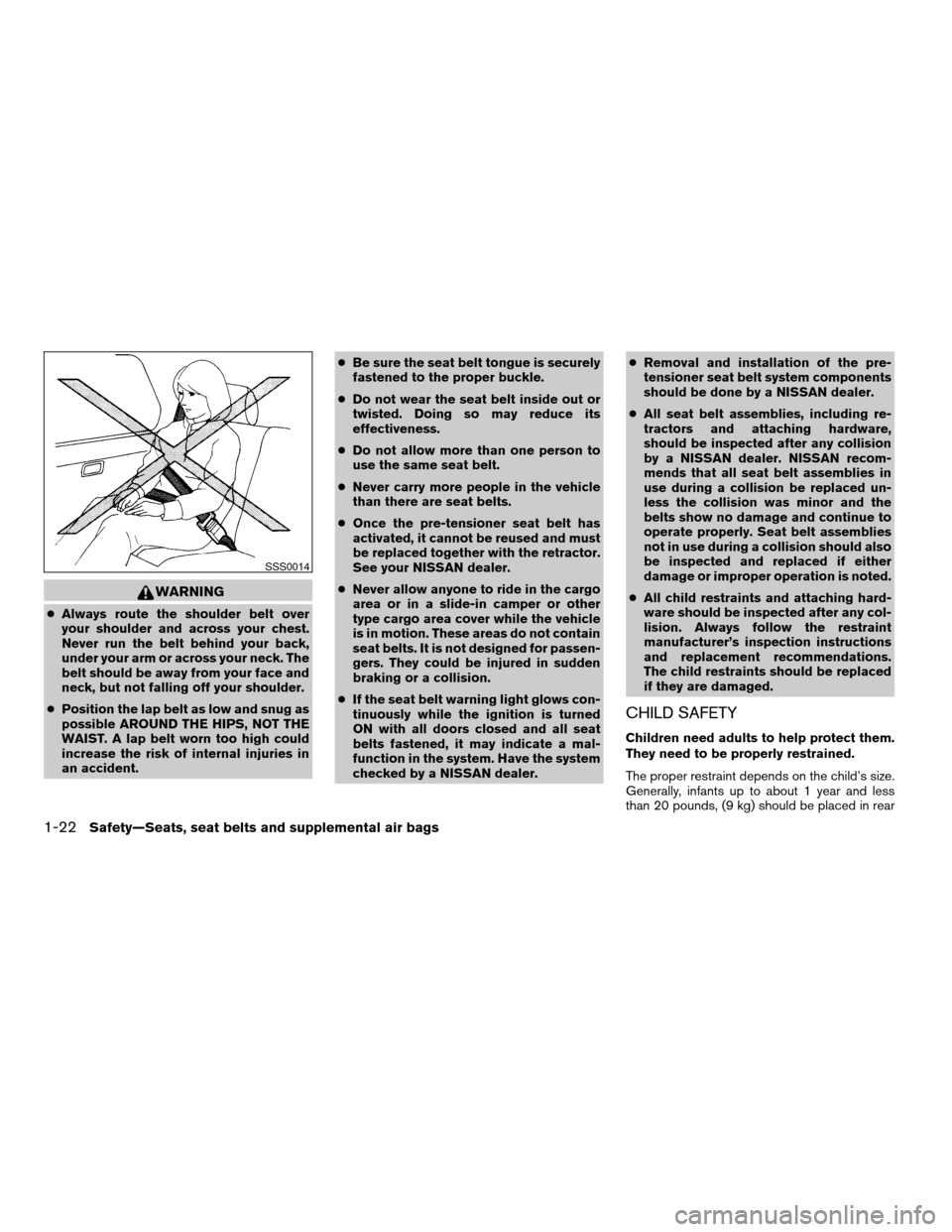
cAlways route the shoulder belt over
your shoulder and across your chest.
Never run the belt behind your back,
under your arm or across your neck. The
belt should be away from your face and
neck, but not falling off your shoulder.
cPosition the lap belt as low and snug as
possible AROUND THE HIPS, NOT THE
WAIST. A lap belt worn too high could
increase the risk of internal injuries in
an accident.cBe sure the seat belt tongue is securely
fastened to the proper buckle.
cDo not wear the seat belt inside out or
twisted. Doing so may reduce its
effectiveness.
cDo not allow more than one person to
use the same seat belt.
cNever carry more people in the vehicle
than there are seat belts.
cOnce the pre-tensioner seat belt has
activated, it cannot be reused and must
be replaced together with the retractor.
See your NISSAN dealer.
cNever allow anyone to ride in the cargo
area or in a slide-in camper or other
type cargo area cover while the vehicle
is in motion. These areas do not contain
seat belts. It is not designed for passen-
gers. They could be injured in sudden
braking or a collision.
cIf the seat belt warning light glows con-
tinuously while the ignition is turned
ON with all doors closed and all seat
belts fastened, it may indicate a mal-
function in the system. Have the system
checked by a NISSAN dealer.cRemoval and installation of the pre-
tensioner seat belt system components
should be done by a NISSAN dealer.
cAll seat belt assemblies, including re-
tractors and attaching hardware,
should be inspected after any collision
by a NISSAN dealer. NISSAN recom-
mends that all seat belt assemblies in
use during a collision be replaced un-
less the collision was minor and the
belts show no damage and continue to
operate properly. Seat belt assemblies
not in use during a collision should also
be inspected and replaced if either
damage or improper operation is noted.
cAll child restraints and attaching hard-
ware should be inspected after any col-
lision. Always follow the restraint
manufacturer’s inspection instructions
and replacement recommendations.
The child restraints should be replaced
if they are damaged.
CHILD SAFETY
Children need adults to help protect them.
They need to be properly restrained.
The proper restraint depends on the child’s size.
Generally, infants up to about 1 year and less
than 20 pounds, (9 kg) should be placed in rear
SSS0014
1-22Safety—Seats, seat belts and supplemental air bags
ZREVIEW COPY:Ð2004 Truck/Frontier(d22)
Owners Manual(owners)ÐUSA English(nna)
11/21/03Ðdebbie
X
Page 41 of 296
facing child restraints. Front facing child re-
straints are available for children who outgrow
rear facing child restraints.
WARNING
cBe sure to turn the passenger supple-
mental air bag ON/OFF switch OFF
when using a rear facing child restraint
in the front passenger seat in models so
equipped. If it is not OFF, the air bag
may inflate in a collision. The force of
the rapidly inflating air bag could cause
serious injury or kill the child in the
child restraint. See “Passenger supple-
mental air bag ON/OFF switch and
light” earlier in this section.
cIn Crew Cab models, never install a rear
facing child restraint in the front pas-
senger seat. An inflating supplemental
air bag could seriously injure or kill your
child. A rear facing child restraint must
only be used in the rear seat.
cDo not install a child restraint in the
jump seats (King Cab model) . These
seats are not suitable for child restraint
installation.cInfants and children need special pro-
tection. The vehicle’s seat belts may not
fit them properly. The shoulder belt may
come too close to the face or neck. The
lap belt may not fit over their small hip
bones. In an accident, an improperly
fitting seat belt could cause serious or
fatal injury. Always use appropriate
child restraints.
All U.S. states and Canadian provinces or terri-
tories require the use of approved child restraints
for infants and small children. See “Child Re-
straints” later in this section.
In addition, there are many types of child re-
straints available for larger children which should
be used for maximum protection.
NISSAN recommends that all pre-teens
and children be restrained in the rear seat if
available (Crew Cab models) . According to
accident statistics, children are safer when
properly restrained in the rear seat than in
the front seat. This is especially important
because your vehicle has a supplemental
restraint system (Air bag system) for the
front passenger. See “Supplemental re-
straint system” earlier in this section. Also,
see “Passenger air bag ON/OFF switch and
light” earlier in this section.
Infants and small children
NISSAN recommends that infants and small chil-
dren be placed in child restraints that comply with
Federal Motor Vehicle Safety Standards or Ca-
nadian Motor Vehicle Safety Standards. You
should choose a child restraint that fits your ve-
hicle and always follow the manufacturer’s in-
structions for installation and use.
Larger children
Children who are too large for child restraints
should be seated and restrained by the seat belts
which are provided.
If the child’s seating position has a shoulder belt
that fits close to the face or neck, the use of a
booster seat (commercially available) may help
overcome this. The booster seat should raise the
child so that the shoulder belt is properly posi-
tioned across the top, middle portion of the
shoulder and the lap belt is low on the hips. The
booster seat should fit the vehicle seat and have
a label certifying that it complies with Federal
Motor Vehicle Safety Standards or Canadian Mo-
tor Vehicle Safety Standards. Once the child has
grown so the shoulder belt is no longer on or near
the face and neck, use the shoulder belt without
the booster seat.
Safety—Seats, seat belts and supplemental air bags1-23
ZREVIEW COPY:Ð2004 Truck/Frontier(d22)
Owners Manual(owners)ÐUSA English(nna)
11/21/03Ðdebbie
X
Page 48 of 296
PRECAUTIONS ON CHILD
RESTRAINTS
WARNING
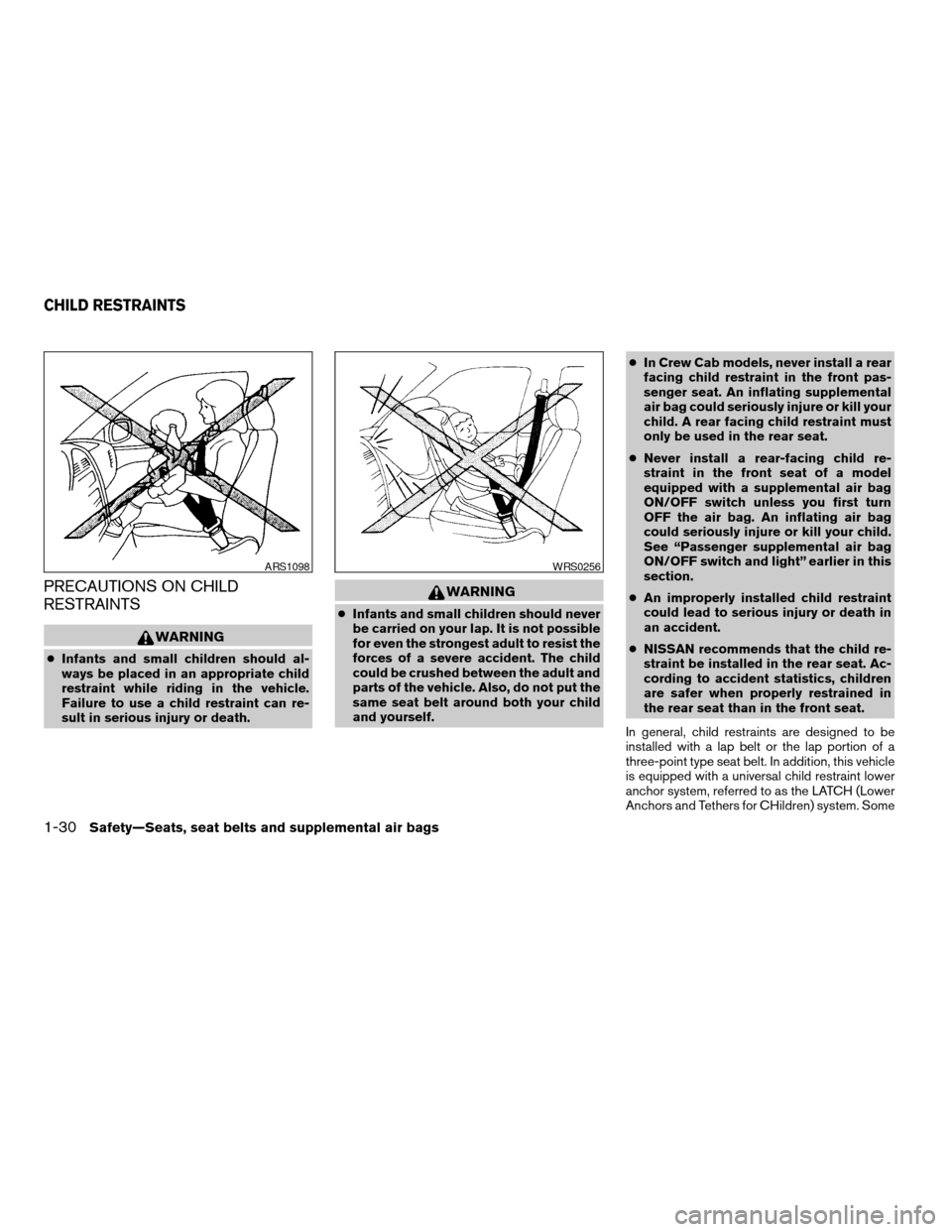
cInfants and small children should al-
ways be placed in an appropriate child
restraint while riding in the vehicle.
Failure to use a child restraint can re-
sult in serious injury or death.
WARNING
cInfants and small children should never
be carried on your lap. It is not possible
for even the strongest adult to resist the
forces of a severe accident. The child
could be crushed between the adult and
parts of the vehicle. Also, do not put the
same seat belt around both your child
and yourself.cIn Crew Cab models, never install a rear
facing child restraint in the front pas-
senger seat. An inflating supplemental
air bag could seriously injure or kill your
child. A rear facing child restraint must
only be used in the rear seat.
cNever install a rear-facing child re-
straint in the front seat of a model
equipped with a supplemental air bag
ON/OFF switch unless you first turn
OFF the air bag. An inflating air bag
could seriously injure or kill your child.
See “Passenger supplemental air bag
ON/OFF switch and light” earlier in this
section.
cAn improperly installed child restraint
could lead to serious injury or death in
an accident.
cNISSAN recommends that the child re-
straint be installed in the rear seat. Ac-
cording to accident statistics, children
are safer when properly restrained in
the rear seat than in the front seat.
In general, child restraints are designed to be
installed with a lap belt or the lap portion of a
three-point type seat belt. In addition, this vehicle
is equipped with a universal child restraint lower
anchor system, referred to as the LATCH (Lower
Anchors and Tethers for CHildren) system. Some
ARS1098WRS0256
CHILD RESTRAINTS
1-30Safety—Seats, seat belts and supplemental air bags
ZREVIEW COPY:Ð2004 Truck/Frontier(d22)
Owners Manual(owners)ÐUSA English(nna)
11/21/03Ðdebbie
X
Page 62 of 296
cNISSAN recommends that the child re-
straint be installed in the rear seat
(Crew Cab models) . However, if you
must install a forward-facing child re-
straint in the front passenger seat,
move the passenger seat to the rear-
most position.
cNever install a rear facing child restraint
in the front seating position of Crew
Cab models. Install a rear-facing child
restraint in the rear seat only. The force
of the inflating air bag could cause se-
rious injury or kill the child in the child
restraint.
cThe three-point seat belt in your vehicle
is equipped with an automatic locking
mode retractor which must be used
when installing a child restraint.
cFailure to use the retractor’s locking
mode will result in the child restraint
not being properly secured. The re-
straint could tip over or otherwise be
unsecured and cause injury to the child
in a sudden stop or collision.cIf the supplemental air bag warning
light located in the instrument panel
next to the speedometer comes on
when the passenger supplemental air
bag OFF indicator light is also illumi-
nated, something may be wrong with
the supplemental air bag system. Do
not use a child restraint in the front
passenger seat until the system is
checked by your NISSAN dealer.
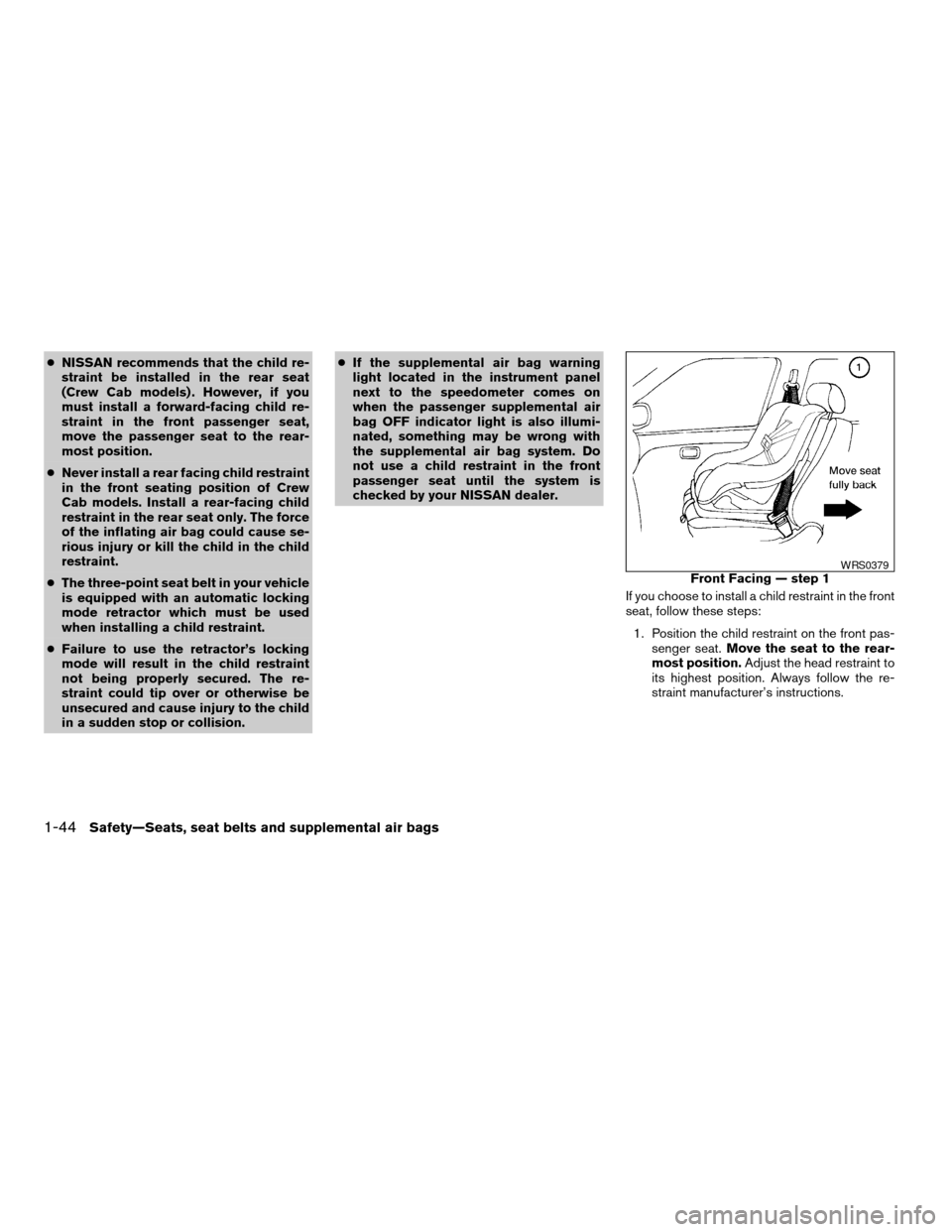
If you choose to install a child restraint in the front
seat, follow these steps:
1. Position the child restraint on the front pas-
senger seat.Move the seat to the rear-
most position.Adjust the head restraint to
its highest position. Always follow the re-
straint manufacturer’s instructions.
Front Facing — step 1WRS0379
1-44Safety—Seats, seat belts and supplemental air bags
ZREVIEW COPY:Ð2004 Truck/Frontier(d22)
Owners Manual(owners)ÐUSA English(nna)
11/21/03Ðdebbie
X