2004 MITSUBISHI L200 water pump
[x] Cancel search: water pumpPage 119 of 264

STARTING AND DRIVING
5-33 Brake pads and linings
(1) With new brake pads or linings, avoid
where possible sudden full applica-
tion of the brakes for the first 200 km
(125 miles) of driving.
(2) The disc brakes are provided with a
warning device which emits a shriek-
ing metallic sound while braking if the
brake pads have reached their limit.
If you hear this sound, have the brake
pads replaced by your MITSUBISHI
dealer.
CAUTION(1) Do not leave any objects or
place a thick floor mat around
the brake pedal; doing so could
prevent the full pedal stroke that
would be necessary in an emer-
gency. Make sure that the pedal
can be operated freely at all
times.
(2) Avoid driving habits that may
lead to sudden braking and
never “ride” the brakes by rest-
ing your foot on the brake pedal
while driving.
It causes brake overheating and
fade.
• Driving on gravel or snow-covered
roads.
• Driving with tyre chains installed.
• Driving on roads where the road
surface is pitted or has other differ-
ences in surface height.
• Driving on bumpy roads or other
poor driving surfaces.
(3) Operation of the ABS is not restricted
to situations where brakes are applied
suddenly. This system may also oper-
ate to prevent wheel lock when you
are driving over manholes, steel road-
work plates, or the vehicle is driven
over steps or level differences in the
road, road markings, or other sur-
faces which are difficult for the wheels
to grip.
(4) When the ABS is activated, you may
feel the brake pedal pulsating and
hear a characteristic noise. Also at
this time, it may feel as if the pedal at-
tempts to resist being depressed.
In this situation, to let the ABS
work for you, just hold the brake
pedal down more firmly. Do not
pump the brake. This will result in
reduced braking performance.Anti-lock brake system
(ABS)*
EI24APD
Environmental conditions can have an ef-
fect on braking. During sudden braking
when there is snow, ice, oil, water etc; on
the road surface, a skid may occur. In this
situation, steering control and braking ef-
fectiveness is reduced and the stopping
distance is increased. The vehicle may
also go into an uncontrolled spin.
The ABS helps prevent the wheels from
locking during braking, thus maintaining
directional stability, ensuring controllabi-
lity, and providing optimum braking force.
Driving hints
(1) With ABS fitted, steering during sud-
den braking (when the ABS functions)
differs slightly from when the brakes
are not being applied.
Steer the vehicle carefully in these
conditions.
(2) Always maintain the same distance
from the vehicle in front of you as you
would for a vehicle not equipped with
an ABS.
Compared with vehicles not fitted
with ABS, your vehicle may require a
longer stopping distance in the follow-
ing cases:
05engL2_240082_4 22-01-2004 13:05 Page 5-33
Page 177 of 264

FOR EMERGENCIES
On a flooded road
(1) Avoid flooded roads. Water could
enter the brake discs, resulting in
temporarily ineffective brakes. In such
cases, lightly depress the brake pedal
to see if the brakes operate properly.
If they do not, lightly depress the
pedal several times while driving in
order to dry the brake pads.
(2) When driving in rain or on a road with
many puddles a layer of water may
form between the tyres and the road
surface.
This reduces a tyre’s frictional
resistance on the road, resulting in
loss of steering stability and braking
capability.
To cope with this, observe the follow-
ing items:
(a) Drive your vehicle at a slow speed.
(b) Do not drive on worn tyres. Always
maintain the specified tyre inflation
pressures.
Tools, jack and jack handle
EN01A-T
The storage location of the tools and jack
should be remembered in case of an
emergency.
Location
1 - Tools
2 - Jack
3 - Jack handle
On a snow-covered or frozen road
(1) When driving on a snow-covered or
frozen road, it is recommended that
you use snow tyres or tyre chains.
Refer to the “Snow tyres” and “Tyre
chains” sections.
(2) Avoid high-speed operation, sudden
acceleration, abrupt brake application
and sharp cornering.
(3) Depressing the brake pedal during
travel on such a road may cause tyre
slippage and skidding. When traction
between the tyres and the road is re-
duced the wheels may skid and the
vehicle cannot readily be brought to a
stop by conventional braking tech-
niques. Braking will differ, depending
upon whether you have anti-lock
brakes (ABS). If you do have ABS,
brake by pressing the brake pedal
hard, and keeping it pressed. If you
do not have ABS, pump the brake
pedal with short rapid jabs, each time
fully applying and fully releasing for
greatest effect.
(4) Allow extra distance between your
vehicle and the vehicle in front of you,
and avoid sudden braking.
8-3
N01A044
3
2
1
Single cab
08engL2_240082_4 22-01-2004 13:10 Page 8-3
Page 200 of 264

FOR EMERGENCIES
2. Pump the hand pump (B) until there
are no more bubbles in the fuel
coming out of the air plug (A). When
doing this, place a cloth around the air
plug (A) to prevent the escaping fuel
from spraying about.
3. Tighten the air plug (A) when there
are no more bubbles in the fuel.
4. Continue pumping until the hand
pump (B) becomes stiff.
5. Finally, check to be sure that there is
no leakage of fuel.
If in doubt, consult your nearest au-
thorized MITSUBISHI dealer.
CAUTION
(1) Do not smoke or have any other
open flame near the vehicle
while bleeding the fuel system.
(2) Be sure to carefully clean away
any spilt fuel which could ignite
and cause a fire.
Removal of water from the
fuel filter (diesel- powered
vehicles only)
EN07B-Bc
If the warning lamp illuminates during
driving, it indicates that water has accu-
mulated in the fuel filter. If this occurs,
remove the water as described below.
1. Loosen the drain plug (A) at the bot-
tom of the fuel filter.
8-26
N07B011
A
N07A008
B
08engL2_240082_4 22-01-2004 13:10 Page 8-26
Page 201 of 264
FOR EMERGENCIES
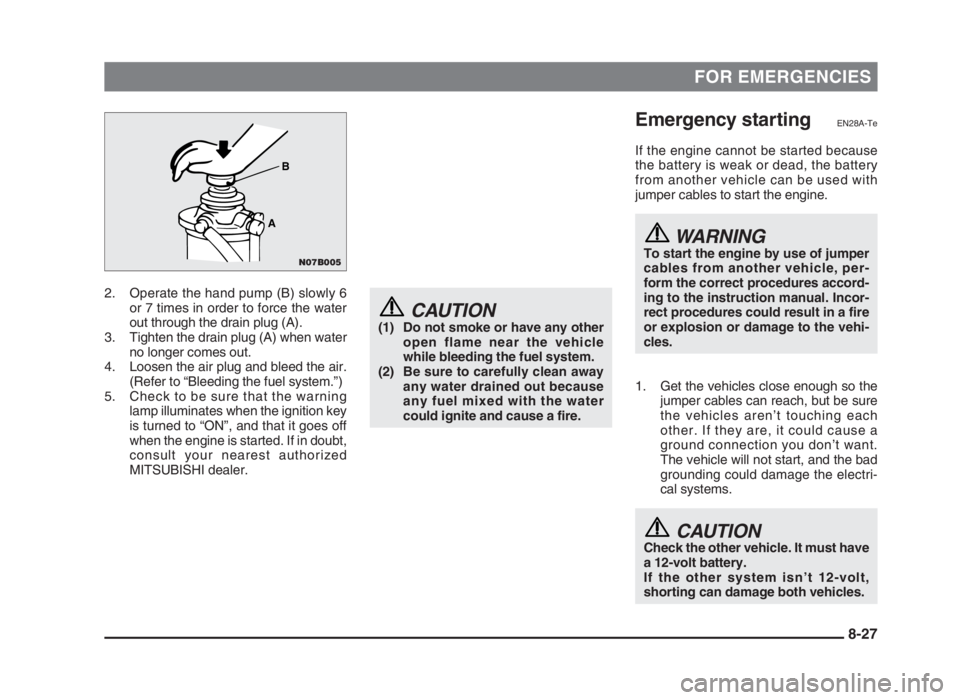
2. Operate the hand pump (B) slowly 6
or 7 times in order to force the water
out through the drain plug (A).
3. Tighten the drain plug (A) when water
no longer comes out.
4. Loosen the air plug and bleed the air.
(Refer to “Bleeding the fuel system.”)
5. Check to be sure that the warning
lamp illuminates when the ignition key
is turned to “ON”, and that it goes off
when the engine is started. If in doubt,
consult your nearest authorized
MITSUBISHI dealer.
Emergency startingEN28A-Te
If the engine cannot be started because
the battery is weak or dead, the battery
from another vehicle can be used with
jumper cables to start the engine.
WARNINGTo start the engine by use of jumper
cables from another vehicle, per-
form the correct procedures accord-
ing to the instruction manual. Incor-
rect procedures could result in a fire
or explosion or damage to the vehi-
cles.
1. Get the vehicles close enough so the
jumper cables can reach, but be sure
the vehicles aren’t touching each
other. If they are, it could cause a
ground connection you don’t want.
The vehicle will not start, and the bad
grounding could damage the electri-
cal systems.
CAUTIONCheck the other vehicle. It must have
a 12-volt battery.
If the other system isn’t 12-volt,
shorting can damage both vehicles.
CAUTION(1) Do not smoke or have any other
open flame near the vehicle
while bleeding the fuel system.
(2) Be sure to carefully clean away
any water drained out because
any fuel mixed with the water
could ignite and cause a fire.
8-27
N07B005
B
A
08engL2_240082_4 22-01-2004 13:10 Page 8-27
Page 219 of 264

Engine coolantEM36A-Gg
A translucent coolant reserve tank is lo-
cated in the engine compartment. The
coolant level in this tank should be kept
between the “LOW” and “FULL” marks
when measured while the engine is cold.
The cooling system is a closed system
and normally the loss of coolant should be
very slight. A noticeable drop in the
coolant level could indicate leakage. If this
occurs, have the system checked at an
authorized MITSUBISHI dealer as soon
as possible. If the level should drop below
the “LOW” level on the reserve tank, open
the lid and add coolant.
Also, if the reserve tank is completely
empty, remove the radiator cap and add
coolant until the level reaches the filler
neck.
MAINTENANCE
CAUTION(1) Do not use alcohol or methanol
anti-freeze or any engine
coolants mixed with alcohol or
methanol anti-freeze. The use of
an improper anti-freeze can
cause the corrosion of the alu-
minium components.
(2) For effective anti-corrosion and
anti-freeze performance, keep
the anti-freeze concentration
within the range of 30 to 60%.
Concentrations exceeding 60%
will result in a reduction of both
the anti-freeze and cooling per-
formance thus adversely affect-
ing the engine.
(3) Do not top up with water only.
Water by itself reduces the rust-
protective and anti-freeze qual-
ities of the coolant and has a
lower boiling point. It can also
cause damage to the cooling
system if it should freeze. Do not
use tapwater, or it causes the
corrosion and rust formation.
CAUTIONDo not open the radiator cap while
the engine is hot. The coolant sys-
tem is under pressure and any hot
coolant escaping could cause se-
vere burns.
Anti-freeze
The engine coolant contains an ethylene
glycol anti-corrosion agent. The cylinder
head and water pump housing are cast
aluminium alloy, and periodic changing of
the engine coolant is necessary to prevent
corrosion of these parts.
Use MITSUBISHI Genuine Coolant or an
equivalent.
MITSUBISHI Genuine Coolant has excel-
lent protection against corrosion and rust
formation of all metals including alu-
minium and can avoid clogs in the radia-
tor, heater, cylinder head, engine block,
etc.
Because of the necessity of this anti-
corrosion agent, the coolant must not be
replaced with plain water even in summer.
The required concentration of anti-freeze
differs depending on the expected
ambient temperature.
9-5
M36A003
Ambient
temperature
(minimum) °C-15-20-25-30-35-50
Anti-freeze
concentration %303540455060
09engL2_240082_4 22-01-2004 13:12 Page 9-5