Page 261 of 434
260 OperationEngine compartmentBattery
Your vehicle is equipped with two batter-
ies:�
The starter battery (located in the en-
gine compartment)
�
The battery for electrical consumers
(located in the trunk)
These batteries should always be suffi-
ciently charged in order to achieve their
rated service life. Refer to Service Booklet
for battery maintenance intervals.
If you use your vehicle mostly for
short-distance trips, you will need to have
the battery charge checked more frequent-
ly.
When replacing batteries, always use bat-
teries approved by Mercedes-Benz.
If you do not intend to operate your vehicle
for an extended period of time, consult an
authorized Mercedes-Benz Center about
steps you need to observe.Batteries contain materials that can harm
the environment if disposed of improperly.
Recycling of batteries is the preferred
method of disposal. Many states require
sellers of batteries to accept old batteries
for recycling.
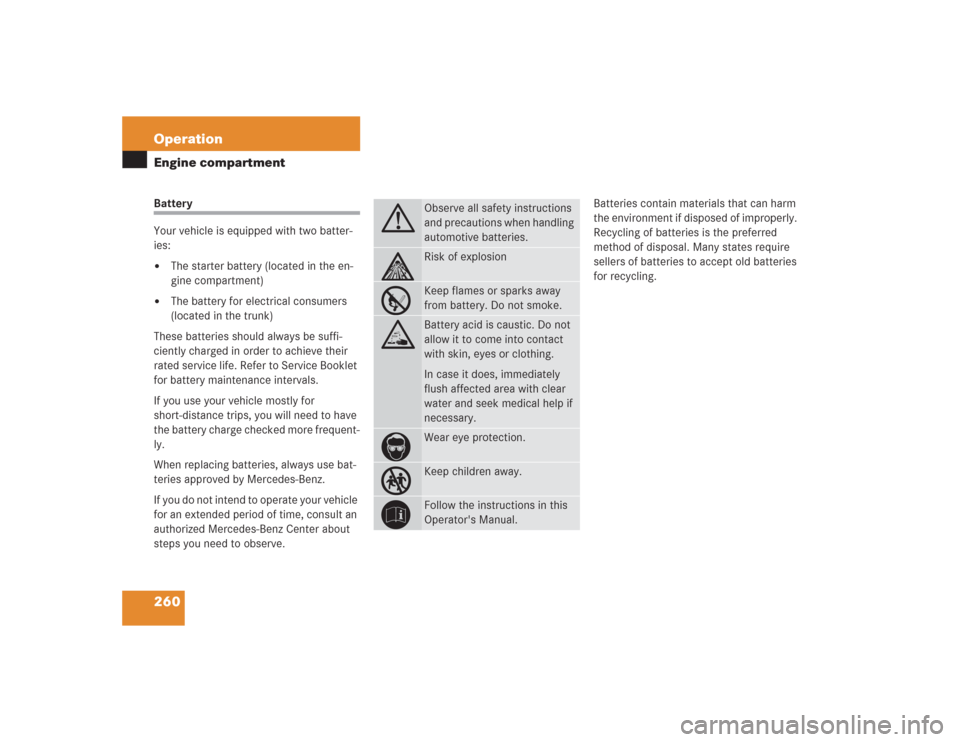
G
Observe all safety instructions
and precautions when handling
automotive batteries.
A
Risk of explosion
D
Keep flames or sparks away
from battery. Do not smoke.
B
Battery acid is caustic. Do not
allow it to come into contact
with skin, eyes or clothing.
In case it does, immediately
flush affected area with clear
water and seek medical help if
necessary.
E
Wear eye protection.
C
Keep children away.
F
Follow the instructions in this
Operator's Manual.
Page 269 of 434
268 OperationWinter driving
�Winter drivingBefore the onset of winter, have your vehi-
cle winterized at an authorized
Mercedes-Benz Center. This service in-
cludes:�
Check of anticorrosion and antifreeze
concentration.
�
Addition of cleaning concentrate to the
water of the windshield and headlamp
cleaning system. Add MB Concentrate
“S” to a pre-mixed windshield washer
solvent / antifreeze which is formulated
for temperatures below freezing point
(�page 392).
�
Battery test. Battery capacity drops
with decreasing ambient temperature.
A well charged battery helps to ensure
that the engine can be started and the
SBC brake system will be fully opera-
tional even at low ambient tempera-
tures.
�
Tire change. Mercedes-Benz recom-
mends M+S rated radial-ply tires with a
minimum tread depth of approximately 1/6in (4 mm) on all four wheels for the
winter season.
Winter tires
Always use winter tires at temperatures
below 45°F (7°C) and whenever wintry
road conditions prevail. Use of winter tires
is the only way to achieve the maximum ef-
fectiveness of the ABS and ESP in winter
operation.
For safe handling, make sure all winter
tires mounted are of the same make and
have the same tread design.
!When scraping ice or snow from the
rear window, be careful not to damage
the sealing strip or apertures along the
side of the window.
Warning!
G
Winter tires with a tread depth of less than 1/6in (4 mm) must be replaced. They are no
longer suitable for winter operation.
Page 285 of 434
284 Practical hintsWhat to do if …Problem
Possible cause
Suggested solution
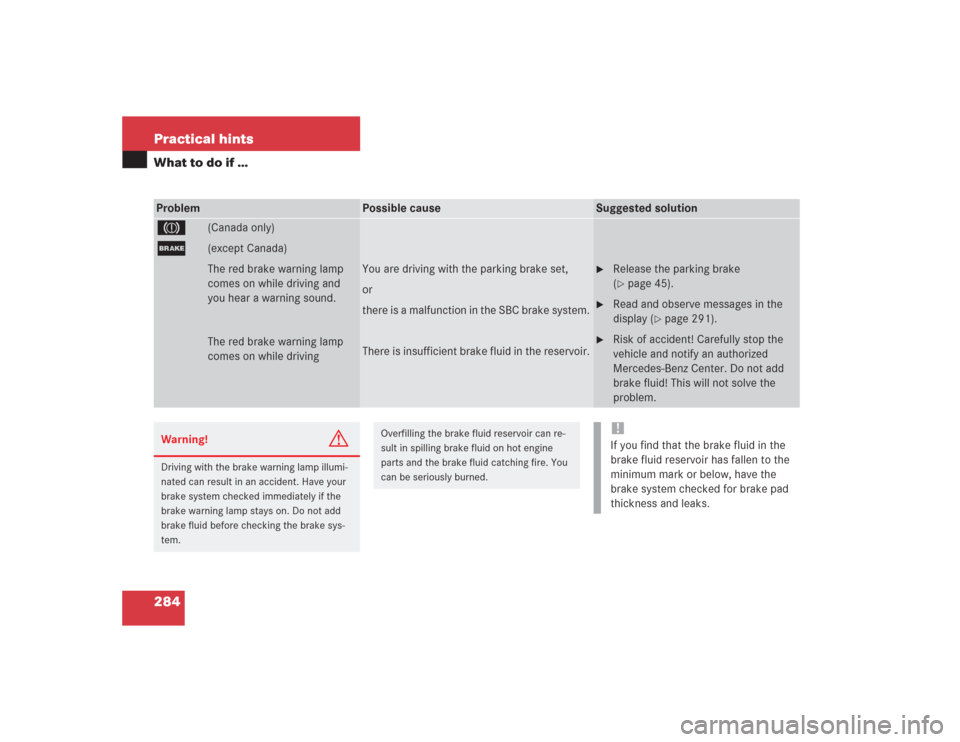
3
(Canada only)
;
(except Canada)
The red brake warning lamp
comes on while driving and
you hear a warning sound.
The red brake warning lamp
comes on while driving
You are driving with the parking brake set,
or
there is a malfunction in the SBC brake system.
There is insufficient brake fluid in the reservoir.
�
Release the parking brake
(�page 45).
�
Read and observe messages in the
display (
�page 291).
�
Risk of accident! Carefully stop the
vehicle and notify an authorized
Mercedes-Benz Center. Do not add
brake fluid! This will not solve the
problem.
Warning!
G
Driving with the brake warning lamp illumi-
nated can result in an accident. Have your
brake system checked immediately if the
brake warning lamp stays on. Do not add
brake fluid before checking the brake sys-
tem.
Overfilling the brake fluid reservoir can re-
sult in spilling brake fluid on hot engine
parts and the brake fluid catching fire. You
can be seriously burned.
!If you find that the brake fluid in the
brake fluid reservoir has fallen to the
minimum mark or below, have the
brake system checked for brake pad
thickness and leaks.
Page 286 of 434
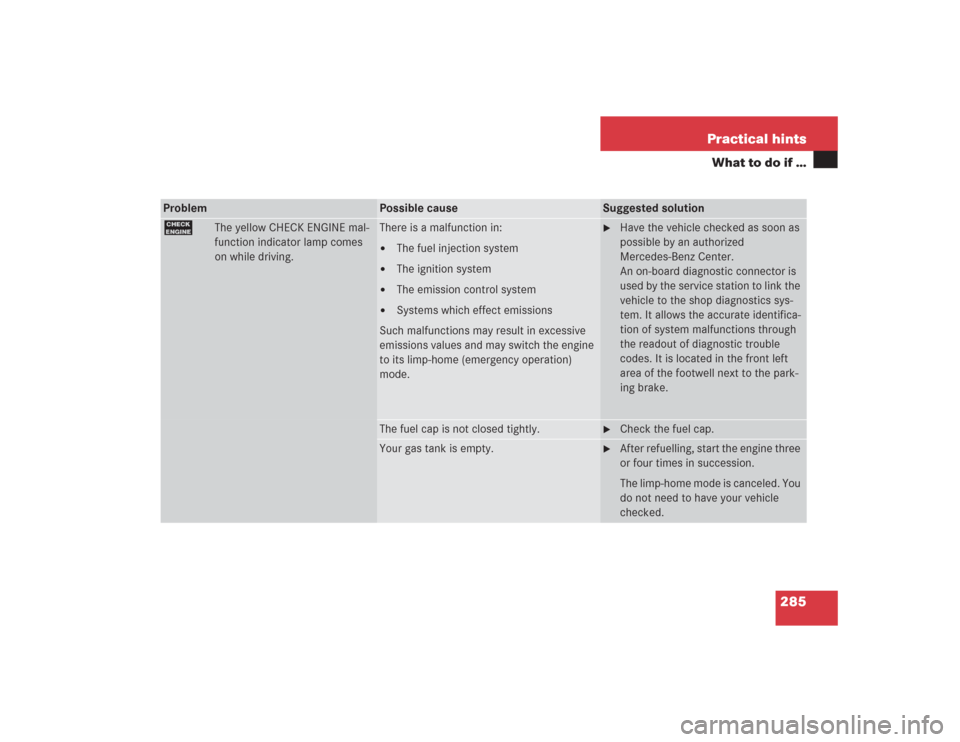
285 Practical hints
What to do if …
Problem
Possible cause
Suggested solution
?
The yellow CHECK ENGINE mal-
function indicator lamp comes
on while driving.
There is a malfunction in:�
The fuel injection system
�
The ignition system
�
The emission control system
�
Systems which effect emissions
Such malfunctions may result in excessive
emissions values and may switch the engine
to its limp-home (emergency operation)
mode.
�
Have the vehicle checked as soon as
possible by an authorized
Mercedes-Benz Center.
An on-board diagnostic connector is
used by the service station to link the
vehicle to the shop diagnostics sys-
tem. It allows the accurate identifica-
tion of system malfunctions through
the readout of diagnostic trouble
codes. It is located in the front left
area of the footwell next to the park-
ing brake.
The fuel cap is not closed tightly.
�
Check the fuel cap.
Your gas tank is empty.
�
After refuelling, start the engine three
or four times in succession.
The limp-home mode is canceled. You
do not need to have your vehicle
checked.
Page 287 of 434
286 Practical hintsWhat to do if …Problem
Possible cause
Suggested solution
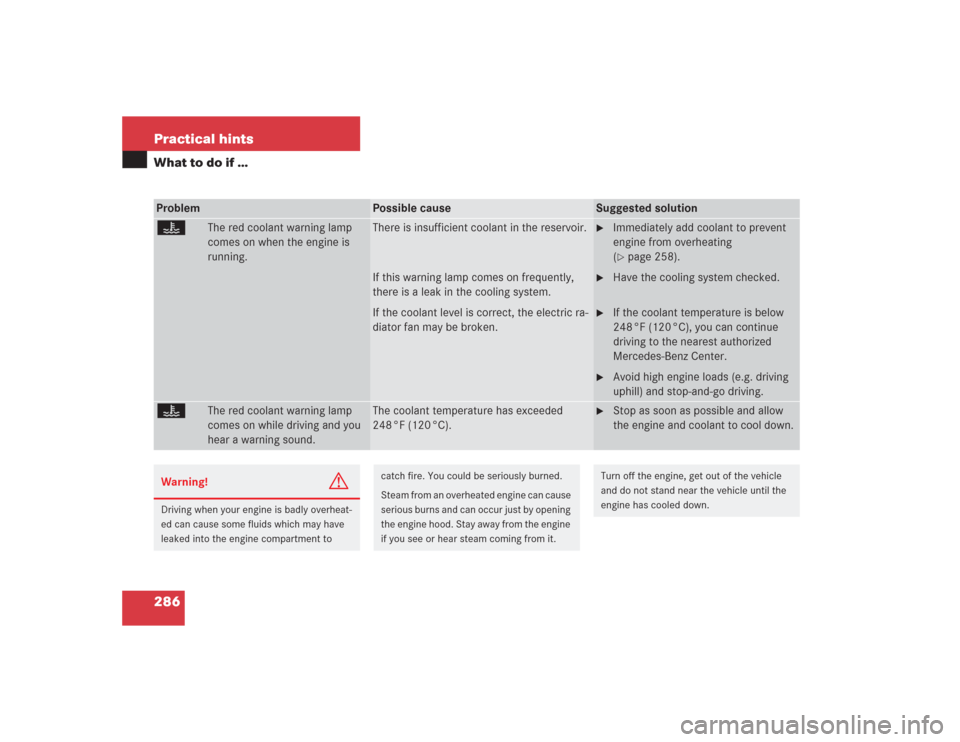
D
The red coolant warning lamp
comes on when the engine is
running.
There is insufficient coolant in the reservoir.
If this warning lamp comes on frequently,
there is a leak in the cooling system.
If the coolant level is correct, the electric ra-
diator fan may be broken.
�
Immediately add coolant to prevent
engine from overheating
(�page 258).
�
Have the cooling system checked.
�
If the coolant temperature is below
248 °F (120 °C), you can continue
driving to the nearest authorized
Mercedes-Benz Center.
�
Avoid high engine loads (e.g. driving
uphill) and stop-and-go driving.
D
The red coolant warning lamp
comes on while driving and you
hear a warning sound.
The coolant temperature has exceeded
248 °F (120 °C).
�
Stop as soon as possible and allow
the engine and coolant to cool down.
Warning!
G
Driving when your engine is badly overheat-
ed can cause some fluids which may have
leaked into the engine compartment to
catch fire. You could be seriously burned.
Steam from an overheated engine can cause
serious burns and can occur just by opening
the engine hood. Stay away from the engine
if you see or hear steam coming from it.
Turn off the engine, get out of the vehicle
and do not stand near the vehicle until the
engine has cooled down.
Page 289 of 434
288 Practical hintsWhat to do if …Problem
Possible cause
Suggested solution
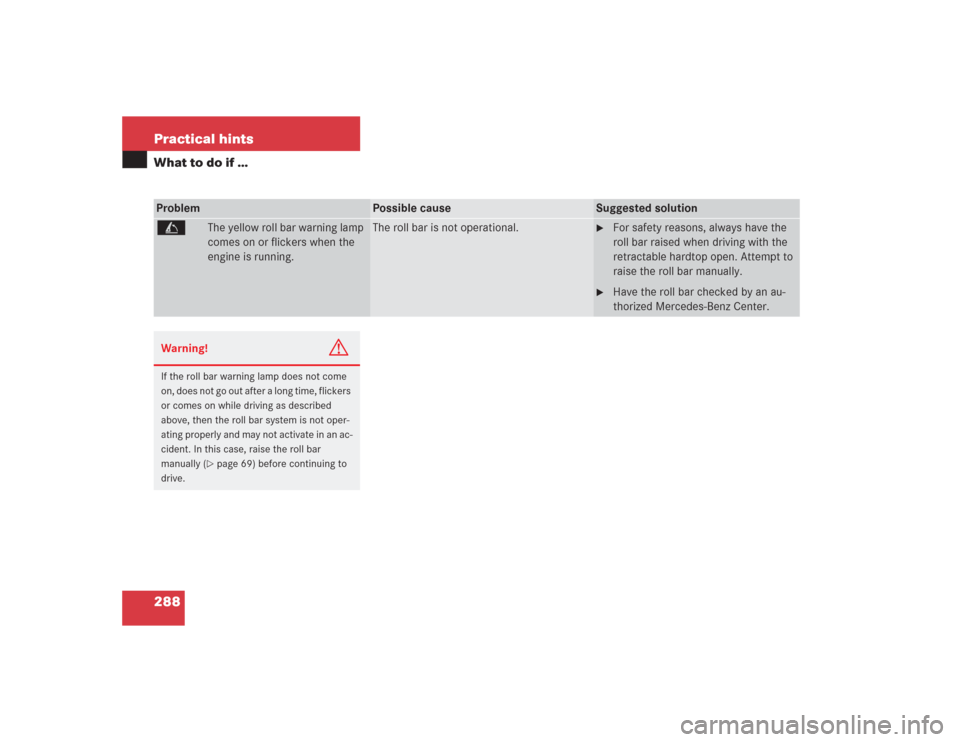
C
The yellow roll bar warning lamp
comes on or flickers when the
engine is running.
The roll bar is not operational.
�
For safety reasons, always have the
roll bar raised when driving with the
retractable hardtop open. Attempt to
raise the roll bar manually.
�
Have the roll bar checked by an au-
thorized Mercedes-Benz Center.
Warning!
G
If the roll bar warning lamp does not come
on, does not go out after a long time, flickers
or comes on while driving as described
above, then the roll bar system is not oper-
ating properly and may not activate in an ac-
cident. In this case, raise the roll bar
manually (
�page 69) before continuing to
drive.
Page 302 of 434
301 Practical hints
What to do if …
Left display
Right display
Possible cause
Possible solution
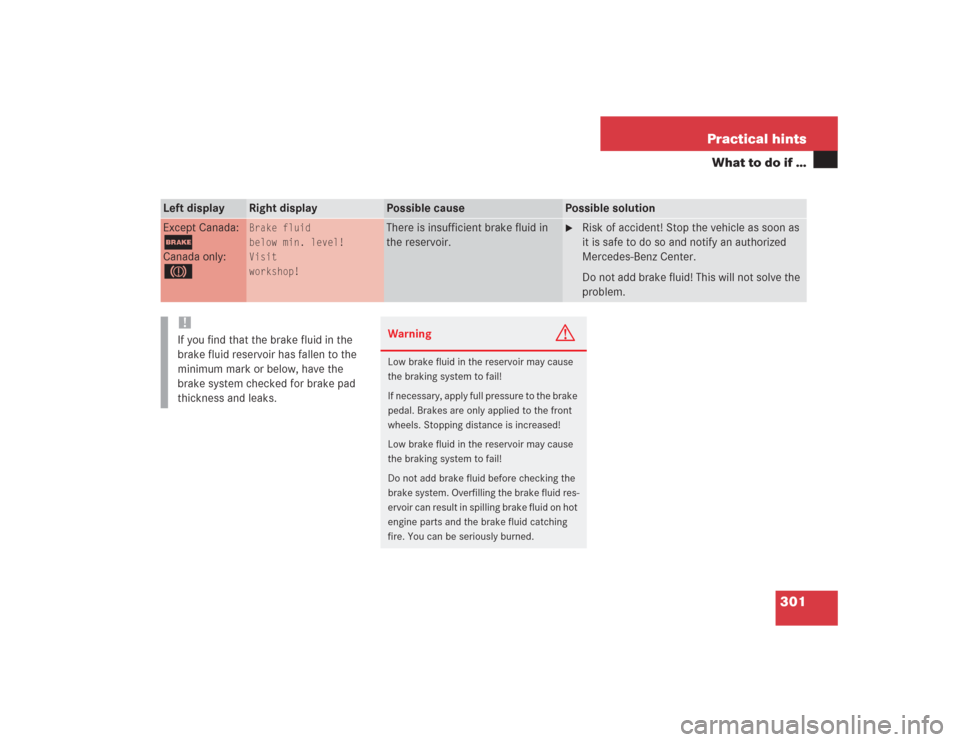
Except Canada:;Canada only:3
Brake fluid
below min. level!
Visit
workshop!
There is insufficient brake fluid in
the reservoir.
�
Risk of accident! Stop the vehicle as soon as
it is safe to do so and notify an authorized
Mercedes-Benz Center.
Do not add brake fluid! This will not solve the
problem.
!If you find that the brake fluid in the
brake fluid reservoir has fallen to the
minimum mark or below, have the
brake system checked for brake pad
thickness and leaks.
Warning
G
Low brake fluid in the reservoir may cause
the braking system to fail!
If necessary, apply full pressure to the brake
pedal. Brakes are only applied to the front
wheels. Stopping distance is increased!
Low brake fluid in the reservoir may cause
the braking system to fail!
Do not add brake fluid before checking the
brake system. Overfilling the brake fluid res-
ervoir can result in spilling brake fluid on hot
engine parts and the brake fluid catching
fire. You can be seriously burned.
Page 304 of 434
303 Practical hints
What to do if …
Left display
Right display
Possible cause
Possible solution
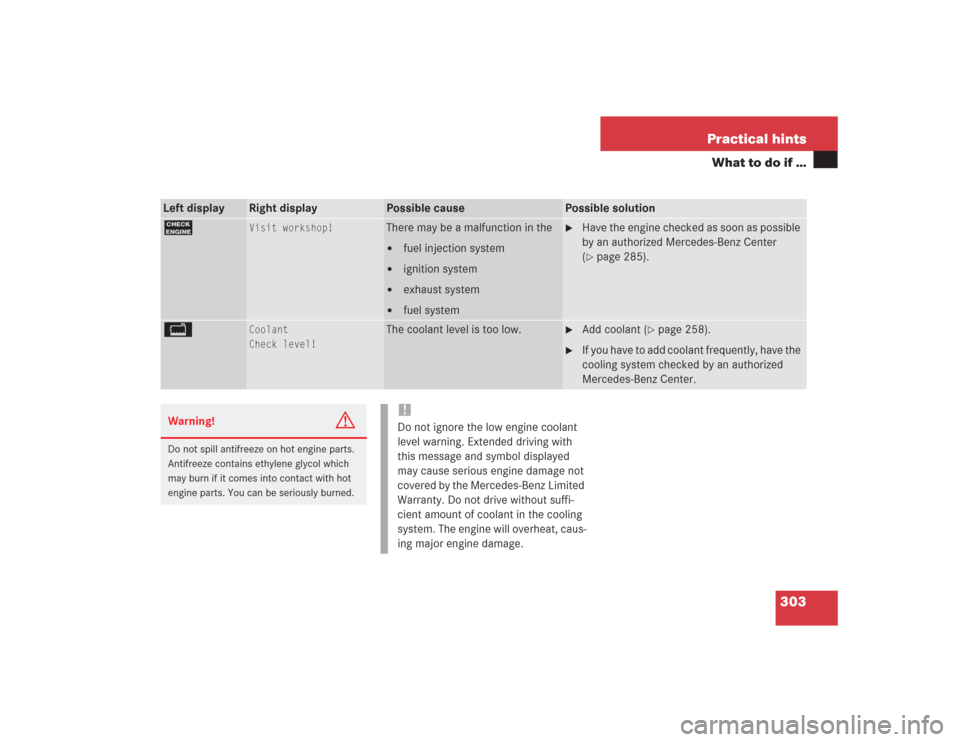
?
Visit workshop!
There may be a malfunction in the �
fuel injection system
�
ignition system
�
exhaust system
�
fuel system
�
Have the engine checked as soon as possible
by an authorized Mercedes-Benz Center
(�page 285).
B
Coolant
Check level!
The coolant level is too low.
�
Add coolant (
�page 258).
�
If you have to add coolant frequently, have the
cooling system checked by an authorized
Mercedes-Benz Center.
Warning!
G
Do not spill antifreeze on hot engine parts.
Antifreeze contains ethylene glycol which
may burn if it comes into contact with hot
engine parts. You can be seriously burned.
!Do not ignore the low engine coolant
level warning. Extended driving with
this message and symbol displayed
may cause serious engine damage not
covered by the Mercedes-Benz Limited
Warranty. Do not drive without suffi-
cient amount of coolant in the cooling
system. The engine will overheat, caus-
ing major engine damage.