Page 13 of 344

13 Introduction
Operator’s Manual
Change of address or ownership
If you change your address, be sure to
send in the “Change of Address Notice”
found in the Service and Warranty Informa-
tion Booklet, or simply call the
Mercedes-Benz Customer Assistance
Center (in the USA) at
1-800-FOR-MERCedes, or Customer Ser-
vice (in Canada) at 1-800-387-0100. It is in
your own interest that we can contact you
should the need arise.
If you sell your Mercedes, please leave all
literature with the vehicle to make it avail-
able to the next operator.
If you bought this vehicle used, be sure to
send in the “Notice of Purchase of Used
Truck” found in the Service and Warranty
Information Booklet, or call the
Mercedes-Benz Customer Assistance Cen-
ter (in the USA) at 1-800-FOR-MERCedes,
or Customer Service (in Canada) at
1-800-387-0100.Operating your vehicle outside the USA
or Canada
If you plan to operate your vehicle in for-
eign countries, please be aware that:�
service facilities or replacement parts
may not be readily available,
�
unleaded gasoline for vehicles with cat-
alytic converters may not be available;
the use of leaded fuels will damage the
catalysts,
�
gasoline may have a considerably low-
er octane rating, and improper fuel can
cause engine damage.
Page 215 of 344
215 Operation
At the gas station
�
Replace the fuel cap by turning it to the
right.
You will hear when the fuel cap is tight-
ened.
�
Close the fuel filler flap.
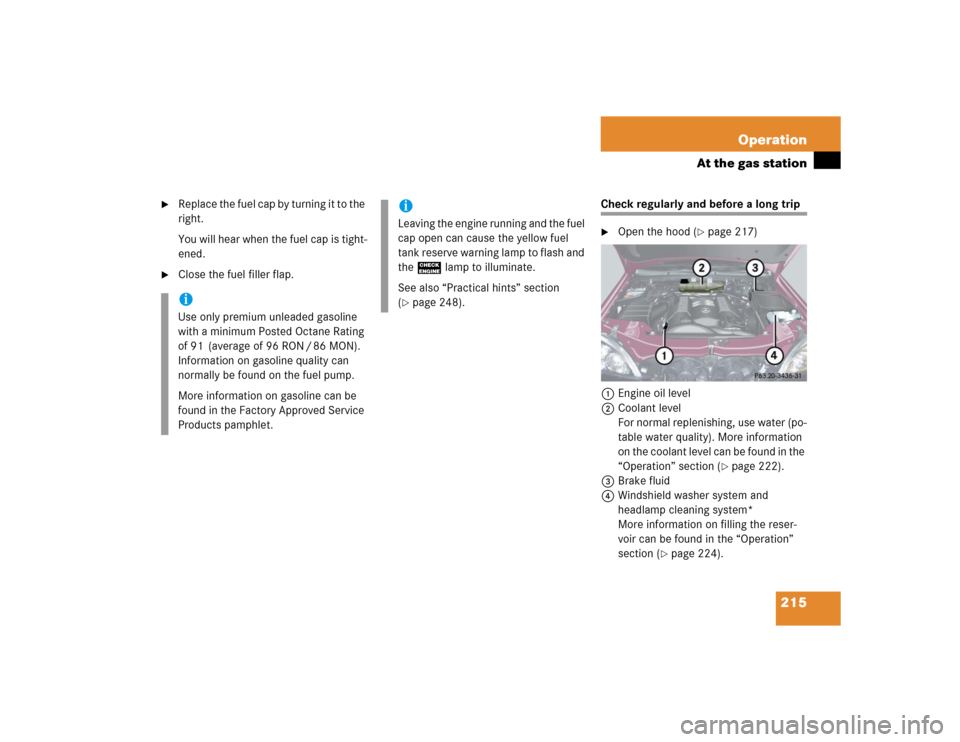
Check regularly and before a long trip�
Open the hood (
�page 217)
1Engine oil level
2Coolant level
For normal replenishing, use water (po-
table water quality). More information
on the coolant level can be found in the
“Operation” section (
�page 222).
3Brake fluid
4Windshield washer system and
headlamp cleaning system*
More information on filling the reser-
voir can be found in the “Operation”
section (
�page 224).
iUse only premium unleaded gasoline
with a minimum Posted Octane Rating
of 91 (average of 96 RON / 86 MON).
Information on gasoline quality can
normally be found on the fuel pump.
More information on gasoline can be
found in the Factory Approved Service
Products pamphlet.
iLeaving the engine running and the fuel
cap open can cause the yellow fuel
tank reserve warning lamp to flash and
the? lamp to illuminate.
See also “Practical hints” section
(�page 248).
Page 303 of 344

303 Technical data
Fuels, coolants, lubricants etc.
Premium unleaded gasoline
Fuel requirements
Use only premium unleaded meeting
ASTM standard D 439:�
The octane number (posted at the
p um p) m us t be 91 mi n. It i s an a vera ge
of both the Research (R) octane num-
ber and the Motor (M) octane number:
(R+M) / 2). This is also known as the
ANTI-KNOCK INDEX.
Unleaded gasoline containing oxygenates
such as ethanol, IPA, IBA and TBA can be
used provided the ratio of any one of these
oxygenates to gasoline does not exceed
10%; MTBE must not exceed 15%.
The ratio of methanol to gasoline must not
exceed 3% plus additional cosolvents.
Using mixtures of ethanol and methanol is
not allowed. Gasohol, which contains 10%
ethanol and 90% unleaded gasoline, can be
used.
These blends must also meet all other fuel
requirements, such as resistance to spark
knock, boiling range, vapor pressure, etc.
Gasoline additives
A major concern among engine manufac-
turers is carbon build-up caused by gaso-
line. Mercedes-Benz recommends only the
use of quality gasoline containing additives
that prevent the build-up of carbon depos-
its.
After an extended period of using fuels
without such additives, carbon deposits
can build up especially on the intake valves
and in the combustion area, leading to en-
gine performance problems such as:�
Warm-up hesitation
�
Unstable idle
�
Knocking / pinging
�
Misfire
�
Power loss
Do not blend other specific fuel additives
with fuel. This only results in unnecessary
costs and may be harmful to the engine
operation.
!To maintain the engine’s durability and
performance, premium unleaded gaso-
l i n e m u s t b e u s e d . I f p r e m i u m u n l e a d e d
is not available and low octane fuel is
used, follow these precautions:�
Have the fuel tank only partially
filled with unleaded regular and fill
up with premium unleaded as soon
as possible.
�
Avoid full throttle driving and abrupt
acceleration.
�
Do not exceed an engine speed of
3000 rpm if the vehicle is loaded
with a light load such as two per-
sons and no luggage.
�
Do not exceed
2/3 of maximum ac-
celerator pedal position if the vehi-
cle is fully loaded or operating in
mountainous terrain.
Page 313 of 344

313 Technical terms
GVWR
(G
ross V
ehicle W
eight R
ating)
This is the maximum permissible vehi-
cle weight. It is indicated on certifica-
tion label located on the driver’s door
pillar.
Instrument cluster
The displays and indicator / warning
lamps in the driver’s field of vision, in-
cluding the tachometer, speedometer,
engine temperature and fuel gauge.
Kickdown
Depressing the accelerator past the
point of resistance shifts the transmis-
sion down to the lowest possible gear.
This very quickly accelerates the vehi-
cle and should not be used for normal
acceleration needs.Line of fall
The direct line that an object moves
downhill when influenced by the force
of gravity alone.
Lock button
Button on the door which indicates
whether the door is locked or un-
locked. Pushing the lock button down
on an individual door from inside will
lock that door.
MCS
(M
odular C
ontrol S
ystem)
Information and operating center for
vehicle sound and communications
systems, including the radio and the ra-
dio and navigation system, as well as
for other optional equipment (CD
changer, telephone, etc.).Memory function*
Used to store three individual seat,
steering wheel and mirror positions.
MON
(M
otor O
ctane N
umber)
The Motor Octane Number for gasoline
as determined by a standardized meth-
od. It is an indication of a gasoline's
ability to resist undesired detonation
(knocking). The average of both the
MON (Motor Octane Number) and
->RON (Research Octane Number) is
posted at the pump, also known as
ANTI-KNOCK INDEX.
Multifunction display
A display field in the instrument cluster
used to present information provided
by the control system.
Parktronic system* (Parking assist)
System which uses visual and acoustic
signals to assist the driver during park-
ing maneuvers.