Page 275 of 374
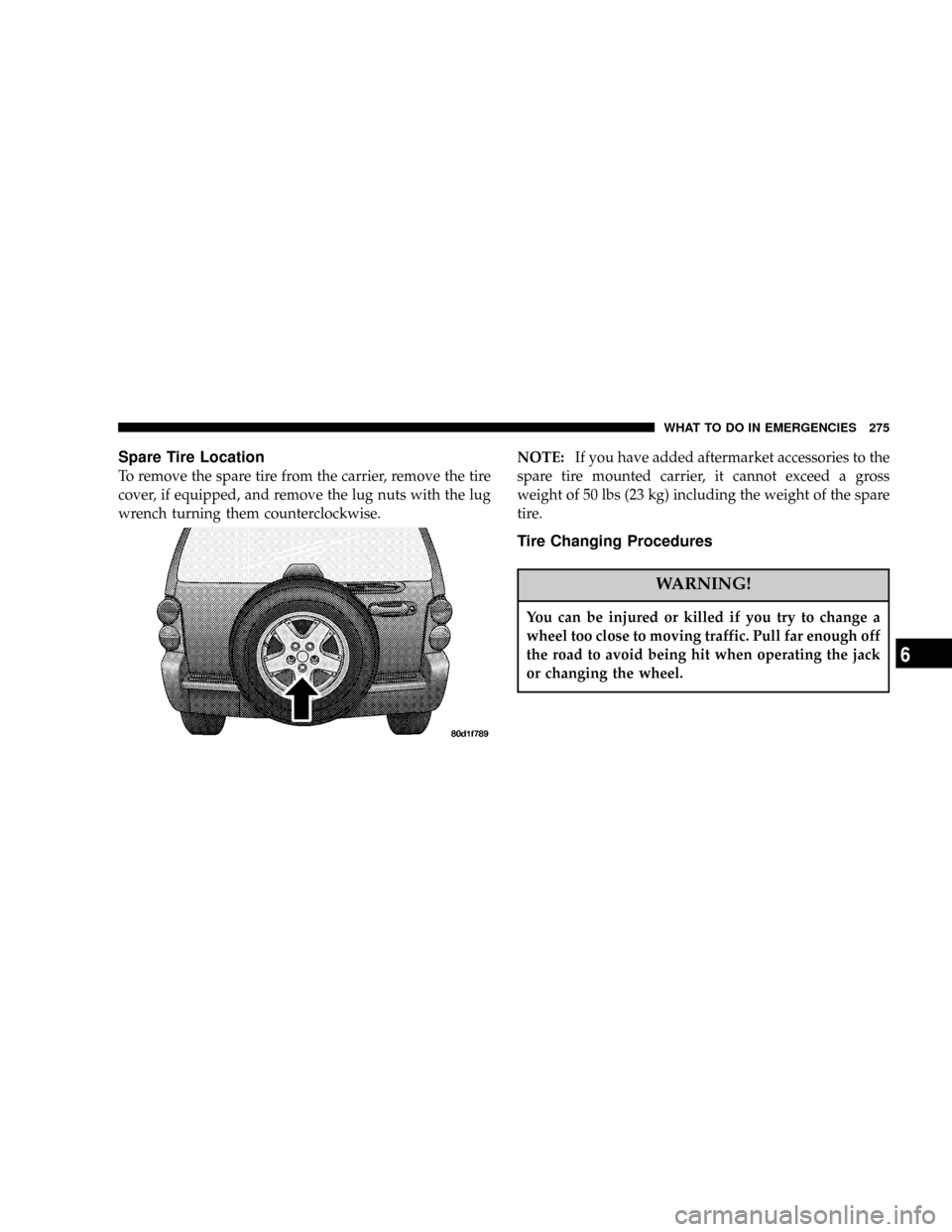
Spare Tire Location
To remove the spare tire from the carrier, remove the tire
cover, if equipped, and remove the lug nuts with the lug
wrench turning them counterclockwise.NOTE:If you have added aftermarket accessories to the
spare tire mounted carrier, it cannot exceed a gross
weight of 50 lbs (23 kg) including the weight of the spare
tire.
Tire Changing Procedures
WARNING!
You can be injured or killed if you try to change a
wheel too close to moving traffic. Pull far enough off
the road to avoid being hit when operating the jack
or changing the wheel.
WHAT TO DO IN EMERGENCIES 275
6
Page 276 of 374
Preparation
²
Park on a firm, level surface well off the road, to
provide ample work space. Place automatic transmis-
sion in P (Park), or manual transmission in R (Re-
verse), and stop engine. Set parking brake firmly and
activate hazard warning flasher.
²Block tire diagonally oppo-
site tire to be changed to pre-
vent forward and backward
vehicle movement.
Instructions
1. Remove spare tire, jack and tools from stored location.
2. Before raising vehicle, loosen lug nuts on wheel with
flat tire.3. Assemble the jack and jacking tools as shown. Connect
jack handle driver to extensions, then to lug wrench.
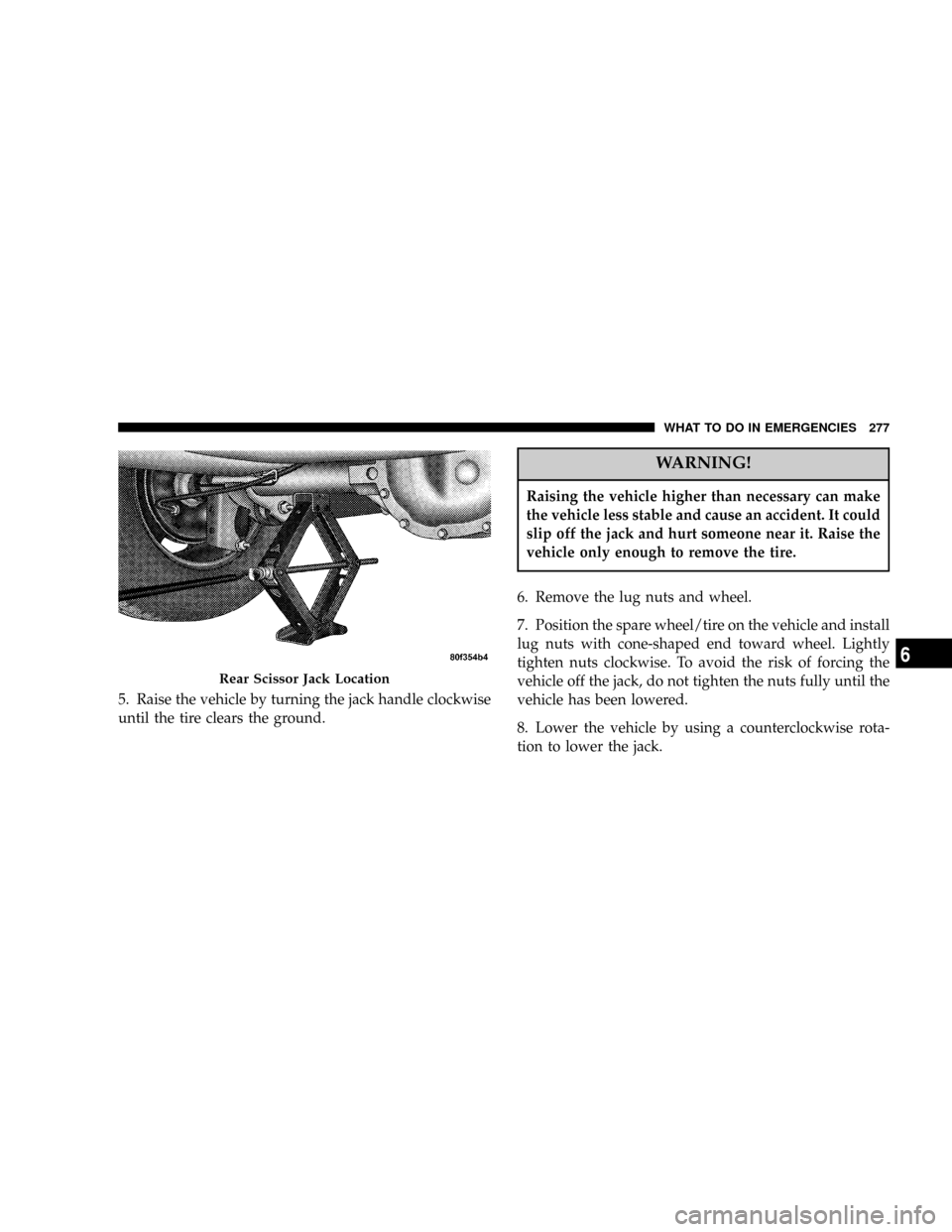
4. Locate the jack as shown. For the front tires, place it in
the notch on the body weld seam behind wheel to be
changed. For the rear tires, place it under the axle as
shown. Position the jack handle on the jack.
Front Scissor Jack Location
276 WHAT TO DO IN EMERGENCIES
Page 277 of 374
5. Raise the vehicle by turning the jack handle clockwise
until the tire clears the ground.
WARNING!
Raising the vehicle higher than necessary can make
the vehicle less stable and cause an accident. It could
slip off the jack and hurt someone near it. Raise the
vehicle only enough to remove the tire.
6. Remove the lug nuts and wheel.
7. Position the spare wheel/tire on the vehicle and install
lug nuts with cone-shaped end toward wheel. Lightly
tighten nuts clockwise. To avoid the risk of forcing the
vehicle off the jack, do not tighten the nuts fully until the
vehicle has been lowered.
8. Lower the vehicle by using a counterclockwise rota-
tion to lower the jack.
Rear Scissor Jack Location
WHAT TO DO IN EMERGENCIES 277
6
Page 278 of 374
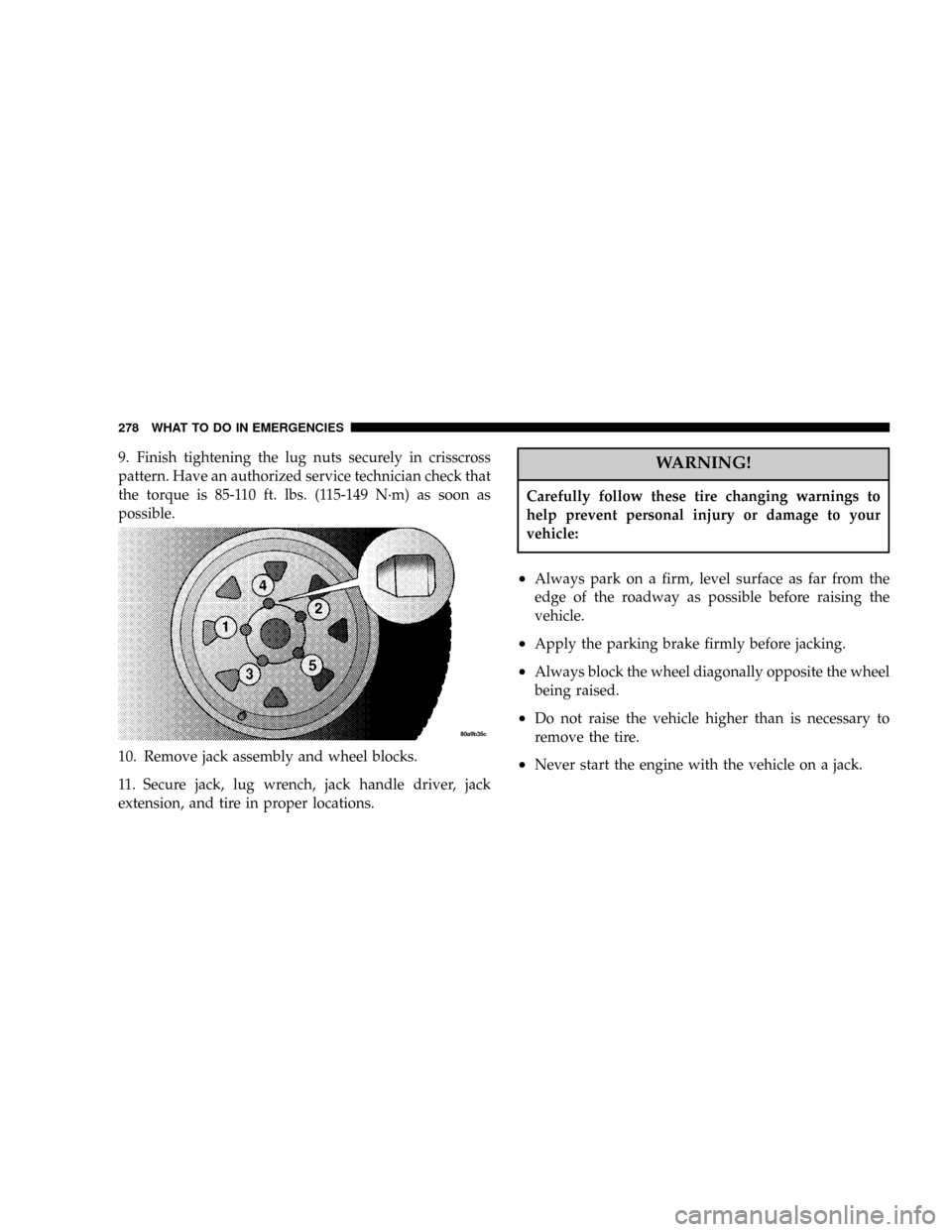
9. Finish tightening the lug nuts securely in crisscross
pattern. Have an authorized service technician check that
the torque is 85-110 ft. lbs. (115-149 N´m) as soon as
possible.
10. Remove jack assembly and wheel blocks.
11. Secure jack, lug wrench, jack handle driver, jack
extension, and tire in proper locations.WARNING!
Carefully follow these tire changing warnings to
help prevent personal injury or damage to your
vehicle:
²Always park on a firm, level surface as far from the
edge of the roadway as possible before raising the
vehicle.
²Apply the parking brake firmly before jacking.
²Always block the wheel diagonally opposite the wheel
being raised.
²Do not raise the vehicle higher than is necessary to
remove the tire.
²Never start the engine with the vehicle on a jack.
278 WHAT TO DO IN EMERGENCIES
Page 281 of 374
WARNING!
Do not attempt to push or tow your vehicle to get it
started. Unburned fuel could enter the catalytic
converter and, once the engine has started, ignite and
damage the converter and vehicle.
EMERGENCY TOW HOOKS Ð IF EQUIPPED
If your vehicle is equipped with tow hooks, they are
mounted in the front and the rear.
CAUTION!
Tow hooks are for emergency use only, to rescue a
vehicle stranded off road. Do not use tow hooks for
tow truck hookup or highway towing. You could
damage your vehicle. Tow straps are recommended
when towing the vehicle, chains may cause vehicle
damage.
WARNING!
Stand clear of vehicles when pulling with tow
hooks. Tow straps and chains may break, causing
serious injury.
TOWING A DISABLED VEHICLE
The manufacturer recommends towing with all four
wheels off the ground. Acceptable methods are to tow the
vehicle on a flatbed or with one end of the vehicle raised
and the other end on a towing dolly.
WHAT TO DO IN EMERGENCIES 281
6
Page 317 of 374

²If you detect any stone chips or scratches in the paint,
touch them up immediately. The cost of such repairs is
considered the responsibility of the owner.
²If your vehicle is damaged due to an accident or
similar cause which destroys the paint and protective
coating have your vehicle repaired as soon as possible.
The cost of such repairs is considered the responsibil-
ity of the owner.
²All wheels and wheel trim, especially aluminum and
chrome plated wheels should be cleaned regularly
with mild soap and water to prevent corrosion. To
remove heavy soil, select a non-abrasive, non-acidic
cleaner. Do not use scouring pads, steel wool, a bristle
brush, or metal polishes. Only MopartCleaners are
recommended. Do not use oven cleaner. Avoid auto-
matic car washes that use acidic solutions or harsh
brushes that may damage the wheel's protective fin-
ish.
²If you carry special cargo such as chemicals, fertilizers,
de-icer salt, etc., be sure that such materials are well
packaged and sealed.
²If a lot of driving is done on gravel roads, consider
mud or stone shields behind each wheel.
²Use MopartTouch Up Paint on scratches or chips as
soon as possible. Your authorized dealer has touch up
paint to match the color of your vehicle.
Interior Care
Use MopartFabric Cleaner to clean fabric upholstery
and carpeting.
Use MopartVinyl Cleaner to clean vinyl or leather
upholstery.
MopartVinyl Cleaner is specifically recommended for
interior vinyl trim.
MAINTAINING YOUR VEHICLE 317
7
Page 328 of 374
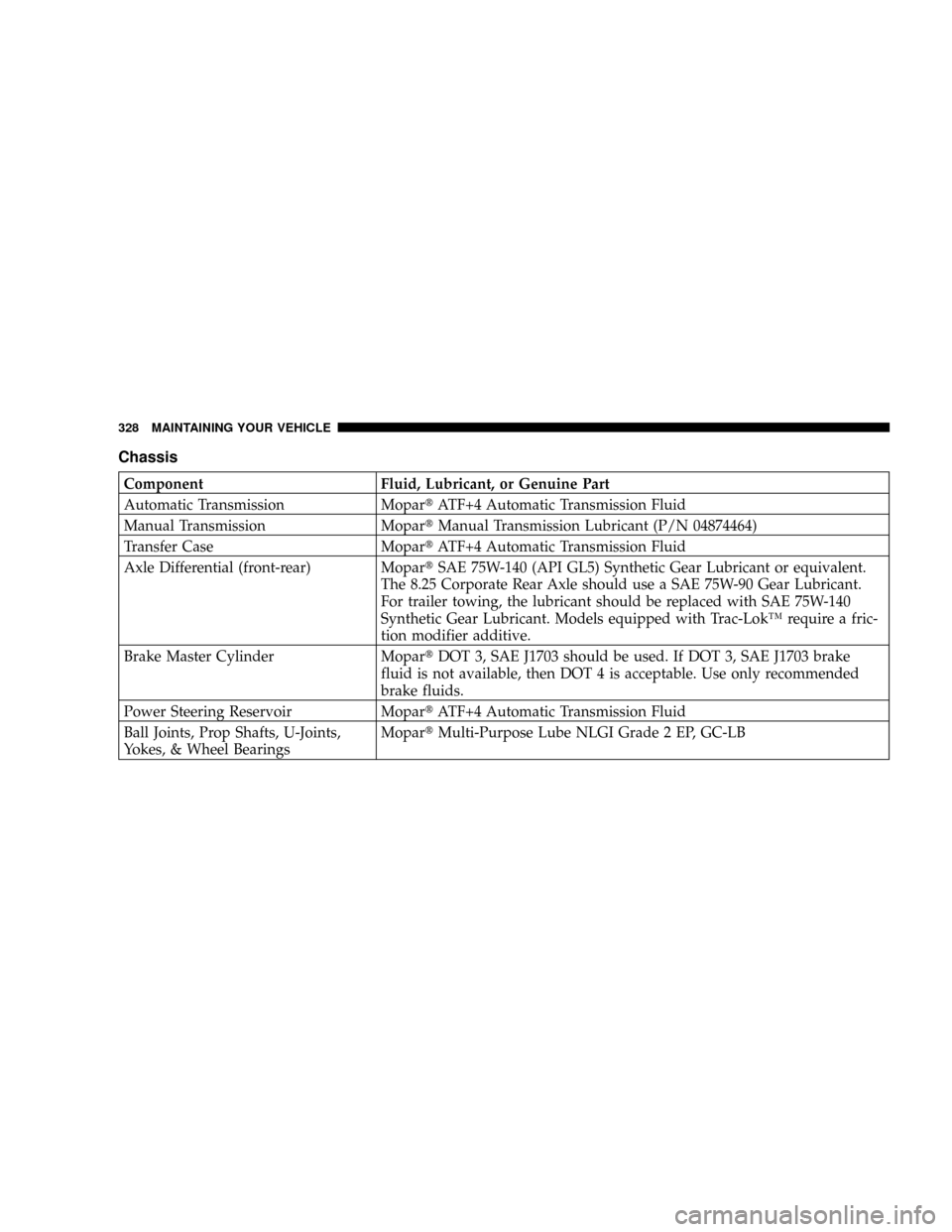
Chassis
Component Fluid, Lubricant, or Genuine Part
Automatic Transmission MopartATF+4 Automatic Transmission Fluid
Manual Transmission MopartManual Transmission Lubricant (P/N 04874464)
Transfer Case MopartATF+4 Automatic Transmission Fluid
Axle Differential (front-rear) MopartSAE 75W-140 (API GL5) Synthetic Gear Lubricant or equivalent.
The 8.25 Corporate Rear Axle should use a SAE 75W-90 Gear Lubricant.
For trailer towing, the lubricant should be replaced with SAE 75W-140
Synthetic Gear Lubricant. Models equipped with Trac-LokŸ require a fric-
tion modifier additive.
Brake Master Cylinder MopartDOT 3, SAE J1703 should be used. If DOT 3, SAE J1703 brake
fluid is not available, then DOT 4 is acceptable. Use only recommended
brake fluids.
Power Steering Reservoir MopartATF+4 Automatic Transmission Fluid
Ball Joints, Prop Shafts, U-Joints,
Yokes, & Wheel BearingsMopartMulti-Purpose Lube NLGI Grade 2 EP, GC-LB
328 MAINTAINING YOUR VEHICLE
Page 363 of 374

Flashers
Hazard Warning....................... 272
Turn Signal.......................... 151
Flat Tire Changing....................... 274
Flooded Engine Starting................... 211
Fluid Capacities......................... 326
Fluid Leaks............................. 70
Fluid Level Checks....................... 70
Automatic Transmission................. 311
Clutch Fluid.......................... 313
Engine Oil........................... 290
Manual Transmission................... 313
Power Steering........................ 300
Fog Lights............................. 102
Folding Rear Seat........................ 94
Four Wheel Drive....................... 222
Operation........................... 222
Shifting..........................225,230
Systems..........................222,226Four-Way Hazard Flasher.................. 272
Front Axle............................. 315
Fuel................................. 259
Filler Cap............................ 262
Filler Door........................... 262
Gasoline............................ 259
Gauge.............................. 157
Materials Added....................... 262
Octane Rating........................ 259
Requirements......................259,326
Tank Capacity........................ 326
Fuel System Caution..................... 263
Fuses................................ 320
Garage Door Opener..................... 125
GasCap .............................. 262
Gasoline.............................. 259
Gasoline, Reformulated................... 260
Gasoline/Oxygenate Blends................ 260
INDEX 363
10