Page 227 of 374
The PART TIME indicator light, located on the instru-
ment cluster, illuminates when the transfer case is shifted
to the 4 PART TIME position.
The FULL TIME indicator light, located on the instru-
ment cluster, illuminates when the transfer case is shifted
to the 4 FULL TIME position.
The 4LO MODE indicator light, located on the instru-
ment cluster, illuminates when the transfer case is shifted
to the 4LO position. There is no light for the 2WD, or N
(Neutral) positions.CAUTION!
²Do not attempt to make a shift while only the
front or rear wheels are spinning. The Selec-Trac
transfer case is not equipped with a synchronizer
and therefore the front and rear driveshaft speeds
must be equal for the shift to take place. Shifting
while only the front or rear wheels are spinning
can cause damage to the transfer case.
²When operating your vehicle in 4LO, the engine
speed is approximately three times that of the
2WD, 4 PART TIME, or 4 FULL TIME positions at
a given road speed. Take care not to overspeed the
engine and do not exceed 25 mph (40 km/h).
STARTING AND OPERATING 227
5
Page 231 of 374

rearward into 4LO. In 4 FULL TIME, there is a neutral
stop to prevent shifting into N (Neutral) by accident.
NOTE:Pausing in transfer case N (Neutral) in vehicles
equipped with an automatic transmission may require
shutting the engine OFF to avoid gear clash while
completing the shift. If difficulty occurs, shift transmis-
sion to N (Neutral), hold foot on brake, and turn engine
OFF. Make shift to desired mode.
NOTE:Shifting into or out of 4LO is possible with the
vehicle completely stopped, however difficulty may oc-
cur due to the mating clutch teeth not being properly
aligned. Several attempts may be required for clutch
teeth alignment and shift completion to occur. The pre-
ferred method is with the vehicle rolling 2 to 3 mph (3 to
5 km/h). Avoid attempting to engage or disengage 4LO
with the vehicle moving faster than 2 to 3 mph (3 to 5
km/h).TRAC-LOKŸ REAR AXLE Ð IF EQUIPPED
The optional Trac-LokŸ rear axle provides a constant
driving force to both rear wheels and reduces wheel spin
caused by the loss of traction at one driving wheel. If
traction differs between the two rear wheels, the differ-
ential automatically proportions the usable torque by
providing more torque to the wheel that has traction.
Trac-LokŸ is especially helpful during slippery driving
conditions. With both rear wheels on a slippery surface, a
slight application of the accelerator will supply maxi-
mum traction. When starting with only one rear wheel on
an excessively slippery surface, slight application of the
parking brake may be necessary to gain maximum trac-
tion.
STARTING AND OPERATING 231
5
Page 232 of 374
WARNING!
On vehicles equipped with a limited-slip differen-
tial, never run the engine with one rear wheel off the
ground. The vehicle may drive through the rear
wheel remaining on the ground and cause you to
lose control of your vehicle.
PARKING BRAKE
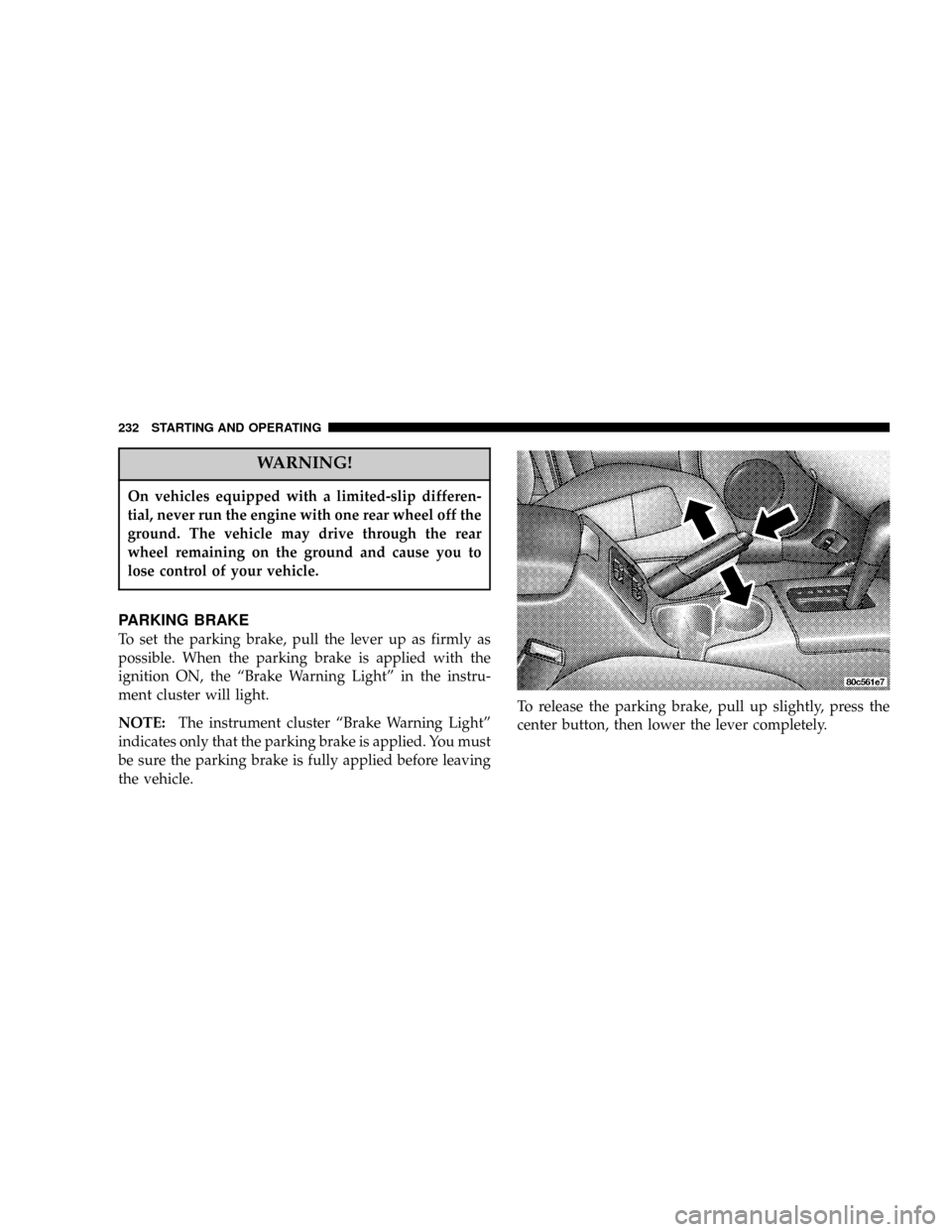
To set the parking brake, pull the lever up as firmly as
possible. When the parking brake is applied with the
ignition ON, the ªBrake Warning Lightº in the instru-
ment cluster will light.
NOTE:The instrument cluster ªBrake Warning Lightº
indicates only that the parking brake is applied. You must
be sure the parking brake is fully applied before leaving
the vehicle.To release the parking brake, pull up slightly, press the
center button, then lower the lever completely.
232 STARTING AND OPERATING
Page 237 of 374
In Snow, Mud and Sand
In heavy snow, when pulling a load, or for additional
control at slower speeds, shift the transmission to a low
gear and shift the transfer case to 4L or 4 LO if necessary.
Don't shift to a lower gear than necessary to maintain
headway. Over-revving the engine can spin the wheels
and traction will be lost.
Do not downshift on icy or slippery roads, because
engine braking may cause skidding and loss of control.
Hill Climbing
Before climbing a steep hill,shift the transmission to a
lower gear and shift the transfer case to 4L or 4 LO. Use
first gear and 4L or 4 LO for very steep hills.If you stall or begin to lose headwaywhile climbing a
steep hill, allow your vehicle to come to a stop and
immediately apply the brakes. Restart the engine and
shift to R (Reverse). Back slowly down the hill allowing
the compression braking of the engine and transmission
to help regulate your speed. If the brakes are required to
control vehicle speed, apply them lightly and avoid
locking or skidding the tires.
WARNING!
If the engine stalls or you lose headway or cannot
make it to the top of a steep hill or grade, never
attempt to turn around. To do so may result in
tipping and rolling the vehicle. Always back care-
fully straight down a hill in R (Reverse) gear. Never
back down a hill in N (Neutral) using only the brake.
STARTING AND OPERATING 237
5
Page 238 of 374

Remember, never drive diagonally across a hill-always
drive straight up or down.
If the wheels start to slip as you approach the crest of a
hill, ease off the accelerator and maintain headway by
turning the front wheels sharply left and right. This will
provide fresh ªbiteº into the surface and will usually
provide traction to complete the climb.
Traction Downhill
Shift the transmission into a low gear and the transfer
case to 4L or 4 LO range. Let the vehicle go slowly down
the hill with all four wheels turning against engine
compression drag. This will permit you to control the
vehicle speed and direction.
When descending mountains or hills, repeated braking
can cause brake fade with loss of braking control. Avoid
repeated heavy braking by downshifting the transmis-
sion whenever possible.
After Driving Off-Road
Off-road operation puts more stress on your vehicle than
does most on-highway driving. After going off-road it is
always a good idea to check for damage. That way you
can get any problems taken care of right away and have
your vehicle ready when you need it.
²Completely inspect the underbody of your vehicle.
Check tires, body structure, steering, suspension, and
exhaust system for damage.
²Check threaded fasteners for looseness, particularly on
the chassis, drivetrain components, steering, and sus-
pension. Retighten them, if required, and torque to the
values specified in the Service Manual.
²Check for accumulations of plants or brush. These
things could be a fire hazard. They might hide damage
to fuel lines, brake hoses, axle pinion seals, and
propeller shafts.
238 STARTING AND OPERATING
Page 259 of 374
NOTE:The Tire Pressure Monitor system must be
retrained following a tire rotation. See your authorized
dealer for service.
The suggested rotation method is the ªforward-crossº
shown in the following diagram.FUEL REQUIREMENTS
Your engine is designed to meet all emis-
sions regulations and provide excellent
fuel economy and performance when us-
ing high quality unleaded gasoline having
an octane rating of 87. The use of premium
gasoline is not recommended. The use of
premium gasoline will provide no benefit over high
quality regular gasoline, and in some circumstances may
result in poorer performance.
Mid-grade gasoline (89 octane) will enhance engine per-
formance during the following conditions (3.7L Only):
²Hot weather
²Towing
²Hard accelerations
²Hilly terrain
²Low humidity
STARTING AND OPERATING 259
5
Page 260 of 374

Light spark knock at low engine speeds is not harmful to
your engine. However, continued heavy spark knock at
high speeds can cause damage and immediate service is
required. Engine damage resulting from operation with a
heavy spark knock may not be covered by the new
vehicle warranty.
Poor quality gasoline can cause problems such as hard
starting, stalling and hesitations. If you experience these
symptoms, try another brand of gasoline before consid-
ering service for the vehicle.
Over 40 auto manufacturer's world wide have issued and
endorsed consistent gasoline specifications (the World-
wide Fuel Charter, WWFC) to define fuel properties
necessary to deliver enhanced emissions, performance,
and durability for your vehicle. The manufacturer recom-
mends the use of gasoline that meets the WWFC speci-
fications if they are available.Reformulated Gasoline
Many areas of the country require the use of cleaner
burning gasoline referred to as Reformulated Gasoline.
Reformulated gasoline contains oxygenates, and is spe-
cifically blended to reduce vehicle emissions and im-
prove air quality.
The manufacturer strongly supports the use of reformu-
lated gasoline. Properly blended reformulated gasoline
will provide excellent performance and durability for the
engine and fuel system components.
Gasoline/Oxygenate Blends
Some fuel suppliers blend unleaded gasoline with oxy-
genates such as 10% ethanol, MTBE, and ETBE. Oxygen-
ates are required in some areas of the country during the
winter months to reduce carbon monoxide emissions.
Fuels blended with these oxygenates may be used in
your vehicle.
260 STARTING AND OPERATING
Page 263 of 374
CAUTION!
Damage to the fuel system or emission control
system could result from using an improper fuel
tank filler cap (gas cap). A poorly fitting cap could let
impurities into the fuel system.
WARNING!
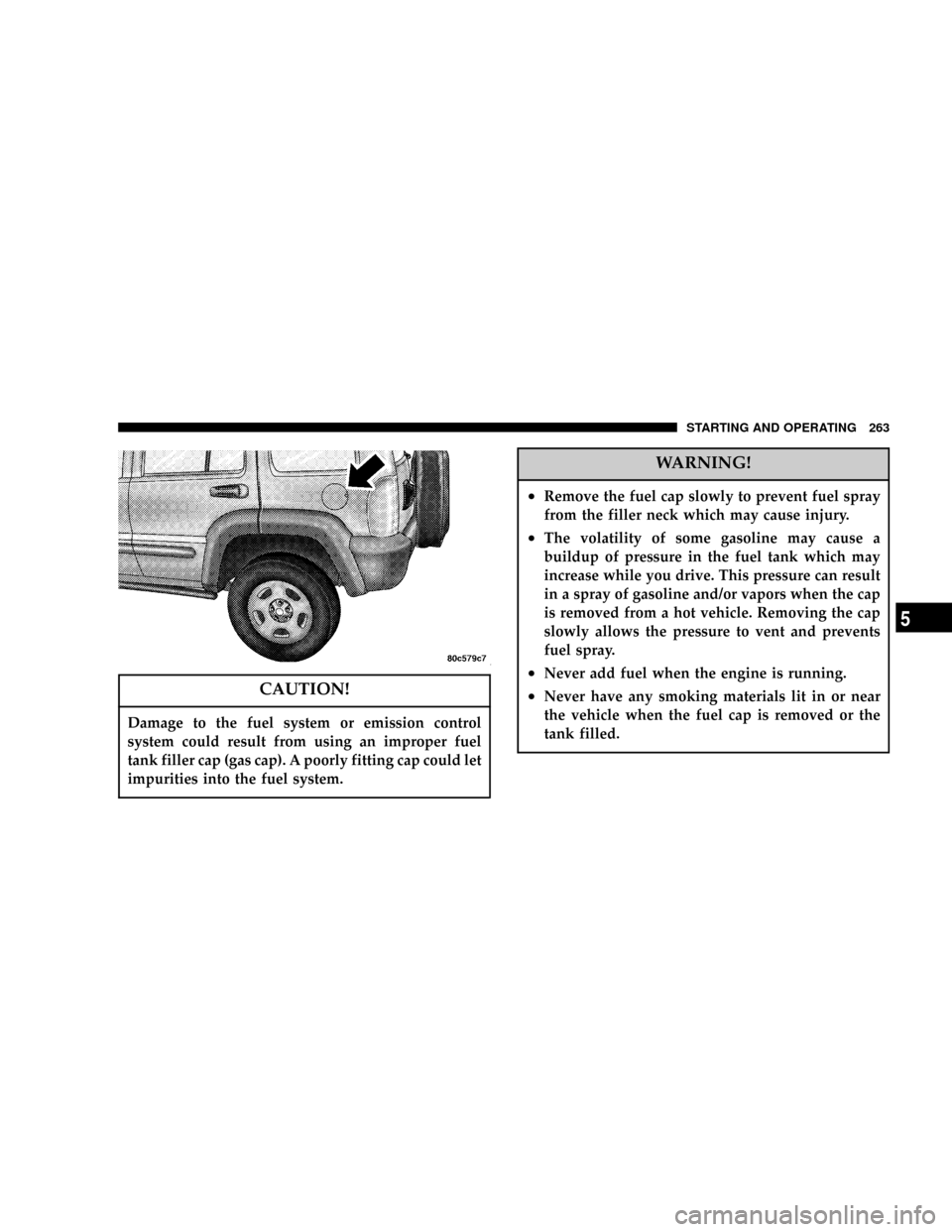
²Remove the fuel cap slowly to prevent fuel spray
from the filler neck which may cause injury.
²The volatility of some gasoline may cause a
buildup of pressure in the fuel tank which may
increase while you drive. This pressure can result
in a spray of gasoline and/or vapors when the cap
is removed from a hot vehicle. Removing the cap
slowly allows the pressure to vent and prevents
fuel spray.
²Never add fuel when the engine is running.
²Never have any smoking materials lit in or near
the vehicle when the fuel cap is removed or the
tank filled.
STARTING AND OPERATING 263
5