Page 248 of 374

WARNING!
Overloading of your tire is dangerous. Overloading
can cause tire failure, affect vehicle handling, and
increase your stopping distance. Use tires of the
recommended load capacity for your vehicle. Never
overload them.
TIRES Ð GENERAL INFORMATION
Proper tire inflation pressure is essential to the safe and
satisfactory operation of your vehicle. Three primary
areas are affected by improper tire pressure:1. SafetyÐ
WARNING!
Improperly inflated tires are dangerous and can
cause accidents.
²Under inflation increases tire flexing and can
result in tire failure.
²Over inflation reduces a tire's ability to cushion
shock. Objects on the road and chuck holes can cause
damage that results in tire failure.
²Unequal tire pressures can cause steering prob-
lems. You could lose control of your vehicle.
²Overinflated or under inflated tires can affect
vehicle handling and can fail suddenly, resulting in
loss of vehicle control.
Always drive with each tire inflated to the recom-
mended pressure.
248 STARTING AND OPERATING
Page 257 of 374

²This device must accept any interference received,
including interference that may cause undesired op-
eration.
The tire pressure sensors are covered under one of the
following licenses:
United States.....................KR5S120123
Canada........................2671-S120123TIRE CHAINS
CAUTION!
To avoid damage to your vehicle or tires, observe the following
precautions:
²Because of restricted chain clearance between tires and other
suspension components, it is important that only chains in
good condition are used. Broken chains can cause serious
damage. Stop the vehicle immediately if noise occurs that could
indicate chain breakage. Remove the damaged parts of the
chain before further use.
²Install chains on the rear wheels as tightly as possible and then
retighten after driving about1¤2mile (0.8 km).
²Do not exceed 30 mph (48 km/h).
²Drive cautiously and avoid severe turns and large bumps,
especially with a loaded vehicle.
²Do not drive for prolonged period on dry pavement.
²Observe the tire chain manufacturer's instructions on the
method of installation, operating speed, and conditions for use.
Always use the lower suggested operating speed of the chain
manufacturer if different than the speed recommended by the
manufacture.
STARTING AND OPERATING 257
5
Page 265 of 374
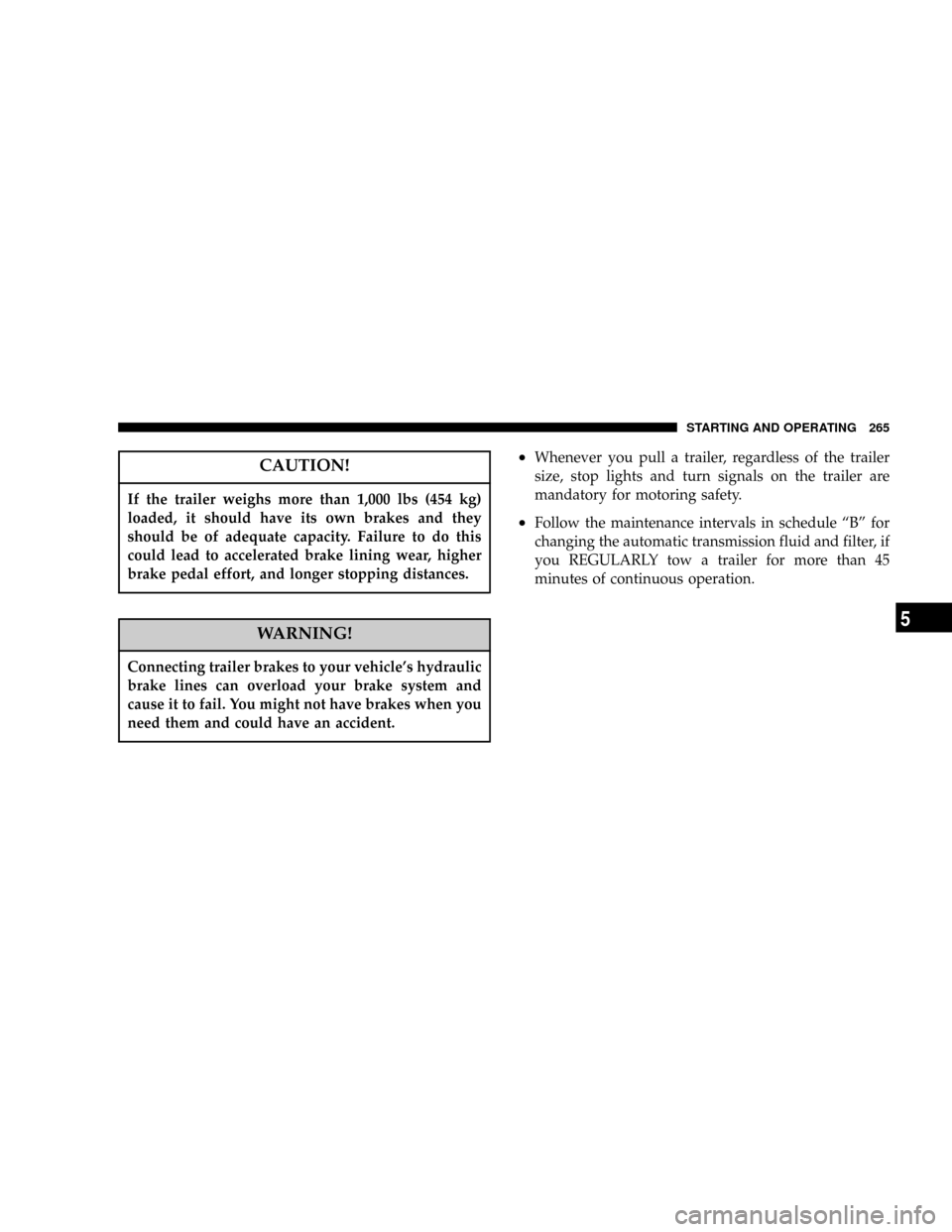
CAUTION!
If the trailer weighs more than 1,000 lbs (454 kg)
loaded, it should have its own brakes and they
should be of adequate capacity. Failure to do this
could lead to accelerated brake lining wear, higher
brake pedal effort, and longer stopping distances.
WARNING!
Connecting trailer brakes to your vehicle's hydraulic
brake lines can overload your brake system and
cause it to fail. You might not have brakes when you
need them and could have an accident.
²Whenever you pull a trailer, regardless of the trailer
size, stop lights and turn signals on the trailer are
mandatory for motoring safety.
²Follow the maintenance intervals in schedule ªBº for
changing the automatic transmission fluid and filter, if
you REGULARLY tow a trailer for more than 45
minutes of continuous operation.
STARTING AND OPERATING 265
5
Page 296 of 374

WARNING!
A hot exhaust system can start a fire if you park over
materials that can burn. Such materials might be
grass or leaves coming into contact with your ex-
haust system. Do not park or operate your vehicle in
areas where your exhaust system can contact any-
thing that can burn.
In unusual situations involving grossly malfunctioning
engine operation, a scorching odor may suggest severe
and abnormal catalyst overheating. If this occurs, stop
the vehicle, turn off the engine and allow it to cool.
Service, including a tune up to manufacturer's specifica-
tions, should be obtained immediately.
To minimize the possibility of catalytic converter dam-
age:
²Do not shut off the engine or interrupt the ignition
when the transmission is in gear and the vehicle is in
motion.
²Do not try to start the engine by pushing or towing the
vehicle.
²Do not idle the engine with any spark plug wires
disconnected or removed, such as when diagnostic
testing.
²Do not idle the engine for prolonged periods during
very rough idle or malfunctioning operating condi-
tions.
²Do not allow vehicle to run out of fuel.
NOTE:Intentional tampering with emissions control
systems can result in civil penalties being assessed
against you.
296 MAINTAINING YOUR VEHICLE
Page 321 of 374
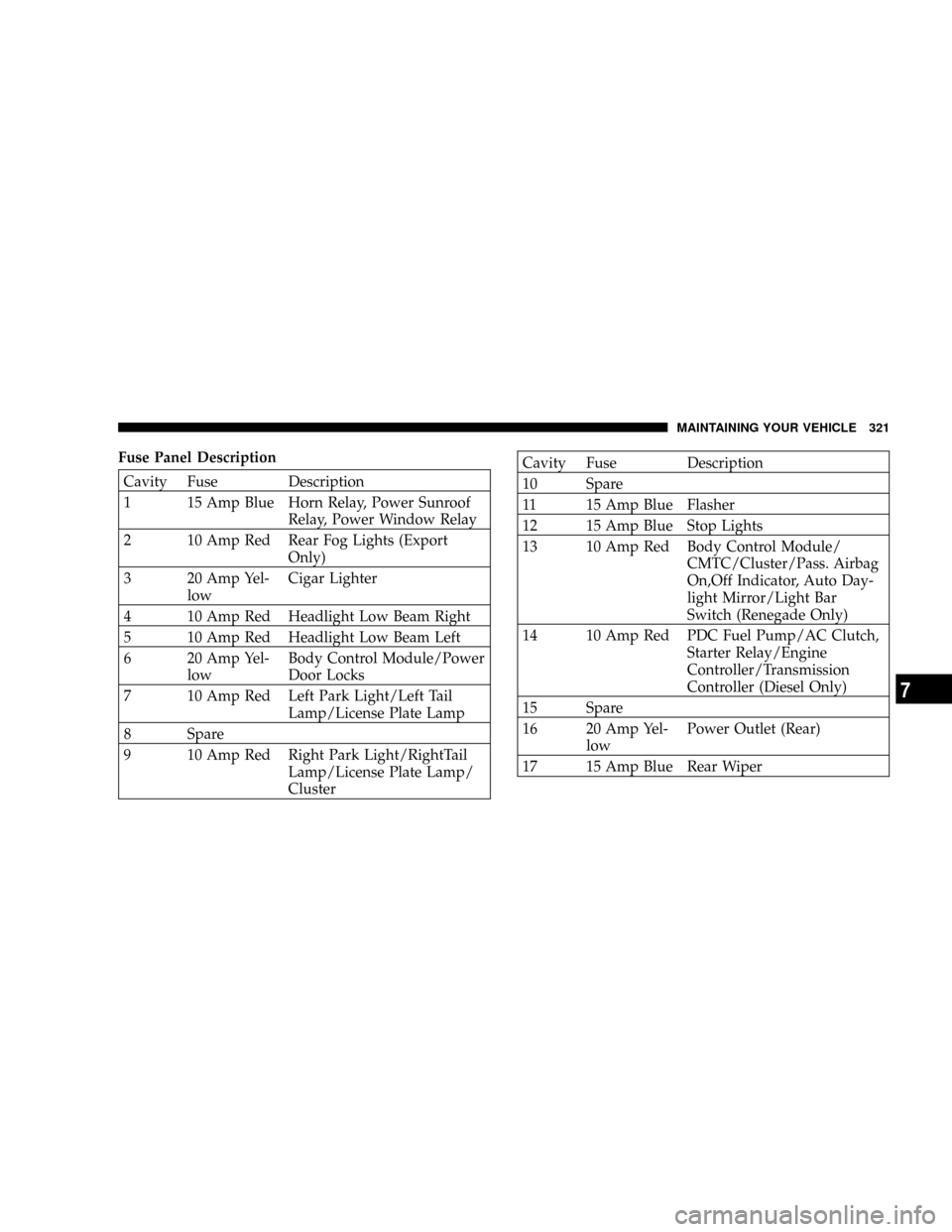
Fuse Panel Description
Cavity Fuse Description
1 15 Amp Blue Horn Relay, Power Sunroof
Relay, Power Window Relay
2 10 Amp Red Rear Fog Lights (Export
Only)
3 20 Amp Yel-
lowCigar Lighter
4 10 Amp Red Headlight Low Beam Right
5 10 Amp Red Headlight Low Beam Left
6 20 Amp Yel-
lowBody Control Module/Power
Door Locks
7 10 Amp Red Left Park Light/Left Tail
Lamp/License Plate Lamp
8 Spare
9 10 Amp Red Right Park Light/RightTail
Lamp/License Plate Lamp/
Cluster
Cavity Fuse Description
10 Spare
11 15 Amp Blue Flasher
12 15 Amp Blue Stop Lights
13 10 Amp Red Body Control Module/
CMTC/Cluster/Pass. Airbag
On,Off Indicator, Auto Day-
light Mirror/Light Bar
Switch (Renegade Only)
14 10 Amp Red PDC Fuel Pump/AC Clutch,
Starter Relay/Engine
Controller/Transmission
Controller (Diesel Only)
15 Spare
16 20 Amp Yel-
lowPower Outlet (Rear)
17 15 Amp Blue Rear Wiper
MAINTAINING YOUR VEHICLE 321
7