2004 JAGUAR XJ light
[x] Cancel search: lightPage 112 of 227

On the Road 4 - 41
Side Sunblinds
The rear door window sunblinds are
manually operated by lifting the blind
and securing it in the two clips provided.
To lower the blind just unhook it from
the clips and lower it gently back into the
stowage.Quarter light blinds have a single securing
clip. Pull the blind re
arwards and locate
it in the clip. To stow the blind, unhook it
and gently let it return into the stowage.
!WARNING:
Take care when re leasing the quarter
light blind because it could strike
your face if it slips from your hand.
Page 113 of 227

4-42 On the Road
Starting/Stopping the
Vehicle
When the vehicle is stationary the
automatic gear selector may be left in ‘D’,
‘ 2 ’, ‘ 3’, ‘ 4’ or ‘ 5’, unless the vehicle is to
be parked. When stopping for traffic
lights, junctions etc., either select ‘ P’ or
apply the parkbrake and select ‘ N’.
Before Starting
Before starting the engine, new owners/
drivers should familiarize themselves with
the layout and operation of the controls
and instruments.
!WARNING:
Before attempting to start the engine,
check parkbrake is ON and gear
selector lever is in position ‘P’ or ‘N’.
To Start the Engine
The engine cannot be started until the
gear selector is in ‘ N’ or ‘ P’.
Insert the key into the ignition switch and
turn clockwise to position ‘II’ to switch
on the ignition.
When the key is turned to position ‘III’
the starter motor will turn the engine
until:
• The key is released and automatically returns to position ‘II’.
• The ignition switch is turned to ‘0’ or ‘I’.
• The gear selector is moved out of ‘P’ or ‘N’.
• The engine starts.
If the engine fails to start, the key must be
turned to position ‘0’ before attempting
to restart.
Do not use the starter continuously for
longer than six seconds. Continued use of
the starter will disc harge the battery and
may damage the starter mechanism.
Wait until the engine stops turning before
re-using the starter.
When the engine starts, release the key. The red charge light and the oil pressure
light in the instrument cluster should go
out when the engine is running.
If the engine fails to start
If an ignition key is placed in the ignition
switch and turned to position ‘II’ and the
alarm security light is flashing, it is
possible that the engine will not start.
In any event, please contact a Jaguar
Retailer to investigate the cause of the
light flashing.
It is possible that the fuel system inertia
switch may have tripped, see page 6 - 3
for the resetting procedure.
If the engine persistent
ly fails to start and
flooding is suspected, depress the
accelerator pedal fully, hold it in this
position and turn the key to position ‘III’
for six seconds. Release the key, remove
your foot from the accelerator pedal and
then attempt to restart the engine.
Note: The engine cannot start whilst the
pedal is fully depressed, it must be
released to enable the engine to start.
If the engine still fail s to start, switch the
ignition OFF and contact a Jaguar
Retailer.
Page 115 of 227

4-44 On the Road
Note:
1. After selecting forward or reverse drive ranges from Neutral or Park,
wait briefly for th e transmission to
engage before accelerating.
2. When in Neutral or Park the engine can only be a ccelerated to
4500 rev/min.
R = Reverse – Do not select if the vehicle
is moving forward.
The reversing lights come ON
automatically when reverse gear is
selected and the ignition switch is in
position ‘II’.
D = Drive – All six gears are changed
automatically as required by the throttle
position and road speed.
2, 3, 4, 5 = If selected, the transmission
operates automatically in second, third,
fourth or fifth gear but will not engage
gears higher than the one selected. Drive to fifth
When driving in gear position ‘D’ with
sixth gear engaged, the gear selector can
be shifted sideways across the gate to ‘
5’.
Provided that the vehicle’s speed is not
too great, the transmission will shift
down to fifth. Sixth gear will be inhibited
until the gear selector is moved back to
‘D’.
Hill climbing and engine braking
When driving on roads with long
downhill gradients, selecting ‘3’ or ‘2’
(depending on road/traffic conditions)
will give engine braking.
When the gear selector is moved
from ‘D’, ‘5’, ‘4’ or ‘3’ down to ‘2’,
downshift to second ge ar will only take
place at appropriate road speeds.
Reverse inhibit
Reverse is inhibited when the vehicle is
moving forward at speeds above 5 mph
(8 km/h).
Note: Reverse inhibit will not function in
limp-home mode. Kickdown
Kickdown is operated when the pedal is
pressed fully down, beyond the normal
operating range and against a spring
pressure, to provide maximum engine
performance. Kickdown is used in
circumstances where rapid acceleration is
required, such as when overtaking.
Kickdown causes the transmission to
change down to the lowest gear possible
to achieve maximum acceleration.
The gear engaged depends on the road
speed at the time of kickdown.
As well as shifting
down, the gearshift
points are extended to give greater
performance. This mode is in effect for as
long as the pedal is pressed fully down.
Page 116 of 227
On the Road 4 - 45
Limp-home mode
In the unlikely event of an electrical or
mechanical failure, transmission
operation will be impaired. The vehicle
gear selector ranges P, R, N, D can still be
used to enable the vehicle to be driven to
a safe area. In this event consult a Jaguar
Retailer immediately.
!WARNING:
The driver should be aware that the
vehicle’s performance will be
reduced and must take this into
account when driving.
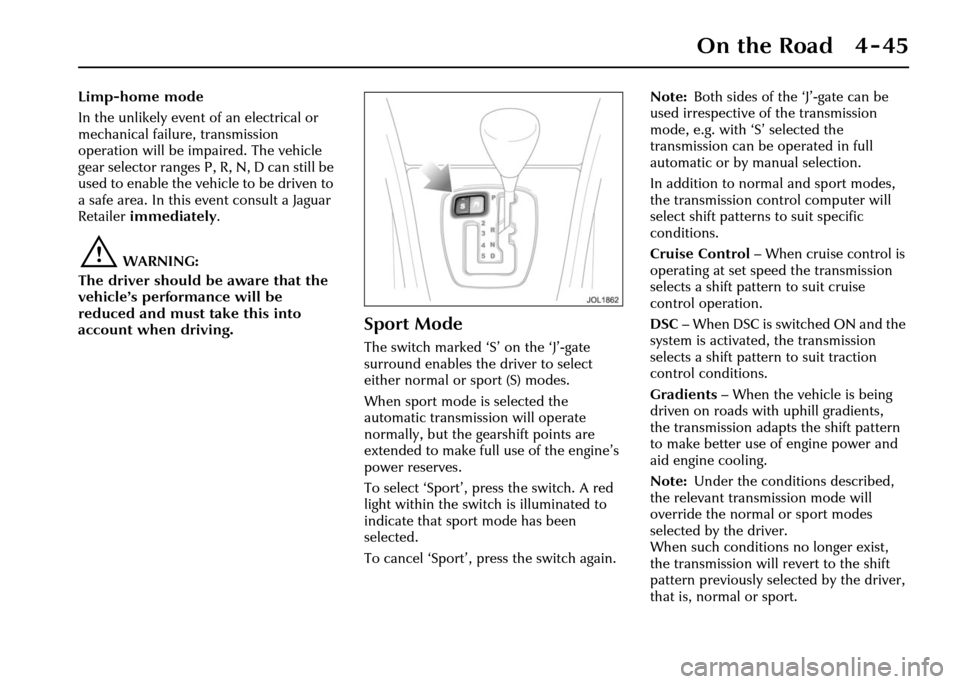
Sport Mode
The switch marked ‘S ’ on the ‘J’-gate
surround enables the driver to select
either normal or sport (S) modes.
When sport mode is selected the
automatic transmission will operate
normally, but the ge arshift points are
extended to make full use of the engine’s
power reserves.
To select ‘Sport’, press the switch. A red
light within the switch is illuminated to
indicate that sport mode has been
selected.
To cancel ‘Sport’, press the switch again. Note:
Both sides of the ‘J’-gate can be
used irrespective of the transmission
mode, e.g. with ‘S’ selected the
transmission can be operated in full
automatic or by manual selection.
In addition to norm al and sport modes,
the transmission control computer will
select shift patterns to suit specific
conditions.
Cruise Control – When cruise control is
operating at set speed the transmission
selects a shift pattern to suit cruise
control operation.
DSC – When DSC is switched ON and the
system is activated, the transmission
selects a shift pattern to suit traction
control conditions.
Gradients – When the vehicle is being
driven on roads with uphill gradients,
the transmission adapts the shift pattern
to make better use of engine power and
aid engine cooling.
Note: Under the conditions described,
the relevant transmission mode will
override the normal or sport modes
selected by the driver.
When such conditions no longer exist,
the transmission will revert to the shift
pattern previously selected by the driver,
that is, normal or sport.
Page 117 of 227

4-46 On the Road
Dynamic Stability
Control (DSC)
Unless it has been switched off, dynamic
stability control is operational whenever
the engine is running. If the system is
operating, the warning light in the
instrument cluster will flash.
The DSC system controls the anti-lock
braking system (ABS), traction control
and yaw control of the vehicle.Yaw control determines the vehicle’s
direction relative to
the driver’s inputs
(sideslip and under/ov ersteer). It applies
braking pressure to individual wheels if
excessive variation is detected.
This ensures that the vehicle follows the
driver’s intended direction of travel.
Traction control will intervene to reduce
wheel spin, by automatically reducing the
power output from the engine and
applying braking to individual wheels.
This improves acceleration, particularly
on surfaces with uneven friction,
for example, one wheel on ice the other
on tarmac.
ABS helps to prevent the road wheels
from locking and skidding during
emergency braking.
When the system is operating,
the warning light in the instrument
cluster will flash.
The dynamic stability control system can
be switched OFF by pressing the switch
on the centre console switchpack.
The warning light in the instrument
cluster will remain on and a message will
be shown to indicate that the system has
been switched OFF. If the switch is
pressed again the system will switch ON. Note:
If cruise control is engaged it will
automatically disengage if stability control
activates.
A system malfunction is indicated by the
message:
DSC NOT AVAILABLE
Warning light: Amber .
and the instrument cluster DSC warning
light will be lit.
It is safe to drive the vehicle but the
system may not activate under wheel spin
or slide conditions. Report the fault to a
Jaguar Retailer as soon as possible.
!WARNING:
1. The fact that the vehicle is fitted with Dynamic Stability Control
must never allow th e driver to be
tempted into taking risks which
could affect his/her safety or that
of other road users. In all cases it
remains the driver’s responsibility
to drive safely according to the
prevailing conditions.
2. It is recommended that when using snow chains, DSC should be
switched OFF.
Page 119 of 227

4-48 On the Road
ABS Monitoring
The ABS control module monitors the
ABS electrical system from ignition switch
ON to ignition switch OFF.
Any malfunction will be indicated by the
anti-lock warning light coming on.
Should a fault develo p in the ABS system,
the brake system will still operate
conventionally and with the same
standard of performance as vehicles not
equipped with ABS.
Caution: Consult a Jaguar Retailer
immediately if the warning light
comes on while driving, a system
failure is indicated.
Advice on ABS Braking
Techniques
For optimum ABS performance the
instructions on braking techniques during
ABS operation should be followed:
1. Do not release brake pressure when the pulsating effect is felt. Maintain a
constant pressure until the manoeuvre
is completed. 2. To familiarise yourself with the feel of
the brake pedal duri ng ABS braking,
practise an emergency stop
procedure, always making sure it is
safe to do so. With the seat belts fitted
to all occupants, drive the vehicle at
20 mph (32 km/h) and brake sharply.
3. ABS enables the driver to steer around obstacles during emergency braking.
However, the consequ ences of turning
sharply at high speed cannot be
overcome by the ABS.
4. Do not attempt to ‘pump’ the brakes to avoid skidding as this can interfere
with the ABS operation. The ABS will
not allow the wheels to skid under
normal road conditions.
5. The ABS will tend to keep the vehicle straight during braking. Because
braking distances may increase under
certain road conditio ns, it is necessary
to plan and make turning manoeuvres
as early as possible.
Emergency Brake Assist (EBA)
The EBA system measures the rate at
which the brake pressure increases.
If the system detect s an emergency
braking situation, EBA automatically
initiates the full br aking effect. This can
reduce stopping distances in critical
situations, which can help an
inexperienced driver to stop in the same
distance as an experienced driver.
!WARNING:
The EBA system is an additional safety
system: it is not intended to relieve
the driver of his responsibility for
exercising due care and attention
when driving.
Page 120 of 227

On the Road 4 - 49
Cruise (Speed) Control
The cruise (speed) control system can be
used by the driver to maintain a selected
vehicle speed above 17.5 mph (28 km/h)
without the driver having to use the
accelerator.
Switches on the steering wheel allow the
driver manual control of the system.
Brake operation also influences the cruise
control system. (
A ) – RESUME to resume the set speed
retained in memory.
( B ) – SET to set the speed or increase/
decrease the set speed when the speed
has been set.
( C ) – CANCEL cancels cruise control but
retains the set speed in memory.
Setting the Vehicle Speed
!WARNING:
Only use cruise control when
conditions are favourable,
for example, straight, dry, open roads
with light traffic.
When you are travelling at the speed you
require, which must be above 17.5 mph
(28 km/h), press the SET button.
Cruise control will engage and maintain
the set speed and you can remove your
foot from the accelerator pedal.
Note: Cruise control will automatically
disengage when the brake pedal is pressed
or when the vehicle speed falls below
16 mph (26 km/h).
Changing the Set Speed
There are three ways to change the set
speed:
1. Accelerate or decelerate to the desired speed then press the SET (+) button.
2. Increase or decrease the speed by pressing and holding either SET (+)
or (–) until the desired speed is
obtained, then release the switch.
3. Increase or decrease the speed in steps of 1 mph (2 km/h) by briefly
pressing either the SET (+) or (–) until
the desired speed is obtained.
Resuming the Set Speed
If the vehicle is accelerated above the set
speed, then the set speed will be resumed
when the accelerator pedal is released.
If CANCEL is pressed, or the brake pedal
is pressed, the cruise control will
disengage but the set speed memory will
be retained. Press RESUME and the
vehicle will return to the set speed.
Note: Cruise control will not resume at
speeds below 17.5 mph (28 km/h).
RESUME will not operate if the ignition
has been turned off.
Page 122 of 227

On the Road 4 - 51
Adaptive Cruise Control (ACC)
(Where fitted)
The adaptive cruise control system is designed to aid the driver
to maintain a gap from the vehicle ahead or a set road speed if
there is no slower vehicle ahead. The system is intended to
provide enhanced operation of th e vehicle when following other
vehicles which are in the same lane and travelling in the same
direction.
!WARNING:
Adaptive cruise control is not a collision warning or
avoidance system. Additionally , adaptive cruise control
will not detect:
1. Stationary or slow moving vehicles below 6 mph (10 km/h).
2. Pedestrians or objects in the roadway.
3. Oncoming vehicles in the same lane. The adaptive cruise control system is based on the use of a radar
sensor which projects a beam directly forward of the vehicle so
as to detect objects ahead. Th e radar sensor is mounted behind
a cover on the left-hand side of the lower cooling aperture,
to provide a clear ‘view’ forward for the radar beam.
• Only use adaptive cruise control when conditions are favourable, that is, straight, dry, open roads with light traffic.
• Do not use in poor visibility, specifically fog, heavy rain,
spray or snow.
• Do not use on icy or slippery roads.