Page 3975 of 4449
PS-42
HYDRAULIC LINE
Revision: 2004 November 2004 FX35/FX45
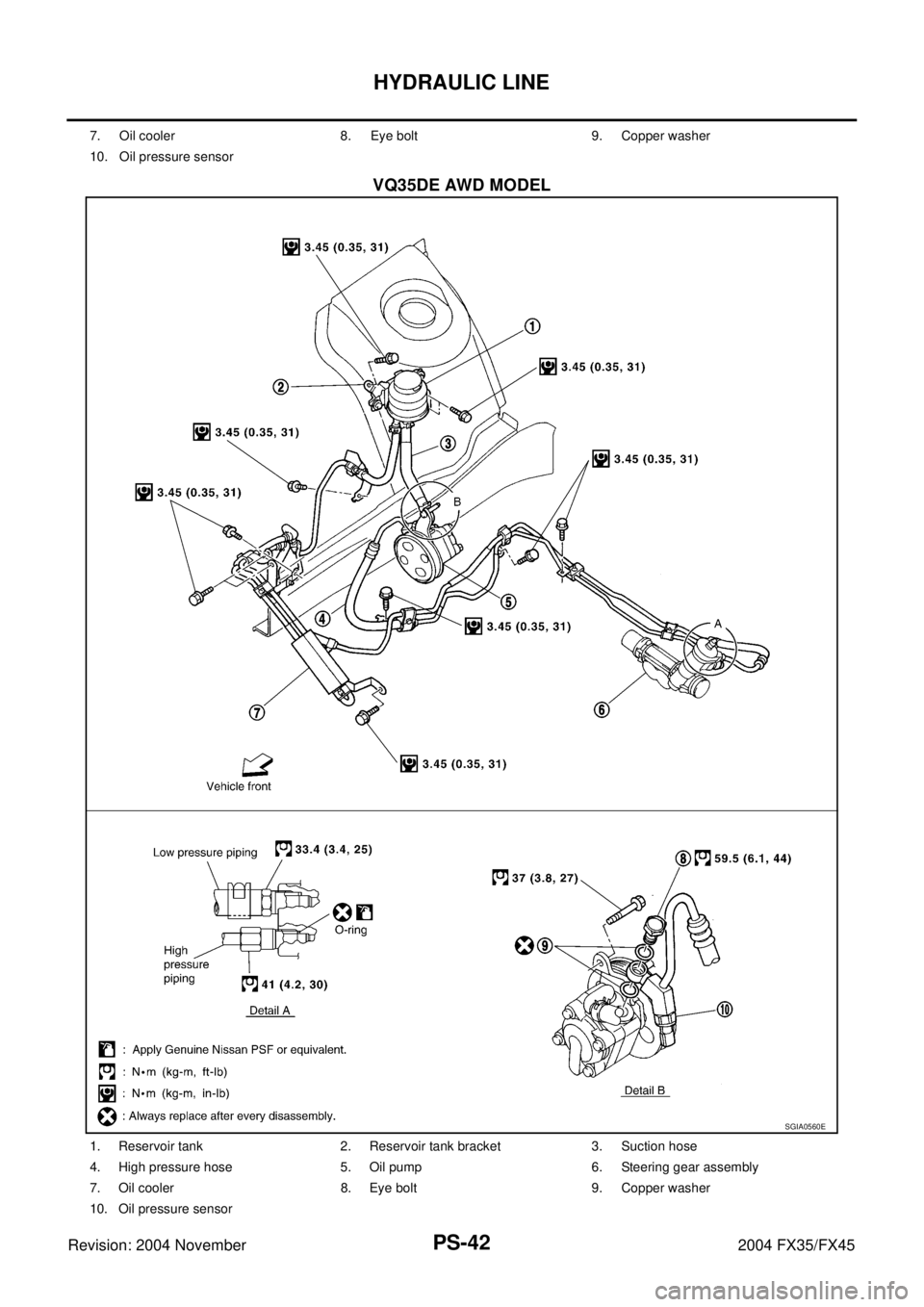
VQ35DE AWD MODEL
7. Oil cooler 8. Eye bolt 9. Copper washer
10. Oil pressure sensor
SGIA0560E
1. Reservoir tank 2. Reservoir tank bracket 3. Suction hose
4. High pressure hose 5. Oil pump 6. Steering gear assembly
7. Oil cooler 8. Eye bolt 9. Copper washer
10. Oil pressure sensor
Page 3977 of 4449
PS-44
HYDRAULIC LINE
Revision: 2004 November 2004 FX35/FX45
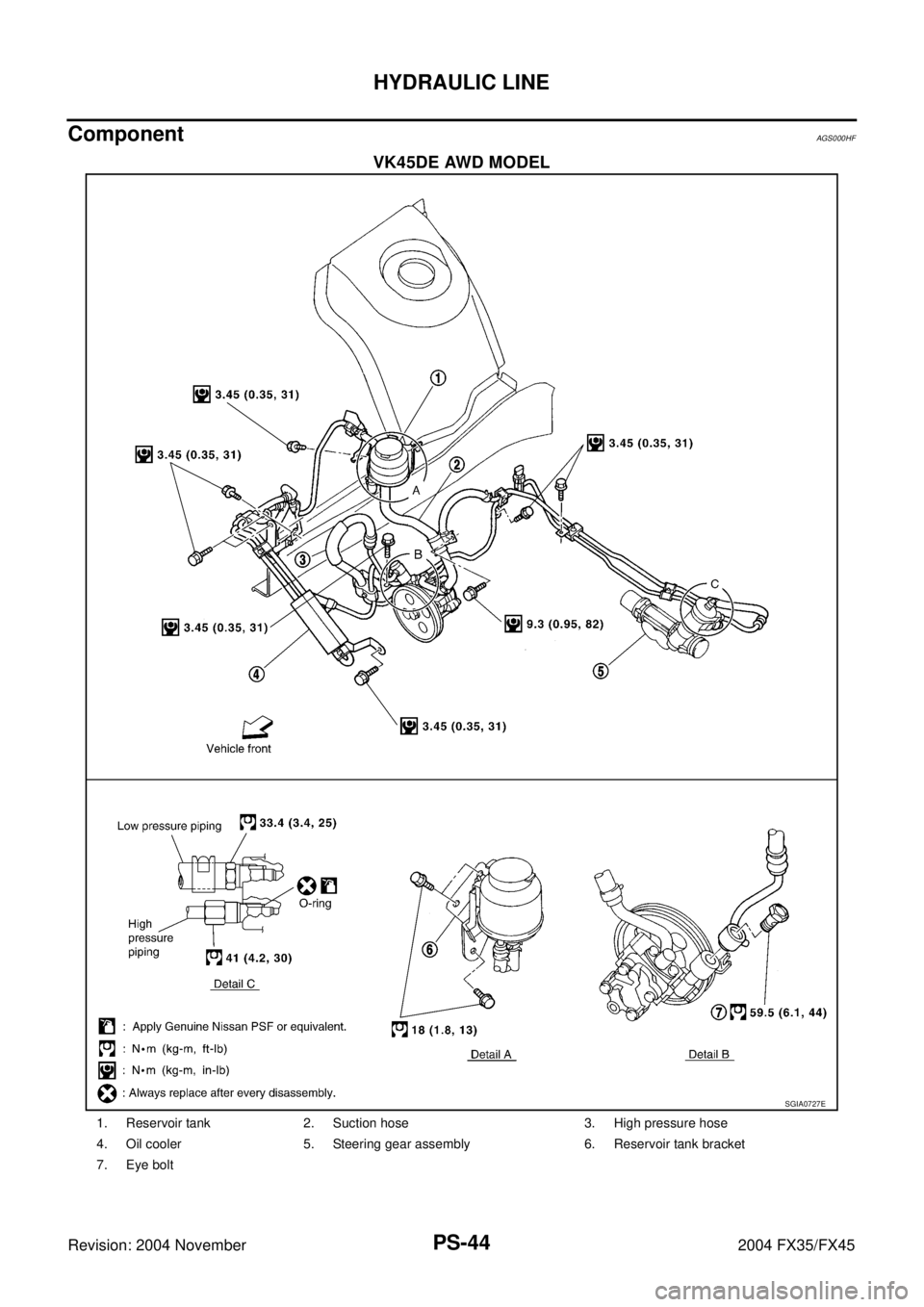
ComponentAGS000HF
VK45DE AWD MODEL
SGIA0727E
1. Reservoir tank 2. Suction hose 3. High pressure hose
4. Oil cooler 5. Steering gear assembly 6. Reservoir tank bracket
7. Eye bolt
Page 3980 of 4449
SERVICE DATA AND SPECIFICATIONS (SDS)
PS-47
C
D
E
F
H
I
J
K
L
MA
B
PS
Revision: 2004 November 2004 FX35/FX45
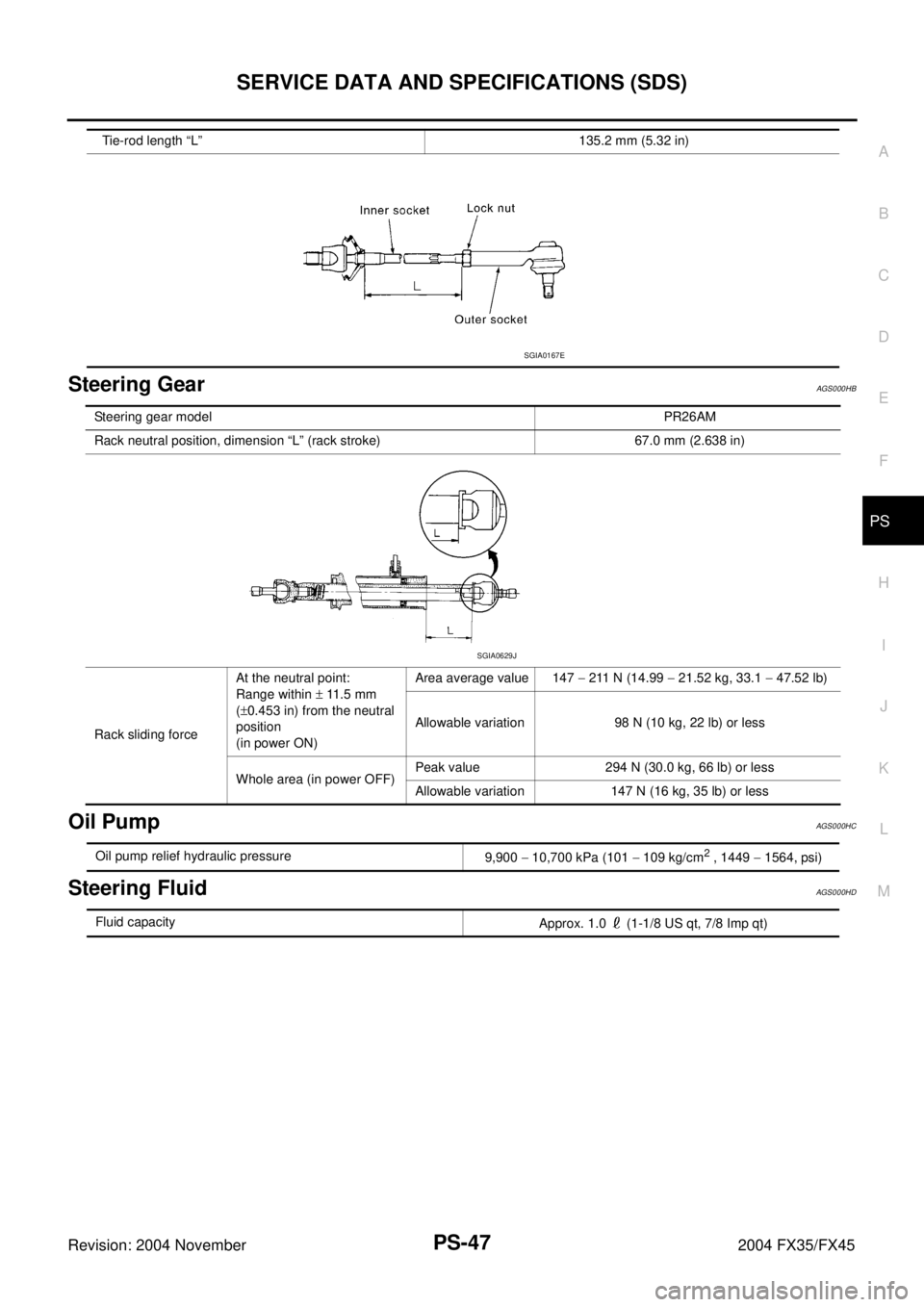
Steering GearAGS000HB
Oil PumpAGS000HC
Steering FluidAGS000HD
Tie-rod length “L” 135.2 mm (5.32 in)
SGIA0167E
Steering gear modelPR26AM
Rack neutral position, dimension “L” (rack stroke) 67.0 mm (2.638 in)
Rack sliding forceAt the neutral point:
Range within ± 11.5 mm
(±0.453 in) from the neutral
position
(in power ON)Area average value 147 − 211 N (14.99 − 21.52 kg, 33.1 − 47.52 lb)
Allowable variation 98 N (10 kg, 22 lb) or less
Whole area (in power OFF)Peak value 294 N (30.0 kg, 66 lb) or less
Allowable variation 147 N (16 kg, 35 lb) or less
SGIA0629J
Oil pump relief hydraulic pressure
9,900 − 10,700 kPa (101 − 109 kg/cm2 , 1449 − 1564, psi)
Fluid capacity
Approx. 1.0 (1-1/8 US qt, 7/8 Imp qt)
Page 3988 of 4449
WHEEL HUB
RAX-7
C
E
F
G
H
I
J
K
L
MA
B
RAX
Revision: 2004 November 2004 FX35/FX45
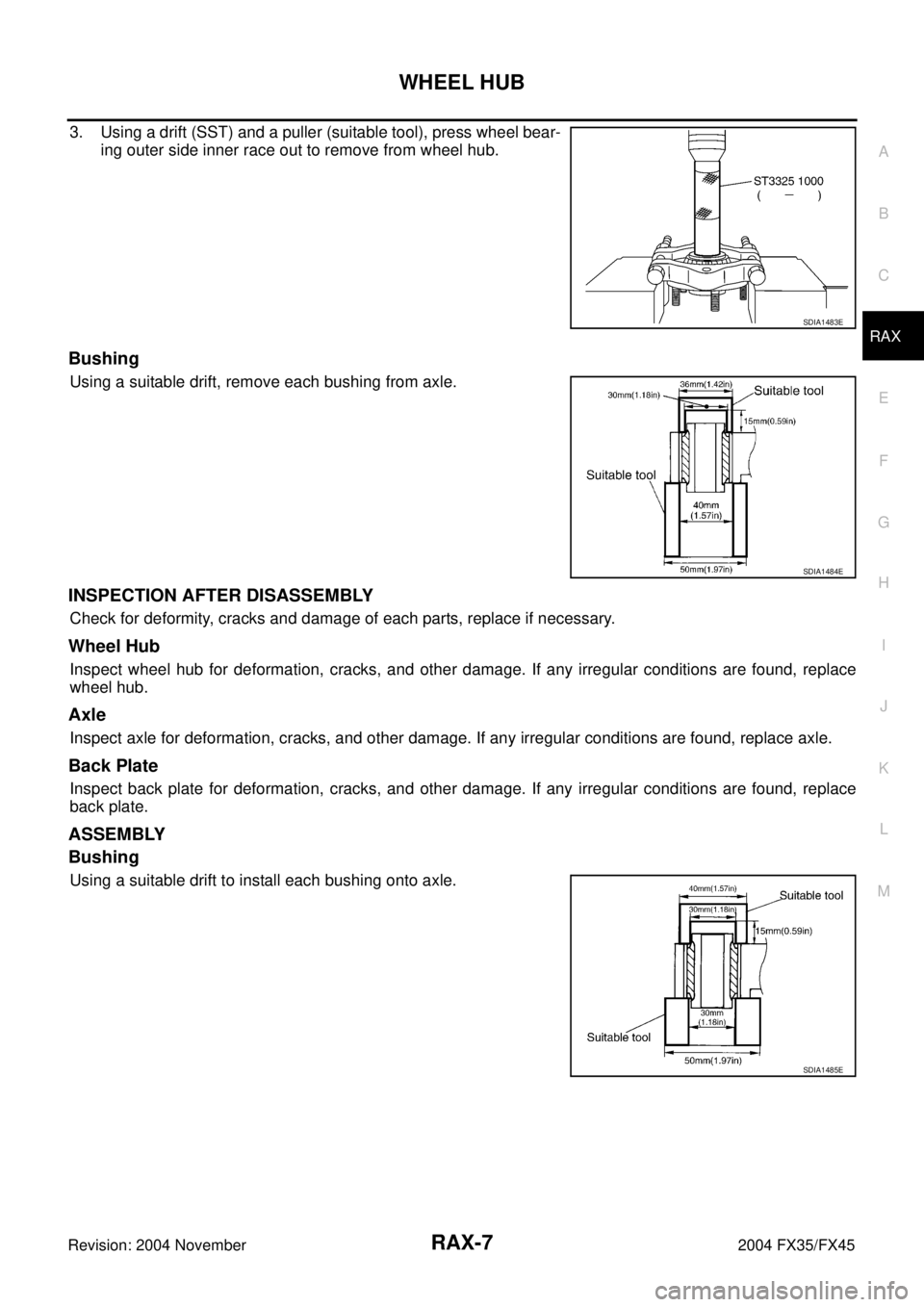
3. Using a drift (SST) and a puller (suitable tool), press wheel bear-
ing outer side inner race out to remove from wheel hub.
Bushing
Using a suitable drift, remove each bushing from axle.
INSPECTION AFTER DISASSEMBLY
Check for deformity, cracks and damage of each parts, replace if necessary.
Wheel Hub
Inspect wheel hub for deformation, cracks, and other damage. If any irregular conditions are found, replace
wheel hub.
Axle
Inspect axle for deformation, cracks, and other damage. If any irregular conditions are found, replace axle.
Back Plate
Inspect back plate for deformation, cracks, and other damage. If any irregular conditions are found, replace
back plate.
ASSEMBLY
Bushing
Using a suitable drift to install each bushing onto axle.
SDIA1483E
SDIA1484E
SDIA1485E
Page 3990 of 4449
REAR DRIVE SHAFT
RAX-9
C
E
F
G
H
I
J
K
L
MA
B
RAX
Revision: 2004 November 2004 FX35/FX45
REAR DRIVE SHAFTPFP:39600
Removal and InstallationADS000C7
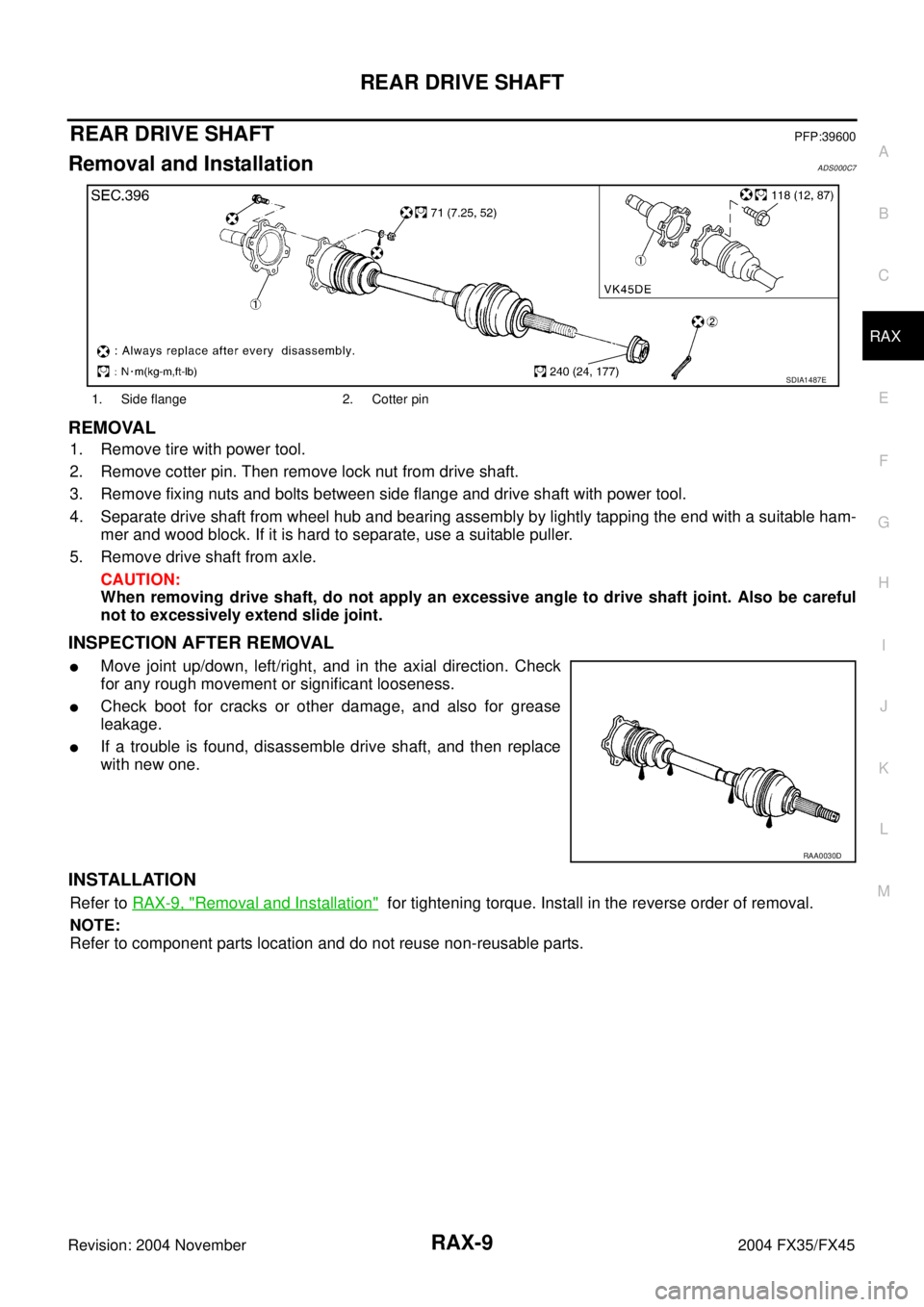
REMOVAL
1. Remove tire with power tool.
2. Remove cotter pin. Then remove lock nut from drive shaft.
3. Remove fixing nuts and bolts between side flange and drive shaft with power tool.
4. Separate drive shaft from wheel hub and bearing assembly by lightly tapping the end with a suitable ham-
mer and wood block. If it is hard to separate, use a suitable puller.
5. Remove drive shaft from axle.
CAUTION:
When removing drive shaft, do not apply an excessive angle to drive shaft joint. Also be careful
not to excessively extend slide joint.
INSPECTION AFTER REMOVAL
�Move joint up/down, left/right, and in the axial direction. Check
for any rough movement or significant looseness.
�Check boot for cracks or other damage, and also for grease
leakage.
�If a trouble is found, disassemble drive shaft, and then replace
with new one.
INSTALLATION
Refer to RAX-9, "Removal and Installation" for tightening torque. Install in the reverse order of removal.
NOTE:
Refer to component parts location and do not reuse non-reusable parts.
1. Side flange 2. Cotter pin
SDIA1487E
RAA0030D
Page 3992 of 4449
REAR DRIVE SHAFT
RAX-11
C
E
F
G
H
I
J
K
L
MA
B
RAX
Revision: 2004 November 2004 FX35/FX45
Wheel Side
1. Place shaft in a vice.
CAUTION:
When retaining drive shaft in a vise, always use copper or aluminum plates between vise and
shaft.
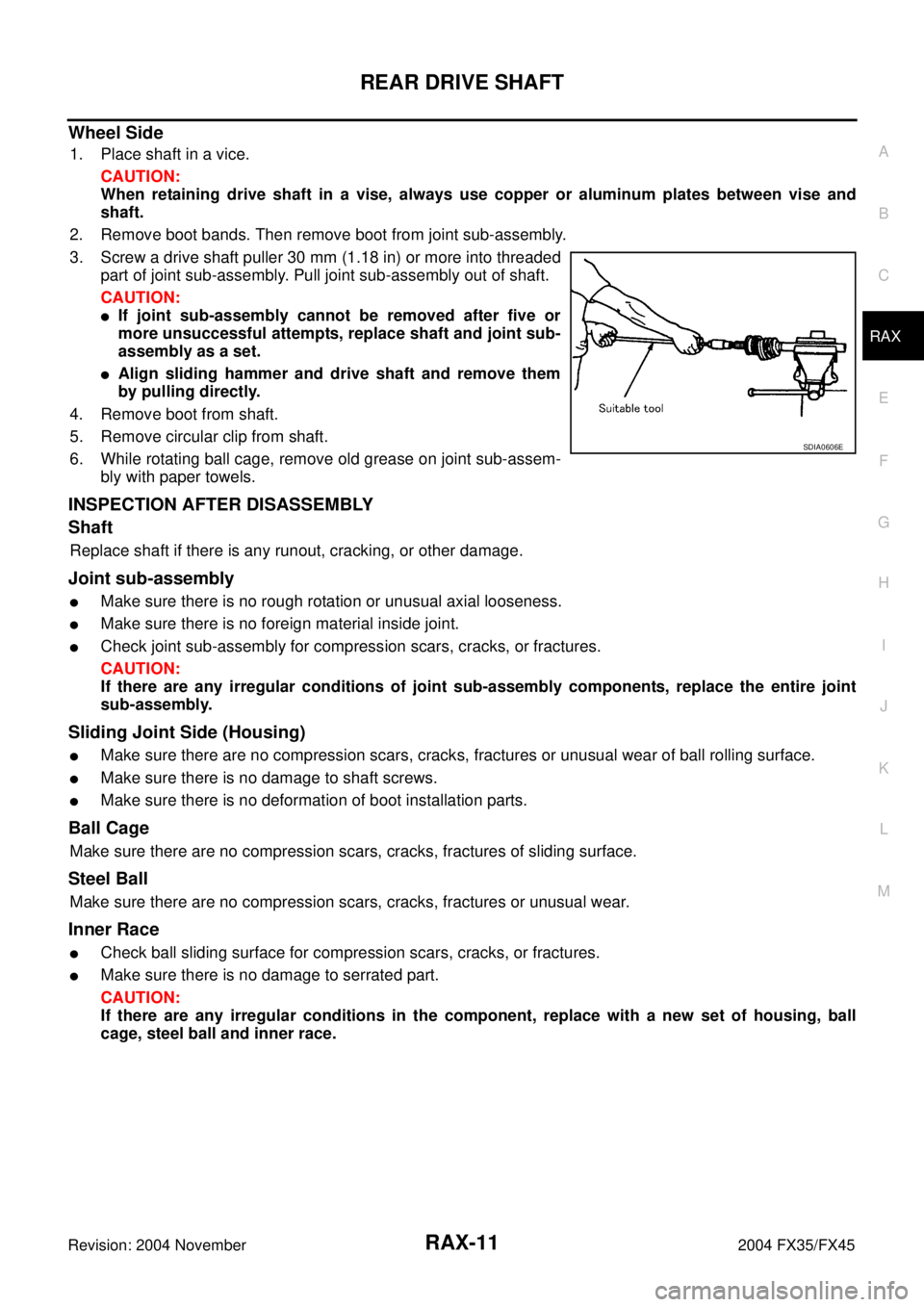
2. Remove boot bands. Then remove boot from joint sub-assembly.
3. Screw a drive shaft puller 30 mm (1.18 in) or more into threaded
part of joint sub-assembly. Pull joint sub-assembly out of shaft.
CAUTION:
�If joint sub-assembly cannot be removed after five or
more unsuccessful attempts, replace shaft and joint sub-
assembly as a set.
�Align sliding hammer and drive shaft and remove them
by pulling directly.
4. Remove boot from shaft.
5. Remove circular clip from shaft.
6. While rotating ball cage, remove old grease on joint sub-assem-
bly with paper towels.
INSPECTION AFTER DISASSEMBLY
Shaft
Replace shaft if there is any runout, cracking, or other damage.
Joint sub-assembly
�Make sure there is no rough rotation or unusual axial looseness.
�Make sure there is no foreign material inside joint.
�Check joint sub-assembly for compression scars, cracks, or fractures.
CAUTION:
If there are any irregular conditions of joint sub-assembly components, replace the entire joint
sub-assembly.
Sliding Joint Side (Housing)
�Make sure there are no compression scars, cracks, fractures or unusual wear of ball rolling surface.
�Make sure there is no damage to shaft screws.
�Make sure there is no deformation of boot installation parts.
Ball Cage
Make sure there are no compression scars, cracks, fractures of sliding surface.
Steel Ball
Make sure there are no compression scars, cracks, fractures or unusual wear.
Inner Race
�Check ball sliding surface for compression scars, cracks, or fractures.
�Make sure there is no damage to serrated part.
CAUTION:
If there are any irregular conditions in the component, replace with a new set of housing, ball
cage, steel ball and inner race.
SDIA0606E
Page 4004 of 4449
SQUEAK AND RATTLE TROUBLE DIAGNOSES
RF-7
C
D
E
F
G
H
J
K
L
MA
B
RF
Revision: 2004 November 2004 FX35/FX45
TRUNK
Trunk noises are often caused by a loose jack or loose items put into the trunk by the owner.
In addition look for:
1. Trunk lid dumpers out of adjustment
2. Trunk lid striker out of adjustment
3. Trunk lid torsion bars knocking together
4. A loose license plate or bracket
Most of these incidents can be repaired by adjusting, securing or insulating the item(s) or component(s) caus-
ing the noise.
SUNROOF/HEADLINING
Noises in the sunroof/headlining area can often be traced to one of the following:
1. Sunroof lid, rail, linkage or seals making a rattle or light knocking noise
2. Sunvisor shaft shaking in the holder
3. Front or rear windshield touching headlining and squeaking
Again, pressing on the components to stop the noise while duplicating the conditions can isolate most of these
incidents. Repairs usually consist of insulating with felt cloth tape.
SEATS
When isolating seat noise it's important to note the position the seat is in and the load placed on the seat when
the noise is present. These conditions should be duplicated when verifying and isolating the cause of the
noise.
Cause of seat noise include:
1. Headrest rods and holder
2. A squeak between the seat pad cushion and frame
3. Rear seatback lock and bracket
These noises can be isolated by moving or pressing on the suspected components while duplicating the con-
ditions under which the noise occurs. Most of these incidents can be repaired by repositioning the component
or applying urethane tape to the contact area.
UNDERHOOD
Some interior noise may be caused by components under the hood or on the engine wall. The noise is then
transmitted into the passenger compartment.
Causes of transmitted underhood noise include:
1. Any component mounted to the engine wall
2. Components that pass through the engine wall
3. Engine wall mounts and connectors
4. Loose radiator mounting pins
5. Hood bumpers out of adjustment
6. Hood striker out of adjustment
These noises can be difficult to isolate since they cannot be reached from the interior of the vehicle. The best
method is to secure, move or insulate one component at a time and test drive the vehicle. Also, engine RPM
or load can be changed to isolate the noise. Repairs can usually be made by moving, adjusting, securing, or
insulating the component causing the noise.
Page 4024 of 4449
SUNROOF
RF-27
C
D
E
F
G
H
J
K
L
MA
B
RF
Revision: 2004 November 2004 FX35/FX45
SUNROOF UNIT ASSEMBLY
Removal
CAUTION:
�Always work with a helper.
�When taking sunroof unit out, use clothes to protect the seats and trim from damage.
�After installing the sunroof unit and glass lid, be sure to perform the leakage test and make sure
there is no malfunction.
1. Tilt up glass lid.
2. Remove the headlining. Refer to EI-42, "
Removal and Installation" .
3. Disconnect drain hoses.
4. Remove glass lid. Refer to RF-28, "
GLASS LID" .
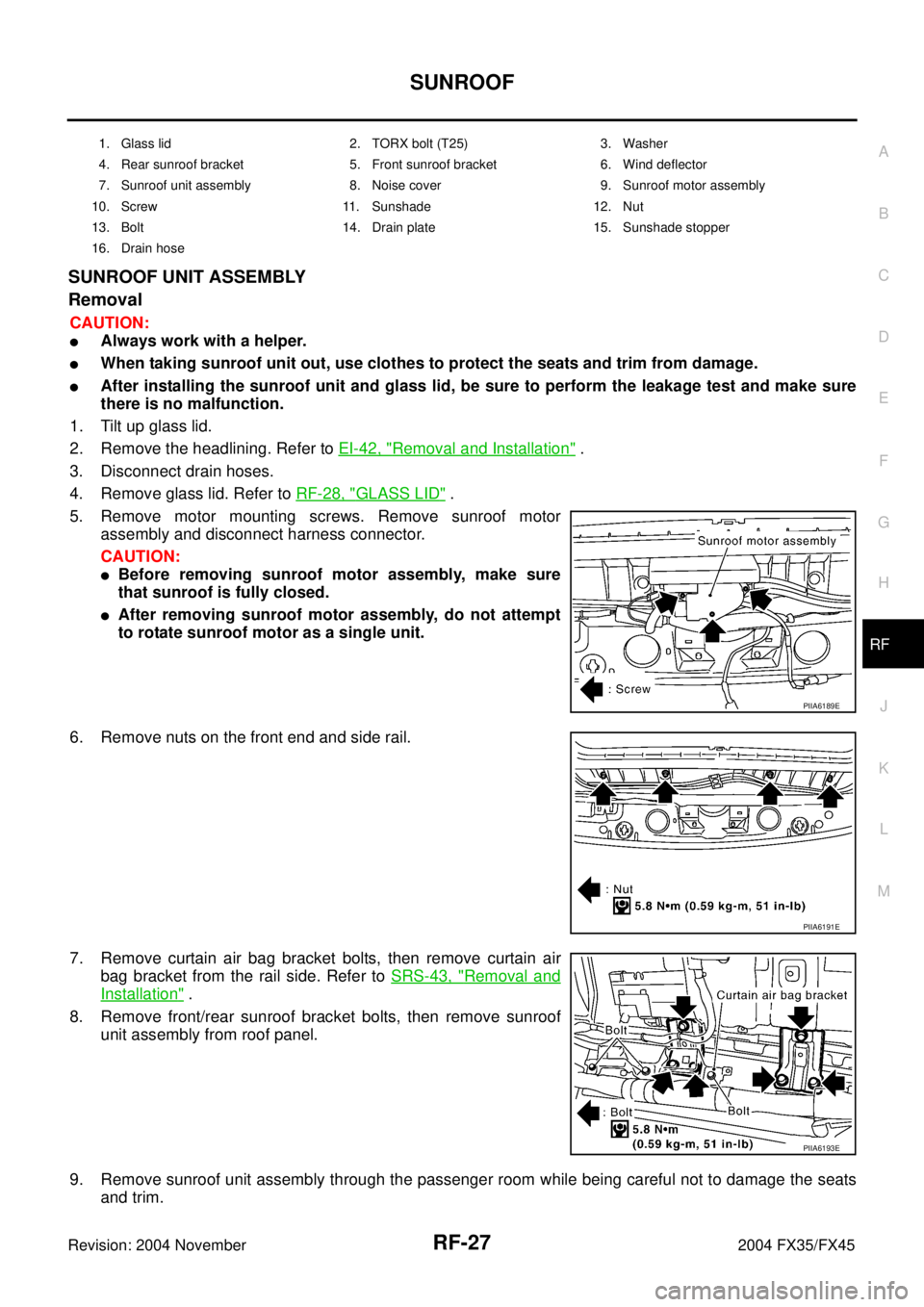
5. Remove motor mounting screws. Remove sunroof motor
assembly and disconnect harness connector.
CAUTION:
�Before removing sunroof motor assembly, make sure
that sunroof is fully closed.
�After removing sunroof motor assembly, do not attempt
to rotate sunroof motor as a single unit.
6. Remove nuts on the front end and side rail.
7. Remove curtain air bag bracket bolts, then remove curtain air
bag bracket from the rail side. Refer to SRS-43, "
Removal and
Installation" .
8. Remove front/rear sunroof bracket bolts, then remove sunroof
unit assembly from roof panel.
9. Remove sunroof unit assembly through the passenger room while being careful not to damage the seats
and trim.
1. Glass lid 2. TORX bolt (T25) 3. Washer
4. Rear sunroof bracket 5. Front sunroof bracket 6. Wind deflector
7. Sunroof unit assembly 8. Noise cover 9. Sunroof motor assembly
10. Screw 11. Sunshade 12. Nut
13. Bolt 14. Drain plate 15. Sunshade stopper
16. Drain hose
PIIA6189E
PIIA6191E
PIIA6193E