2004 Hyundai Grandeur wiring
[x] Cancel search: wiringPage 46 of 235

FEATURES OF YOUR HYUNDAI 1- 33
o For maximum safety protection
in all types of crashes, all occu- pants including the driver should always wear their seat belts whether or not an airbag is alsoprovided at their seating posi- tion to minimize the risk of se- vere injury or death in the eventof a crash. Do not sit or lean unnecessarily close to the airbag while the vehicle is in motion.
o The SRS airbag system must de- ploy very rapidly to provide pro-tection in a crash. If an occupantis out of position because of not wearing a seat belt, the airbag may forcefully contact the occu-pant causing serious or fatal in- juries.o Front airbags are not intended to
deploy in side-impact, rear-im- pact or rollover crashes. In addi- tion, airbags will not deploy in frontal crashes below the deploy-ment threshold speed.
o The driver should sit back as far
as possible while still maintain-ing control of the vehicle. If you are sitting too close to the airbag, it can cause death or seriousinjury when it inflates.
o No objects should be placed over
or near the airbag modules onthe steering wheel, instrument panel, and the front passenger's panel above the glove box,because any such object could cause harm if the vehicle is in a crash severe enough to causethe airbags to deploy.
o If the airbags deploy, they must
be replaced by an authorizedHyundai dealer. o Do not tamper with or discon-
nect SRS wiring, or other com-ponents of the SRS system. Do- ing so could result in injury, due to accidental firing of the airbagsor by rendering the SRS inopera- tive.
o Do not install a child restraint
system in the front passengerseat position. A child restraint system must never be placed inthe front seat. The infant or child could be severely injured or killed by an airbag deployment in caseof an accident.
o Do not allow children to ride in
the front passenger seat. If olderchildren (teenagers and older) must ride in the front seat, make sure they are always properlybelted and that the seat is moved back as far as possible.
Page 51 of 235

1- 38 FEATURES OF YOUR HYUNDAI
o Modification to SRS components
or wiring, including the addition of any kind of badges to the padcovers or modifications to the body structure, can adversely affect SRS performance and leadto possible injury.
o For cleaning the airbag pad cov-
ers, use only a soft, dry cloth orone which has been moistened with plain water. Solvents or cleaners could adversely affectthe airbag covers and proper deployment of the system.
o No objects should be placed over
or near the airbag modules onthe steering wheel, instrument panel, and the front passenger'spanel above the glove box, be- cause any such object could cause harm if the vehicle is in acrash severe enough to cause the airbags to inflate.
o If the airbags inflate, they must
be replaced by an authorizedHyundai dealer.
B240C01HP
WARNING:
o Extreme Hazard! Do not use a rearward facing child restraint on a seat protected by an airbagin front of it!
o Do not install a child restraint
system in the front passengerseat position. A child restraint system must never be placed in the front seat.The infant or child could be se- verely injured by an airbag de- ployment in case of an accident.
!
B240C03Y-GAT SRS Care The SRS is virtually maintenance-free and there are no parts you can safelyservice by yourself. The entire SRS system must be inspected by an au- thorized Hyundai dealer 10 years afterthe date that the vehicle was manufac- tured. Any work on the SRS system, such as removing, installing, repairing, or any work on the steering wheel must be
performed by a qualified Hyundai tech- nician. Improper handling of the SRS system may result in serious personalinjury. NOTE: Your vehicle's Supplemental Re- straint System Control Module isequipped a recording device which may record the use of the seat belt restraint system by the driver andfront passenger in certain colli- sions.
Page 52 of 235
FEATURES OF YOUR HYUNDAI 1- 39
o Do not tamper with or discon-
nect SRS wiring, or other com- ponents of the SRS system. Do-ing so could result in injury, due to accidental firing of the airbags or by rendering the SRS inopera-tive.
o If components of the airbag sys-
tem must be discarded, or if thevehicle must be scrapped, cer- tain safety precautions must be observed. Your Hyundai dealerknows these precautions and can give you the necessary informa- tion. Failure to follow these pre-cautions and procedures could increase the risk of personal in- jury.
o If you sell your vehicle, make certain that this manual is trans-ferred to the new owner.
o If your car was flooded and has soaked carpeting or water onflooring, you shouldn't try to startengine; have the car towed to authorized Hyundai dealer.B240D01JM-AAT Additional Safety Precautions oNever let passengers ride in the cargo area (trunk) or on top of a folded-down back seat. All occu-
pants should sit upright, fully back in their seats with their seat belts on and their feet on the floor.
o Passengers should not move out of or change seats while the ve- hicle is moving. A passenger who
is not wearing a seat belt during a crash or emergency stop can be thrown against the inside of thevehicle, against other occupants, or out of the vehicle.
o Each seat belt is designed to restrain one occupant. If more
than one person uses the sameseat belt, they could be seriouslyinjured or killed in a collision.
o Do not use any accessories onseat belts. Devices claiming to im-
prove occupant comfort or reposi- tion the seat belt can reduce the protection provided by the seat beltand increase the chance of serious injury in a crash. o
Passengers should not placehard or sharp objects between themselves and the airbags. Car-
rying hard or sharp objects on your lap or in your mouth can result in injuries if an airbag inflates.
o Keep occupants away from the airbag covers. All occupants should
sit upright, fully back in their seats with their seat belts on and their feet on the floor. If occupants are too close to the airbag covers, theycould be injured if the airbags in- flate.
o Do not attach or place objects onor near the airbag covers. Any
object attached to or placed on the front or side impact airbag covers could interfere with the proper op- eration of the airbags.
o Do not modify the front seats. Modification of the front seats could interfere with the operation of thesupplemental restraint system sens- ing components or side impact airbags.
Page 53 of 235
1- 40 FEATURES OF YOUR HYUNDAI
!
o Do not place items under the front seats. Placing items under
the front seats could interfere with the operation of the supplemental restraint system sensing compo- nents and wiring harnesses.
o Never hold an infant or child on your lap. The infant or child could
be seriously injured or killed in the event of a crash. All infants and children should be properly re- strained in appropriate child safetyseats or seat belts in the rear seat. Adding Equipment to or Modify- ing Your Airbag-Equipped Ve-hicle. If you modify your vehicle by changing your vehicle's frame, bumper system, front end or side sheet metal or rideheight, this may affect the operation of your vehicle's airbag system.
WARNING:
o Sitting improperly or out of posi- tion can result in serious injury or death in a crash.
o Always sit upright, fully back in the seat, with your seat belt on,and your feet on the floor.
Page 150 of 235

DRIVING YOUR HYUNDAI 2- 17
C160F01A-AAT Check Spark Plugs and Ignition System Inspect your spark plugs as described in Section 6 and replace them if neces-sary. Also check all ignition wiring and components to be sure they are not cracked, worn or damaged in any way. C160G01A-GAT To Keep Locks from Freezing To keep the locks from freezing, squirt an approved de-icer fluid or glycerineinto the key opening. If a lock is cov- ered with ice, squirt it with an approved de-icing fluid to remove the ice. If thelock is frozen internally, you may be able to thaw it out by using a heated key. Handle the heated key with careto avoid injury. NOTE: The proper temperature for using the immobilizer key is from -40°C to80°C. If you heat the immobilizer key over 80°C to open the frozen lock, it may cause damage to thetransponder in its head.
C160D01A-AAT Check Battery and Cables Winter puts additional burdens on the battery system. Visually inspect thebattery and cables as described in Section 6. The level of charge in your battery can be checked by your Hyun-dai dealer or a service station. C160E01A-AAT Change to "Winter Weight" Oil if Necessary In some climates it is recommended that a lower viscosity "winter weight" oil be used during cold weather. SeeSection 9 for recommendations. If you aren't sure what weight oil you should use, consult your Hyundai dealer.
C160I01A-AAT Don't Let Your Parking Brake Freeze Under some conditions your parking brake can freeze in the engaged posi- tion. This is most likely to happenwhen there is an accumulation of snow or ice around or near the rear brakes or if the brakes are wet. If there is a riskthe parking brake may freeze, apply it only temporarily while you put the gear selector lever in "P" (automatic) or infirst or reverse gear (manual transaxle) and block the rear wheels so the car cannot roll. Then release the parkingbrake.
C160H01A-AAT Use Approved Anti-Freeze in WindowWasher System To keep the water in the window washer system from freezing, add an approved anti-freeze solution in accordance withinstructions on the container. Window washer anti-freeze is available from Hyundai dealers and most auto partsoutlets. Do not use engine coolant or other types of anti-freeze as these may damage the finish.
Page 173 of 235

4- 6 CORROSION PREVENTION AND APPEARANCE CARE
E040E01A-AAT Cleaning the Windows You may use any household window cleaner on the windows. However, when cleaning the inside of the rearwindow be careful not to damage the rear window defroster wiring. E050A01A-AAT Any Questions? If you have any questions about the care of your car, consult your Hyundaidealer.
E040D01A-AAT Cleaning the Seat Belts To clean the seat belts, use a cloth or sponge with mild soap or detergent and warm water. Do not use strongdetergents, dye, bleach or abrasive materials on the seat belts as this may weaken the fabric.
E040C01A-AAT Cleaning the Carpets Use a foam-type carpet cleaner. Clean- ers of this type are available in aerosolcans in liquid form or powder. Read the instructions and follow them exactly. Using a vacuum cleaner with the ap-propriate attachment, remove as much dirt from the carpets as possible. Apply the foam following the manufacturer'sdirections, then rub in overlapping circles. Do not add water. These clean- ers work best when the carpet is keptas dry as possible.
E040B01A-AAT To Clean the Leather Upholstery (If installed) In the normal course of use, leather upholstered surfaces will, like any material, pick-up dust and dirt. Thisdust and dirt must be cleaned off or it may work into the surface of the leather, causing damage. Fine leather needs care, and should be cleaned when necessary. Washingleather thoroughly with soap and water will keep your leather lustrous, beauti- ful and ensure you have many years ofwear. Take a piece of cheese cloth and using any mild soap and lukewarm water,work up a good lather. Thoroughly wash the leather. Wipe clean with a slightly damp cloth and dry with softcloth. Do this as often as the leather becomes soiled. During tanning operations, sufficient oils are incorporated through process- ing that none need be applied duringthe life of the leather. Oil applied to the finished surface will in no way help the leather and may do more harm than good. Varnishes and furniture polishes should never be used under any con- ditions.
While cleaning the belts, inspect them for excessive wear, cuts, fraying or other signs of damage and replacethem if necessary.
Page 203 of 235
DO-IT-YOURSELF MAINTENANCE 6- 21
G190A01A-GAT
CHECKING DRIVE BELTS
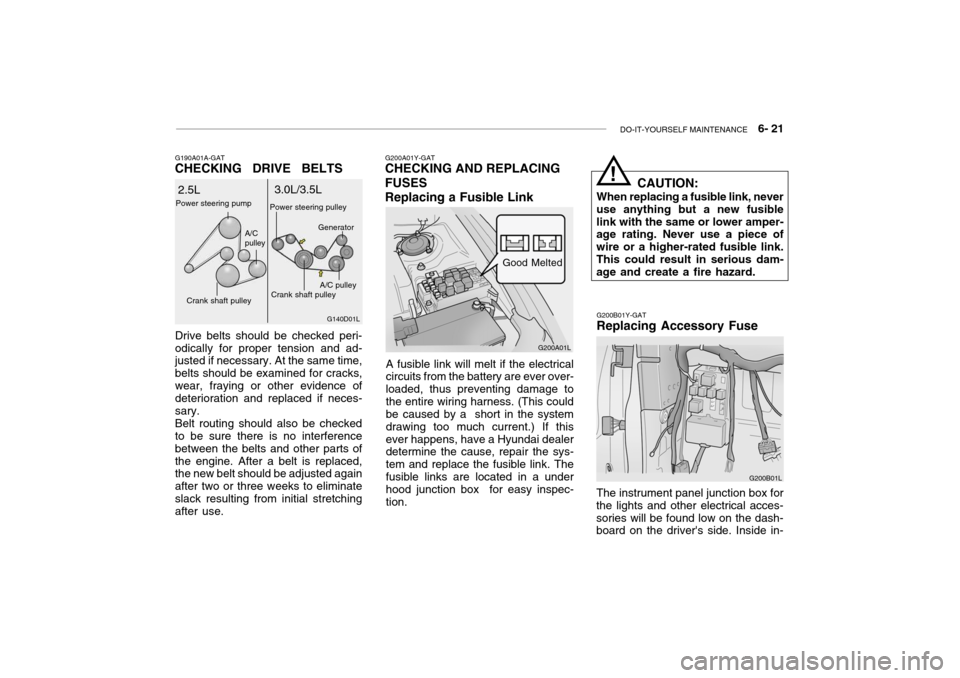
Drive belts should be checked peri- odically for proper tension and ad- justed if necessary. At the same time, belts should be examined for cracks,wear, fraying or other evidence of deterioration and replaced if neces- sary. Belt routing should also be checked to be sure there is no interference between the belts and other parts ofthe engine. After a belt is replaced, the new belt should be adjusted again after two or three weeks to eliminateslack resulting from initial stretching after use. G140D01L
2.5L
3.0L/3.5L
Power steering pump
Crank shaft pulley A/C pulley
Crank shaft pulley
A/C pulley
Power steering pulley
Generator
G200A01Y-GAT
CHECKING AND REPLACING FUSES Replacing a Fusible Link
A fusible link will melt if the electrical circuits from the battery are ever over- loaded, thus preventing damage tothe entire wiring harness. (This could be caused by a short in the system drawing too much current.) If thisever happens, have a Hyundai dealer determine the cause, repair the sys- tem and replace the fusible link. Thefusible links are located in a under hood junction box for easy inspec- tion. G200A01L
Melted
Good
G200B01Y-GAT Replacing Accessory Fuse
G200B01L
The instrument panel junction box for
the lights and other electrical acces- sories will be found low on the dash- board on the driver's side. Inside in- CAUTION:
When replacing a fusible link, never use anything but a new fusiblelink with the same or lower amper- age rating. Never use a piece of wire or a higher-rated fusible link.This could result in serious dam- age and create a fire hazard.
!