2004 Hyundai Getz warning
[x] Cancel search: warningPage 270 of 445

1- 12 FEATURES OF YOUR HYUNDAI
HFC2028
Lock knob
SB070D2-E
Head Restraint Adjustment
To raise the head restraint, pull it up. To
lower it, push it down while pressing the
lock knob. For maximum effectiveness
in the event of an accident, the restraint
must be adjusted so that the restraint is
approximately at the level of the seat
occupant's ears. The restraint must
never be so adjusted that it is centred
about the level of the seat occupant's
neck.SB070C1-E
Front Seat Recline Adjustment
HTB026-D
The front seat back recline angle may
be adjusted by leaning forward slightly
and raising the recline adjustment lever
at the side of the seat. When the
seatback is at the desired angle, the
lever should be released. Ensure that
the seatback is locked before driving
the vehicle.
!WARNING:
To minimize risk of severe injury in
the event of a collision or a sudden
stop, both the driver and passenger
seatbacks should always be in an
upright position while the vehicle is
in motion. The protection provided
by the seat belts and airbags in a
frontal collision may be reduced sig-
nificantly when the seatbacks are
reclined. There is greater risk that
the driver and passenger will slide
under the seat belt which may result
in serious injury if a crash occurs
when the seatbacks are reclined. The
seat belt cannot provide full protec-
tion to an occupant if the seatback is
reclined.
tbuk-1a.p65 3/23/04, 2:21 PM
12
Page 271 of 445

FEATURES OF YOUR HYUNDAI 1- 13
HTB025-D
SB070F1-F
Seat Cushion Height Adjustment
(Not all models) (Driver's seat
only)
To raise or lower the front part of the
seat cushion, turn the front knob for-
ward or rearward.
To raise or lower the rear part of the seat
cushion, turn the rear knob forward or
rearward.HTB027-D
SB070E1-E
Lumbar Support Adjustment
(Not all models) (Driver's seat
only)
Some models are fitted with adjustable
driver seat lumbar support which may
be used to increase the amount of
lumbar support offered by the seat back.
Adjustment is performed by moving the
handle at the side of the backrest in a
forward direction to increase the sup-
port.
!WARNING:
o For maximum effectiveness in case of an accident, the headrest should
be adjusted so the top of the head-
rest is at the same height as the
top of the occupant's ears. The
use of a cushion that holds the
body away from the seatback is
not recommended.
o Do not operate the vehicle with the headrests removed as severe in-
jury to an occupant may occur in
the event of an accident. Head-
rests may provide protection
against severe neck injuries when
properly adjusted.
tbuk-1a.p65 3/23/04, 2:21 PM
13
Page 272 of 445
1- 14 FEATURES OF YOUR HYUNDAI
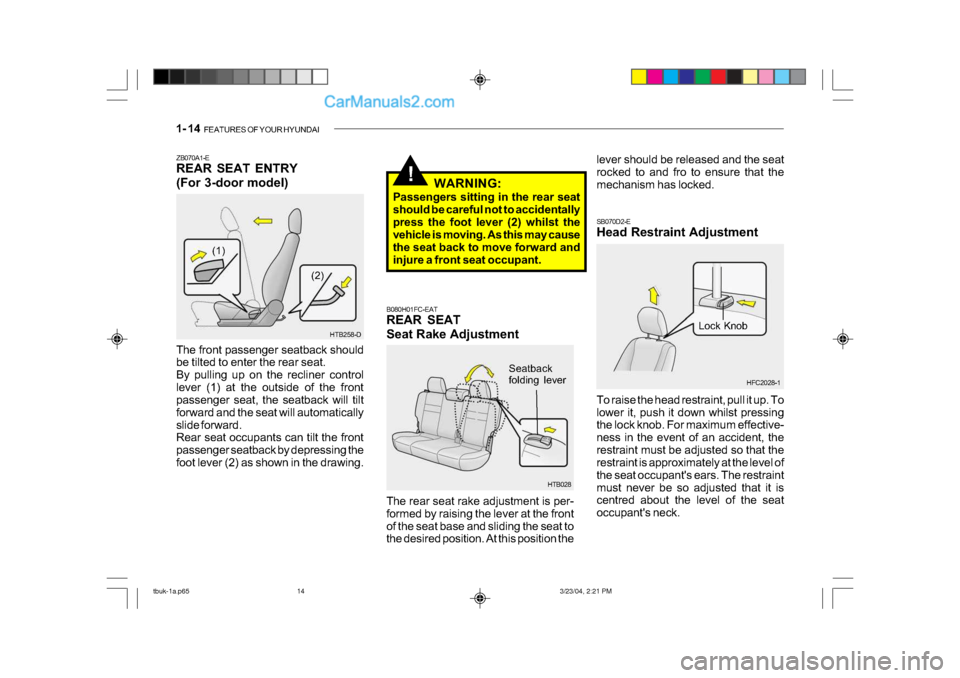
Lock Knob
SB070D2-E
Head Restraint Adjustment
To raise the head restraint, pull it up. To
lower it, push it down whilst pressing
the lock knob. For maximum effective-
ness in the event of an accident, the
restraint must be adjusted so that the
restraint is approximately at the level of
the seat occupant's ears. The restraint
must never be so adjusted that it is
centred about the level of the seat
occupant's neck. HFC2028-1
ZB070A1-E
REAR SEAT ENTRY
(For 3-door model)
The front passenger seatback should
be tilted to enter the rear seat.
By pulling up on the recliner control
lever (1) at the outside of the front
passenger seat, the seatback will tilt
forward and the seat will automatically
slide forward.
Rear seat occupants can tilt the front
passenger seatback by depressing the
foot lever (2) as shown in the drawing. B080H01FC-EAT
REAR SEAT
Seat Rake Adjustment
HTB258-D
(1)
(2)
The rear seat rake adjustment is per-
formed by raising the lever at the front
of the seat base and sliding the seat to
the desired position. At this position the HTB028
Seatback
folding lever
!WARNING:
Passengers sitting in the rear seat
should be careful not to accidentally
press the foot lever (2) whilst the
vehicle is moving. As this may cause
the seat back to move forward and
injure a front seat occupant. lever should be released and the seat
rocked to and fro to ensure that the
mechanism has locked.
tbuk-1a.p65
3/23/04, 2:21 PM
14
Page 273 of 445

FEATURES OF YOUR HYUNDAI 1- 15
HTB294
B099A02F-EAT
BEFORE FOLDING THE REAR
SEATS
Outboard Rear Seat Belt
HTB300
!
Rear Seat Centre's 3 Point Type Seat
Belt. In order to prevent the shoulder belt
from being damaged while folding the
rear seat, the shoulder belt must be
passed through the hanger to keep it
out of the way.
CAUTION:
Seat belts must be removed from the
hanger when in use.
!WARNING:
o For maximum effectiveness in case of an accident, the headrest should
be adjusted so the top of the head-
rest is at the same height as the
top of the occupant's ears. The
use of a cushion that holds the
body away from the seatback is
not recommended.
o Do not operate vehicle with the headrests removed as severe in-
jury to an occupant may occur in
the event of an accident. Head-
rests may provide protection
against severe neck injuries when
properly adjusted.
tbuk-1a.p65 3/23/04, 2:21 PM
15
Page 274 of 445

1- 16 FEATURES OF YOUR HYUNDAI
3. Pull the seat cushion release handle
rear ward, then lift up a desired seat
cushion.!WARNING:
o When you return the folded down seatback to its upright position,
make sure the seat belts are in
position to be accessible and to
function properly.
o When you return the folded down seatback to its upright position,
be careful not to get your fingers
or legs caught in the mechanism.
o The purpose of the fold down
rear seatback and the fold for-
ward rear seat cushion is to in-
crease cargo space. Do not allow
passengers to sit in the cargo
area while the car is moving. This
is not a proper seating position
4. To secure the seat, hook the secur-
ing strap under the seat back to the
headrest stay of front driver and
passenger seat.
5. To return the seatback and seat
cushion to its normal position, re-
verse the above procedure.
o When you return the seatback to its
upright position, always be sure it is
locked into position by pulling and
pushing on the top of seatback.
HTB030A
Seat cushion release handle
HTB031Securing strap
Securing Strap
B090B01TB-EAT
Folding Rear Seatback and Seat
Cushion
For greater convenience, the entire
seatback and seat cushion may be
folded down and up.
1. Push the headrest down to the low-
est position.
2. To fold down the seatback , push and hold the seatback folding lever
toward the headrest, then push down
the seatback. HTB029
Seatback folding lever
tbuk-1a.p65
3/23/04, 2:21 PM
16
Page 275 of 445

FEATURES OF YOUR HYUNDAI 1- 17
HTB195
B140A01B-GAT
REAR SEAT WARNING
For the safety of all passengers, lug-
gage or other cargo should not be piled
higher than the top of the seatback.
and no seat belts are available for
use when the seatback is folded
down. Passengers who are not
properly seated and wearing seat
belts could sustain serious inju-
ries or death in case of an accident
or a sudden stop.
o Objects should not extend higher
than the top of the front seatbacks.
This could allow cargo to slide
forward and cause injury or dam-
age during sudden stops.
o When you return the folded down seatback to its upright position,
always be sure to install the head-
rests in their proper positions.
Headrests are important to the
safety of occupants in a rear colli-
sion. If the headrests are not
installed in their proper position,
serious injury or death could re-
sult if a rear end collision occurs. SB090A1-E
SEAT BELT PRECAUTIONS
Seat belts should be worn at all times
by all occupants front and rear. The
possibility of injury or the severity of
injuries suffered in the event of an
accident will be greatly reduced by the
wearing of seat belts.
In addition the following recommenda-
tions should be observed.
SB090B1-E
Babies/Small Children
Babies and small children must be
restrained using a restraint system spe-
cifically designed for this purpose. Un-
der no circumstances should a child be
carried in the vehicle without the use of
a suitable restraint which meets the
regulations in force in the country where
the vehicle is in operation.
tbuk-1a.p65
3/23/04, 2:21 PM
17
Page 276 of 445

1- 18 FEATURES OF YOUR HYUNDAI
SB090C1-E
Larger Children
Larger children should occupy the rear
seat and be restrained at all times. The
restraint may take the form of a special
safety belt or the original factory fitted
seat belt used in conjunction with an
approved booster cushion depending
upon the size and weight of the child.
Under no circumstances should chil-
dren be allowed to travel standing, kneel-
ing or lying on the seat.
Never allow children to ride in the front
passenger seat.
SB090O1-E
Pregnant Women
The use of a seat belt is recommended
for pregnant women. The seat belt should
be worn as low and snugly as possible
across the hips, not across the abdo-
men. A qualified Medical Practitioner
should be consulted for further informa-
tion. SB090E1-E
Injured Persons
A seat belt should be used when an
injured person is being transported. For
specific recommendations, the advice
of a qualified Medical Practioner should
be sought.
SB090F1-E
Seat Belt Occupancy
The seat belts are designed to be used
by one seat occupant only. The use of
a seat belt by more than one person
increases the levels of injury which
may be sustained in the event of an
accident.
SE090G1-E
Do Not Lie Down
To ensure that the maximum level of
protection may be afforded by the seat
belt system, all passengers should be
sitting in an upright position throughout
the journey. The seat belt will be unable
to afford maximum protection if the
front seats are at or near the fully
reclined position.
!WARNING:
Sitting in a reclined position or lying
down when your vehicle is in motion
can be dangerous. Even if you buckle
up, your seat belts can't do their job
when you're reclined.
The shoulder belt can't do its job
because it won't be against your
body. Instead, it will be in front of
you. In a crash you could go into it
with great force, receiving serious
neck or other injuries.
The lap belt can't do its job either. In
a crash the belt could go up over
your abdomen. The belt forces would
be applied there, not at your strong
pelvic bones. This could cause seri-
ous internal injuries.
For proper protection when the ve-
hicle is in motion, have the seatback
upright. Then sit back in the seat and
wear your seat belt properly. See
page 1-20.
tbuk-1a.p65 3/23/04, 2:21 PM
18
Page 277 of 445
FEATURES OF YOUR HYUNDAI 1- 19
!
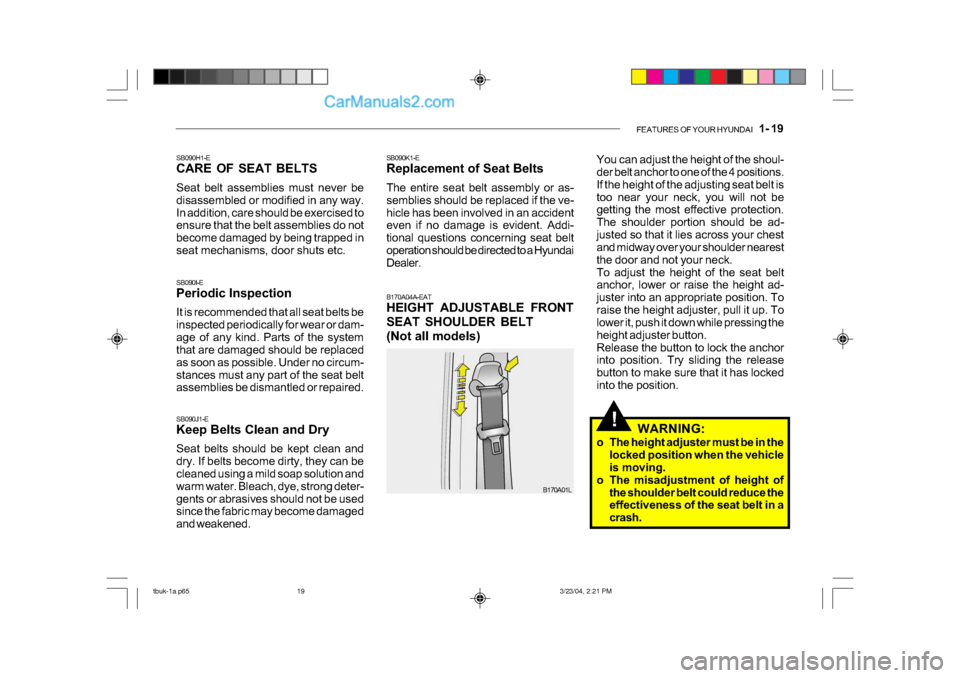
B170A01L
SB090K1-E
Replacement of Seat Belts
The entire seat belt assembly or as-
semblies should be replaced if the ve-
hicle has been involved in an accident
even if no damage is evident. Addi-
tional questions concerning seat belt
operation should be directed to a Hyundai
Dealer.
B170A04A-EAT
HEIGHT ADJUSTABLE FRONT
SEAT SHOULDER BELT
(Not all models)
You can adjust the height of the shoul-
der belt anchor to one of the 4 positions.
If the height of the adjusting seat belt is
too near your neck, you will not be
getting the most effective protection.
The shoulder portion should be ad-
justed so that it lies across your chest
and midway over your shoulder nearest
the door and not your neck.
To adjust the height of the seat belt
anchor, lower or raise the height ad-
juster into an appropriate position. To
raise the height adjuster, pull it up. To
lower it, push it down while pressing the
height adjuster button.
Release the button to lock the anchor
into position. Try sliding the release
button to make sure that it has locked
into the position.
WARNING:
o The height adjuster must be in the locked position when the vehicle
is moving.
o The misadjustment of height of the shoulder belt could reduce the
effectiveness of the seat belt in a
crash.
SB090H1-E
CARE OF SEAT BELTS
Seat belt assemblies must never be
disassembled or modified in any way.
In addition, care should be exercised to
ensure that the belt assemblies do not
become damaged by being trapped in
seat mechanisms, door shuts etc.
SB090I-E
Periodic Inspection
It is recommended that all seat belts be
inspected periodically for wear or dam-
age of any kind. Parts of the system
that are damaged should be replaced
as soon as possible. Under no circum-
stances must any part of the seat belt
assemblies be dismantled or repaired.
SB090J1-E
Keep Belts Clean and Dry
Seat belts should be kept clean and
dry. If belts become dirty, they can be
cleaned using a mild soap solution and
warm water. Bleach, dye, strong deter-
gents or abrasives should not be used
since the fabric may become damaged
and weakened.
tbuk-1a.p65
3/23/04, 2:21 PM
19