2004 Hyundai Getz engine
[x] Cancel search: enginePage 254 of 445
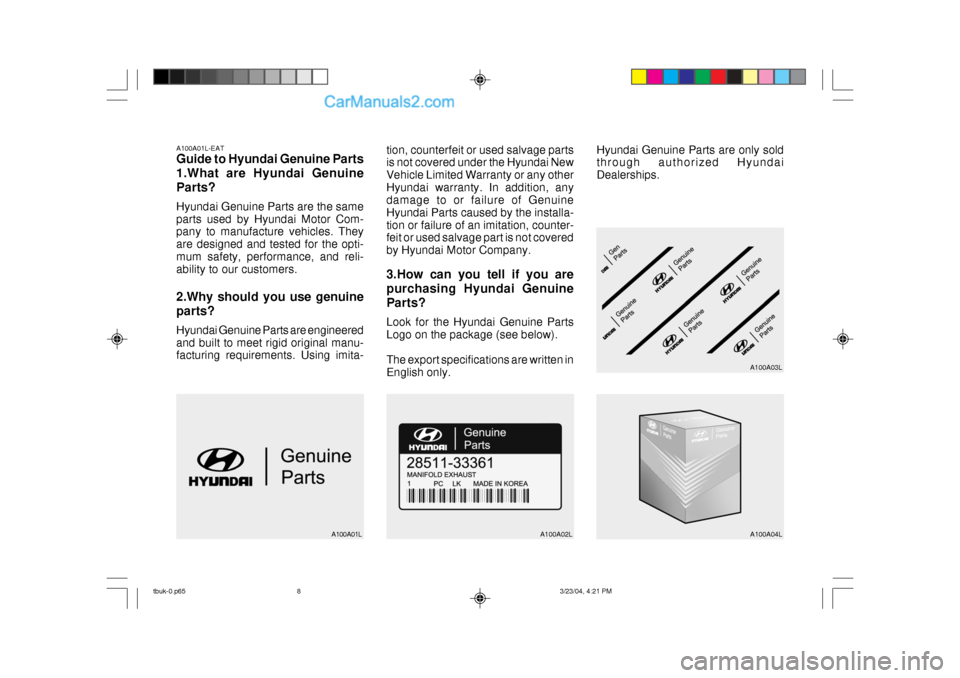
A100A01L-EAT Guide to Hyundai Genuine Parts 1.What are Hyundai GenuineParts? Hyundai Genuine Parts are the same parts used by Hyundai Motor Com- pany to manufacture vehicles. They are designed and tested for the opti-mum safety, performance, and reli- ability to our customers. 2.Why should you use genuine parts? Hyundai Genuine Parts are engineered and built to meet rigid original manu- facturing requirements. Using imita-A100A01Ltion, counterfeit or used salvage partsis not covered under the Hyundai New Vehicle Limited Warranty or any otherHyundai warranty. In addition, any damage to or failure of Genuine Hyundai Parts caused by the installa-tion or failure of an imitation, counter- feit or used salvage part is not covered by Hyundai Motor Company. 3.How can you tell if you are purchasing Hyundai GenuineParts? Look for the Hyundai Genuine Parts Logo on the package (see below). The export specifications are written in English only.
A100A02L A100A04L
A100A03L
Hyundai Genuine Parts are only sold through authorized Hyundai Dealerships.
tbuk-0.p65
3/23/04, 4:21 PM
8
Page 260 of 445

1- 2 FEATURES OF YOUR HYUNDAI
B010A03O-EAT
FUEL RECOMMENDATIONS
Petrol Engines
THIS VEHICLE MUST ONLY BE OP-
ERATED WITH UNLEADED FUEL.
SERIOUS DAMAGE WILL RESULT
FROM THE USE OF LEADED FUEL. The use of leaded fuel in this vehicle will
result in irreversible pollution of the
catalyst element. Such pollution will
prevent correct operation of the cata-
lyst and give rise to increased operating
temperatures leading to the catalyst
element melting and restricting the ex-
haust flow along with an increase in
exhaust emission levels.
Unleaded fuel with a Research Octane
Number (RON) of 91 or higher must be
used in this vehicle.
To prevent accidental filling of the fuel
tank with leaded fuel, a small diameter
filler neck along with a restrictor flap are
fitted to ensure that only unleaded fuel
pump nozzles may enter the filler neck.
However, care must be exercised when
filling the vehicle tank from jerry cans or
by means of a funnel that the fuel being
used is unleaded. HTB187
!
CAUTION:
The vehicle warranty will not extend
to damage arising from the use of
incorrect fuels.
Diesel Engines
Diesel fuel of 52 to 54 cetane is used in
Hyundai vehicle. If two types of diesel
fuel are available, use summer or winter
fuel properly according to the following
temperature conditions.
o Above 23°F (-5°C) ... Summer type diesel fuel.
o Below 23°F (-5°C) ... Winter type diesel fuel.
! Watch the fuel level in the tank very
carefully : If the engine stops due to fuel
failure, the circuits must be completely
purged to permit restarting.
CAUTION:
Do not let any petrol or water enter
the tank. If this happens, the tank
should be completely drained and
the fuel lines should all be cleaned
out. This will stop the fuel pump
from becoming contaminated.
Overseas Operation:
When the vehicle is to be operated
overseas, the vehicle operator should
establish that a suitable fuel for satis-
factory operation of the vehicle is avail-
able. SB010E1-E
FUELS FOR CLEANER AIR
To help contribute to cleaner air, Hyundai
recommends that you use fuels treated
with detergent additives, which help to
prevent deposit formation in the engine.
These fuels will help the engines run
cleaner and the Emission Control Sys-
tem performance.
tbuk-1a.p65 3/23/04, 2:21 PM
2
Page 261 of 445

FEATURES OF YOUR HYUNDAI 1- 3
B020A01FC-EAT
RUNNING IN YOUR NEW
HYUNDAI (Petrol Engine)
The longevity and performance of the
vehicle are greatly affected by the care
exercised during the first 1,000 miles of
motoring. Because of modern manu-
facturing techniques, rigid guidelines
regarding maximum road speeds have
become unnecessary. However, cer-
tain precautions should be observed in
order to obtain the best possible perfor-
mance and useful life from the vehicle.
1) Do not race the engine without a load
(i.e revving the engine in neutral).
2) During the first 500 miles the maxi-
mum engine speed should be re-
stricted to 3,000 rpm and gradually
increased thereafter.
3) Avoid prolonged constant speed op- eration. The internal components of
the engine will become more quickly
run in if the operation speed is varied
during the running-in period.
4) Never allow the engine to labour. Use
the gearbox freely and avoid large
throttle openings when the engine
speed is below 1,500 rpm.
5) Avoid rapid acceleration and maxi- mum throttle openings.
6) Avoid harsh braking during the first
100 miles of urban motoring or 1,000
miles of motorway driving to allow
the friction facings of the brake pads
and shoes to bed against the discs
and drums properly.
7) No trailer towing should be under-
taken during the running-in period.
B020B01FC-EAT
(Diesel Engine)
The longevity and performance of the
vehicle are greatly affected by the care
exercised during the first 1,000 miles of
motoring. Because of modern manu-
facturing techniques, rigid guidelines
regarding maximum road speeds have
become unnecessary. However, cer-
tain precautions should be observed in
order to obtain the best possible perfor-
mance and useful life from the vehicle. 1) Do not race the engine without a load
(i.e revving the engine in neutral).
2) During the first 600 miles the maxi- mum engine speed should be re-
stricted to 3,000 rpm and gradually
increased thereafter. And while driv-
ing, keep under three quarters of
maximum vehicle speed.
3) Avoid prolonged constant speed op- eration. The internal components of
the engine will become more quickly
run in if the operation speed is varied
during the running in period.
4) Never allow the engine to labour. Use
the gearbox freely and avoid large
throttle openings when the engine
speed is below 1,500 rpm.
5) Avoid rapid acceleration and maxi- mum throttle openings.
6) Avoid harsh braking during the first
100 miles of urban motoring or 1,000
miles of motorway driving to allow
the friction facings of the brake pads
and shoes to bed against the discs
and drums properly.
7) No trailer towing should be under
taken during the running in period.
tbuk-1a.p65 3/23/04, 2:21 PM
3
Page 262 of 445
1- 4 FEATURES OF YOUR HYUNDAI
6SB035A1-FE
IMMOBILISER SYSTEM
The immobiliser system is an anti-theft
device, designed to prevent and deter
vehicle theft.
B880B03A-GAT
Keys
All of the locks fitted to the vehicle are
operated by the same key. However,
since it is possible to lock the doors
without the use of the key, care should
be exercised to ensure that the key
does not become locked inside the
vehicle by mistake.
NOTE:
If you make your own duplicate key,
you will not be able to cancel the
system or start the engine. B880C02A-GAT
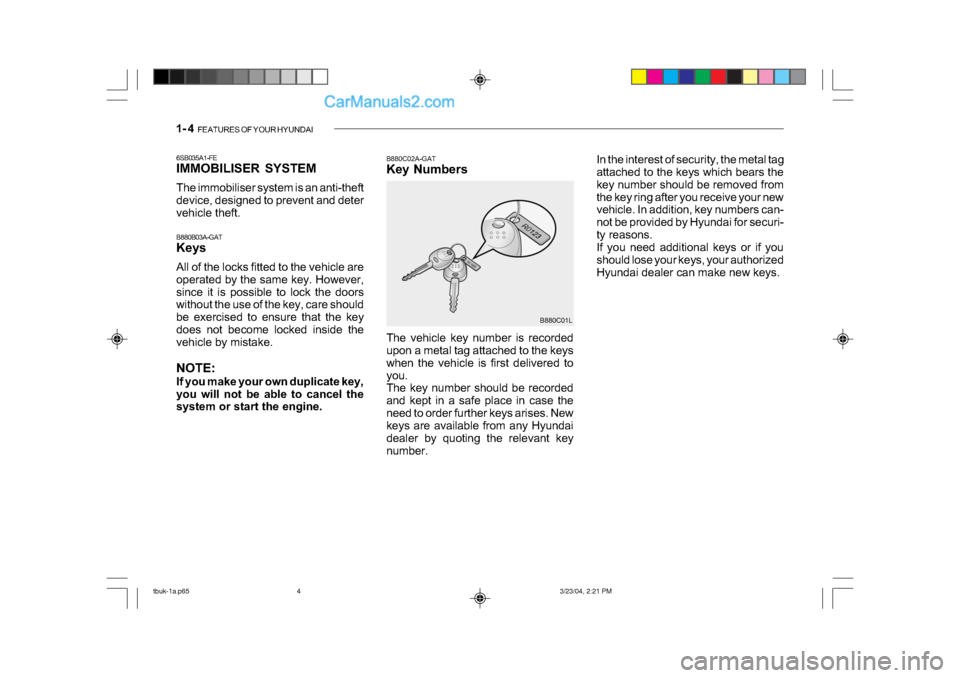
Key Numbers
The vehicle key number is recorded
upon a metal tag attached to the keys
when the vehicle is first delivered to
you.
The key number should be recorded
and kept in a safe place in case the
need to order further keys arises. New
keys are available from any Hyundai
dealer by quoting the relevant key
number.
B880C01L
In the interest of security, the metal tag
attached to the keys which bears the
key number should be removed from
the key ring after you receive your new
vehicle. In addition, key numbers can-
not be provided by Hyundai for securi-
ty reasons.
If you need additional keys or if you
should lose your keys, your authorized
Hyundai dealer can make new keys.
tbuk-1a.p65
3/23/04, 2:21 PM
4
Page 265 of 445

FEATURES OF YOUR HYUNDAI 1- 7
B070A01A-EAT
ANTI-THEFT ALARM SYSTEM
(Not all models)
This system is designed to provide
protection from unauthorized entry into
the car. This system is operated in
three stages: the first is the "Armed"
stage, the second is the "Alarm" stage,
and the third is the "Disarmed" stage. If
triggered, the system provides an au-
dible alarm with blinking of the turn
signal lights.
The central door locking is operated by
pushing the driver's door lock switch
toward the front or rear of the vehicle. If
the passenger and rear doors are open
when the switch is pushed, the door will
remain locked when closed.
NOTE:
o When pushing the switch toward
the rear, all doors and tail gate will
unlock.
When pushing the switch toward
the front, all doors and tail gate
will lock.
o When the door is unlocked, the
red mark on the switch is visible
and the character "LOCK" on the
switch is visible.
o The central door locking is oper- ated by turning the key (with theft-
alarm system: driver's door and
passenger's door, without theft-
alarm system: driver's door only)
toward the front or rear of the
vehicle. Park the car and stop the engine. Arm
the system as described below.
1) Remove the ignition key from the
ignition switch.
2) Make sure that the engine bonnet and hatchback door are closed.
3) Lock the doors using the transmitter
of the keyless entry system.
After completion of the steps above,
the turn signal lights will blink once to
indicate that the system is armed.
NOTE:
1) If any door, hatchback door or engine bonnet remains open, the
system will not be armed.
2) If this happens, rearm the system
as described above.
CAUTION:
Do not arm the system until all pas-
sengers have left the car. If the sys-
tem is armed while a passenger(s)
remains in the car, the alarm may be
activated when the remaining
passenger(s) leaves the car.
!
HTB052-D
B070B01O-EAT
Armed Stage
tbuk-1a.p65
3/23/04, 2:21 PM
7
Page 266 of 445

1- 8 FEATURES OF YOUR HYUNDAI
HTB202
B070D02TB-AAT
Disarmed Stage
B070C02FC-EAT
Alarm Stage
The alarm will be activated if any of the
following occurs while the car is parked
and the system is armed.
1) A front or rear door is unlocked and
opened without using the transmit-
ter.
2) The hatchback door is opened with-
out using the transmitter.
3) The engine bonnet is opened.
The alarming horn will sound and the
turn signal lights will blink continuously
for 27 seconds. To turn off the system,
unlock the door or hatchback door with
the transmitter. The system will be disarmed when the
driver's or passenger's door is un-
locked by depressing the button on the
transmitter.
After completion of the step above, the
turn signal lights will blink twice to
indicate that the system is disarmed.
NOTE:
When the vehicle is unlocked using
the unlock button on the remote, but
the doors, bonnet or boot are not
opened within 30 seconds, the doors
will relock and the system will re-
arm. CAUTION:
Only the transmitter can disarm the
armed stage. If the transmitter does
not disarm the system, it is neces-
sary to take the following steps;
1. Unlock the door with the key, which will cause, the alarm to be
activated.
2. Insert the key in the ignition key cylinder and turn the ignition key
to "ON" position.
3. Wait for 30 seconds.
After completing the step above, the
system will be disarmed.
!
tbuk-1a.p65 3/23/04, 2:21 PM
8
Page 290 of 445

1- 32 FEATURES OF YOUR HYUNDAI
B240B03L-D
The airbag modules are located both in
the centre of the steering wheel and in
the front passenger's panel above the
glove box. When the SRSCM detects a
considerable impact to the front of the
vehicle, it will automatically deploy the
airbags.
Passenger's Airbag
HTB204-D
Upon deployment, tear seams molded
directly into the pad covers will sepa-
rate under pressure from the expansion
of the airbags. Further opening of the
covers then allows full inflation of the
airbags.
A fully inflated airbag in combination
with a properly worn seat belt slows the
driver's or the passenger's forward mo-
tion, thus reducing the risk of head or
chest injury.
The SRS service reminder indicator
(SRI) on the instrument panel will blink
for about 6 seconds after the ignition
key is turned to the "ON" position or
after the engine is started, after which
the SRI should go out.
B240B02L-D
tbuk-1a.p65
3/23/04, 2:22 PM
32
Page 291 of 445

FEATURES OF YOUR HYUNDAI 1- 33
!
!
CAUTION:
When installing a container of liquid
air freshener inside a vehicle, do not
place it near the instrument cluster
nor on the instrument panel pad
surface. If there is any leakage from
the air freshener onto these areas
(instrument cluster, instrument panel
pad or air ventilator), it may damage
these parts. If the liquid from the air
freshener does leak onto these ar-
eas, wash them with water immedi-
ately.
WARNING:
o When the SRS is activated, there may be a loud noise and fine dust
will be released throughout the
vehicle. These conditions are nor-
mal and are not hazardous. How-
ever, the fine dust generated dur-
ing airbag deployment may cause
skin irritation. Be sure to wash
your hands and face thoroughly
with lukewarm water and a mild
soap after an accident in which
the airbags were deployed. o The SRS can function only when
the ignition key is in the "ON"
position. If the SRS SRI does not
come on, or continuously remains
on, after flashing for about 6 sec-
onds when the ignition key is
turned to the "ON" position, or
after the engine is started, or comes
on while driving, the SRS is not
working properly. If this occurs,
have your vehicle immediately
inspected by your Hyundai dealer.
o Before you replace a fuse or dis-
connect a battery terminal, turn
the ignition key to the "LOCK"
position or remove the ignition
key. Never remove or replace the
air bag related fuse(s) when the
ignition key is in the "ON" posi-
tion. Failure to heed this warning
will cause the SRS SRI to illumi-
nate.
B240B05L-D
Passenger's Airbag
!
CAUTION:
Do not install or place any accesso-
ries (drink holder, cassette holder,
sticker, etc) on the front passenger's
panel above the glove box in a ve-
hicle with passenger's side air bag.
Such objects may become danger-
ous projectiles and cause injury if
the passenger's side air bag inflates.
After complete inflation, the airbag im-
mediately starts deflating, enabling the
driver to maintain forward visibility.
tbuk-1a.p65 3/23/04, 2:22 PM
33