Page 308 of 389

3 IN CASE OF EMERGENCY
10
HGK4014
D060H02Y-EAT 7. Reinstall Wheel Nuts To reinstall the wheel hold it on the studs put the wheel nuts on the studsand tighten them finger tight. The nuts should be installed with their small diameter ends directed inward. Jigglethe tyre to be sure it is completely seated, then tighten the nuts as much as possible with your fingers again. SD070J1-E
8. Lower Vehicle and Tighten
Nuts
Lower the car to the ground by turning the wheel nut wrench counterclock- wise. Then position the wrench as shown in the drawing and tighten thewheel nuts. Be sure the socket is seated completely over the nut. Do not stand on the wrench handle or use an exten-sion pipe over the wrench handle.
D060H01GK Go around the wheel tightening everyother nut until they are all tight. Thendouble-check each nut for tightness. After changing wheels, have a techni- cian tighten the wheel nuts to theirproper torque as soon as possible. Wheel nut tightening torque Steel wheel & aluminium alloy wheel: 90-110 Nm. (65-80 lb.ft)
Page 309 of 389
3
IN CASE OF EMERGENCY
11
SD070K1-E AFTER CHANGING WHEELS The pressure of the spare tyre should be checked at the first available oppor-tunity. If any doubt exists as to the tyre pressure, the vehicle should be driven slowly to the nearest service stationand the tyre pressure checked and adjusted as required. If the valve cap is lost from any of thevalves, a replacement should be ob- tained and fitted at the first available opportunity. The valve cap preventsthe ingress of dirt which may cause the valve to stick and therefore leak and is part of the valve sealing function. Ensure that the spare wheel, jack and wheel nut wrench as well tools are correctly located in the boot of the vehicle to prevent damage and noise. HGK4032
IF YOUR VEHICLE MUST BE TOWED
D080A01O-GAT If your vehicle has to be towed, it should be done by your Hyundai dealeror a commercial tow truck service. This will help assure that your vehicle is not damaged in towing. Also, profes-sionals are generally aware of local laws governing towing. In any case, rather than risk damage to your car, itis suggested that you show this infor- mation to the tow truck operator. Be sure that a safety chain system is usedand that all local laws are observed. It is recommended that your vehicle be towed with a wheel lift and dollies orflatbed equipment with all the wheels off the ground.
! CAUTION:
o Your vehicle can be damaged if towed incorrectly!
o Be sure the transaxle is in neu-
tral.
o When the engine will not start, be
sure the steering is unlocked by placing the key in the "ACC" po- sition.
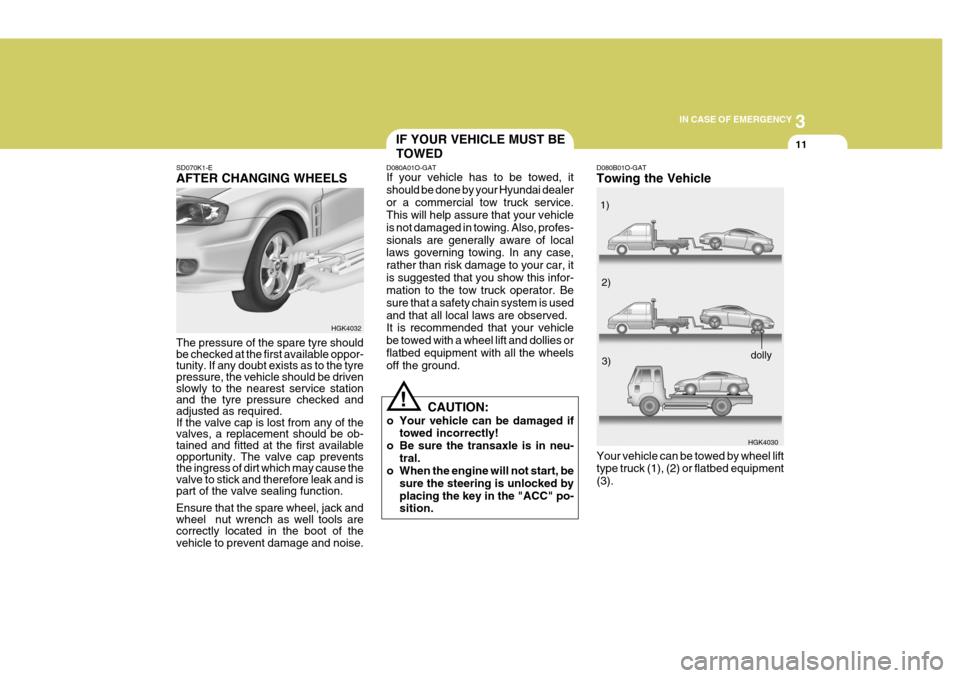
D080B01O-GAT Towing the Vehicle
HGK4030
Your vehicle can be towed by wheel lift type truck (1), (2) or flatbed equipment (3). 1)
2)
3)
dolly
Page 310 of 389
3 IN CASE OF EMERGENCY
12
!
HGK4017
!
!
1) If the vehicle is being towed with the
rear wheels on the ground, be sure the parking brake is released.
NOTE: Before towing, check the level of the automatic transaxle fluid. If it is below the "HOT" range on the dip-stick, add fluid. If you cannot add fluid, a towing dolly must be used.
2) If any of the loaded wheels or sus- pension components are damaged or the vehicle is being towed with the front wheels on the ground, use a towing dolly under the front wheels.
o Manual Transaxle: If you do not use a towing dolly,place the ignition key in the "ACC"position and put the transaxle in "N (Neutral)".
CAUTION:
Do not tow with the key removed or in the "LOCK" position when tow- ing from the rear without a towing dolly. o Automatic Transaxle:
Be sure to use a towing dolly underthe front wheels.
CAUTION:
A vehicle with an automatictransaxle should never be towed from the rear with the front wheels on the ground. This can cause seri-ous damage to the transaxle.
3) It is recommended that your vehicle be towed with all the wheels off the ground.
CAUTION:
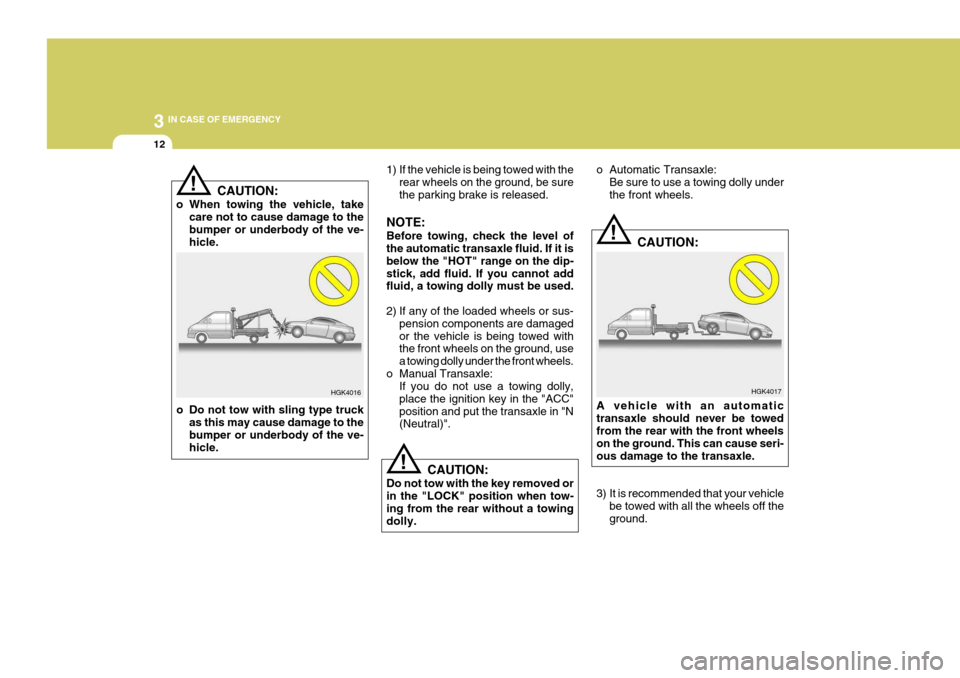
o When towing the vehicle, take care not to cause damage to the bumper or underbody of the ve- hicle.
o Do not tow with sling type truck as this may cause damage to thebumper or underbody of the ve-hicle. HGK4016
Page 311 of 389
3
IN CASE OF EMERGENCY
13
HGK4018
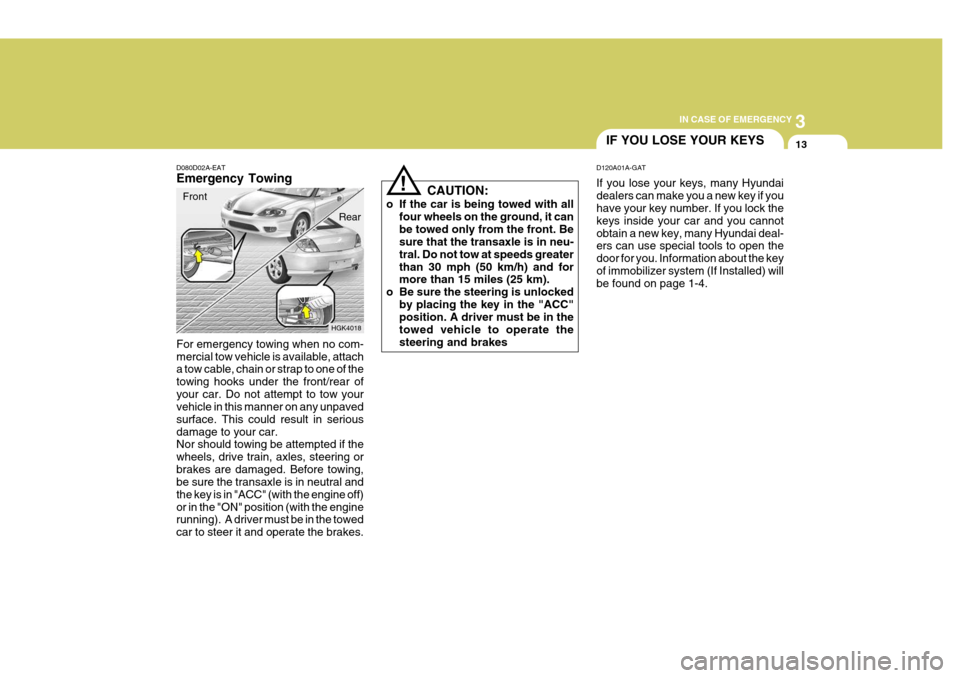
D080D02A-EAT Emergency Towing For emergency towing when no com- mercial tow vehicle is available, attach a tow cable, chain or strap to one of the towing hooks under the front/rear ofyour car. Do not attempt to tow your vehicle in this manner on any unpaved surface. This could result in seriousdamage to your car. Nor should towing be attempted if the wheels, drive train, axles, steering orbrakes are damaged. Before towing, be sure the transaxle is in neutral and the key is in "ACC" (with the engine off)or in the "ON" position (with the engine running). A driver must be in the towed car to steer it and operate the brakes. Front
Rear
!CAUTION:
o If the car is being towed with all four wheels on the ground, it can be towed only from the front. Be sure that the transaxle is in neu- tral. Do not tow at speeds greaterthan 30 mph (50 km/h) and for more than 15 miles (25 km).
o Be sure the steering is unlocked by placing the key in the "ACC"position. A driver must be in the towed vehicle to operate thesteering and brakes
IF YOU LOSE YOUR KEYS
D120A01A-GAT If you lose your keys, many Hyundai dealers can make you a new key if you have your key number. If you lock the keys inside your car and you cannotobtain a new key, many Hyundai deal- ers can use special tools to open the door for you. Information about the keyof immobilizer system (If Installed) will be found on page 1-4.
Page 321 of 389
5
VEHICLE MAINTENANCE REQUIREMENTS
5
NO. 1 23 4 5678 9
10 11121314 15 1617181920 21 DESCRIPTION
GENERAL MAINTENANCE COOLING SYSTEMCOOLANTCOOLANT SPECIFIC GRAVITYMANUAL TRANSAXLE OILAUTOMATIC TRANSAXLE FLUID BRAKE PIPES, HOSES, AND CONNECTIONS BRAKE FLUIDCLUTCH FLUIDREAR BRAKE LININGS AND CYLINDERSBRAKE PADS SUSPENSION AND STEERING SYSTEM FRONT SUSPENSION BALL JOINTSPOLLEN FILTER (For Blower unit)REAR WHEEL BEARINGSTYRE CONDITION AND PRESSURE (incl. Spare)LUBRICATE LOCKS AND HINGES CHECK ALL ELECTRICAL SYSTEMS ROAD TESTCHECK ALL SYSTEMS WITH HI-SCANCHECK 4 GASDRIVE SHAFT & BOOT
F030C02GK-EAT R : REPLACE I : INSPECT AND, AFTER INSPECTION, CLEAN, ADJUST, REPAIR OR REPLACE IF NECESSARY
60 72
I
R I I
R
I
RR
III I
R
I III I III
50 60
I I III I I I I I
R I III I III
40 48
I
R
I III
RR
III I
R I III I III
30 36
I I III I I I I I
R I III I III
20 24
I
R I III
RR
III I
R I III I III
10 12
I I III I I I I I
R I III I III
MILES X 1000 MONTHS
Page 333 of 389
6
OWNER MAINTENANCE
7
HGK5005
SG030D2-E
ENGINE OIL REPLENISHMENT
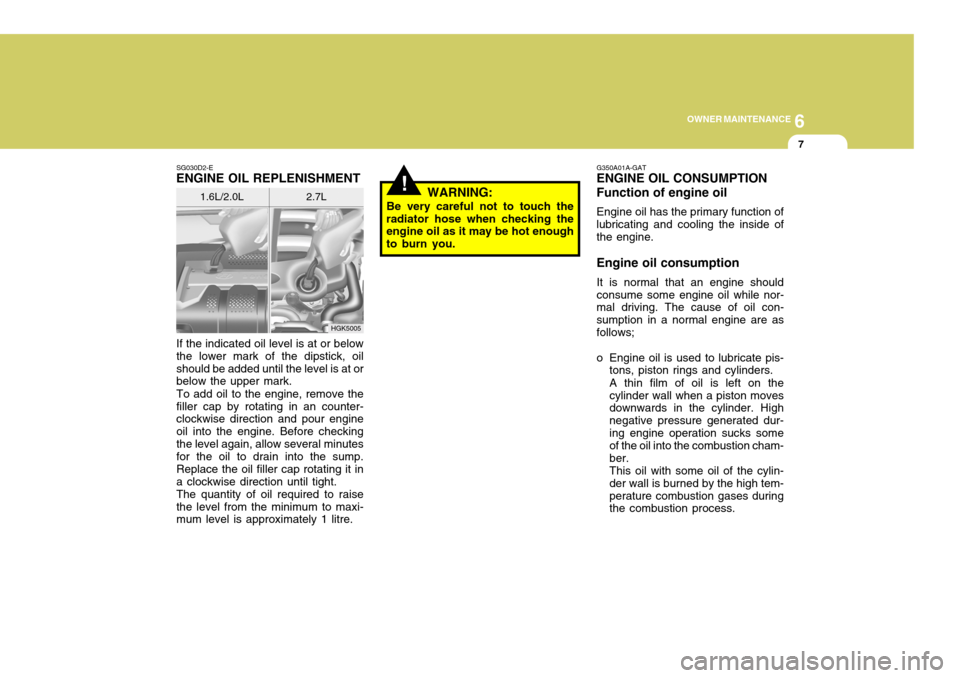
If the indicated oil level is at or below the lower mark of the dipstick, oilshould be added until the level is at or below the upper mark. To add oil to the engine, remove the filler cap by rotating in an counter- clockwise direction and pour engine oil into the engine. Before checkingthe level again, allow several minutes for the oil to drain into the sump. Replace the oil filler cap rotating it ina clockwise direction until tight.The quantity of oil required to raisethe level from the minimum to maxi- mum level is approximately 1 litre. 1.6L/2.0L
G350A01A-GAT ENGINE OIL CONSUMPTION Function of engine oil Engine oil has the primary function of lubricating and cooling the inside of the engine. Engine oil consumption It is normal that an engine should consume some engine oil while nor- mal driving. The cause of oil con- sumption in a normal engine are asfollows;
o Engine oil is used to lubricate pis-
tons, piston rings and cylinders. A thin film of oil is left on the cylinder wall when a piston moves downwards in the cylinder. High negative pressure generated dur-ing engine operation sucks some of the oil into the combustion cham- ber.This oil with some oil of the cylin-der wall is burned by the high tem-perature combustion gases during the combustion process.
2.7L
!WARNING:
Be very careful not to touch the
radiator hose when checking the engine oil as it may be hot enough to burn you.
Page 335 of 389
6
OWNER MAINTENANCE
9
!
3. Prepare a suitable receptacle to
collect the displaced oil and re- move the drain plug from the sump.
WARNING:
The oil being drained from the
engine will be hot. Care should beexercised to prevent scalding. 6. Install a new oil filter having
smeared the sealing ring with cleanoil and rotating clockwise until the filter contacts the mounting and then a further one half turn. Do notover-tighten. Tightening torque: 1.2 ~ 1.6 kgf.m
7. Remove the engine oil level dip- stick.
8. Pour the specified quantity of the recom-mended oil into the engine and replace the filler cap. Start theengine and ensure that no oil leaks exist. Turn off the engine and after a couple minutes, recheck the oillevel.
4. When the oil has drained from the
sump, replace the drain plug usinga new gasket ensuring that the plug is not over tightened. Tightening torque: 4.5 ~ 4.0 kgf.m (1.6/2.0L) 4.5 ~ 3.5 kgf.m (2.7L)
5. Remove the oil filter by rotating counterclock-wise, using a propri-etary oil filter removal tool if neces- sary. Note that the oil filter will contain approximately 0.5 litres ofoil and this should be collected in a suitable receptacle. WARNING:
Prolonged and repeated contact with used engine oils may result inserious skin disorders including dermatitis and cancer. Avoid con- tact with skin as far as possibleand always wash thoroughly after any contact. Keep used oils out of reach of children. It is illegal topollute drains, water courses and soil. Use only authorized waste collection facilities including civic amenity sites and garages for the disposal of used oil and oil filters.If in doubt, contact the local au- thority for disposal instructions.
!
Page 340 of 389
6OWNER MAINTENANCE
14
!
HGK5066 4. When preparing to remove the old
spark plug, guide the socket down over the spark plug, being careful not to damage the ceramic insula-tor.
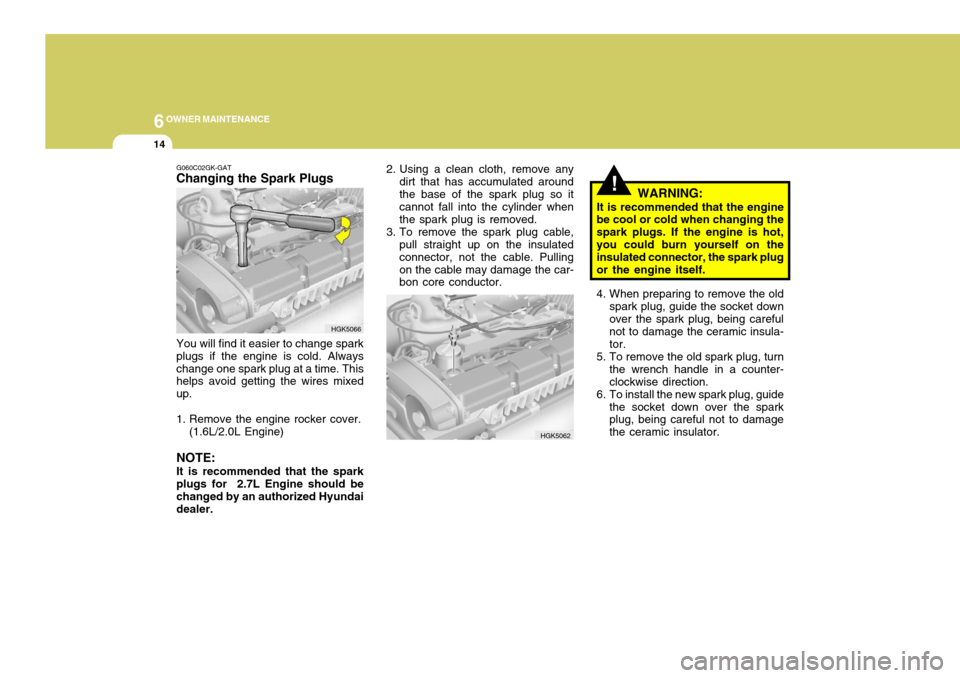
5. To remove the old spark plug, turn
the wrench handle in a counter-clockwise direction.
6. To install the new spark plug, guide the socket down over the spark plug, being careful not to damage the ceramic insulator.
G060C02GK-GAT Changing the Spark Plugs You will find it easier to change spark plugs if the engine is cold. Alwayschange one spark plug at a time. This helps avoid getting the wires mixed up.
1. Remove the engine rocker cover.
(1.6L/2.0L Engine)
NOTE: It is recommended that the spark plugs for 2.7L Engine should be changed by an authorized Hyundaidealer. 2. Using a clean cloth, remove any
dirt that has accumulated aroundthe base of the spark plug so it cannot fall into the cylinder when the spark plug is removed.
3. To remove the spark plug cable, pull straight up on the insulatedconnector, not the cable. Pullingon the cable may damage the car- bon core conductor.
HGK5062 WARNING:
It is recommended that the engine
be cool or cold when changing the spark plugs. If the engine is hot,you could burn yourself on the insulated connector, the spark plug or the engine itself.