Page 68 of 296

This indicator reminds you that it is
time to take your vehicle in for
scheduled maintenance.
Ref er to the Maintenance Schedules
f or Normal and Severe Driving
Conditions on pages and .Between 6,000 miles (9,600 km) and
7,500 miles (12,000 km), it will light
f or 2 seconds when you f irst turn the
ignition switch to ON (II), and then
f lash f or 10 seconds.
If you exceed 7,500 miles (12,000
km) without having the scheduled
maintenance perf ormed, this
indicator will remain on as a constant
reminder.
Your dealer will reset this indicator
af ter completing the scheduled
maintenance. If this maintenance is
done by someone other than your
Honda dealer, reset the indicator as
f ollows.
Turn of f the engine. Hold the button for about 10
seconds until the indicator goes
of f .
For the f irst 6,000 miles (9,600 km)
af ter the Maintenance Required
Indicator is reset, it will come on f or
2 seconds when you turn the ignition
switch to ON (II).
Press and hold the Select/Reset
buttonintheinstrumentpanel,
then turn the ignition switch to
ON (II).
1. 2.
3.
205 206
Maintenance Required Indicator
Inst rument s and Cont rols
Maintenance Required
Indicator
65
SELECT/RESET BUTTON
Page 69 of 296
This shows how much f uel you have.
It may show slightly more or less
than the actual amount. The needle
returns to the bottom after you turn
of f the ignition. This shows the total distance your
vehicle has been driven. It measures
miles in U.S. models and kilometers
in Canadian models.
It is illegal under U.S. f ederal law and
Canadian provincial regulations to
disconnect, reset, or alter the
odometer with the intent to change
the number of miles or kilometers
indicated.
Gauges
Inst rument s and Cont rols
Odometer
Fuel Gauge
66
NOTICE:
TACHOMETER SPEEDOMETERTEMPERATURE
GAUGE
TRIP METER FUEL GAUGE
TRIP METER SELECT/RESET BUTTON
MAINTENANCE
REQUIRED INDICATOR ODOMETER
Avoid driving with an
extremely low f uel level. Running out
of f uel could cause the engine to
misf ire, damaging the catalytic
converter.
Page 171 of 296

Help assure your vehicle’s f uture
reliability and perf ormance by paying
extra attention to how you drive
during the f irst 600 miles (1,000 km).
During this period:Avoid full throttle starts and rapid
acceleration.
Avoidhardbrakingforthefirst
200 miles (300 km).
Do not change the oil until the
scheduled maintenance time.
We also recommend that you should
not tow a trailer during the f irst 500
miles (800 km). Your Honda is designed to operate
on unleaded gasoline with a pump
octane number of 86 or higher. Use
of a lower octane gasoline can cause
a persistent, heavy, metallic rapping
noise in the engine that can lead to
mechanical f ailure.
We recommend gasolines containing
detergent additives that help prevent
f uel system and engine deposits.
Using gasoline containing lead will
damage your vehicle’s emissions
controls. This contributes to air
pollution.
Use of gasoline with these additives
may adversely af f ect perf ormance,
and cause the Malfunction Indicator
Lamp on your instrument panel to
come on. If this happens, contact
your authorized Honda dealer f or
service.
Some gasoline today is blended with
oxygenates such as ethanol or
MTBE. Your vehicle is designed to
operate on oxygenated gasoline
containing up to 10 percent ethanol
by volume and up to 15 percent
MTBE by volume. Do not use
gasoline containing methanol.
In addition, in order to maintain good
perf ormance, f uel economy, and
emissions control, we strongly
recommend, in areas where it is
available, the use of gasoline that
does NOT contain manganese-based
f uel additives such as MMT.
You should also f ollow these same
recommendations with an
overhauled or exchanged engine, or
when the brakes are replaced.
If you notice any undesirable
operating symptoms, try another
service station or switch to another
brand of gasoline.
For f urther important f uel-related
inf ormation, please ref er to your
.
Break-in Period, Gasoline T ype
Bef ore Driving
Break-in Period Gasoline Type
Quick Start Guide
168
Page 175 of 296
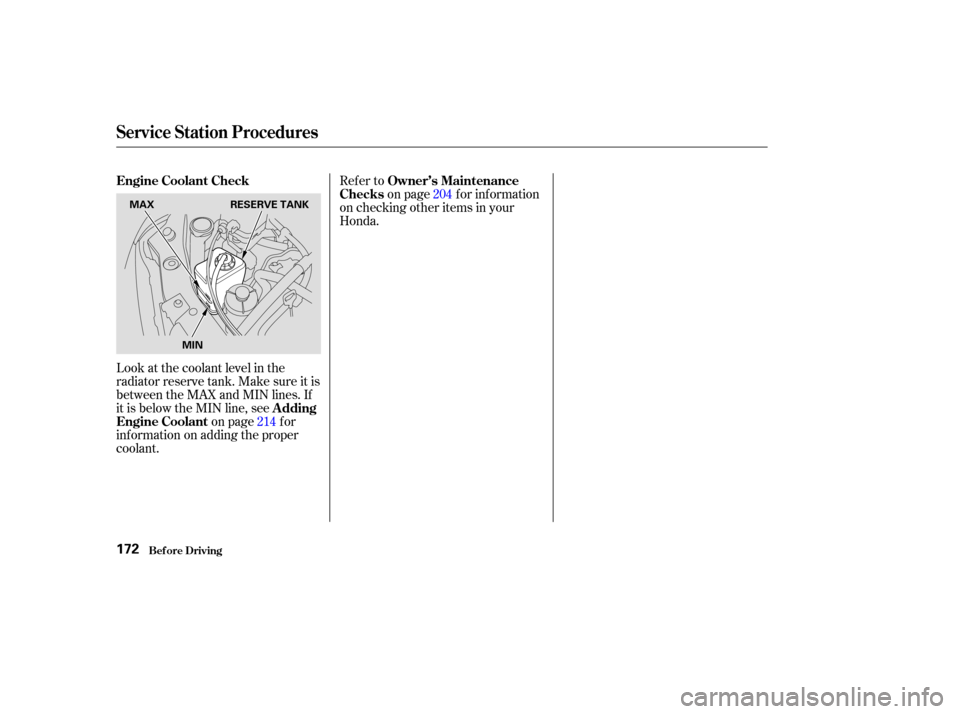
Look at the coolant level in the
radiator reserve tank. Make sure it is
between the MAX and MIN lines. If
it is below the MIN line, seeon page f or
inf ormation on adding the proper
coolant. Refer to
on page f or inf ormation
on checking other items in your
Honda.
214 204
A dding
Engine Coolant Engine Coolant Check Owner’s Maintenance
Checks
Bef ore Driving
Service Station Procedures
172
MAX RESERVE TANK
MIN
Page 176 of 296
Always maintain your vehicle
according to the maintenance
schedule. See(see page
).
an underinf lated tire
causes more ‘‘rolling resistance,’’
which uses f uel.
The build-up of snow or mud on
your vehicle’s underside adds
weight and rolling resistance.
Frequent cleaning helps your f uel
mileage and reduces the chance of
corrosion.
Drive moderately. Rapid
acceleration, abrupt cornering,
and hard braking use more f uel.
Always drive in the highest gear
possible. Try to maintain a constant speed.
Everytimeyouslowdownand
speed up, your vehicle uses extra
fuel.Usethecruisecontrolwhen
appropriate.
Combine several short trips into
one.
The air conditioning puts an extra
load on the engine which makes it
usemorefuel.Usethefresh-air
ventilation when possible.
204
For example,
Fuel Economy
Bef ore Driving
Improving Fuel Economy
Owner’s
Maintenance Checks
173
Page 201 of 296

When towing a trailer, you should
carry a f ull-size wheel and tire as a
spare in case you have a flat. If you
use the compact spare tire that came
with the vehicle, it may adversely
af f ect vehicle handling. See pagef or inf ormation on proper tire
size, and page f or inf ormation on
how to store a f ull-size tire. When
storing a f ull-size spare tire in the
trailer, f ollow the trailer maker’s
instructions.
Many states and Canadian provinces
require special outside mirrors when
towing a trailer. Even if they don’t,
you should install special mirrors if
you cannot clearly see behind you, or
if the trailer creates a blind spot.
Askyourtrailersalesorrental
agency if any other items are
recommended or required f or your
towing situation. When preparing to tow, and bef ore
driving away, be sure to check the
f ollowing:
You may want to fill the fuel tank
with premium f uel. Premium f uel
provides improved perf ormance. Your vehicle tires and spare are
properly inf lated (see page ),
and the trailer tires and spare are
inflated as recommended by the
trailer maker. The lights and brakes on your
vehicle and the trailer are working
properly. Allitemsonandinthetrailerare
properly secured and cannot shif t
while you drive.
Thehitch,safetychains,andany
other attachments are secure. All weights and loads are within
limits (see pages and ). The trailer has been properly
serviced and is in good condition. If you tow f requently, f ollow the
Severe Conditions maintenance
schedule. The vehicle has been properly
serviced, and the tires, brakes,
suspension, and cooling system
are in good operating condition.
244
233
194231
195
Towing a Trailer
Driving
Spare Vehicle T ire
Additional Trailer EquipmentPre-T ow Checklist
198
Page 204 of 296

This section explains why it is
important to keep your vehicle well
maintained and how to f ollow basic
maintenance saf ety precautions.
This section also includes
Maintenance Schedules f or normal
driving and severe driving conditions,
a Maintenance Record, and instruc-
tions f or simple maintenance tasks
you may want to take care of
yourself .
If you have the skills and tools to per-
f orm more complex maintenance
tasks on your Honda, you may want
to purchase the Service Manual. See
page f or inf ormation on how to
obtain a copy, or see your Honda
dealer.......................
Maintenance Saf ety .202
.................
Maintenance Schedule . 203
....................
Maintenance Record .207
..............................
Fluid Locations .210
........................
Adding Engine Oil .211
.........
Changing the Oil and Filter . 212
..............................
Engine Coolant .214
....................
Windshield Washers .216
....
Automatic Transmission Fluid . 216
....................................
Brake Fluid .218
....................
Power Steering Fluid . 219
....................................
Timing Belt .219
....................................
Hood Latch .220
.............................................
Lights .220
.......................................
Seat Belts .226
.....................................
Floor Mats .226
..............................
Audio Antenna .227
..................
Dust and Pollen Filter . 227
.................................
Wiper Blades .228
...............................................
Tires .230
........................
Check the Battery .235
.............................
Vehicle Storage .236
281
Maintenance
Maint enance201
Page 205 of 296
All service items not detailed in this
section should be perf ormed by a
Honda technician or other qualif ied
mechanic.
To eliminate potential hazards, read
the instructions bef ore you begin,
and make sure you have the tools
and skills required.Do
not run the engine unless
instructed to do so.
Some of the most important saf ety
precautions are given here. However,
we cannot warn you of every
conceivable hazard that can arise in
perf orming maintenance. Only you
can decide whether or not you
should perf orm a given task.
Make sure your vehicle is parked
on level ground, the parking brake
is set, and the engine is of f .
To clean parts, use a commercially
available degreaser or parts
cleaner, not gasoline.
To reduce the possibility of f ire or
explosion, keep cigarettes, sparks,
and f lames away f rom the battery
and all f uel-related parts.
Wear eye protection and
protective clothing when working
with the battery or compressed air.
Be sure there is
adequate ventilation whenever you
operate the engine.
Let the
engine and exhaust system cool
bef ore touching any parts.
Maintenance Saf ety
Maint enance
Important Saf ety Precautions Injury f rom moving parts.
Potential Vehicle Hazards Carbon Monoxide poison f rom
engine exhaust.
Burns f rom hot parts.
202
Failure to properly follow
maintenance instructions and
precautions can cause you to
be seriously hurt or killed.
Always follow the procedures
and precautions in this owner’s
manual.
Improperly maintaining this
vehicle or failing to correct a
problem before driving can
cause a crash in which you can
be seriously hurt or killed.
Always follow the inspection,
maintenance recommendations,
and schedules in this owner’s
manual.