Page 173 of 256

�Î
�Î
�Ì �Î
�µ
�Ì�Ì�Î�Î
�Î
Follow the Severe Maintenance
Schedule if you drive your vehicle
MAINLY under one or more of the
f ollowing conditions: Extensive idling or long periods of
stop and go driving, such as a taxi or
a delivery vehicle. Driving less than 5 miles (8 km) per
trip or, in f reezing temperatures,
driving less than 10 miles (16 km)
per trip.
Driving in extremely hot [over 90°F
(32°C)] conditions.
Follow the
Maintenance Schedule f or Severe
Conditions. Driving on muddy, dusty, or de-iced
roads. T railer towing, driving with a roof
rack, or driving in mountainous
conditions.
commercial
Canadian Owners
Maint enance
169
miles x 1,000
km x 1,000
Every 3 years (independent of mileage)
( (O
O r
re
ev
ve
er
ry
y 3
3y
ye
ea
ar
rs
s, , w
w h
hi
ic
ch h e
ev
ve
er
r c
coo m
m e
es
s f
fi
ir
r s
st t)
)
(
(
O
O t
th
h e
er
rw
w i
is
se e a
ad
d j
ju
u s
stt o
o n
nl
ly
y i
if
f n
n o
oi
is
sy y )
)
(
(
O
O r
re
ev
ve
er
ry
y 2
2y
ye
ea
ar
rs
s, , w
w h
hi
ic
ch h e
ev
ve
er
r c
coo m
m e
es
s f
fi
ir
r s
st t)
)
10
16 50
8070
112
Check oil and coolant at each fuel stop 150
240
Service the items listed at the indicated distance (or time, if given).
Every 10,000 miles (16,000 km)
Check inflation and condition once a month
Every 5,000 miles (8,000 km) or every 6 months, whichever comes first
( (O
O r
re
ev
ve
er
ry
y 1
1y
ye
ea
ar
r,
, w
w h
hi
ic
ch h e
ev
ve
er
r c
coo m
m e
es
s f
fi
ir
r s
st t)
)
(
( O
O r
re
ev
ve
er
ry
y 1
1y
ye
ea
ar
r,
, w
w h
hi
ic
ch h e
ev
ve
er
r c
coo m
m e
es
s f
fi
ir
r s
st t)
)
40
64
20
32 60
9680
128
30
48
Every 160,000 miles (256,000 km)
At 120,000 miles (192,000 km) or 10 years, then every 60,000 miles (96,000 km) or 5 years
( (O
O r
re
ev
ve
er
ry
y 4
4y
ye
ea
ar
rs
s, , w
w h
hi
ic
ch h e
ev
ve
er
r c
coo m
m e
es
s f
fi
ir
r s
st t)
)
Replace at 60,000 miles (96,000 km) or 3
years, then every 30,000 miles (48,000
km) or 2 years.
90
144 100
160 140
224
130
208
120
192
110
176
See dust and pollen filter on page for
replacement information under special
driving conditions.
Check engine oil and coolant
Check tires
Replace engine oil
Rotate tires (follow pattern on page
193)
Replace engine oil filter
Check front and rear brakes
Lubricate all hinges, locks and latches
Inspect the following items: Tie rod ends, steering gear box, and boots
Suspension components, Driveshaft boots
Check parking brake adjustment
Inspect the following items: Brake hoses and lines (including ABS)
All fluid levels and condition of fluids
Exhaust system , Fuel lines and connections
Lights and controls/vehicle underbody
Inspect drive belts
Replace dust and pollen filter
Clean and replace air cleaner element
Replace spark plugs
Inspect valve clearance
Replace automatic transmission fluid
Replace manual transmission fluid
Replace rear differential fluid
Inspect idle speed
Replace engine coolant
Replace brake fluid Clean every 15,000 miles (24,000 km), and replace every 30,000
miles (48,000 km)
Use normal schedule except in dusty
condition.
See information on maintenance and
emission warranty on page .
1:
2:
: 188
3: 166
13
2
Maintenance Schedule for Severe Conditions
Page 178 of 256

You may use a synthetic motor oil if
it meets the same requirements
given f or a conventional motor oil: it
displays the API Certif ication Seal
and it is the proper weight. You must
f ollow the oil and f ilter change
intervals given on the maintenance
schedule.
Your Honda does not require any oil
additives. Additives may adversely
af f ect your engine’s or transmission’s
perf ormance and durability.Always change the oil and f ilter
according to the recommendations in
the maintenance schedule. The oil
and f ilter collect contaminants that
can damage your engine if they are
not removed regularly.
Changing the oil and f ilter requires
special tools and access f rom
underneath the vehicle. The vehicle
should be raised on a service station-
type hydraulic lif t f or this service.
Unless you have the knowledge and
proper equipment, you should have
this maintenance done by a skilled
mechanic.
Open the hood and remove the
engine oil f ill cap. Remove the oil
drain bolt and washer f rom the
bottom of the engine. Drain the oil
into an appropriate container. Run the engine until it reaches
normal operating temperature,
then shut it off.
1.
2.
A dding Engine Oil, Changing the Oil and Filter
Maint enance
Synthetic Oil
Engine Oil A dditives Changing the Oil and Filter
174
WASHER
OIL DRAIN BOLT
Page 208 of 256
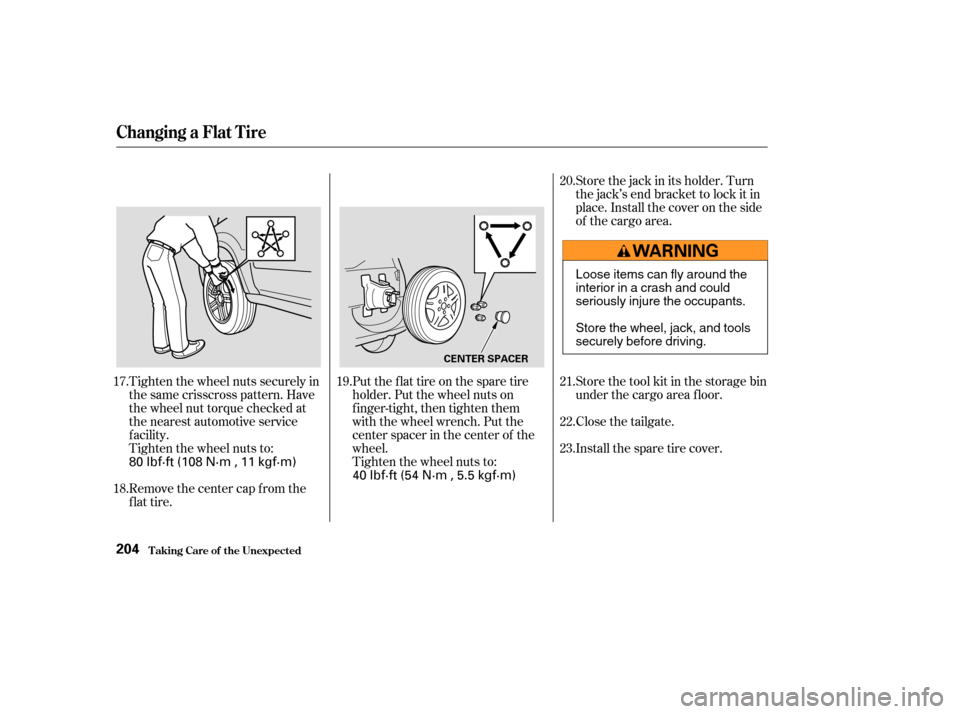
Tighten the wheel nuts securely in
the same crisscross pattern. Have
the wheel nut torque checked at
the nearest automotive service
f acility.
Tighten the wheel nuts to:
Remove the center cap from the
flat tire.Put the flat tire on the spare tire
holder. Put the wheel nuts on
finger-tight, then tighten them
with the wheel wrench. Put the
center spacer in the center of the
wheel.
Tighten the wheel nuts to:Store the jack in its holder. Turn
the jack’s end bracket to lock it in
place. Install the cover on the side
of the cargo area.
Install the spare tire cover. Close the tailgate. Store the tool kit in the storage bin
under the cargo area f loor.
17.
18. 19.20.
21.
22.
23.
Changing a Flat T ire
T aking Care of t he Unexpect ed204
CENTER SPACER
80 lbf·ft (108 N·m , 11 kgf·m)
40 lbf·ft (54 N·m , 5.5 kgf·m)Loose items can fly around the
interiorinacrashandcould
seriously injure the occupants.
Store the wheel, jack, and tools
securely before driving.
Page 217 of 256

Let the vehicle sit f or a minute.
Open the hood, and check the oil
level (see page ). An engine
very low on oil can lose pressure
during cornering and other driving
maneuvers.
If necessary, add oil to bring the
level back to the full mark on the
dipstick (see page ).If the charging system
indicator comes on brightly
when the engine is running, the
battery is not being charged.
Immediately turn of f all electrical
accessories. Try not to use other
electrically operated controls such as
the power windows. Keep the engine
running; starting the engine will
discharge the battery rapidly.
Go to a service station or garage
where you can get technical
assistance.
This light should never
come on when the engine is
running. If it starts f lashing or stays
on, the oil pressure has dropped very
low. Serious engine damage is
possible and you should take
immediate action. Saf ely pull of f the road, and shut
of f the engine. Turn on the hazard
warning lights.
Start the engine, and watch the oil
pressure light. If it does not go out
within ten seconds, turn off the
engine. There is a mechanical
problem that needs to be repaired
bef ore you can continue driving.
(See
on page
).
1.
2.
4. 3.
173
216 127
L ow Oil Pressure Indicator
Emergency T owingCharging System Indicator
L ow Oil Pressure Indicator, Charging System Indicator
T aking Care of t he Unexpect ed213
NOTICE:
Running the engine with low
oil pressure can cause serious
mechanical damage almost immediately.
Turn of f the engine as soon as you can
saf ely get the vehicle stopped.
Page 219 of 256

However, if the brake pedal does not
f eel normal, you should take
immediate action. A problem in one
part of the system’s dual circuit
design will still give you braking at
two wheels. You will f eel the brake
pedal go down much f arther bef ore
the vehicle begins to slow down and
you will have to press harder on the
pedal.
If you must drive the vehicle a short
distance in this condition, drive
slowly and caref ully. Slow down by shif ting to a lower
gear, and pull to the side of the road
when it is saf e. Because of the long
distance needed to stop, it is
hazardous to drive the vehicle. You
should have it towed and repaired as
soon as possible (seeon page ).
If the brake system
indicator comes on while
driving, the brake f luid
level is probably low. Press
lightly on the brake pedal if
it f eels normal. If it does
not, check the brake f luid
level the next time you stop
at a service station (see
page ).
If the f luid level is low, take the
vehicle to your dealer and have the
brake system inspected f or leaks or
worn brake pads.
216
181
Brake System Indicator
T aking Care of t he Unexpect ed
Emergency
Towing
215
Canada U.S.
Page 220 of 256
If your vehicle needs to be towed,
call a prof essional towing service or
an organization. Never tow your
vehicle with just a rope or chain. It is
very dangerous.The operator will load
your vehicle on the back of a truck.
Any other method of towing will
damage the drive system. When you
contact the towing agency, inf orm
them a f lat-bed is required. Refer to
on page
for non-emergency towing
inf ormation. 157
The only way you can saf ely tow
your vehicle is with f lat-bed
equipment. Towing Your Vehicle
Behind a Motorhome
Emergency T owing
T aking Care of t he Unexpect ed216
NOTICE: Towing with only two tires
on the ground will damage parts of the
4WD system. It should be transported
on a f lat-bed truck or trailer.
Page 232 of 256

�µ
The tires on your vehicle meet all
U.S. Federal Saf ety Requirements.
All tires are also graded f or
treadwear, traction, and temperature
perf ormance according to
Department of Transportation
(DOT) standards. The f ollowing
explains these gradings.
Quality grades can be f ound where
applicable on the tire sidewall
between the tread shoulder and the
maximum section width. For
example: The treadwear grade is a compara-
tive rating based on the wear rate of
the tire when tested under controlled
conditions on a specif ied government
test course. For example, a tire
graded 150 would wear one and one-
half (1 1/2) times as well on the
government course as a tire graded
100. The relative perf ormance of
tires depends upon the actual condi-
tions of their use, however, and may
depart signif icantly f rom the norm
due to variations in driving habits,
service practices and dif f erences in
road characteristics and climate.The traction grades, f rom highest to
lowest, are AA, A, B, and C. Those
grades represent the tire’s ability to
stop on wet pavement as measured
under controlled conditions on
specif ied government test surf aces
of asphalt and concrete. A tire
marked C may have poor traction
perf ormance.
Warning: The traction grade
assignedtothistireisbasedon
straight-ahead braking traction tests,
and does not include acceleration,
cornering, hydroplaning, or peak
traction characteristics.
All passenger vehicle tires must
conf orm to Federal Saf ety
Requirements in addition to these
grades.
DOT T ire Quality Grading (U.S. Vehicles)
T echnical Inf ormation
T readwear 200
Traction AA
Temperature A
Unif orm T ire Quality Grading Treadwear
Traction AA, A, B, C
228
Page 241 of 256
Customer Service................................
Inf ormation .238
....................
Warranty Coverages .239
Reporting Saf ety Def ects ..........................
(U.S. Vehicles) .240
.....................
Authorized Manuals .241
Warranty and Customer Relations
Warrant y and Cust omer Relat ions237