Page 40 of 256
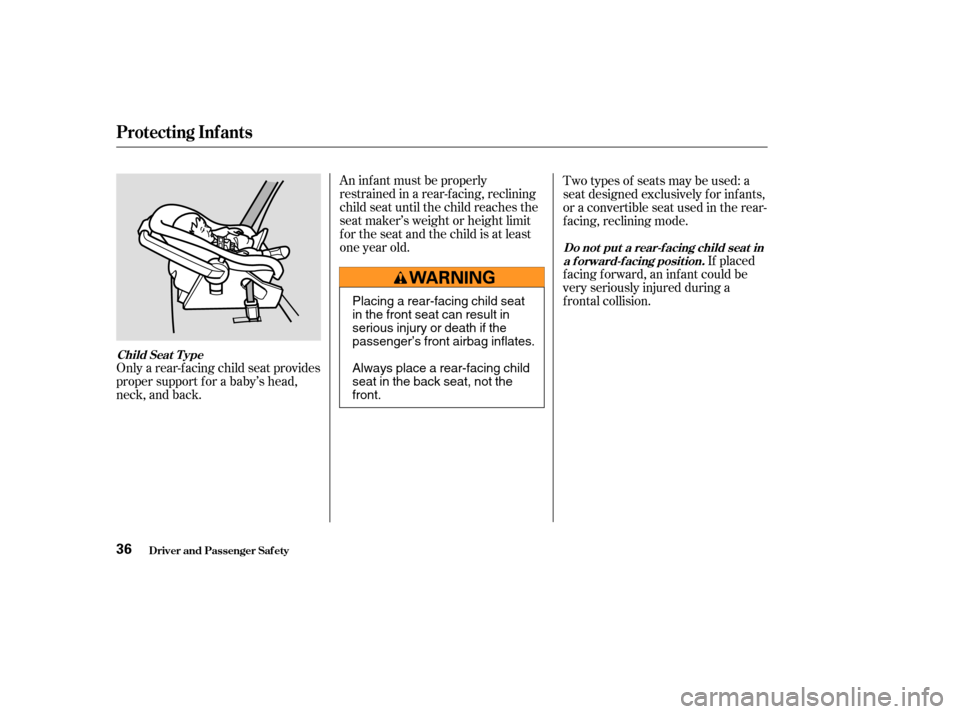
Only a rear-f acing child seat provides
proper support f or a baby’s head,
neck, and back.An inf ant must be properly
restrained in a rear-f acing, reclining
child seat until the child reaches the
seat maker’s weight or height limit
for the seat and the child is at least
one year old.
Two types of seats may be used: a
seat designed exclusively f or inf ants,
or a convertible seat used in the rear-
f acing, reclining mode.
If placed
f acing f orward, an inf ant could be
very seriously injured during a
f rontal collision.
Child Seat T ype Do not put a rear-f acing child seat in
a f orward-f acing position.
Protecting Inf ants
Driver and Passenger Saf ety36
Placing a rear-facing child seat
in the front seat can result in
serious injury or death if the
passenger’s front airbag inflates.
Always place a rear-facing child
seat in the back seat, not the
front.
Page 42 of 256
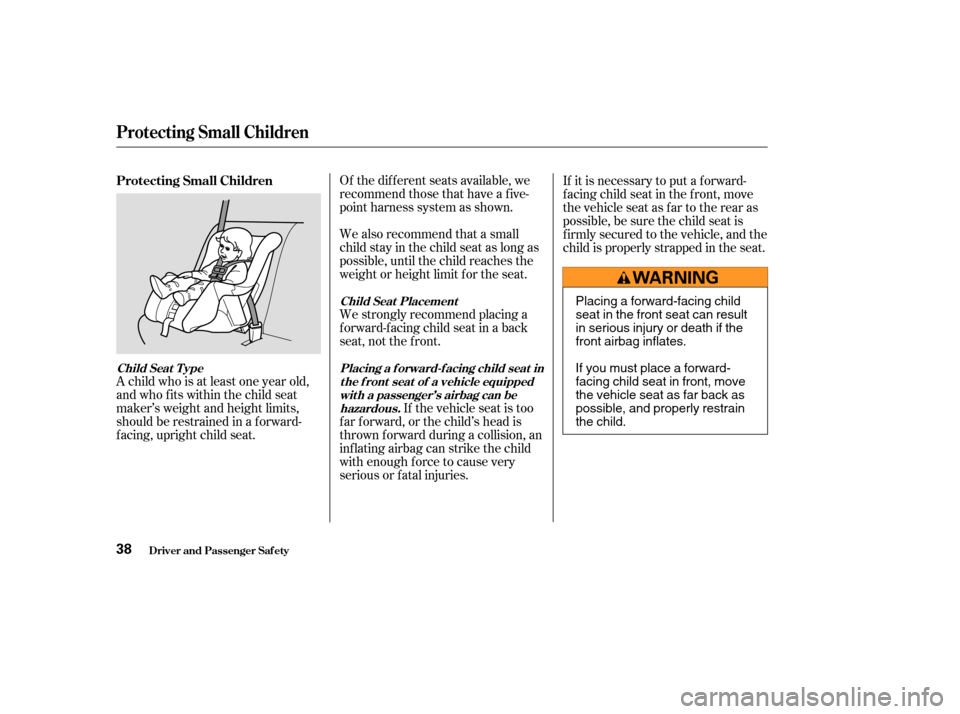
Of the different seats available, we
recommend those that have a f ive-
point harness system as shown.
A child who is at least one year old,
and who fits within the child seat
maker’s weight and height limits,
should be restrained in a f orward-
f acing, upright child seat. We also recommend that a small
child stay in the child seat as long as
possible, until the child reaches the
weight or height limit f or the seat.
If it is necessary to put a f orward-
f acing child seat in the f ront, move
the vehicle seat as far to the rear as
possible, be sure the child seat is
f irmly secured to the vehicle, and the
child is properly strapped in the seat.
We strongly recommend placing a
forward-facing child seat in a back
seat, not the f ront. If the vehicle seat is too
f ar f orward, or the child’s head is
thrown f orward during a collision, an
inf lating airbag can strike the child
with enough force to cause very
serious or f atal injuries.
Protecting Small Children
Child Seat T ype
Child Seat Placement
Placing a f orward-f acing child seat int he f ront seat of a vehicle equippedwith a passenger’s airbag can behazardous.
Protecting Small Children
Driver and Passenger Saf ety38
Placing a forward-facing child
seat in the front seat can result
in serious injury or death if the
front airbag inflates.
Ifyoumustplaceaforward-
facing child seat in front, move
the vehicle seat as far back as
possible, and properly restrain
the child.
Page 43 of 256

When buying a child seat, you need
to choose between a conventional
child seat, or one designed f or use
with the Lower Anchors and Tethers
f or Children (LATCH) system.
Conventional child seats must be
secured to a vehicle with a seat belt,
whereas LATCH-compatible seats
are secured by attaching the seat to
hardware built into the two outer
seating positions in the back seat.
Since LATCH-compatible child seats
are easier to install and reduce the
possibility of improper installation,
we recommend selecting this style.We also recommend selecting a
LATCH-compatible seat with a rigid,
rather than a f lexible, anchor (see
page ).
In seating positions and vehicles not
equipped with LATCH, a LATCH-
compatible child seat can be installed
using a seat belt.
Whatever type of seat you choose, to
provide proper protection, a child
seat should meet three
requirements:
Look f or FMVSS
213 or CMVSS 213 on the box.
Rear-facing for infants, forward-
f acing f or small children. Bef ore purchasing a conventional
child seat, or using a previously
purchased one, we recommend that
you test the seat in the specif ic
vehicle seating position, or positions,
where the seat will be used.
1.
2. 3.
41
Driver and Passenger Saf ety
Selecting a Child Seat
T he child seat should meet U.S. or Canadian Mot or Vehicle Saf et ySt andard 213.
T he child seat should be of theproper t ype and size t o f it t he child. T he child seat should f it the
vehicle seat ing posit ion (orposit ions) where it will be used.
39
Page 44 of 256

A child seat secured with a seat belt
should be installed as f irmly as
possible. However, it does not need
to be ‘‘rock solid’’. Some side-to-side
movement can be expected and
should not reduce the child seat’s
ef f ectiveness.
If the child seat is not secure, try
installing it in a dif f erent seating
position, or use a dif f erent style of
child seat that can be f irmly secured.Make sure the child is properly
strappedinthechildseat
according to the child seat maker’s
instructions. A child who is not
properly secured in a child seat
can be seriously injured in a crash.
Af ter selecting a proper child seat,
and a good place to install the seat,
there are three main steps in
installing the seat:
All child seats must be
secured to the vehicle with the lap
part of a lap/shoulder belt or with
the LATCH (Lower Anchors and
Tethers f or Children) system. A
child whose seat is not properly
secured to the vehicle can be
endangered in a crash.
Af ter installing a child
seat, push and pull the seat
f orward and f rom side to side to
verif y that it is secure. The f ollowing pages provide
guidelines on how to properly install
a child seat. A f orward-f acing child
seat is used in all examples, but the
instructions are the same f or rear-
f acing child seat.Secure the child in the child seat.
Properly secure t he child seat t o the vehicle.
Make sure t he child seat is f irmlysecured.
Installing a Child Seat
Driver and Passenger Saf ety
1.
2. 3.
40
Page 45 of 256
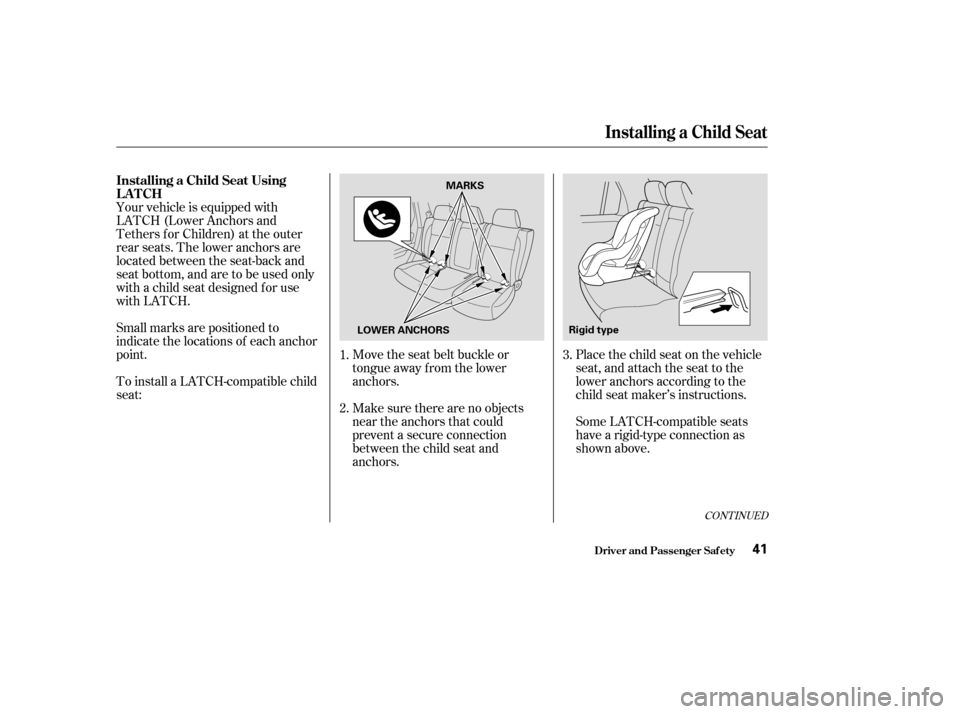
Your vehicle is equipped with
LATCH (Lower Anchors and
Tethers for Children) at the outer
rear seats. The lower anchors are
located between the seat-back and
seat bottom, and are to be used only
with a child seat designed f or use
with LATCH.
Small marks are positioned to
indicate the locations of each anchor
point.
To install a LATCH-compatible child
seat:Move the seat belt buckle or
tongue away f rom the lower
anchors.
Make sure there are no objects
near the anchors that could
prevent a secure connection
between the child seat and
anchors.Place the child seat on the vehicle
seat, and attach the seat to the
lower anchors according to the
child seat maker’s instructions.
Some LATCH-compatible seats
have a rigid-type connection as
shown above.
1.
2.
3.
CONT INUED
Installing a Child Seat Using
LATCH
Installing a Child Seat
Driver and Passenger Saf ety41
LOWER ANCHORS
Rigid type
MARKS
Page 46 of 256
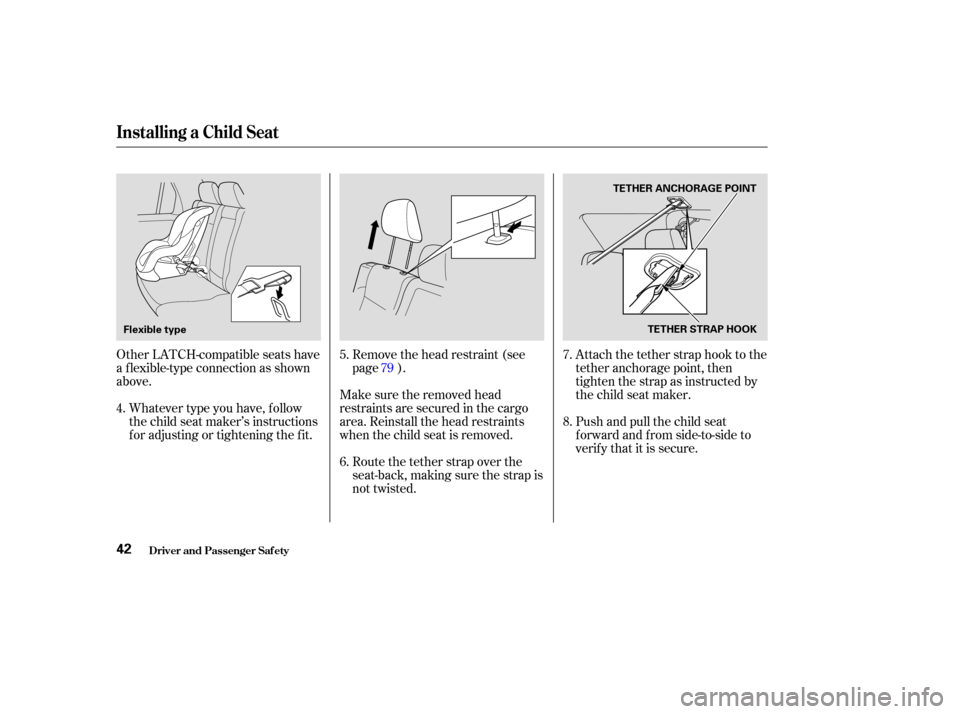
Remove the head restraint (see
page ).
Make sure the removed head
restraints are secured in the cargo
area. Reinstall the head restraints
when the child seat is removed.
Other LATCH-compatible seats have
a f lexible-type connection as shown
above.
Whatever type you have, f ollow
the child seat maker’s instructions
f or adjusting or tightening the f it. Route the tether strap over the
seat-back, making sure the strap is
not twisted.Attach the tether strap hook to the
tether anchorage point, then
tighten the strap as instructed by
the child seat maker.
Push and pull the child seat
f orward and f rom side-to-side to
verif y that it is secure.
5.
4. 6.7.
8.
79
Installing a Child Seat
Driver and Passenger Saf ety42
TETHER ANCHORAGE POINT
TETHER STRAP HOOK
Flexible type
Page 47 of 256
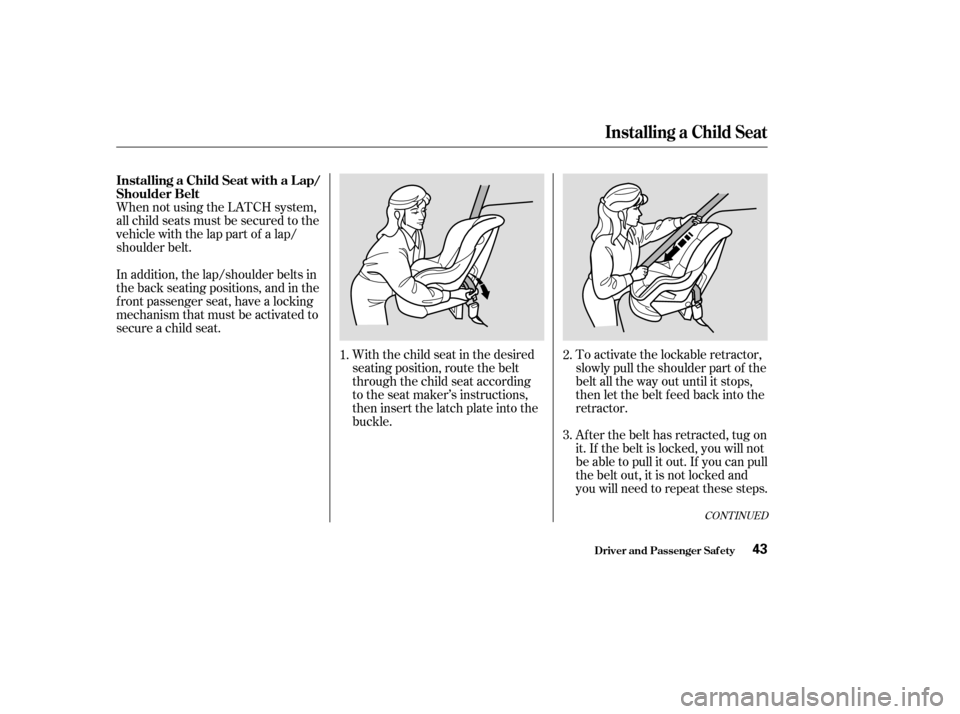
When not using the LATCH system,
all child seats must be secured to the
vehicle with the lap part of a lap/
shoulder belt.With the child seat in the desired
seating position, route the belt
through the child seat according
to the seat maker’s instructions,
then insert the latch plate into the
buckle.To activate the lockable retractor,
slowly pull the shoulder part of the
belt all the way out until it stops,
then let the belt f eed back into the
retractor.
Af ter the belt has retracted, tug on
it. If the belt is locked, you will not
be able to pull it out. If you can pull
the belt out, it is not locked and
you will need to repeat these steps.
In addition, the lap/shoulder belts in
the back seating positions, and in the
f ront passenger seat, have a locking
mechanism that must be activated to
secure a child seat.
2.
1.
3.
CONT INUED
Installing a Child Seat with a L ap/
Shoulder Belt
Installing a Child Seat
Driver and Passenger Saf ety43
Page 52 of 256

Some states also require children to
use a booster until they reach a
given age or weight (e.g., 6 years or
60lbs).Besuretocheckcurrent
laws in the state or states where you
intend to drive.The National Highway Traffic Safety
Administration and Transport
Canada recommend that all children
ages 12 and under be properly
restrained in the back seat.
If the passenger’s f ront airbag
inf lates in a moderate to severe
f rontal collision, the airbag can cause
serious injuries to a child who is
unrestrained, improperly restrained,
sitting too close to the airbag, or out
of position.
The side airbag also poses risks. If
any part of a larger child’s body is in
the path of a deploying side airbag,
the child could receive possibly
serious injuries.Of course, children vary widely. And
while age may be one indicator of
when a child can saf ely ride in the
f ront. There are other important
f actors you should consider.
To saf ely ride in f ront, a child must
be able to f ollow the rules, including
sitting properly, and wearing the seat
belt properly throughout a ride.
Booster seats can be high-back or
low-back. Whichever style you select,
make sure the booster meets f ederal
saf ety standards and that you f ollow
the booster seat maker’s instructions.
If a child who uses a booster must be
in front, move the passenger seat as
f ar back as possible and be sure the
child is wearing the seat belt
properly.
A child may continue using a booster
seat until the tops of their ears are
even with the top of the vehicle’s or
booster’s seat-back. A child of this
height should be tall enough to use
the lap/shoulder belt without a
booster. Physically, a child must be large
enough f or the lap/shoulder belt to
properly f it (see page ). If the seat
belt does not f it properly, with or
without the child sitting on a booster,
the child should not sit in the f ront.
47When Can a Larger Child Sit in Front
MaturityPhysical Size
Protecting L arger Children
Driver and Passenger Saf ety48