Page 159 of 301

Canadian Owners:The remote control
you are training f rom may stop trans-
mitting after two seconds. This is not
enough f or HomeLink to learn the
code. Release and press the button
on the remote control every two
seconds until HomeLink has learned
the code.
The red light in HomeLink should
begin f lashing. It will f lash slowly
at first, then rapidly.
When the red light f lashes rapidly,
release both buttons. HomeLink
should have learned the code from
the remote control.
Plug in the garage door opener
motor, then test the HomeLink
Transceiver button by pushing it. If the button does not work, repeat
this procedure to train it again. If it
still does not work, you may have a
variable or rolling code garage
door opener. See if you do by
pressing and holding the
HomeLink transceiver button you
just trained. If the red light blinks
f or two seconds, then stays on,
you have a rolling code garage
door opener. Go to ‘‘Training With
a Rolling Code System’’.
For security purposes, newer garage
door opening systems use a ‘‘rolling’’
or variable code. Inf ormation f rom
the remote control and the garage
door opener are needed bef ore
HomeLink can operate the garage
door opener.
The ‘‘Training HomeLink’’
procedure trains HomeLink to the
proper garage door opener code.
The f ollowing procedure
synchronizes HomeLink to the
garage door opener so they send and
receive the correct codes.
Repeat these steps to train the
other two HomeLink buttons to
operate any other remotely-
controlled devices around your
home (lighting, automatic gate,
security system, etc.).
5. 6.
8.
7. T raining With a Rolling Code
System
HomeL ink Universal T ransceiver
Features160
�����—�����—�����y�
�
����
������y���
�(�������
���y���
�����y
Page 166 of 301
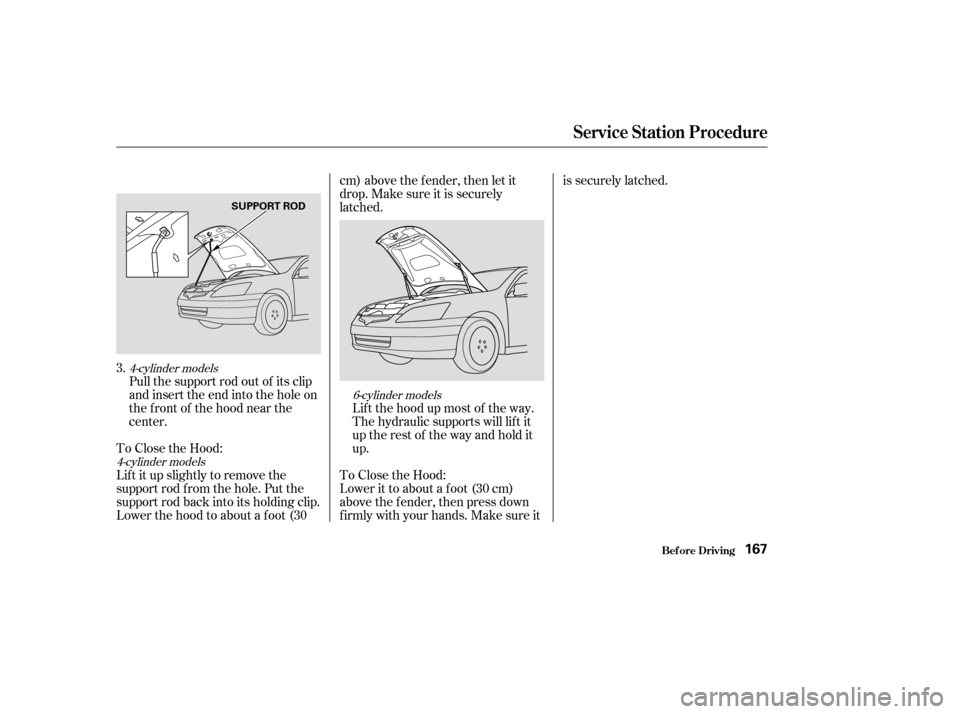
Pull the support rod out of its clip
and insert the end into the hole on
the front of the hood near the
center.
To Close the Hood:
Lif t it up slightly to remove the
support rod f rom the hole. Put the
support rod back into its holding clip.
Lower the hood to about a f oot (30 cm) above the f ender, then let it
drop. Make sure it is securely
latched.
Lif t the hood up most of the way.
The hydraulic supports will lif t it
uptherestof thewayandholditup.
Lower it to about a f oot (30 cm)
above the f ender, then press down
f irmly with your hands. Make sure it is securely latched.
To Close the Hood:
3.
4-cylinder models
4-cylinder models 6-cylinder models
Service Station Procedure
Bef ore Driving167
SUPPORT ROD
�����—�����—�����y�
�
�����������y���
�(�������
���y���
�����y
Page 174 of 301

The total weight must not exceed
theGrossVehicleWeightRating
(GVWR). The load f or the f ront and
rear axles also must not exceed the
Gross Axle Weight Rating (GAWR)
(see page ).Store or secure all items that could
be thrown around and hurt
someone during a crash.
Be sure items placed on the f loor
behind the f ront seats cannot roll
under the seats and interf ere with
the pedals or seat operation.
Keep the glove box closed while
driving. If it is open, a passenger
could injure their knees during a
crash or sudden stop.
If you carry large items that
prevent you f rom closing the trunk
lid, exhaust gas can enter the
passenger area. To avoid the
possibility of
, f ollow the instructions
on page .
If you carry any items on a roof
rack,besurethetotalweightof
the rack and the items does not
exceed 165 lbs (75 kg).
If you use an accessory roof rack,
the roof rack weight limit may be
lower. Ref er to the inf ormation that
came with your roof rack.
Distribute cargo evenly on the
f loor of the trunk, placing the
heaviest items on the bottom and
as far forward as possible.
If youfolddownthebackseat,tie
down items that could be thrown
about the vehicle during a crash or
sudden stop. 56
195
Carrying Cargo
Bef ore Driving
Carrying Items in the Passenger
Compartment
Carrying Cargo in the Trunk carbon monoxide
poisoning
175
�����—�����—�����y�
�
���������
�y���
�(�������
���y���
�����y
Page 177 of 301
Youshoulddothefollowingchecks
and adjustments bef ore you drive
your vehicle.Make sure all windows, mirrors,
and outside lights are clean and
unobstructed. Remove f rost, snow,
or ice.
Visually check the tires. If a tire
looks low, use a gauge to check its
pressure.
Check that any items you may be
carrying are stored properly or
f astened down securely. Check the adjustment of the
inside and outside mirrors (see
page ).
Make sure the doors are securely
closed and locked.
Fasten your seat belt. Check that
your passengers have f astened
their seat belts (see page ).When you start the engine, check
the gauges and indicator lights in
the instrument panel (see page
).
Check the steering wheel
adjustment (see page ).
Check the seat adjustment (see
pages and ).
3. 2.
1.
4. 5. 6. 7.8.
159.
61
98 92 93
78
Preparing to Drive
Driving178
�����—�����—�����y�
�
�����������y���
�(�������
���y���
���
�y
Page 186 of 301

Always use the parking brake when
you park your vehicle. Make sure
the parking brake is set f irmly or
your vehicle may roll if it is parked
on an incline.
If your vehicle has an automatic
transmission, set the parking brake
bef ore you put the transmission in
Park. This keeps the vehicle f rom
moving and putting pressure on the
parking mechanism in the
transmission.Make sure the moonroof (if
equipped) and the windows are
closed.
Turn of f the lights.
Place any packages, valuables, etc.,
in the trunk or take them with you.
Lockthedoorswiththekeyorthe
remote transmitter.
Check the indicator on the
instrument panel to verif y that the
security system is set.
Never park over dry leaves, tall
grass, or other f lammable
materials. The hot three way
catalytic converter could cause
these materials to catch on fire.
If your vehicle has a manual
transmission, put it in f irst gear.
Make sure the parking brake is
f ully released bef ore driving away.
Driving with the parking brake
partially set can overheat or
damage the rear brakes.
If the vehicle is f acing uphill, turn
the f ront wheels away f rom the
curb. If your vehicle has a manual
transmission, put it in f irst gear.
If the vehicle is f acing downhill,
turn the front wheels toward the
curb. If your vehicle has a manual
transmission, put it in reverse gear.
On EX, LX-V6, and Canadian LX-G
models
Driving
Parking T ips
Parking
187
�����—�����—�����y�
�
�����������y���
�(�������
���y���
�����y
Page 194 of 301

To achieve a proper tongue load,
start by loading 60 percent of the
load toward the front of the trailer
and 40 percent toward the rear, then
re-adjust the load as needed.The total weight of the vehicle, all
occupants, all cargo, and the
tongue load must not exceed: The best way to conf irm that vehicle
and trailer weights are within limits
is to have them checked at public
scale.
Using a suitable scale or a special
tongue load gauge, check the tongue
load the f irst time you set up a
towing combination (a f ully-loaded
vehicle and trailer), then recheck the
tongue load whenever the conditions
change.
Always use saf ety chains. Make sure
they are secured to both the trailer
and hitch, and that they cross under
the tongue so they can catch the
trailer if it becomes unhitched.
Leave enough slack to allow the
trailer to turn corners easily, but do
not let chains drag on the ground.
The total weight of the vehicle, all
occupants, all cargo, and the
tongue load must not exceed:
(DX, LX)
(DX, LX) on the f ront axle
on the rear axle
on the f ront axle
on the rear axle
on the f ront axle
on the rear axle
(EX, EX-L)
(EX, EX-L)
4-cylinder models:
6-cylinder models: 4-cylinder models:
6-cylinder models:
Driving
Gross Vehicle Weight Rating
(GVWR): Checking L oads
Gross Axle Weight Rating
(GA WR):
Saf et y Chains
Towing a Trailer
195
4,080 Ibs (1,850 kg)
4,125 Ibs (1,870 kg)
4,300 Ibs (1,950 kg) 2,195 Ibs (995 kg)
1,960 Ibs (890 kg)
2,225 Ibs (1,010 kg)
1,985 Ibs (900 kg)
2,360 Ibs (1,070 kg)
2,005 Ibs (910 kg)
�����—�����—�����y�
�
�������
���y���
�(�������
���y���
�����y
Page 196 of 301

When preparing to tow, and bef ore
driving away, be sure to check the
f ollowing:The vehicle has been properly
serviced, and the tires, brakes,
suspension, and cooling system
are in good operating condition.
All weights and loads are within
limits (see pages and ).
Thehitch,safetychains,andany
other attachments are secure.
Allitemsonandinthetrailerare
properly secured and cannot shif t
while you drive.
The lights and brakes on your
vehicle and the trailer are working
properly. Your vehicle tires and spare are
properly inf lated (see page ),
and the trailer tires and spare are
trailer maker.
Crosswinds and air turbulence
caused by passing trucks can disrupt
your steering and cause trailer
swaying. When being passed by a
large vehicle, keep a constant speed
and steer straight ahead. Do not try
to make quick steering or braking
corrections. Always drive slowly and have
someone guide you when backing up.
Grip the of the steering
wheel; then turn the wheel to the lef t
to get the trailer to move to the lef t,
andturnthewheelrighttomovethe
trailer to the right.
Follow all normal precautions when
parking, including f irmly setting the
parking brake and putting the
transmission in Park (automatic) or
in 1st or Reverse (manual). Also,
place wheel chocks at each of the
trailer’s tires.
194 195 238
bottom
Towing a Trailer
Driving
Pre-T ow Checklist
Handling Crosswinds and Buf f et ing
Backing Up
Parking
197
�����—�����—�����y�
�
�����������y���
�(�������
���y���������y
Page 213 of 301
Oil is a major contributor to your
engine’s perf ormance and longevity.
Always use a premium-grade 5W-20
detergent oil displaying the API
Certif ication Seal. This seal indicates
the oil is energy conserving, and that
it meets the American Petroleum
Institute’s latest requirements.
Unscrew and remove the engine oil
fill cap on top of the valve cover.
Pour in the oil slowly and caref ully so
you do not spill. Clean up any spills
immediately. Spilled oil could
damage components in the engine
compartment. Install the engine oil f ill cap and
tighten it securely. Wait a f ew
minutes and recheck the oil level. Do
not f ill above the upper mark; you
could damage the engine.
A dding Engine Oil
Maint enance
Recommended Engine Oil
214
ENGINE OIL FILL CAP ENGINE OIL FILL CAP
6-cylinder models
4-cylinder models
�����—�����—�����y�
������
������y���
�(�������
���y�����
���y