Page 45 of 301
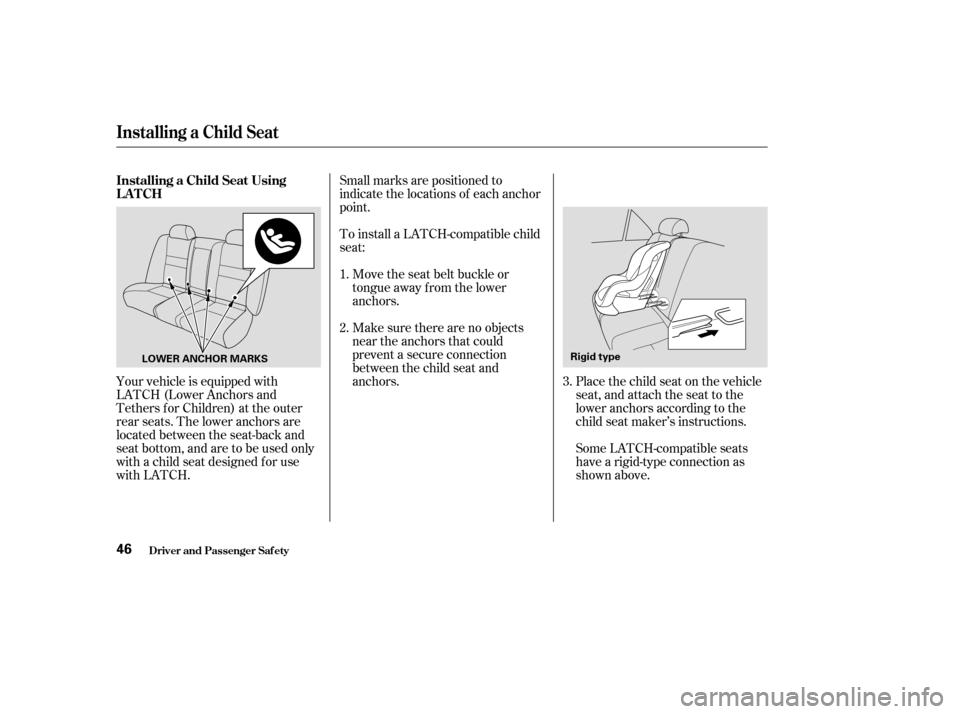
Your vehicle is equipped with
LATCH (Lower Anchors and
Tethers for Children) at the outer
rear seats. The lower anchors are
located between the seat-back and
seat bottom, and are to be used only
with a child seat designed f or use
with LATCH.Place the child seat on the vehicle
seat, and attach the seat to the
lower anchors according to the
child seat maker’s instructions.
Some LATCH-compatible seats
have a rigid-type connection as
shown above.
To install a LATCH-compatible child
seat:
Move the seat belt buckle or
tongue away f rom the lower
anchors.
Make sure there are no objects
near the anchors that could
prevent a secure connection
between the child seat and
anchors.
Small marks are positioned to
indicate the locations of each anchor
point. 1. 2.
3.
Installing a Child Seat Using
LATCH
Installing a Child Seat
Driver and Passenger Saf ety46
Rigid type
LOWERANCHORMARKS
�����—�����—�����y�
�
����
������y���
�(�������
���y���������y
Page 46 of 301
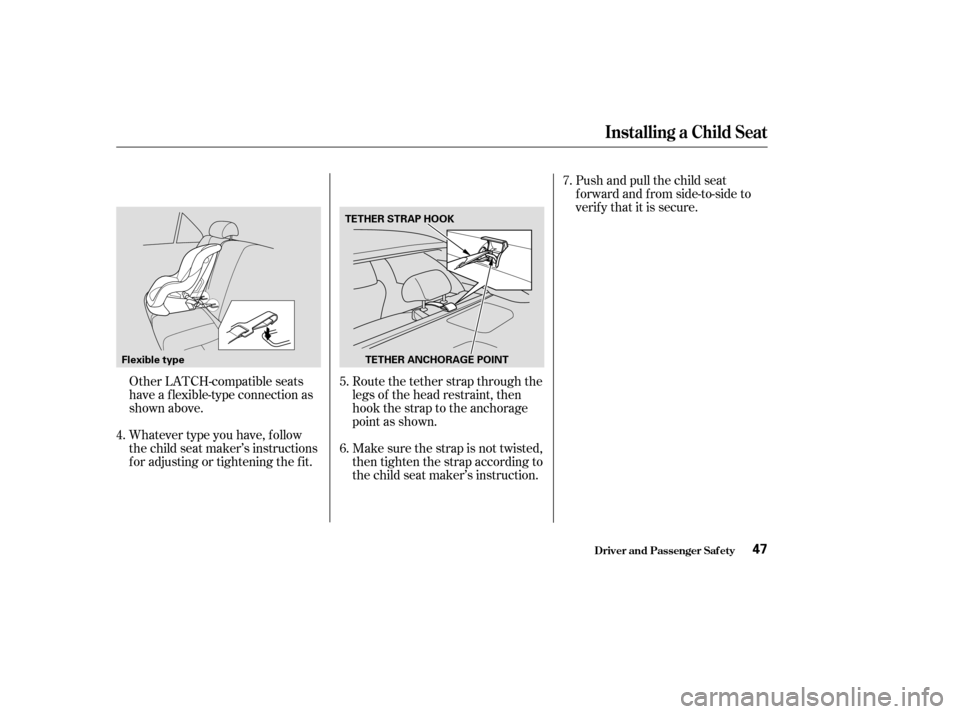
Other LATCH-compatible seats
have a f lexible-type connection as
shown above.
Whatever type you have, f ollow
the child seat maker’s instructions
f or adjusting or tightening the f it.Route the tether strap through the
legs of the head restraint, then
hook the strap to the anchorage
point as shown.
Make sure the strap is not twisted,
then tighten the strap according to
the child seat maker’s instruction.Push and pull the child seat
f orward and f rom side-to-side to
verif y that it is secure.
4. 5. 6.7.
Installing a Child Seat
Driver and Passenger Saf ety47
TETHER STRAP HOOK
Flexible type TETHER ANCHORAGE POINT
�����—�����—�����y�
�
����
������y���
�(�������
���y���������y
Page 47 of 301
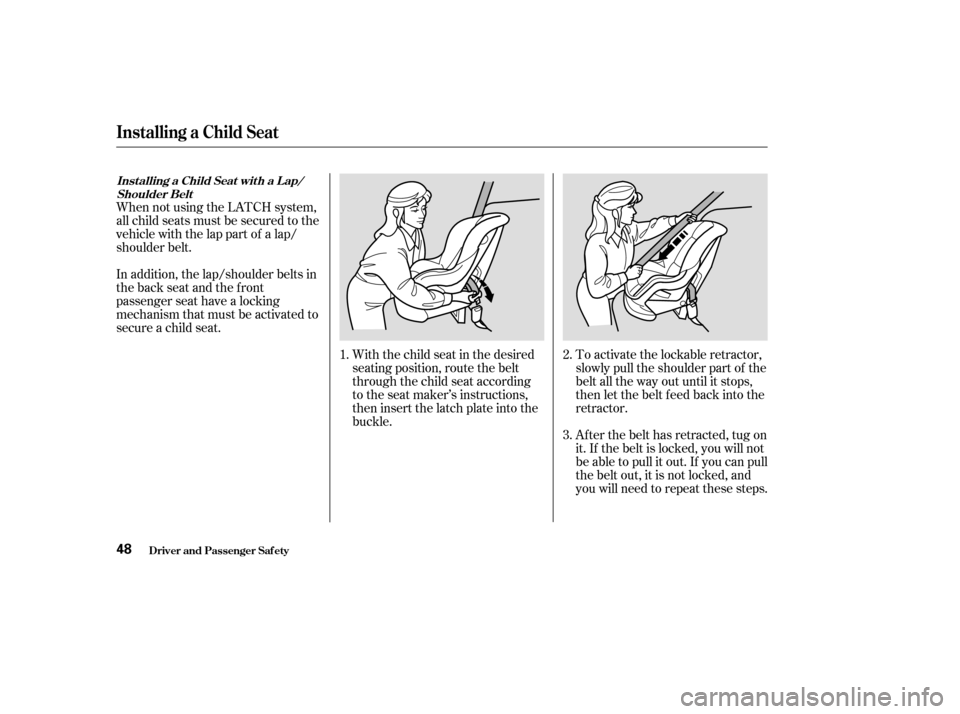
When not using the LATCH system,
all child seats must be secured to the
vehicle with the lap part of a lap/
shoulder belt.With the child seat in the desired
seating position, route the belt
through the child seat according
to the seat maker’s instructions,
then insert the latch plate into the
buckle.To activate the lockable retractor,
slowly pull the shoulder part of the
belt all the way out until it stops,
then let the belt f eed back into the
retractor.
Af ter the belt has retracted, tug on
it. If the belt is locked, you will not
be able to pull it out. If you can pull
thebeltout,itisnotlocked,and
you will need to repeat these steps.
In addition, the lap/shoulder belts in
the back seat and the front
passenger seat have a locking
mechanism that must be activated to
secure a child seat.
1.2. 3.
Inst alling a Child Seat wit h a L ap/
Shoulder Belt
Driver and Passenger Saf ety
Installing a Child Seat
48
�����—�����—�����y�
�
�����������y���
�(�������
���y�������
�y
Page 48 of 301
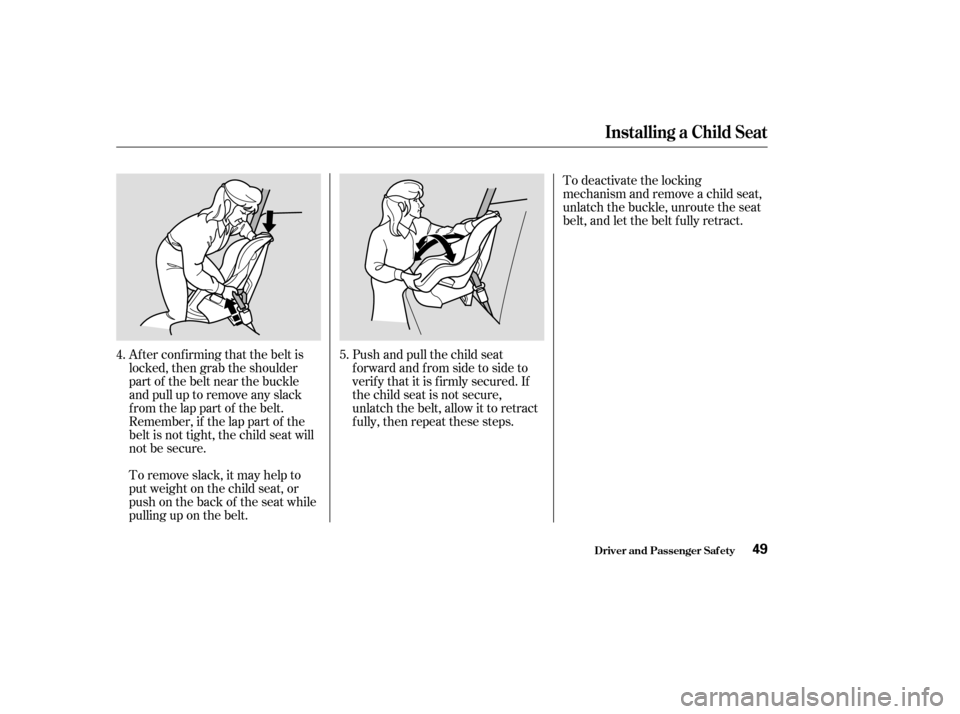
Af ter conf irming that the belt is
locked,thengrabtheshoulder
part of the belt near the buckle
andpulluptoremoveanyslack
f rom the lap part of the belt.
Remember, if the lap part of the
belt is not tight, the child seat will
not be secure.
To remove slack, it may help to
putweightonthechildseat,or
push on the back of the seat while
pulling up on the belt.To deactivate the locking
mechanism and remove a child seat,
unlatch the buckle, unroute the seat
belt, and let the belt f ully retract.
Push and pull the child seat
f orward and f rom side to side to
verif y that it is f irmly secured. If
the child seat is not secure,
unlatch the belt, allow it to retract
f ully, then repeat these steps.
4.
5.
Installing a Child Seat
Driver and Passenger Saf ety49
�����—�����—�����y�
�
�������
�
�y���
�(�������
���y���������y
Page 49 of 301
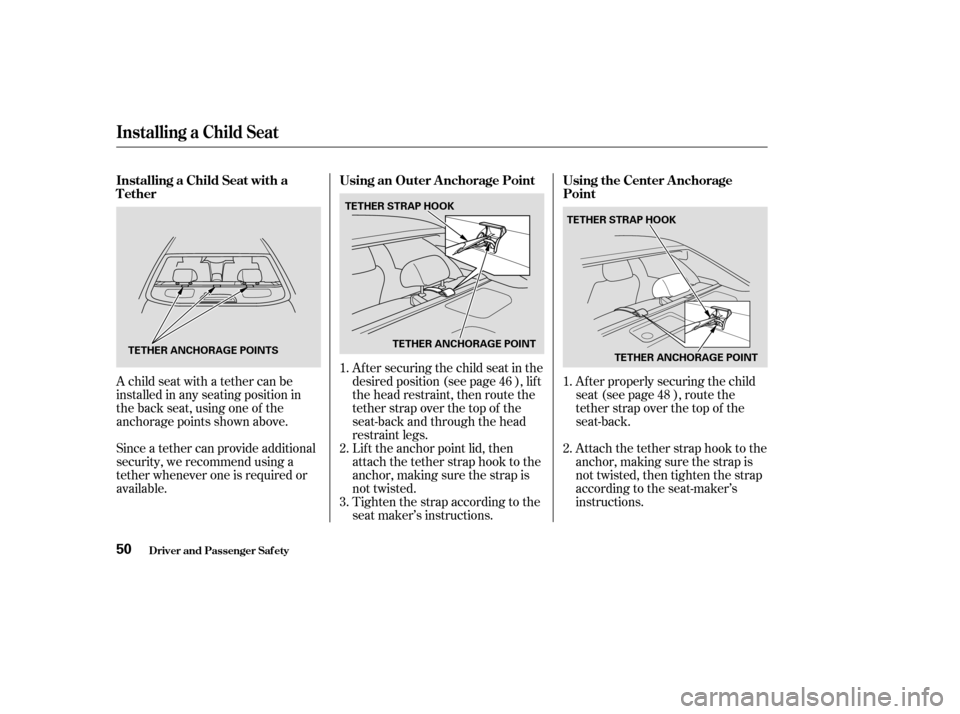
A child seat with a tether can be
installed in any seating position in
the back seat, using one of the
anchorage points shown above.
Since a tether can provide additional
security, we recommend using a
tether whenever one is required or
available.Af ter securing the child seat in the
desired position (see page ), lif t
the head restraint, then route the
tether strap over the top of the
seat-back and through the head
restraint legs.
Lif t the anchor point lid, then
attach the tether strap hook to the
anchor, making sure the strap is
not twisted.
Tighten the strap according to the
seat maker’s instructions.Af ter properly securing the child
seat (see page ), route the
tether strap over the top of the
seat-back.
Attach the tether strap hook to the
anchor, making sure the strap is
not twisted, then tighten the strap
according to the seat-maker’s
instructions.
1. 2. 3.
1. 2.
46
48
Installing a Child Seat
Driver and Passenger Saf ety
Installing a Child Seat with a
Tether Using an Outer A nchorage Point Using the Center A nchorage
Point
50
TETHER STRAP HOOK
TETHER ANCHORAGE P OINTS TETHER ANCHORAGE P
OINTTETHER STRAP HOOK
TETHER ANCHORAGE P OINT
�����—�����—�����y�
�
�����������y���
�(�������
���y���������y
Page 53 of 301

Of course, children vary widely. And
while age may be one indicator of
when a child can saf ely ride in the
f ront. There are other important
f actors you should consider.
To saf ely ride in f ront, a child must
be able to f ollow the rules, including
sitting properly, and wearing the seat
belt properly throughout a ride.If you decide that a child can saf ely
ride up f ront, be sure to:
Caref ully read the owner’s manual,
and make sure you understand all
seat belt instructions and all saf ety
inf ormation.
Have the child sit up straight, back
against the seat, and feet on or
near the f loor.
Check that the child’s seat belt is
properly positioned and secured.
Physically, a child must be large
enough f or the lap/shoulder belt to
properly f it (see pages and ). If
the seat belt does not f it properly,
with or without the child sitting on a
booster, the child should not sit in
the front.
Move the vehicle seat to the rear-
most position.
Supervise the child. Even mature
children sometimes need to be
reminded to f asten the seat belts
or sit properly.
14 51
Maturity
Physical Size
Protecting L arger Children
Driver and Passenger Saf ety54
�����—�����—�����y�
�������������y���
�(�������
���y���������y
Page 60 of 301
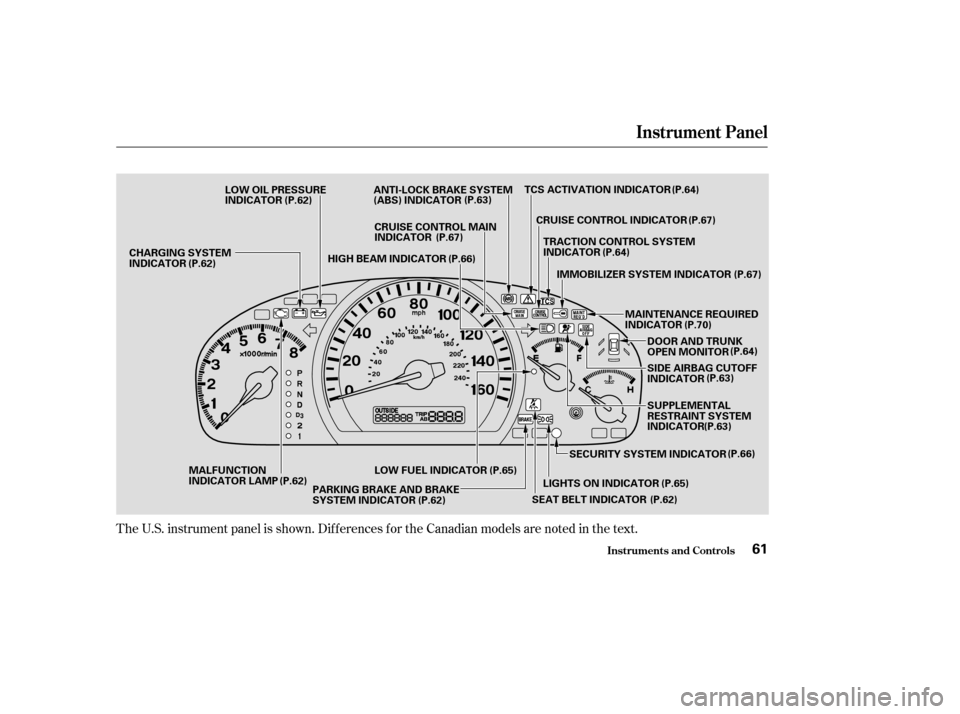
The U.S. instrument panel is shown. Dif f erences f or the Canadian models are noted in thetext.
Instrument Panel
Inst rument s and Cont rols61
CRUISE CONTROL INDICATOR
LOW FUEL INDICATOR MAINTENANCE REQUIRED
INDICATOR
MALFUNCTION
INDICATOR LAMP TRACTION CONTROL SYSTEM
INDICATOR
PARKING BRAKE AND BRAKE
SYSTEM INDICATOR TCS ACTIVATION INDICATOR
LOW OIL PRESSURE
INDICATOR
CHARGING SYSTEM
INDICATOR
SECURITY SYSTEM INDICATOR
IMMOBILIZER SYSTEM INDICATOR
ANTI-LOCK BRAKE SYSTEM
(ABS) INDICATOR
SUPPLEMENTAL
RESTRAINT SYSTEM
INDICATOR
DOOR AND TRUNK
OPEN MONITOR
SIDE AIRBAG CUTOFF
INDICATOR
CRUISE CONTROL MAIN
INDICATOR
(P.62)
(P.62)
(P.62) (P.65)
(P.62) LIGHTS ON INDICATOR (P.65) (P.64)
(P.63)
(P.63)
(P.64)
(P.63)
HIGH BEAM INDICATOR (P.66)
SEAT BELT INDICATOR (P.62)
(P.67)
(P.64)
(P.67)
(P.67)
(P.70)
(P.66)
�����—�����—�����y�
�
�����������y���
�(�������
���y���������y
Page 65 of 301
Canadian models only
This indicator comes on when you
turn the ignition switch to ON (II)
with the headlight switch off and the
parking brake set. It should go of f if
youturnontheheadlightsorrelease
the parking brake. If it comes on at
any other time, it means there is a
problem with the DRL. There may
also be a problem with the high
beam headlights.This indicator comes on with the
high beam headlights. See page
f or inf ormation on the headlight
controls.
On Canadian models, this indicator
comes on with reduced brightness
when the Daytime Running Lights
(DRL) are on (see page ).
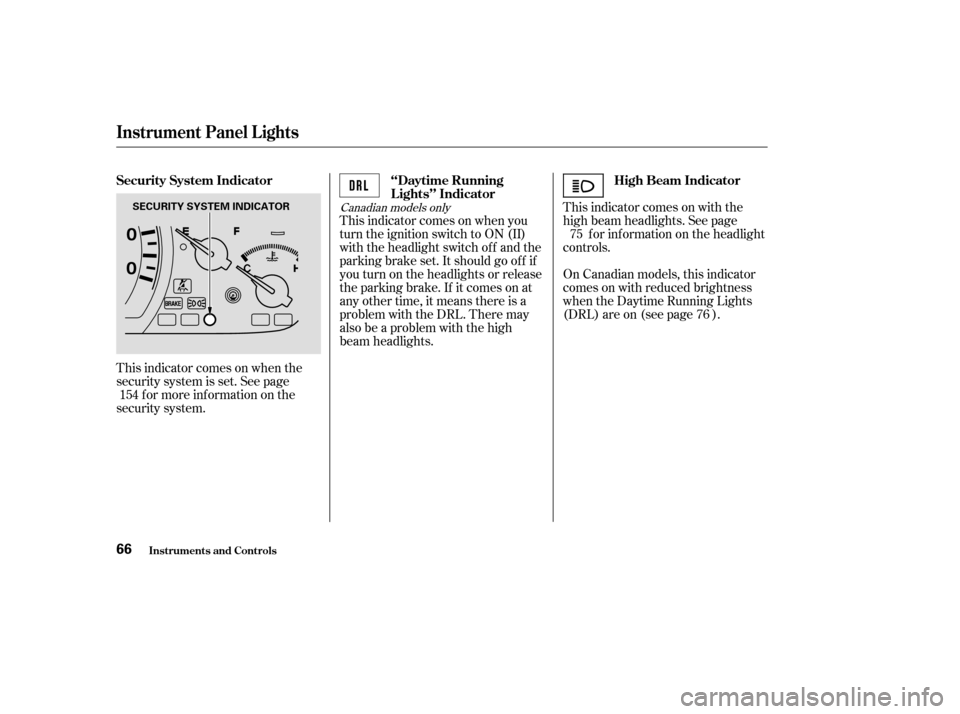
This indicator comes on when the
security system is set. See page f or more inf ormation on the
security system. 154 76
75
Security System Indicator ‘‘Daytime Running
Lights’’ IndicatorHigh Beam Indicator
Instrument Panel L ights
Inst rument s and Cont rols66
SECURITY SYSTEM INDICATOR
�����—�����—�����y�
�
�����������y���
�(�������
���y���������y