Page 328 of 420

Traction:The friction between the tire and the road
surface. The amount of grip provided.
Tread:The portion of a tire that comes into contact
with the road.
Treadwear Indicators:Narrow bands, sometimes
called “wear bars,” that show across the tread of a
tire when only 1/16 inch (1.6 mm) of tread remains.
SeeWhen It Is Time for New Tires on page 5-67.
UTQGS:Uniform Tire Quality Grading Standards,
a tire information system that provides consumers with
ratings for a tire’s traction, temperature and treadwear.
Ratings are determined by tire manufacturers using
government testing procedures. The ratings are molded
into the sidewall of the tire. SeeUniform Tire Quality
Grading on page 5-69.
Vehicle Capacity Weight:The number of designated
seating positions multiplied by 150 lbs. (68 kg) plus the
rated cargo load. SeeLoading Your Vehicle on page 4-52.
Vehicle Maximum Load on the Tire:Load on an
individual tire due to curb weight, accessory weight,
occupant weight and cargo weight.
Vehicle Placard:A label permanently attached to a
vehicle showing the original equipment tire size and
recommended ination pressure. SeeLoading
Your Vehicle on page 4-52.
Ination - Tire Pressure
The tire and loading information label, shows the correct
ination pressures for your tires when they’re cold.
“Cold” means your vehicle has been sitting for at least
three hours or driven no more than 1 mile (1.6 km).
SeeLoading Your Vehicle on page 4-52, for the location
of your vehicle’s tire and loading information label.
Notice:Don’t let anyone tell you that underination
or overination is all right. It’s not. If your tires
don’t have enough air (underination), you can get
the following:
Too much exing
Too much heat
Tire overloading
Bad wear
Bad handling
Bad fuel economy
If your tires have too much air (overination),
you can get the following:
Unusual wear
Bad handling
Rough ride
Needless damage from road hazards
5-64
Page 382 of 420

(f)Lubricate all key lock cylinders, body door and fuel
door hinges, latches and locks (including glove box
and console doors), hood latch assembly, secondary
latch, pivots, spring anchor, release pawl and any
moving seat hardware. Lubricate hood safety lever
pivot and prop rod pivot and tailgate latch bolt, handle
assembly pivot points and hinges. More frequent
lubrication may be required when exposed to a corrosive
environment. Applying silicone grease on weatherstrips
with a clean cloth will make them last longer, seal
better and not stick or squeak.
(g)A uid loss in any vehicle system could indicate a
problem. Have the system inspected and repaired
and the uid level checked. Add uid if needed.(h)Change automatic transmission uid and lter if the
vehicle is mainly driven under one or more of these
conditions:
In heavy city traffic where the outside temperature
regularly reaches 90°F (32°C) or higher.
In hilly or mountainous terrain.
When doing frequent trailer towing.
Uses such as found in taxi, police or delivery
service.
(i)Drain, ush and rell cooling system. See Engine
Coolant on page 5-25for what to use. Inspect hoses.
Clean radiator, condenser, pressure cap and ller neck.
Pressure test the cooling system and pressure cap.
6-8
Page 383 of 420

Owner Checks and Services
These owner checks and services should be performed
at the intervals specied to help ensure the safety,
dependability and emission control performance of your
vehicle. Your GM Goodwrench dealer can assist you
with these checks and services.
Be sure any necessary repairs are completed at once.
Whenever any uids or lubricants are added to your
vehicle, make sure they are the proper ones, as shown
inRecommended Fluids and Lubricants on page 6-13.
At Each Fuel Fill
It is important to perform these underhood checks at
each fuel ll.
Engine Oil Level Check
Check the engine oil level and add the proper oil if
necessary. SeeEngine Oil on page 5-13for further
details.
Notice:It is important to check your oil regularly
and keep it at the proper level. Failure to keep your
engine oil at the proper level can cause damage
to your engine not covered by your warranty.
Engine Coolant Level Check
Check the engine coolant level and add
DEX-COOL®coolant mixture if necessary. SeeEngine
Coolant on page 5-25for further details.
Windshield Washer Fluid Level Check
Check the windshield washer uid level in the windshield
washer tank and add the proper uid if necessary.
At Least Once a Month
Tire Ination Check
Visually inspect your tires and make sure tires are
inated to the correct pressures. Do not forget to check
your spare tire. SeeTires on page 5-57for further
details. Check to make sure the spare tire is stored
securely. Push, pull and then try to rotate or turn
the spare tire. If it moves, tighten it. SeeChanging a
Flat Tire on page 5-74.
6-9
Page 412 of 420
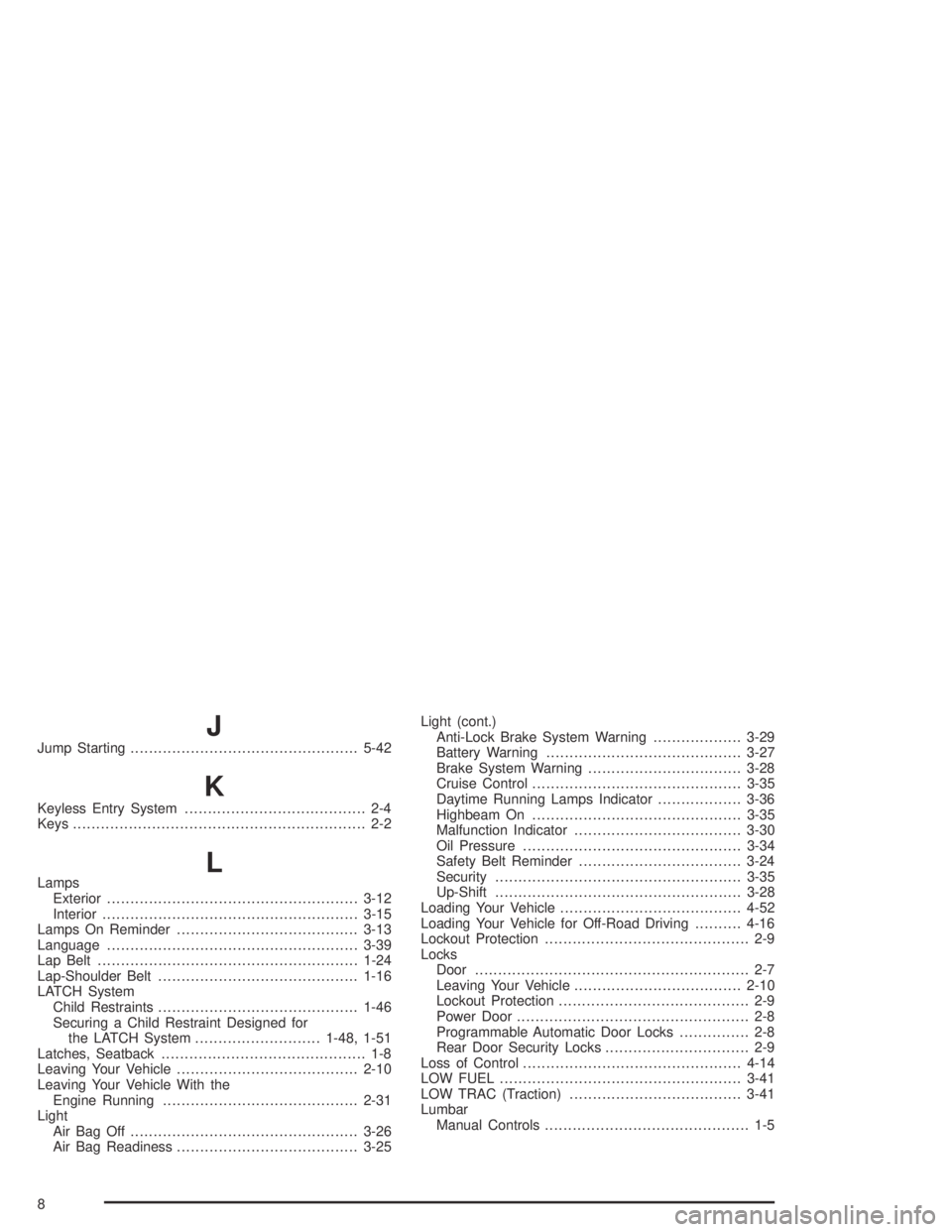
J
Jump Starting.................................................5-42
K
Keyless Entry System....................................... 2-4
Keys............................................................... 2-2
LLamps
Exterior......................................................3-12
Interior.......................................................3-15
Lamps On Reminder.......................................3-13
Language......................................................3-39
Lap Belt........................................................1-24
Lap-Shoulder Belt...........................................1-16
LATCH System
Child Restraints...........................................1-46
Securing a Child Restraint Designed for
the LATCH System...........................1-48, 1-51
Latches, Seatback............................................ 1-8
Leaving Your Vehicle.......................................2-10
Leaving Your Vehicle With the
Engine Running..........................................2-31
Light
Air Bag Off .................................................3-26
Air Bag Readiness.......................................3-25Light (cont.)
Anti-Lock Brake System Warning...................3-29
Battery Warning..........................................3-27
Brake System Warning.................................3-28
Cruise Control.............................................3-35
Daytime Running Lamps Indicator..................3-36
Highbeam On.............................................3-35
Malfunction Indicator....................................3-30
Oil Pressure...............................................3-34
Safety Belt Reminder...................................3-24
Security.....................................................3-35
Up-Shift.....................................................3-28
Loading Your Vehicle.......................................4-52
Loading Your Vehicle for Off-Road Driving..........4-16
Lockout Protection............................................ 2-9
Locks
Door........................................................... 2-7
Leaving Your Vehicle....................................2-10
Lockout Protection......................................... 2-9
Power Door.................................................. 2-8
Programmable Automatic Door Locks............... 2-8
Rear Door Security Locks............................... 2-9
Loss of Control...............................................4-14
LOW FUEL....................................................3-41
LOW TRAC (Traction).....................................3-41
Lumbar
Manual Controls............................................ 1-5
8