Page 161 of 272

STARTING AND OPERATING 161
5
For the indicator lamp k refer to
"Indicator Lamp
Acceleration Skid Control (ASR) and Brake Assist
System (BAS)
".
Indicator Lamp Electronic Stability Program (ESP)
(Cargo/passenger vans type 2500 C/HC/SHC only)When the key is in position 2 in the ignition lock, the
ESP indicator lamp will light up in the instrument
cluster as a function check. It goes out when the engine
is running.
If the indicator lamp remains on or lights up when
the engine is running, the electronic stability program
(ESP) is malfunctioning and switched off
automatically. The engine’s power output may be then
reduced.
WARNING!
The Brake Assist system (BAS) cannot prevent the
natural laws of physics from acting on the vehicle,
nor can it increase braking efficiency beyond that
afforded by the condition of the vehicle brakes
and tires or the traction afforded.
The BAS cannot prevent accidents, including
those resulting from excessive speed in turns,
following another vehicle too closely, or
hydroplaning. Only a safe, attentive, and skillful
driver can prevent accidents.
The capabilities of an BAS equipped vehicle must
never be exploited in a reckless or dangerous
manner which could jeopardize the user’s safety
or the safety of others
.
Adapt your speed and driving style to the
prevailing road, traffic and weather conditions.
Driving too fast increases the risk of an accident.
Freightliner-all.book Pag e 161 Monday, December 1, 2003 2:54 PM
Page 162 of 272

162 STARTING AND OPERATINGNOTE: If the ABS is malfunctioning or the voltage in
the vehicle’s electrical system drops below 10 volts, the
indicator lamp will also light up in the instrument
cluster and the ESP will be deactivated. The indicator
lamp will go out as soon as the voltage reaches this
level again or the ABS is operational again
– the ESP is
then reactivated.
Electronic Stability Program (ESP) (Cargo/
passenger vans type 2500 C/HC/SHC only)The Electronic Stability Program (ESP) monitors the
vehicle’s traction (force of adhesive friction between
the tires and the road surface) and handling.
The ESP recognizes when a wheel is spinning or if the
vehicle starts to skid. By applying brakes to the
appropriate wheel and by limiting engine output, the
ESP works to stabilize the vehicle. The ESP is especially
useful while driving off and on wet or slippery wet
surfaces.
The warning lamp v in the speedometer flashes
when the ESP is engaged, refer also to
"Warning Lamp
Acceleration Skid Control (ASR) and Electronic
Stability Program (ESP)
".
If wheels with tires of a different size than those offered
by an authorized Sprinter Dealer are used, the correct
operation of the ESP cannot be guaranteed.
WARNING!
If the ESP indicator lamp remains on, the
electronic stability program (ESP) is malfunction-
ing. The vehicle stability will no longer be auto-
matically regulated in good time.
The danger that your vehicle breaks into a skid, is
increased in certain driving situations. Drive with
extra caution.
Have the ESP repaired as soon as possible by an
authorized Spinter Dealer.
Freightliner-all.book Pag e 162 Monday, December 1, 2003 2:54 PM
Page 175 of 272

STARTING AND OPERATING 175
5
DRAINING FUEL FILTER WITH WATER
SEPARATOR1. Fuel filter
2. Drain hose
3. Water drain screw
The fuel filter (1) is located in the engine compartment.
NOTE: The fuel filter must be drained as soon as the
water in fuel indicator lamp lights up.NOTE: Prior to opening water drain screw (3), place a
suitable receptacle underneath the drain hose (2). Turn
water drain screw (3) on and off only by hand.
Diesel fuels and diesel fuel mixtures must be disposed
of properly; we recommend water be drained from fuel
filters by an authorized Sprinter Dealer.
Draining Fuel Filter
Stop the engine.
Shift gear selector lever to ‘‘P’’ position.
Open the hood.
Place a suitable receptacle underneath the drain
hose (2).
Turn the key in the ignition lock to position 2.
CAUTION!
Delaying draining of the fuel filter for a
considerable time after the indicator lamp lights
up may lead to engine damage.
Freightliner-all.book Pag e 175 Monday, December 1, 2003 2:54 PM
Page 180 of 272

180 STARTING AND OPERATINGTowing a TrailerThere are many different laws, including speed limit
restrictions, having to do with trailer towing. Make
sure that your vehicle-trailer combination will be legal,
not only for where you reside, but also for where you
will be driving. A good source for this information can
be the police or local authorities.
Before you start driving with the trailer, check the
trailer hitch, break-away switch, safety chains,
electrical connections, lighting and tires. Also adjust
the mirrors to permit unobstructed view beyond rear
of trailer.
If the trailer has electric brakes, start your vehicle and
trailer moving slowly, and then apply only the trailer
brake controller by hand to be sure the brakes are
working properly.
When towing a trailer, check occasionally to be sure
that the load is secure, and that lighting and trailer
brakes (if so equipped) are functioning properly.
Always secure items in the trailer to prevent load shifts
while driving.Take into consideration that when towing a trailer, the
handling characteristics are different and less stable
from those when operating the vehicle without a
trailer. It is important to avoid sudden maneuvers. The
vehicle and trailer combination is heavier, and
therefore is limited in acceleration and climbing ability,
and requires longer stopping distances. It is more
prone to reacting to side wind gusts, and requires more
sensitive steering input.
In order to gain skill and an understanding of the
vehicle’s behavior, you should practice turning, stopping
and backing up in an area which is free from traffic.If possible, do not brake abruptly, but rather engage
the brake slightly at first to permit the trailer to activate
its brake. Then increase the braking force.
Freightliner-all.book Pag e 180 Monday, December 1, 2003 2:54 PM
Page 186 of 272
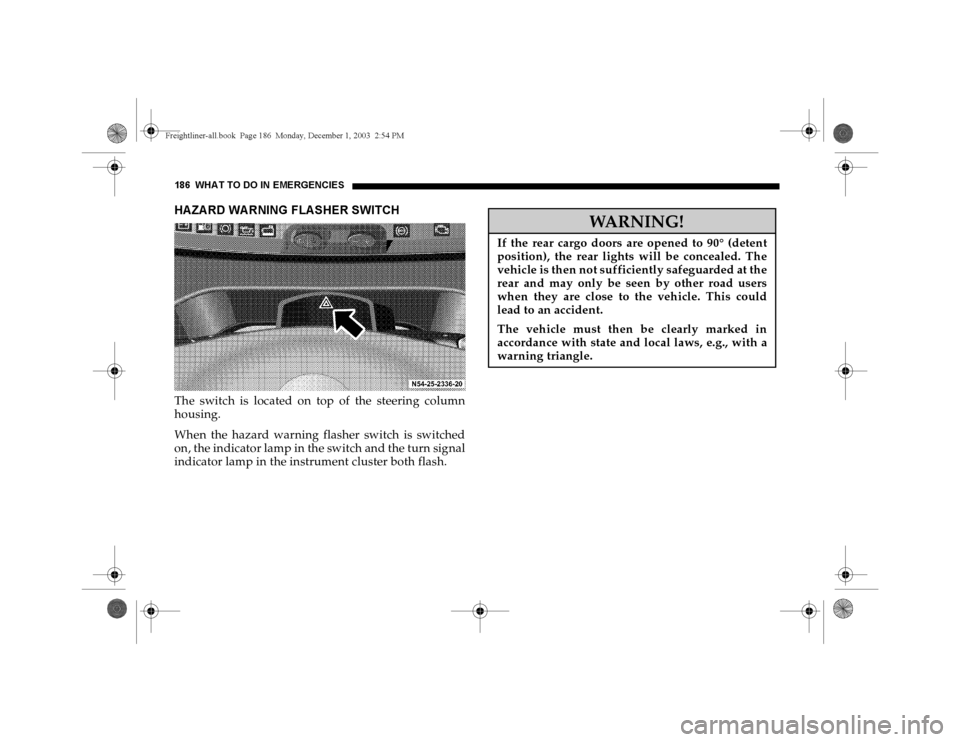
186 WHAT TO DO IN EMERGENCIESHA ZA RD WA RNING FLA SHER SWITCHThe switch is located on top of the steering column
housing.
When the hazard warning flasher switch is switched
on, the indicator lamp in the switch and the turn signal
indicator lamp in the instrument cluster both flash.
WARNING!
If the rear cargo doors are opened to 90° (detent
position), the rear lights will be concealed. The
vehicle is then not sufficiently safeguarded at the
rear and may only be seen by other road users
when they are close to the vehicle. This could
lead to an accident.
The vehicle must then be clearly marked in
accordance with state and local laws, e.g., with a
warning triangle.
Freightliner-all.book Pag e 186 Monday, December 1, 2003 2:54 PM
Page 189 of 272

WHAT TO DO IN EMERGENCIES 189
6
3. Everyone must leave the vehicle before you jack it
up.
4. Everyone must leave the danger zone, before
jacking the vehicle.
5. The vehicle must be safeguarded in accordance
with legal regulations (such as using a warning
triangle).
6. Prevent vehicle from rolling away by blocking
wheels with wheel chocks (not supplied with
vehicle) or sizable wood block or stone.
On a level road, place one chock in front of and one
behind the wheel that is diagonally opposite to the
wheel being changed.
When changing a wheel on mild uphill or downhill
grades, place chocks on the downhill side blocking
both wheels of the other axle.
Spare Wheel Location
WARNING!
Do not change wheels on either steep uphill or
downhill grades. The vehicle may begin to move
and fall from the jack which could cause personal
injury and property damage.
WARNING!
If the rear cargo doors are opened to 90° (detent
position), the rear lights will be concealed. The ve-
hicle is then not sufficiently safeguarded at the
rear and may only be seen by other road users
when they are close to the vehicle. This could lead
to an accident.
The vehicle must then be clearly marked in
accordance with state and local laws, e.g., with a
warning triangle.
Freightliner-all.book Pag e 189 Monday, December 1, 2003 2:54 PM
Page 196 of 272
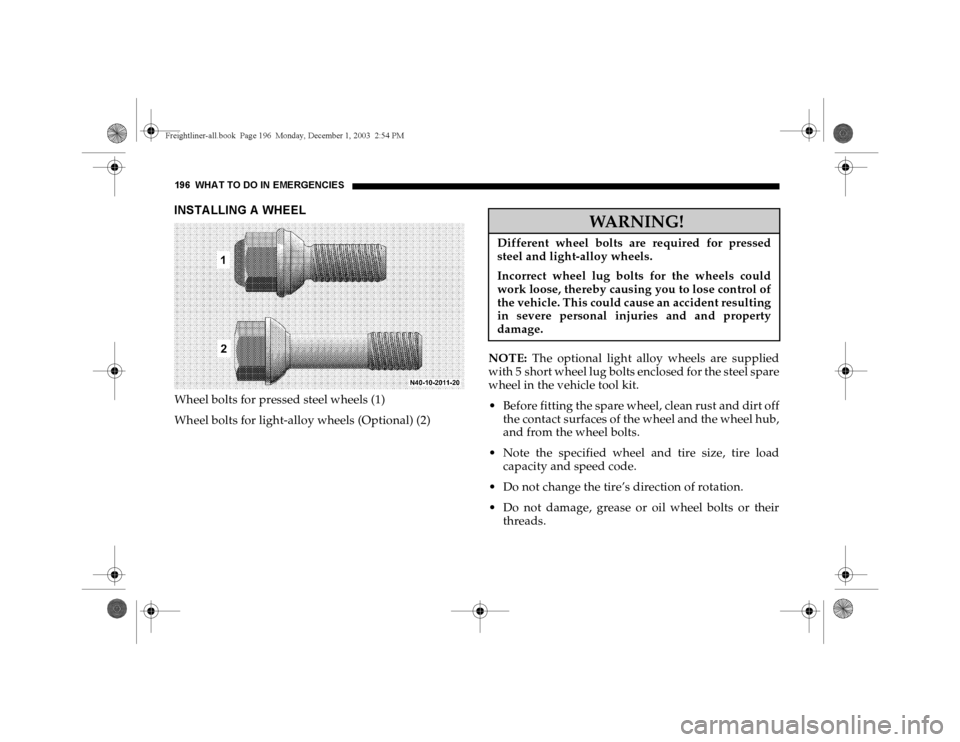
196 WHAT TO DO IN EMERGENCIESINSTALLING A WHEELWheel bolts for pressed steel wheels (1)
Wheel bolts for light-alloy wheels (Optional) (2)NOTE: The optional light alloy wheels are supplied
with 5 short wheel lug bolts enclosed for the steel spare
wheel in the vehicle tool kit.
Before fitting the spare wheel, clean rust and dirt off
the contact surfaces of the wheel and the wheel hub,
and from the wheel bolts.
Note the specified wheel and tire size, tire load
capacity and speed code.
Do not change the tire’s direction of rotation.
Do not damage, grease or oil wheel bolts or their
threads.
WARNING!
Different wheel bolts are required for pressed
steel and light-alloy wheels.
Incorrect wheel lug bolts for the wheels could
work loose, thereby causing you to lose control of
the vehicle. This could cause an accident resulting
in severe personal injuries and and property
damage.
Freightliner-all.book Pag e 196 Monday, December 1, 2003 2:54 PM
Page 197 of 272

WHAT TO DO IN EMERGENCIES 197
6
Centering wheels with wheel bolts
If dual assemblies are used, before placement the
inner wheel should be inspected to ensure that all
ball bearing rings are in proper position.
Install the wheel and snug the wheel bolts.
Slightly tighten wheel bolts.
Slowly open jack release valve to lower vehicle until
tire is resting on ground.
Tighten the wheel bolts in a crosswise pattern to the
specified torque with a torque wrench.
Tightening torque for 8,550 lbs (3,880 kgs)
(vehicle type 2500 C/HC/SHC):
Steel wheel – 177 lbf.ft ±7 lbf.ft (240 N.m ±10 N.m)
Light alloy wheel – 138 lbf.ft ±14 lbf.ft
(190 N.m ±20 N.m)
WARNING!
Incorrect mounting bolts or improperly tightened
mounting bolts can cause the wheel to come off.
To avoid the risk of serious or fatal injuries or ve-
hicle damage, please bear the following points in
mind:• Always replace wheel bolts that are damaged or
rusted.• Never apply oil or grease to wheel bolts• If a wheel hub thread is damaged, you must not
drive the vehicle. Consult a qualified specialist
workshop.
WARNING!
Do not tighten the wheel bolts and wheel nuts
completely while the vehicle is still jacked up.
The vehicle could tip.
Freightliner-all.book Pag e 197 Monday, December 1, 2003 2:54 PM