2004 DODGE RAM 1500 GAS 12 000 km
[x] Cancel search: 12 000 kmPage 112 of 429
To Accelerate For Passing
Depress the accelerator as you would normally. When the
pedal is released, the vehicle will return to the set speed.
NOTE:When driving uphill, at elevations above 2,000
feet (610 meters), or when the vehicle is heavily loaded
(especially when towing) the vehicle may slow below the
SET speed. If the vehicle speed drops below (refer to the
table below for the speed for your specific engine), the
speed control will automatically disengage. If this hap-
pens, you can push down on the accelerator pedal to
maintain the desired speed.
Vehicles equipped with a 5±speed-manual transmission
should be operated in 4th gear or lower under the above
conditions.Vehicles equipped with a Automatic transmission may
exhibit several downshifts under the above conditions.
To reduce the frequency of the downshifts and to im-
prove vehicle performance, it is advisable to lock out
overdrive by pressing the ªTOW/HAULº button located
at the end of the gear shifter.
WARNING!
Speed Control can be dangerous where the system
can't maintain a constant speed. Your vehicle could
go too fast for the conditions, and you could lose
control. An accident could be the result. Don't use
Speed Control in heavy traffic or on roads that are
winding, icy, snow-covered, or slippery.
112 UNDERSTANDING THE FEATURES OF YOUR VEHICLE
Page 135 of 429
There are stampings in the sheet metal on the inner side
bulkheads of the box in front of and behind both wheel
housings. Place wooden boards across the box from side
to side to create separate load compartments in the
pickup box.
There are four tie-down cleats bolted to the lower sides of
the pickup box that can sustain loads up to 1000 lbs (450
kg) total.
SLIDE-IN CAMPERS
Camper Applications
Certain truck models are not recommended for slide-in
campers. To determine if your vehicle is excluded, please
refer to the ªConsumer Information Truck-Camper Load-
ingº document available from your dealer. For safety
reasons, follow all instructions in this important docu-
ment.NOTE:When a cap or pickup camper is installed on a
vehicle, an alternate CHMSL (Center High Mounted Stop
Light) must be provided.
EASY-OFF TAILGATE
To simplify mounting of a camper unit with an overhang,
the tailgate can be removed quickly. If the truck is a 3500
dual rear wheel model, unplug the tailgate wire harness
from under the rear of the truck and pull the harness out
of the cargo box access hole. Unlatch the tailgate and
remove the support cables by releasing the lock tang
from the pivot, then rotate and pull away from the box.
Once the cables are free, move to the right side of the
tailgate hinge bracket.
Raise the right side of the tailgate until the right side
pivot clears the hanger bracket. Slide the entire tailgate to
the right to free the left side pivot. Remove the tailgate
from the vehicle entirely. Do not carry the tailgate loose in
the truck pickup box.
UNDERSTANDING THE FEATURES OF YOUR VEHICLE 135
3
Page 197 of 429
speeds will reduce fogging. Interior fogging on the
windshield can be quickly removed by selecting the
defrost mode.
Regular cleaning of the inside of the windows with a
non-filming cleaning solution (vinegar and water works
very well) will help prevent contaminates (cigarette
smoke, perfumes, etc.) from sticking to the windows.
Contaminates increase the rate of window fogging.
Summer Operation
Air conditioned vehicles must be protected with a high
quality antifreeze coolant during summer to provide
proper corrosion protection and to raise the boiling point
of the coolant for protection against overheating. A 50 %
concentration is recommended. Refer to Recommended
Fluids and Genuine Parts for the proper coolant type.
When using the air conditioner in extremely heavy traffic
in hot weather especially when towing a trailer, addi-
tional engine cooling may be required. If this situation isencountered, operate the transmission in a lower gear to
increase engine RPM, coolant flow and fan speed. When
stopped in heavy traffic, it may be necessary to shift into
NEUTRAL and depress the accelerator slightly for fast
idle operation to increase coolant flow and fan speed.
NOTE:On models equipped with Diesel engines, the
idle speed will automatically increase to 1000 rpm at
elevated coolant temperatures to improve engine cooling.
Your air conditioning system is also equipped with an
automatic recirculation system. When the system senses
a heavy load or high heat conditions, it may use partial
Recirculation A/C mode to provide additional comfort.
Winter Operation
When operating the system during the winter months,
make sure the air intake, located directly in front of the
windshield, is free of ice, slush, snow, or other obstruc-
tions.
UNDERSTANDING YOUR INSTRUMENT PANEL 197
4
Page 238 of 429
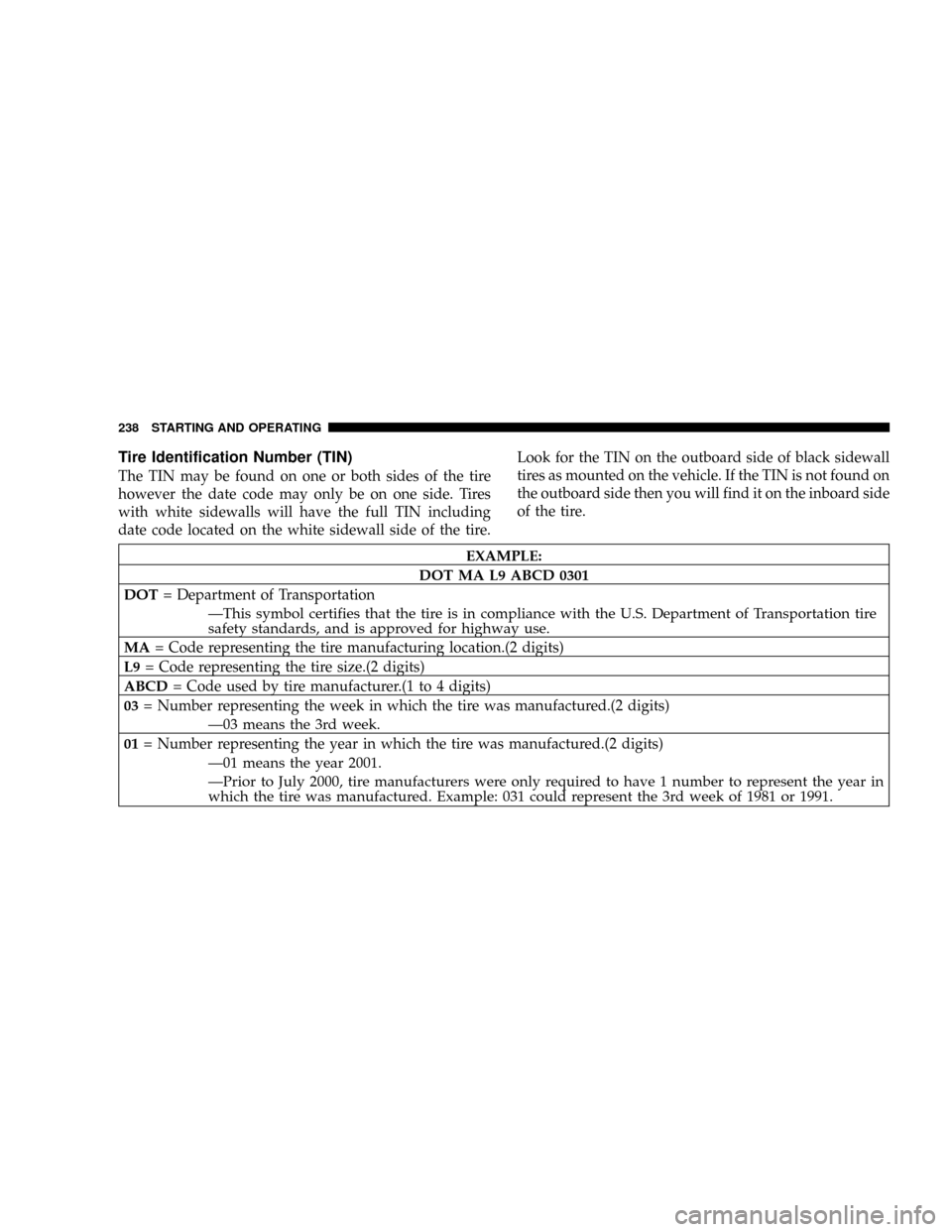
Tire Identification Number (TIN)
The TIN may be found on one or both sides of the tire
however the date code may only be on one side. Tires
with white sidewalls will have the full TIN including
date code located on the white sidewall side of the tire.Look for the TIN on the outboard side of black sidewall
tires as mounted on the vehicle. If the TIN is not found on
the outboard side then you will find it on the inboard side
of the tire.
EXAMPLE:
DOT MA L9 ABCD 0301
DOT
= Department of Transportation
ÐThis symbol certifies that the tire is in compliance with the U.S. Department of Transportation tire
safety standards, and is approved for highway use.
MA
= Code representing the tire manufacturing location.(2 digits)
L9= Code representing the tire size.(2 digits)
ABCD= Code used by tire manufacturer.(1 to 4 digits)
03= Number representing the week in which the tire was manufactured.(2 digits)
Ð03 means the 3rd week.
01
= Number representing the year in which the tire was manufactured.(2 digits)
Ð01 means the year 2001.
ÐPrior to July 2000, tire manufacturers were only required to have 1 number to represent the year in
which the tire was manufactured. Example: 031 could represent the 3rd week of 1981 or 1991.
238 STARTING AND OPERATING
Page 270 of 429
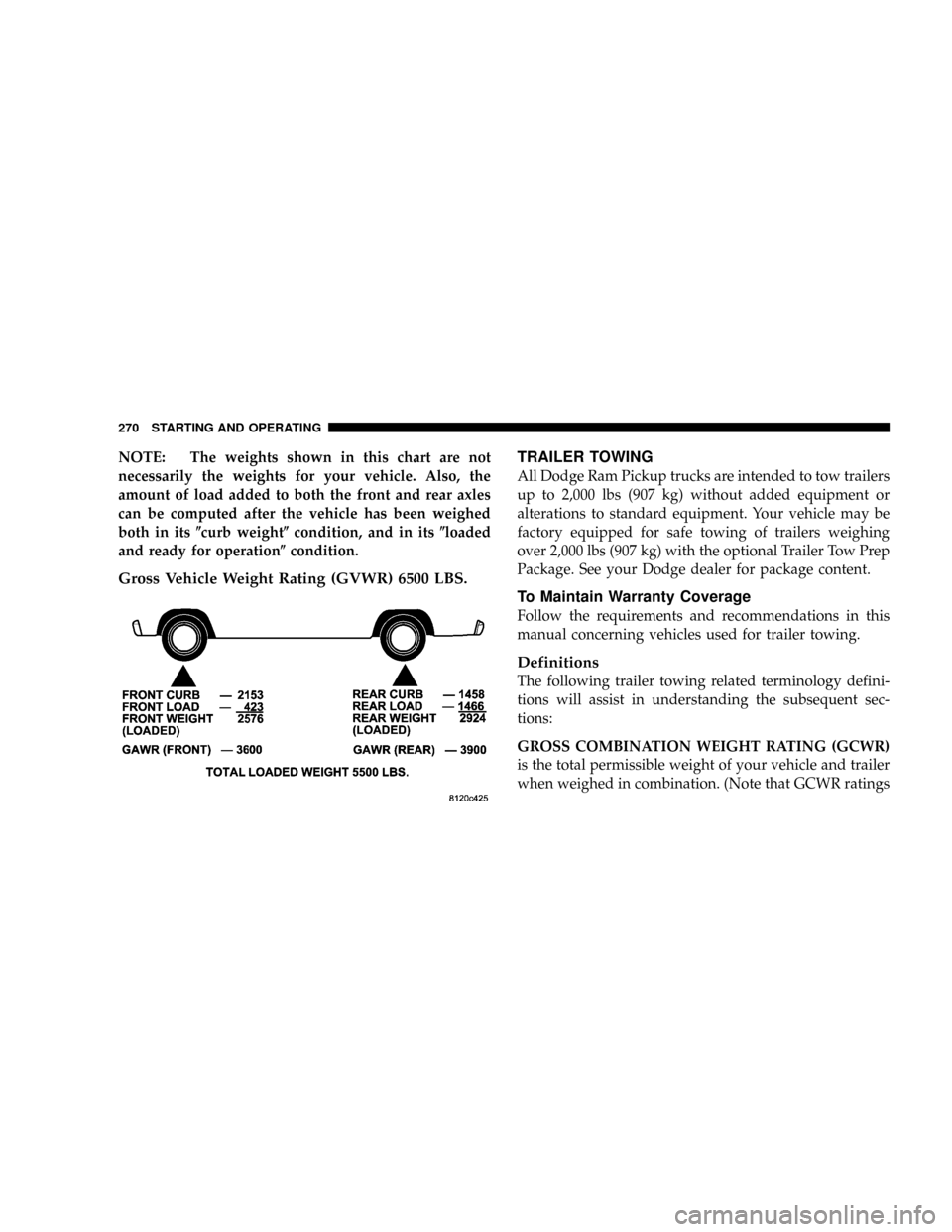
NOTE: The weights shown in this chart are not
necessarily the weights for your vehicle. Also, the
amount of load added to both the front and rear axles
can be computed after the vehicle has been weighed
both in its(curb weight(condition, and in its(loaded
and ready for operation(condition.
Gross Vehicle Weight Rating (GVWR) 6500 LBS.TRAILER TOWING
All Dodge Ram Pickup trucks are intended to tow trailers
up to 2,000 lbs (907 kg) without added equipment or
alterations to standard equipment. Your vehicle may be
factory equipped for safe towing of trailers weighing
over 2,000 lbs (907 kg) with the optional Trailer Tow Prep
Package. See your Dodge dealer for package content.
To Maintain Warranty Coverage
Follow the requirements and recommendations in this
manual concerning vehicles used for trailer towing.
Definitions
The following trailer towing related terminology defini-
tions will assist in understanding the subsequent sec-
tions:
GROSS COMBINATION WEIGHT RATING (GCWR)
is the total permissible weight of your vehicle and trailer
when weighed in combination. (Note that GCWR ratings
270 STARTING AND OPERATING
Page 273 of 429
2500/3500 Models
²
The Axles on 2500/3500 Modelsare trailer tow ready
andDO NOT REQUIREany special axle lubes or
additives.
Trailer Towing Recommendations
²
All trailer hitches should be professionally installed on
your vehicle.
²Safety chains must always be used between your
vehicle and trailer.
²Donotinterconnect the hydraulic brake system or
vacuum system of your vehicle with that of the trailer.
This could cause inadequate braking and possible
personal injury. An electrically±actuated electric trailer
brake controller is recommended.
²Trailer brakes are recommended for trailers over 1000
lbs (454 kg) and are required for trailers in excess of
2,000 lbs (907 kg)
²Use an approved wiring harness connector on the
trailer. Standard equipment on all RAM pickup mod-
els provides a 4-way trailer tow connector located
under the bumper. This connector contains the follow-
ing vehicle circuits: park/tail lamps, left stop/turn
lamp, right stop/turn lamp, and ground. With the
optional Trailer Tow Prep package a 7-way connector
is provided with the following additional circuits:
backup lamp, trailer battery and electric brake.
NOTE:Connect trailer lighting and brakes using factory
harnesses only. Do not cut or splice wiring to the brake
circuits.
STARTING AND OPERATING 273
5
Page 274 of 429
²Be sure the trailer is loaded heavier in front, with 60%
to 65% of the weight in front of the axle(s). Loads
balanced over the wheels or heavier in the rear can
cause the trailer to sway severely side to side which
will cause loss of control of vehicle and trailer. Failure
to load trailers heavier in front is the cause of many
trailer accidents. (For a95th Wheel9style trailer, this
range of loading on the9King Pin9should be between
15% and 25%.)
²Make certain that the load is secured in the trailer and
will not shift during travel. When towing cargo such
as livestock, dynamic load shifts can occur that require
the driver to maintain attention.
Trailer Towing Ð Hitches
With a Class I Hitch, your vehicle can be equipped to tow
trailers with a Gross Trailer Weight (GTW) of 2,000 lbs
(907 kg) maximum.With a Class II Hitch, your vehicle can be equipped to
tow trailers with a Gross Trailer Weight (GTW) of 3,500
lbs (1 587 kg ) maximum. Tongue weight must be equal to
at least 10% of GTW, but no more than 15% of GTW.
With a Class III Hitch, your vehicle can be equipped to
tow trailers with a Gross Trailer Weight (GTW) of 5,000
lbs (2 268 kg) maximum. Factory-installed rear step
bumpers are rated a Class III hitch.
A frame mounted hitch of up to Class IV rating, as rated
by the hitch manufacturer, may also be installed. With a
Class IV Hitch, you can tow a trailer with a Gross Trailer
Weight of up to 12,000 lbs (5 443 kg) maximum depend-
ing on your vehicle equipment.
274 STARTING AND OPERATING
Page 280 of 429

If your vehicle has an automatic transmission and you
tow a trailer frequently, change transmission fluid and
filter every 30,000 miles (48 000 km)
SNOWPLOW
Snowplow Prep Packages are available as a factory
installed option. These packages include components
necessary to equip your vehicle with a snowplow.
Dodge Ram 1500 Models
NOTE:Do not use Dodge Ram 1500 Models for snow-
plow applications.
WARNING!
On 1500 Models, snowplows, winches, and other
aftermarket equipment should not be added to the
front end of your vehicle. The airbag crash sensors
may be affected by the change in the front end
structure. The airbags could deploy unexpectedly or
could fail to deploy during a collision resulting in
serious injury or death.
CAUTION!
Using 1500 Model vehicles for snowplow applica-
tions can cause damage to the vehicle.
NOTE:Before installation of a snowplow it is highly
recommended that the owner / installer obtain and
follow the recommendations contained within the Dodge
280 STARTING AND OPERATING