2004 DODGE DAKOTA warning
[x] Cancel search: warningPage 35 of 300
seat is too small for a rear-facing infant restraint or
because the infant has a medical condition which
makes it necessary for the driver to be able to see the
infant,
²is a child, age 1 to 12 who must ride in the front seat
because there is no rear seat, because there is no rear
seat position available, or because the child has a
medical condition which makes it necessary for the
driver to be able to see the child,
²has a medical condition which makes passenger airbag
inflation (deployment) a greater risk for the passenger
than the risk of hitting the dashboard (instrument
panel) or windshield in a crash.
WARNING!
Whenever an airbag is turned off, even a lap/
shoulder belted passenger may hit their head, neck,
or chest on the dashboard (instrument panel) or
windshield in a crash. This may result in serious
injury or death.
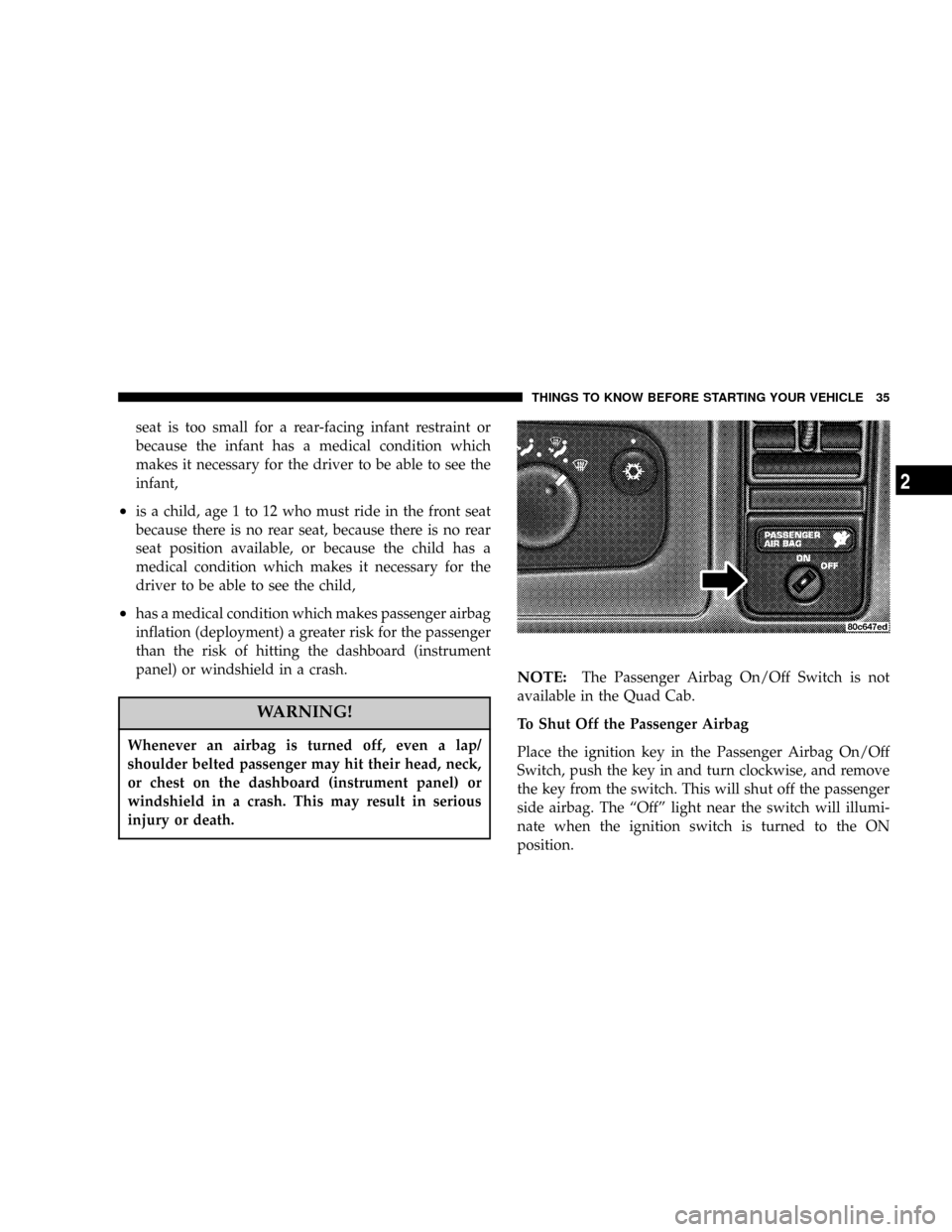
NOTE:The Passenger Airbag On/Off Switch is not
available in the Quad Cab.
To Shut Off the Passenger Airbag
Place the ignition key in the Passenger Airbag On/Off
Switch, push the key in and turn clockwise, and remove
the key from the switch. This will shut off the passenger
side airbag. The ªOffº light near the switch will illumi-
nate when the ignition switch is turned to the ON
position.
THINGS TO KNOW BEFORE STARTING YOUR VEHICLE 35
2
Page 37 of 300
WARNING!
Deployed airbags can't protect you in another colli-
sion. Have the airbags replaced by an authorized
dealer as soon as possible.
Enhanced Accident Response System
If the airbags deploy after an impact and the electrical
system remains functional, vehicles equipped with
power door locks will unlock automatically. In addition,
approximately 10 seconds after the vehicle has stopped
moving, the interior lights will light until the ignition
switch is turned off.
Maintaining Your Airbag Systems
WARNING!
²Modifications to any part of the airbag system
could cause it to fail when you need it. You could
be injured because the airbags are not there to
protect you. Do not modify the components or
wiring, including adding any kind of badges or
stickers to the steering wheel hub trim cover or
the upper right side of the instrument panel. Do
not modify the front bumper, vehicle body struc-
ture, or frame.
²You need proper knee impact protection in a
collision. Do not mount or locate any aftermarket
equipment on or behind the knee bolster.
²It is dangerous to try to repair any part of the
airbag system yourself. Be sure to tell anyone who
works on your vehicle that it has airbags.
THINGS TO KNOW BEFORE STARTING YOUR VEHICLE 37
2
Page 38 of 300

Airbag Light
You will want to have the airbags ready to inflate for your
protection in an impact. While the airbag system is
designed to be maintenance free, if any of the following
occurs, have an authorized dealer service the system
promptly:
²The airbag light does not come on or flickers during
the 6 to 8 seconds when the ignition switch is first
turned on.
²The light remains on or flickers after the 6 to 8 second
interval.
²The light flickers or comes on and remains on while
driving.
NOTE:If the speedometer, tachometer or any engine
related gauges are not working, the airbag control mod-
ule may also be disabled. The airbags may not be ready
to inflate for your protection. Promptly check fuse num-
bers 18 and 19 in the fuse block. See your dealer if the
fuse is good.
Child Restraint
Everyone in your vehicle needs to be buckled up all the
time Ð babies and children, too. Every state in the United
States and all Canadian provinces require that small
children ride in proper restraint systems. This is the law,
and you can be prosecuted for ignoring it.
Children 12 years and under should ride properly buck-
led up in a rear seat, if available. According to crash
statistics, children are safer when properly restrained in
the rear seats rather than in the front.
WARNING!
In a collision, an unrestrained child, even a tiny
baby, can become a missile inside the vehicle. The
force required to hold even an infant on your lap can
become so great that you could not hold the child, no
matter how strong you are. The child and others
could be badly injured. Any child riding in your
vehicle should be in a proper restraint for the child's
size.
38 THINGS TO KNOW BEFORE STARTING YOUR VEHICLE
Page 40 of 300
with a front shield and are held in the vehicle by the
lap portion.) For further information refer to
www.seatcheck.org.
WARNING!
²Improper installation can lead to failure of an
infant or child restraint. It could come loose in a
collision. The child could be badly injured or
killed. Follow the manufacturers directions ex-
actly when installing an infant or child restraint.
²A rearward facing child restraint should only be
used in a rear seat, or in the front seat if the
passenger's front airbag is Off. If the airbag is left
On, a rearward facing child restraint in the front
seat may be struck by a deploying passenger
airbag which may cause severe or fatal injury to
the infant.
Here are some tips for getting the most out of your child
restraint:
²Before buying any restraint system, make sure that it
has a label certifying that it meets all applicable Safety
Standards. We also recommend that you make sure
that you can install the child restraint in the vehicle
where you will use it before you buy it.
²The restraint must be appropriate for your child's
weight and height. Check the label on the restraint for
weight and height limits.
²Carefully follow the instructions that come with the
restraint. If you install the restraint improperly, it may
not work when you need it.
²The passenger seat belts are equipped with cinching
latch plates, which are designed to keep the lap portion
tight around the child restraint so that it is not neces-
sary to use a locking clip. Pulling up on the shoulder
portion of the lap/shoulder belt will tighten the belt.
The cinching latch plate will keep the belt tight, how-
ever, any seat belt system will loosen with time, so
check the belt occasionally and pull it tight if necessary.
40 THINGS TO KNOW BEFORE STARTING YOUR VEHICLE
Page 41 of 300
²In the rear seat, you may have trouble tightening the
lap/shoulder belt on the child restraint because the
buckle or latch plate is too close to the belt path
opening on the restraint. Disconnect the latch plate
from the buckle and twist the short buckle-end belt
several times to shorten it. Insert the latch plate into
the buckle with the release button facing out.
²If the belt still can't be tightened, or if pulling and
pushing on the restraint loosens the belt, disconnect
the latch plate from the buckle, turn the buckle
around, and insert the latch plate into the buckle
again. If you still can't make the child restraint secure,
try a different seating position.
²Buckle the child into the seat according to the child
restraint manufacturers directions.
²When your child restraint is not in use, secure it in the
vehicle with the seat belt or remove it from the vehicle.
Do not leave it loose in the vehicle. In a sudden stop or
collision, it could strike the occupants or seat backs
and cause serious personal injury.
WARNING!
Improper installation can lead to failure of an infant
or child restraint. It could come loose in a collision.
The child could be badly injured or killed. Follow
the manufacturers directions exactly when installing
an infant or child restraint.
THINGS TO KNOW BEFORE STARTING YOUR VEHICLE 41
2
Page 45 of 300
Installing the Child Restraint System
WARNING!
Do not install child restraint systems equipped with
LATCH attachments in the center position of a Quad
Cab model rear seat. The LATCH anchorages in this
seat are designed for the two outboard seating posi-
tions only. A child may be placed in the rear center
seating position of a Quad Cab model using the seat
belt and child tether anchorage. Failure to follow this
may result in serious or fatal injury.
We urge that you carefully follow the directions of the
manufacturer when installing your child restraint. Many,
but not all, restraint systems will be equipped with
separate straps on each side, with each having a hook or
connector and a means for adjusting the tension in the
strap. Forward-facing toddler restraints and some
rearward-facing infant restraints will also be equipped
with a tether strap, a hook and means for adjusting the
tension in the strap.In general, you will first loosen the adjusters on the lower
straps and tether straps so that you can more easily attach
the hook or connector to the lower anchorages and tether
anchorages. Then tighten all three straps as you push the
child restraint rearward and downward into the seat.
Not all child restraint systems will be installed as we
have described here. Again, carefully follow the instruc-
tions that come with the child restraint system.
WARNING!
Improper installation of a child restraint to the
LATCH anchorages can lead to failure of an infant or
child restraint. The child could be badly injured or
killed. Follow the manufacturers directions exactly
when installing an infant or child restraint.
THINGS TO KNOW BEFORE STARTING YOUR VEHICLE 45
2
Page 46 of 300
Child Restraint Tether Anchor
Regular Cab models have two tether anchorages, one
behind each passenger seating position (front center and
right seat positions). Club Cab and Quad Cab models
have three anchorages, one behind each of the rear seat
positions (rear left, center, and right seat positions).
WARNING!
With a child restraint installed in the rear driver or
passenger side locations, use care when adjusting
the front seat(s) rearward, to avoid the front seat
back coming in contact with the belted child directly
behind the seat. The child could be injured.
WARNING!
Improper installation can lead to failure of an infant
or child restraint. It could come loose in a collision.
The child could be seriously injured or killed. Make
sure the child restraint tether strap is always routed
through the proper anchor strap inner loop.
Tether Straps at the Front Passenger's Seat (Regular
Cab With All Seats)
1. Route the child restraint tether strap up and over the
passenger seat back.
2. Thread the tether strap through the anchor strap inner
loop (loop with metal ring), located directly behind the
passenger's seat.
3. Route the tether strap across to the anchor strap
installed in the center, and attach the tether strap hook to
the anchor strap metal ring.
46 THINGS TO KNOW BEFORE STARTING YOUR VEHICLE
Page 52 of 300

WARNING!
An incorrectly anchored tether strap could lead to
seat failure and injury to the child. In a collision, the
seat could come loose and allow the child to crash
into the inside of the vehicle or other passengers, or
even be thrown from the vehicle. Use only the
anchor positions directly behind the child restraint
to secure a child restraint top tether strap. See your
dealer for help if necessary.
Children Too Large for Booster Seats
Children who are large enough to wear the shoulder belt
comfortably, and whose legs are long enough to bend
over the front of the seat when their back is against the
seat back should use the lap/shoulder belt in a rear seat.
²Make sure that the child is upright in the seat.
²The lap portion should be low on the hips and as snug
as possible.
²Check belt fit periodically. A child's squirming or
slouching can move the belt out of position.If the shoulder belt contacts the face or neck, move the
child closer to the center of the vehicle. If this doesn't
help, move the child to the center rear seating position
and use the lap belt. Never allow a child to put the
shoulder belt under an arm or behind their back.
ENGINE BREAK-IN RECOMMENDATIONS
A long break-in period is not required for the engine in
your new vehicle. Drive moderately during the first 300
miles (500 km). After the initial 60 miles (100 km), speeds
up to 50 or 55 mph (80 or 90 km/h) are desirable. While
cruising, brief full-throttle acceleration, within the limits
of local traffic laws, contributes to a good break-in.
Avoid wide open throttle acceleration in low gear.
The engine oil installed in the engine at the factory is a
high-quality, energy-conserving type lubricant. Oil
changes should be consistent with anticipated climate
conditions under which vehicle operations will occur.
The recommended viscosity and quality grades are
shown in Section 7.
NON-DETERGENT OR STRAIGHT MINERAL OILS
MUST NEVER BE USED.
52 THINGS TO KNOW BEFORE STARTING YOUR VEHICLE