2004 DODGE DAKOTA steering
[x] Cancel search: steeringPage 175 of 300

WARNING!
Overloading of your tire is dangerous. Overloading
can cause tire failure, affect vehicle handling, and
increase your stopping distance. Use tires of the
recommended load capacity for your vehicle. Never
overload them.
TIRESÐGENERAL INFORMATION
Tire Pressure
Proper tire inflation pressure is essential to the safe and
satisfactory operation of your vehicle. Three primary
areas are affected by improper tire pressure:
1. SafetyÐ
WARNING!
Improperly inflated tires are dangerous and can
cause accidents.
²Under inflation increases tire flexing and can
result in tire failure.
²Over inflation reduces a tire's ability to cushion
shock. Objects on the road and chuck holes can cause
damage that results in tire failure.
²Unequal tire pressures can cause steering prob-
lems. You could lose control of your vehicle.
²Over inflated or under inflated tires can affect
vehicle handling and can fail suddenly, resulting in
loss of vehicle control.
²Unequal tire pressures from one side of the vehicle
to the other can cause the vehicle to drift to the right
or left.
Always drive with each tire inflated to the recom-
mended cold tire inflation pressure.
STARTING AND OPERATING 175
5
Page 181 of 300
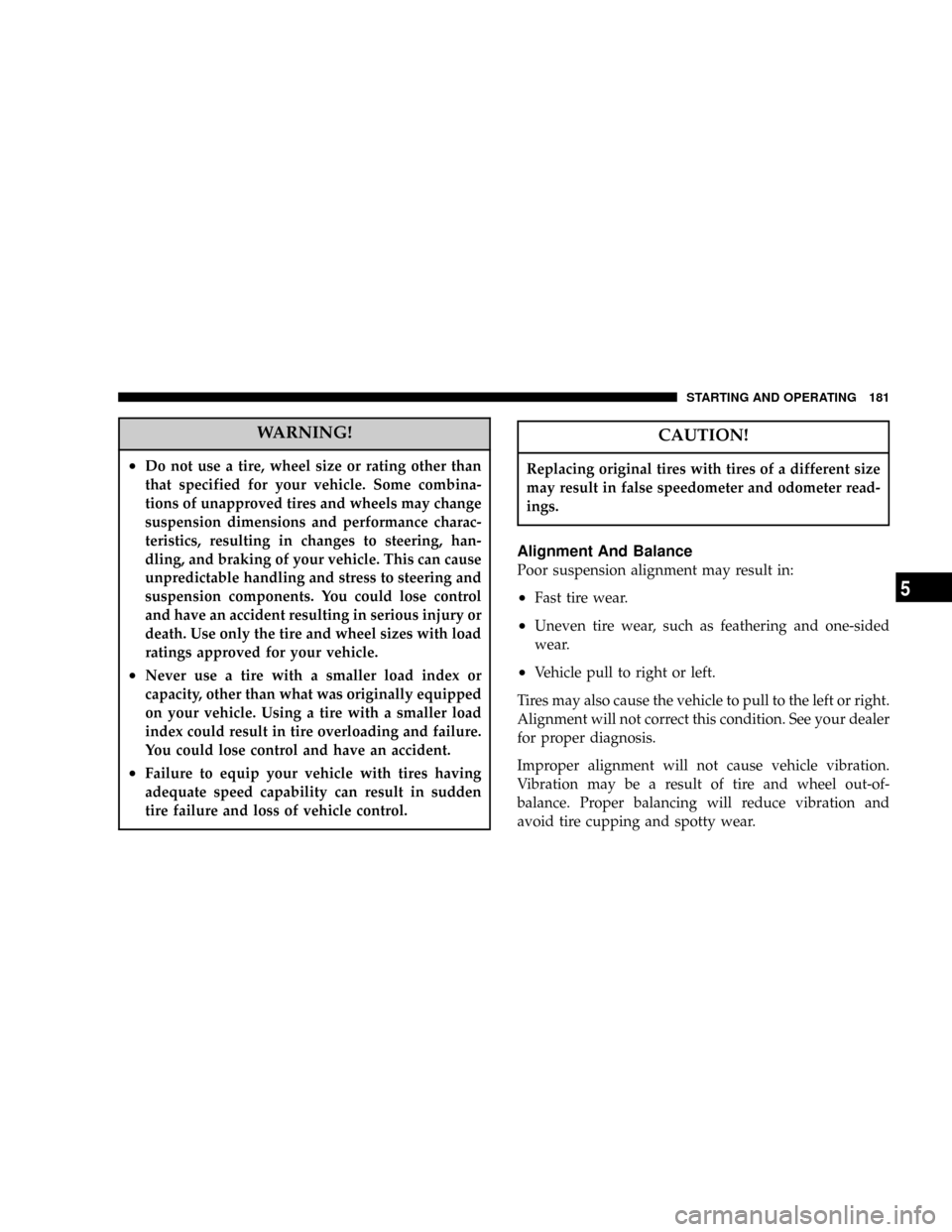
WARNING!
²Do not use a tire, wheel size or rating other than
that specified for your vehicle. Some combina-
tions of unapproved tires and wheels may change
suspension dimensions and performance charac-
teristics, resulting in changes to steering, han-
dling, and braking of your vehicle. This can cause
unpredictable handling and stress to steering and
suspension components. You could lose control
and have an accident resulting in serious injury or
death. Use only the tire and wheel sizes with load
ratings approved for your vehicle.
²Never use a tire with a smaller load index or
capacity, other than what was originally equipped
on your vehicle. Using a tire with a smaller load
index could result in tire overloading and failure.
You could lose control and have an accident.
²Failure to equip your vehicle with tires having
adequate speed capability can result in sudden
tire failure and loss of vehicle control.
CAUTION!
Replacing original tires with tires of a different size
may result in false speedometer and odometer read-
ings.
Alignment And Balance
Poor suspension alignment may result in:
²Fast tire wear.
²Uneven tire wear, such as feathering and one-sided
wear.
²Vehicle pull to right or left.
Tires may also cause the vehicle to pull to the left or right.
Alignment will not correct this condition. See your dealer
for proper diagnosis.
Improper alignment will not cause vehicle vibration.
Vibration may be a result of tire and wheel out-of-
balance. Proper balancing will reduce vibration and
avoid tire cupping and spotty wear.
STARTING AND OPERATING 181
5
Page 183 of 300

SNOW TIRES
Snow tires should be of the same size and type construc-
tion as the front tires. Consult the manufacturer of the
snow tire to determine any maximum vehicle speed
requirement associated with the tire. These tires should
always be operated at the vehicle maximum capacity
inflation pressures under any load condition.
While studded tires improve performance on ice, skid
and traction capability on wet or dry surfaces may be
poorer than that of non-studded tires. Some states pro-
hibit studded tires; therefore, local laws should be
checked before using these tire types.
TIRE ROTATION RECOMMENDATIONS
Tires on the front and rear axles of vehicles operate at
different loads and perform different steering, driving,
and braking functions. For these reasons, they wear at
unequal rates and tend to develop irregular wear pat-
terns. These effects can be reduced by timely rotation of
tires. The benefits of rotation are especially worthwhile
with aggressive tread designs such as those on all season
type tires. Rotation will increase tread life, help to main-
tain mud, snow and wet traction levels, and contribute to
a smooth, quiet ride.
STARTING AND OPERATING 183
5
Page 197 of 300

Wheel9style trailer, this range of loading on the9King
Pin9should be between 15% and 25%.) Loads balanced
over the wheels or biased toward9heavier in the rear9
can cause the trailer to sway severely side to side
which will cause loss of control of vehicle and trailer.
Failure to load trailers heavier in front is the cause of
many trailer accidents.
²Donotinterconnect the hydraulic brake system of
your vehicle with that of the trailer. This could cause
inadequate braking and possible personal injury.
²Trailer brakes are recommended for trailers over 1,000
lbs. (454 kg) and required for trailers in excess of 2,000
lbs. (907 kg).
²Use an approved trailer harness and connector. If a
hitch is ordered, the proper wiring will be provided.
²When hauling cargo or towing a trailer, do not over-
load your vehicle or trailer. Overloading can cause a
loss of control, poor performance or damage to brakes,
axle, engine, transmission, steering, suspension, chas-
sis structure or tires.
²Make certain that the load is secured in the trailer and
will not shift during travel. When trailering cargo that
cannot be fully secured, dynamic load shifts can occur
that may be difficult for the driver to control.
²All trailer hitches should be professionally installed on
your vehicle.
²Safety chains must always be used between your
vehicle and trailer.
²Connect trailer lighting and brakes using factory har-
nesses only. Do not cut or splice any wiring to the
brake circuits.
Trailer and Tongue Weight
Gross Trailer Weight (GTW) means the weight of the
trailer plus the weight of all cargo and equipment loaded
on the trailer when in actual underway towing condition.
The recommended way to measure GTW is to put your
fully loaded trailer on a vehicle scale. The entire weight
of the trailer must be supported by the scale.
Tongue Weight is the weight placed on the vehicle's
trailer hitch by the trailer. Always load a trailer with 60%
STARTING AND OPERATING 197
5
Page 208 of 300

HAZARD WARNING FLASHER
The flasher switch is on the top of the steering column,
just behind the steering wheel. Press the flasher switch
and all front and rear directional signals will flash
intermittently.
Press the switch a second time to turn off the emergency
flashers.
This is an emergency warning system and should not be
used when the vehicle is in motion. Use it when your
vehicle is disabled and is creating a safety hazard for
other motorists.If it is necessary to leave the vehicle to go for service, the
flasher system will continue to operate with the ignition
key removed and the vehicle locked.
ADDING FUEL
On some models, the fuel tank filler tube, on vehicles
equipped with a catalytic converter, has a restricting door
about 2 inches (50 mm) inside the opening. If using a
portable fuel container, it should have a flexible nozzle
long enough to force open the restricting door.
WARNING!
A fire may result if gasoline is pumped into a
portable container that is in a vehicle or on a truck
bed. You could be burned. Always place gas contain-
ers on the ground while filling.
208 WHAT TO DO IN EMERGENCIES
Page 219 of 300

MAINTAINING YOUR VEHICLE
CONTENTS
mEngine Compartment 3.7L V6.............221
mEngine Compartment 4.7L V-8............222
mOnboard Diagnostic System Ð OBD II......223
mEmissions Inspection And Maintenance
Programs
............................224
mReplacement Parts.....................225
mDealer Service........................225
mMaintenance Procedures.................226
NEngine Oil..........................226
NEngine Oil Filter......................229
NDrive Belts Ð Check Condition And Tension . . 230
NSpark Plugs.........................230NIgnition Cables.......................230
NEngine Air Cleaner Filter................230
NEngine Fuel Filter.....................231
NCatalytic Converter....................231
NMaintenance-Free Battery................232
NAir Conditioner Maintenance.............233
NPower Steering Ð Fluid Check............234
NFront Suspension Ball Joints..............235
NSteering Linkage......................235
NDrive Shaft Constant Velocity
Joints Ð 4X4 Models...................235
NBody Lubrication.....................235
7
Page 234 of 300

WARNING!
²Use only refrigerants and compressor lubricants
approved by the manufacturer for your air condi-
tioning system. Some unapproved refrigerants are
flammable and can explode, injuring you. Other
unapproved refrigerants or lubricants can cause
the system to fail, requiring costly repairs.
²The air conditioning system contains refrigerant
under high pressure. To avoid risk of personal
injury or damage to the system, adding refrigerant
or any repair requiring lines to be disconnected
should be done by an experienced repairman.
Refrigerant Recovery and Recycling
R-134a Air Conditioning Refrigerant is a hydrofluorocar-
bon (HFC) that is endorsed by the Environmental Pro-
tection Agency and is an ozone-saving product. How-
ever, the manufacturer recommends that air conditioning
service be performed by dealers or other service facilities
using recovery and recycling equipment.
Power Steering Ð Fluid Check
Checking the power steering fluid level at a defined
service interval is not required. The fluid should only be
checked if a leak is suspected, abnormal noises are
apparent, and/or the system is not functioning as antici-
pated. Coordinate inspection efforts through a certified
DaimlerChrysler Dealership.9
WARNING!
Fluid level should be checked on a level surface and
with the engine off to prevent injury from moving
parts and to insure accurate fluid level reading. Do
not overfill. Use only manufacturers recommended
power steering fluid.
If necessary, add fluid to restore to the proper indicated
level. With a clean cloth, wipe any spilled fluid from all
surfaces. Refer to Recommended Fluids, Lubricants, and
Genuine Parts for correct fluid type.
234 MAINTAINING YOUR VEHICLE
Page 235 of 300

Front Suspension Ball Joints
The ball joints and seals should be inspected whenever
the vehicle is serviced for other reasons. Damaged seals
should be replaced to prevent leakage or contamination
of the grease.
Steering Linkage
Whenever the vehicle is hoisted, all steering linkage
joints should be inspected for evidence of damage. Dam-
aged seals should be replaced to prevent leakage or
contamination of the grease.
Drive Shaft Constant Velocity Joints Ð 4X4
Models
All four-wheel drive models are equipped with four
constant velocity joints. Periodic lubrication of these
joints is not required. However, the joint boot should be
inspected for external leakage or damage periodically. If
external leakage or damage is evident, the joint boot and
grease should be replaced immediately. Continued op-
eration could result in failure of the joint due to water
and dirt contamination of the grease. This would require
complete replacement of the joint assembly. Refer to the
Service Manual for the detailed replacement procedure.
Body Lubrication
Locks and all body pivot points, including such items as
seat tracks, doors,liftgate and hood hinges, should be
lubricated periodically to assure quiet, easy operation
and to protect against rust and wear. Prior to the appli-
cation of any lubricant, the parts concerned should be
wiped clean to remove dust and grit; after lubricating
excess oil and grease should be removed. Particular
attention should also be given to hood latching compo-
nents to insure proper function. When performing other
underhood services, the hood latch, release mechanism
and safety catch should be cleaned and lubricated.
The external lock cylinders should be lubricated twice a
year, preferably in the fall and spring. Apply a small
amount of a high quality lubricant such as MopartLock
Cylinder Lubricant directly into the lock cylinder.
Windshield Wiper Blades
The rubber edges of the wiper blades and the windshield
should be cleaned periodically with a sponge or soft cloth
and a mild nonabrasive cleaner. This will remove accu-
mulations of salt or road film.
MAINTAINING YOUR VEHICLE 235
7