2004 DODGE DAKOTA warning
[x] Cancel search: warningPage 238 of 300
WARNING!
You or others can be badly burned by hot coolant or
steam from your radiator. If you see or hear steam
coming from under the hood don't open the hood
until the radiator has had time to cool. If you open
the hood and see steam or hot coolant escaping from
the radiator, don't touch anything. Get away quickly.
Never try to open a pressure cap when the radiator is
hot.
Cooling System Maintenance
At the intervals shown on the Maintenance Schedules,
the system should be drained, flushed and filled.
Cooling System Ð Drain, Flush And Refill
If the solution is dirty and contains a considerable
amount of sediment, clean and flush with a reliable
cooling system cleaner. Follow with a thorough rinsing to
remove all deposits and chemicals. Discard old antifreeze
solution according to recommended procedure.
Disposal of Used Engine Coolant
Used ethylene glycol-based engine coolant is a regulated
substance requiring proper disposal. Check with your
local authorities to determine the disposal rules for your
community. Do not store ethylene glycol-based engine
coolant in open containers or allow it to remain in
puddles on the ground. Prevent ingestion by animals and
children. If ingested by a child, contact a physician
immediately. Clean up any ground spills immediately.
Recommended Engine Coolant
Refer to Recommended Fluids, Lubricants and Genuine
Parts for correct fluid type.
238 MAINTAINING YOUR VEHICLE
Page 239 of 300
CAUTION!
Mixing of coolants other than specified (non-
HOAT), may result in engine damage that may not
be covered under the new vehicle warranty, and
decreased corrosion protection. If a non-HOAT cool-
ant is introduced into the cooling system in an
emergency, it should be replaced with the specified
coolant as soon as possible.
Do not use plain water alone or alcohol base anti-
freeze products. Do not use additional rust inhibi-
tors or antirust products, as they may not be compat-
ible with the radiator coolant and may plug the
radiator.
This vehicle has not been designed for use with
Propylene Glycol based coolants. Use of Propylene
Glycol based coolants is not recommended.
Adding Coolant
When adding coolant or refilling system, a 50% solution
of ethylene glycol antifreeze coolant in water should beused. Higher concentrations (not to exceed 65%) are
required if temperatures below ±37ÉF (± 38ÉC) are antici-
pated.
Use only high purity water such as distilled or deionized
water when mixing the water/antifreeze solution. The
use of lower quality water will reduce the amount of
corrosion protection in the engine cooling system.
Please note that it is the owner's responsibility to main-
tain the proper level of protection against freezing ac-
cording to the temperatures occurring in the area where
the vehicle is operated.
WARNING!
Never add coolant to the radiator when the engine is
overheated. Do not loosen or remove pressure cap to
cool overheated engine. The coolant is under pres-
sure and severe scalding could result.
MAINTAINING YOUR VEHICLE 239
7
Page 240 of 300
Coolant Pressure Cap
The coolant pressure cap must be fully tightened to
prevent loss of coolant, and to insure that coolant will
return to the radiator from the coolant reserve tank.
The pressure cap should be inspected and cleaned if there
is any accumulation of foreign material on the sealing
surfaces.
WARNING!
The warning words ªDO NOT OPEN HOTº on the
coolant pressure cap are a safety precaution. Heat
causes pressure to build up in the cooling system. To
prevent scalding or injury, do not remove the pres-
sure cap when the system is hot or under pressure.
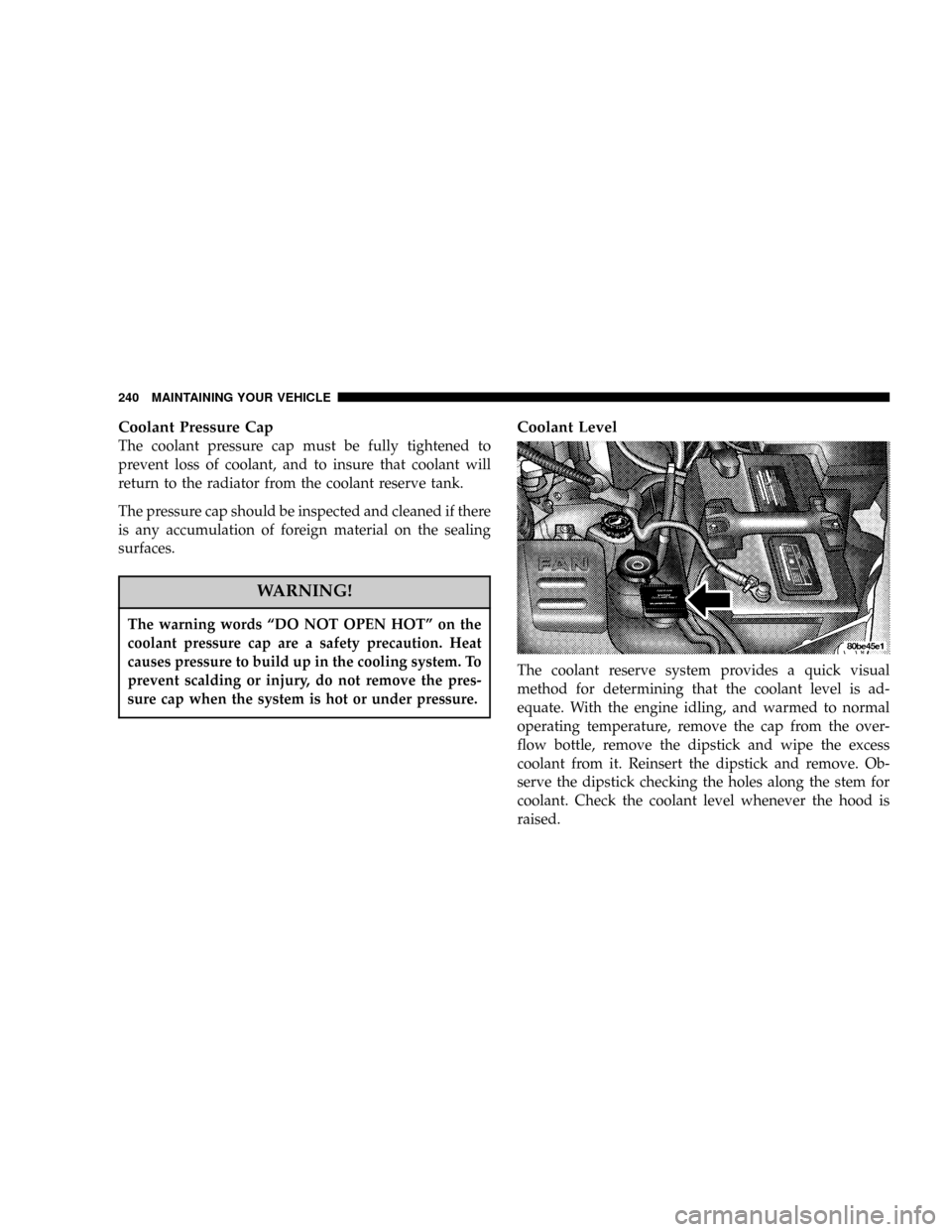
Coolant Level
The coolant reserve system provides a quick visual
method for determining that the coolant level is ad-
equate. With the engine idling, and warmed to normal
operating temperature, remove the cap from the over-
flow bottle, remove the dipstick and wipe the excess
coolant from it. Reinsert the dipstick and remove. Ob-
serve the dipstick checking the holes along the stem for
coolant. Check the coolant level whenever the hood is
raised.
240 MAINTAINING YOUR VEHICLE
Page 243 of 300

Brake System
Power Disc Brakes (Front)
Disc brakes do not require adjustment; however, several
hard stops during the break-in period are recommended
to seat the linings and wear off any foreign material.
Self-Adjusting Rear Brakes
To maintain the correct adjustment, you need only drive
your vehicle in reverse and apply the brakes. If further
adjustment is needed, drive forward about 20 feet (6
meters) before you repeat the reverse application. To
avoid poor braking, brake pull, or damage to brake
drums, the brake linings should be inspected as specified
in the Maintenance Schedule.
Brake Master Cylinders
The fluid level in the master cylinders should be checked
whenever the vehicle is serviced, or immediately if the
brake system warning light is on. If necessary, add fluid
to bring level to the full mark on the side of the reservoir
of the brake master cylinder. Be sure to clean the top of
the master cylinder area before removing the cap. With
disc brakes, fluid level can be expected to fall as the brakepads wear. Brake fluid level should be checked when
pads are replaced. If the brake fluid level is abnormally
low, check system for leaks.
Refer to Recommended Fluids, Lubricants and Genuine
Parts for correct fluid type.
MAINTAINING YOUR VEHICLE 243
7
Page 244 of 300
WARNING!
Use of brake fluid that may have a lower initial
boiling point, or is unidentified as to specifications,
may result in sudden brake failure during hard
prolonged braking. You could have an accident.
WARNING!
Overfilling the brake fluid reservoir can result in
spilling brake fluid on hot engine parts and the
brake fluid catching fire.
Use only brake fluid that has been in a tightly closed
container to avoid contamination from foreign matter or
moisture.
CAUTION!
Do not allow a petroleum-base fluid to contaminate
the brake fluid. Seal damage may result.
Brake Linings
Your vehicle is equipped with self-adjusting brakes. A
few brake applications while moving in reverse will
maintain your brakes at the specified adjustment. Adjust-
ment will continue until the brake linings are worn. To
avoid brake failure, brake pull or damage to drums,
inspect the brake linings as specified. If excessively worn,
the brake linings must be replaced.
Brake Hoses
Inspection should be performed whenever the brake
system is serviced or at intervals specified. Inspect hy-
draulic brake hoses for surface cracking, scuffing or worn
spots. If there is any evidence of cracking, scuffing, or
worn spots, the hose should be replaced immediately!
Eventual deterioration of the hose can take place with
possible burst failure.
244 MAINTAINING YOUR VEHICLE
Page 245 of 300
WARNING!
Worn brake hoses can burst and cause brake failure.
You could have an accident. If you see any sign of
cracking, scuffing, or worn spots, have the brake
hoses replaced immediately.
Clutch Hydraulic System
The clutch hydraulic system is a sealed maintenance free
system. In the event of leakage or other malfunction, the
system must be replaced.
Manual Transmission
Fluid Level Check
This fluid should be checked whenever other underhood
services are performed. The fluid level is checked by
removing the fill plug. If the level of the lubricant is more
than 1/49(6.35 mm) below the bottom of the filler hole
while the vehicle is level, enough lubricant should be
added to bring the level to the bottom of the filler hole.
NV-3500 5-Speed Transmission Lubricant Selection
These transmissions are filled with manual transmission
fluid at the factory. This fluid does not require periodic
changing. If it becomes necessary to add or change the
fluid in these transmissions, Refer to Recommended
Fluids, Lubricants and Genuine Parts for correct fluid
type.
Automatic Transmission
Fluid Level Check ± 3.7/4.7L Engine
Check the fluid level while the transmission is at normal
operating temperature 180ÉF (82ÉC). This occurs after at
least 15 miles (25 km) of driving. At normal operating
temperature the fluid cannot be held comfortably be-
tween the fingertips.
To check the automatic transmission fluid level properly,
the following procedure must be used:
1. Operate the engine at idle speed and normal operating
temperature.
2. The vehicle must be on level ground.
MAINTAINING YOUR VEHICLE 245
7
Page 251 of 300
recommended. Do not use oven cleaner. Avoid auto-
matic car washes that use acidic solutions or harsh
brushes that may damage the wheels' protective fin-
ish.
²If you carry special cargo such as chemicals, fertilizers,
de-icer salt, etc., be sure that such materials are well
packaged and sealed.
²If a lot of driving is done on gravel roads, consider
mud or stone shields behind each wheel.
²Use Mopar touch up paint on scratches as soon as
possible. Your dealer has touch up paint to match the
color of your vehicle.
Interior Care
Use Mopar Fabric Cleaner to clean fabric upholstery and
carpeting.
Use Mopar Vinyl Cleaner to clean vinyl upholstery and
trim.
Mopar Total Clean is specifically recommended for
leather upholstery.Your leather upholstery can be best preserved by regular
cleaning with a damp soft cloth. Small particles of dirt
can act as an abrasive and damage the leather upholstery
and should be removed promptly with a damp cloth.
Stubborn soils can be removed easily with a soft cloth
and Mopar Total Clean. Care should be taken to avoid
soaking your leather upholstery with any liquid. Please
do not use polishes, oils, cleaning fluids, solvents, deter-
gents, or ammonia based cleaners to clean your leather
upholstery. Application of a leather conditioner is not
required to maintain the original condition.
WARNING!
Do not use volatile solvents for cleaning purposes.
Many are potentially flammable, and if used in
closed areas they may cause respiratory harm.
Glass Surfaces
All glass surfaces should be cleaned on a regular basis
with any commercial household-type glass cleaner.
Never use an abrasive type cleaner. Use caution when
cleaning inside rear windows equipped with electric
MAINTAINING YOUR VEHICLE 251
7
Page 254 of 300

NOTE:If you are leaving your vehicle dormant for
longer than 21 days, you may want to take steps to
protect your battery. You may do this by disconnecting
the battery or by disconnecting the ignition-off draw
(I.O.D.) fuse in cavity #12. The I.O.D. cavity includes a
snap-in retainer that allows the fuse to be disconnected,
without removing it from the fuse block. Pressing the
I.O.D. fuse back into the cavity reconnects it.
VEHICLE STORAGE
If you are storing your vehicle for more than 21 days, we
recommend that you take the following steps to mini-
mize the drain on your vehicle's battery:
²Disconnect the Ignition-Off Draw fuse (I.O.D.) fuse
located in cavity #12 of the fuse block. The I.O.D.
cavity includes a snap-in retainer that allows the fuse
to be disconnected, without removing it from the fuse
block.
²The transfer case should be placed in the 4HI mode
and kept in this position to minimize the battery drain.
²As an alternative to the above steps you may discon-
nect the negative cable from the battery.
REPLACEMENT LIGHT BULBS
LIGHT BULBS Ð Inside Bulb No.
A/C Control............................. 74
Ash Tray.............................. 161
Brake System Warning Indicator.............. 194
Dome Light............................ 579
EGR Reminder.......................... 194
Glove Box.............................. 194
Heater Control.......................... 158
High Beam Indicator...................... 194
Instrument Cluster........................ 194
Low Fuel Indicator....................... 194
Low Washer Fluid Indicator................. 194
Oil Indicator............................ 194
Overhead Console........................ 578
Seat Belt Indicator........................ 194
Switched Dome.......................... 578
Temperature Indicator..................... 194
Turn Signals............................ 194
Underhood Light......................... 561
4x4 Shift Indicator........................ 161
254 MAINTAINING YOUR VEHICLE