2004 DAEWOO LACETTI Automatic
[x] Cancel search: AutomaticPage 862 of 2643

1F – 616IENGINE CONTROLS
DAEWOO V–121 BL4
3. Remove the crankshaft position sensor (CKP) bolt.
4. Remove the CKP sensor.
Installation Procedure
1. Install the CKP sensor with the bolt.
Tighten
Tighten the crankshaft position sensor (CKP) bolt to
6.5 NSm (57 lb–in).
2. Connect the CKP sensor electrical connector.
3. Connect the negative battery cable.
CRANKSHAFT POSITION (CKP)
SENSOR (1.8L DOHC)
Removal Procedure
1. Disconnect the negative battery cable.
2. Remove the power steering pump, if equipped. Re-
fer to Section 6B, Power Steering Pump.
3. Remove the A/C compressor. Refer to Section 7D,
Automatic Temperature Control Heating, Ventilation
and Air Conditioning System.
4. Remove the rear A/C compressor mounting bracket
bolts and the rear A/C compressor mounting brack-
et.
Page 863 of 2643

ENGINE CONTROLS 1F – 617
DAEWOO V–121 BL4
5. Remove the accessory mounting bracket by remov-
ing the bolts.
6. Disconnect the crankshaft position (CKP) sensor
connector.
7. Remove the CKP sensor retaining bolt.
8. Gently rotate and remove the CKP sensor from the
engine block.
Installation Procedure
1. Insert the CKP sensor into the engine block.
2. Install the CKP sensor retaining bolt.
Tighten
Tighten the crankshaft position sensor retaining bolt
to 8 NSm (71 lb–in).
3. Connect the CKP sensor connector.
4. Install the accessory mounting bracket with the
bolts.
Tighten
Tighten the accessory mounting bracket bolts to 27
NSm (37 lb–ft).
5. Install the rear A/C mounting bracket.
Tighten
Tighten the rear A/C mounting bracket bolts to 35
NSm (26 lb–ft).
6. Install the A/C compressor. Refer to Section 7D,
Automatic Temperature Control Heating, Ventilation
and Air Conditioning System.
7. Install the power steering pump. Refer to Section
6B, Power Steering Pump.
8. Connect the negative battery cable.
Page 872 of 2643

1F – 626IENGINE CONTROLS
DAEWOO V–121 BL4
EXHAUST GAS RECIRCULATION
VA LV E
The Exhaust Gas Recirculation (EGR) system is used on
engines equipped with an automatic transaxle to lower
NOx (oxides of nitrogen) emission levels caused by high
combustion temperature. The EGR valve is controlled by
the engine control module (ECM). The EGR valve feeds
small amounts of exhaust gas into the intake manifold to
decrease combustion temperature. The amount of ex-
haust gas recirculated is controlled by variations in vacu-
um and exhaust back pressure. If too much exhaust gas
enters, combustion will not take place. For this reason,
very little exhaust gas is allowed to pass through the valve,
especially at idle.
The EGR valve is usually open under the following condi-
tions:
S Warm engine operation.
S Above idle speed.
Results of Incorrect Operation
Too much EGR flow tends to weaken combustion, causing
the engine to run roughly or to stop. With too much EGR
flow at idle, cruise, or cold operation, any of the following
conditions may occur:
S The engine stops after a cold start.
S The engine stops at idle after deceleration.
S The vehicle surges during cruise.
S Rough idle.
If the EGR valve stays open all the time, the engine may
not idle. Too little or no EGR flow allows combustion tem-
peratures to get too high during acceleration and load con-
ditions. This could cause the following conditions:
S Spark knock (detonation)
S Engine overheating
S Emission test failure
INTAKE AIR TEMPERATURE
SENSOR
The Intake Air Temperature (IAT) sensor is a thermistor,
a resistor which changes value based on the temperature
of the air entering the engine. Low temperature produces
a high resistance (4,500 ohms at –40°F [–40°C]), while
high temperature causes a low resistance (70 ohms at
266°F [130°C]).
The engine control module (ECM) provides 5 volts to the
IAT sensor through a resistor in the ECM and measures
the change in voltage to determine the IAT. The voltage will
be high when the manifold air is cold and low when the air
is hot. The ECM knows the intake IAT by measuring the
voltage.
The IAT sensor is also used to control spark timing when
the manifold air is cold.
A failure in the IAT sensor circuit sets a diagnostic trouble
code P0112 or P0113.
IDLE AIR CONTROL VALVE
Notice : Do not attempt to remove the protective cap to
readjust the stop screw. Misadjustment may result in dam-
age to the Idle Air Control (IAC) valve or to the throttle
body.
The IAC valve is mounted on the throttle body where it
controls the engine idle speed under the command of the
engine control module (ECM). The ECM sends voltage
pulses to the IAC valve motor windings, causing the IAC
valve pintle to move in or out a given distance (a step or
count) for each pulse. The pintle movement controls the
airflow around the throttle valves which, in turn, control the
engine idle speed.
The desired idle speeds for all engine operating conditions
are programmed into the calibration of the ECM. These
programmed engine speeds are based on the coolant
temperature, the park/neutral position switch status, the
vehicle speed, the battery voltage, and the A/C system
pressure (if equipped).
The ECM ”learns” the proper IAC valve positions to
achieve warm, stabilized idle speeds (rpm) desired for the
various conditions (park/neutral or drive, A/C on or off, if
equipped). This information is stored in ECM ”keep alive”
memories. Information is retained after the ignition is
turned OFF. All other IAC valve positioning is calculated
based on these memory values. As a result, engine varia-
tions due to wear and variations in the minimum throttle
valve position (within limits) do not affect engine idle
speeds. This system provides correct idle control under all
conditions. This also means that disconnecting power to
the ECM can result in incorrect idle control or the necessity
to partially press the accelerator when starting until the
ECM relearns idle control.
Engine idle speed is a function of total airflow into the en-
gine based on the IAC valve pintle position, the throttle
valve opening, and the calibrated vacuum loss through ac-
cessories. The minimum throttle valve position is set at the
factory with a stop screw. This setting allows enough air-
flow by the throttle valve to cause the IAC valve pintle to
be positioned a calibrated number of steps (counts) from
the seat during ”controlled” idle operation. The minimum
throttle valve position setting on this engine should not be
considered the ”minimum idle speed,” as on other fuel in-
jected engines. The throttle stop screw is covered with a
plug at the factory following adjustment.
If the IAC valve is suspected as the cause of improper idle
speed, refer to ”Idle Air Control System Check” in this sec-
tion.
MANIFOLD ABSOLUTE PRESSURE
SENSOR
The Manifold Absolute Pressure (MAP) sensor measures
the changes in the intake manifold pressure which result
from engine load and speed changes. It converts these to
a voltage output.
Page 967 of 2643

TIRES AND WHEELS 2E – 5
DAEWOO V–121 BL4
UNIT REPAIR
ALLOY WHEEL POROSITY
Wheel repairs that use welding, heating or peening are not
approved.
1. Raise and suitably support the vehicle.
2. Remove the wheel. Refer to ”Wheel” in this sec-
tion.
CAUTION : To avoid serious injury, do not stand over
the tire when inflating, because the bead may break
when it snaps over the safety hump. Do not exceed
275 kPa (40 psi) of air pressure in any tire if the beads
are not seated. If 275 kPa (40 psi) of air pressure will
not seat the beads, deflate the tire. Relubricate the
beads. Reinflate the tire. Overinflation may cause the
bead to break and cause serious injury.
3. Locate leaking areas by inflating the tire to 345 kPa
(50 psi) and dipping the tire and wheel assembly
into a water bath.
4. Mark the leak areas and remove the tire from the
wheel.
5. Scuff the inside wheel surface at the leak area with
80–grit sandpaper. Clean the leak area with a gen-
eral–purpose cleaner.
6. Apply a 3.3 mm (0.13 inch) thick layer of adhesive/
sealant to the leak area. Allow it to dry for 12 hours.
7. Install the tire on the wheel. Inflate the tire to 345
kPa (50 psi) and check for leaks as in step 3.
8. Adjust the tire pressure to meet specifications. Re-
fer to ”Tire Size and Pressure Specifications” in
this section.
9. Balance the wheel. Refer to ”Tire and Wheel Bal-
ancing” in this section.
10. Install the wheel. Refer to ”Wheel” in this section.
11. Lower the vehicle.
ALLOY WHEEL REFINISHING
A protective clear or color coating is applied to the surface
of the original equipment cast alloy wheels. Surface deg-
radation can develop if this clear coating is damaged or re-
moved. This can happen at some automatic car wash fa-
cilities that use silicon carbide–tipped tire brushes to clean
white walls and tires. Once the protective coating is dam-
aged, exposure to caustic cleaners or road salt causes fur-
ther surface degradation. The following procedure details
how to strip, clean and recoat alloy wheels.
CAUTION : To avoid serious personal injury, follow
the manufacturer’s recommendations and cautions
when using these materials.
Required materials:
S Amchem Alumi Prep No. 33. Stock No. DX533 or
equivalent cleaning and conditioning chemical for
alloys.
Page 969 of 2643

TIRES AND WHEELS 2E – 7
DAEWOO V–121 BL4
Recoating Procedure
CAUTION : To avoid serious personal injury when ap-
plying any two–part component paint system, follow
the specific precautions provided by the paint
manufacturer. Failure to follow these precautions
may cause lung irritation and an allergic respiratory
reaction.
1. Clean the surface.
2. Soak the wheel with Amchem Alumi Prep No. 33 or
equivalent for 1 to 3 minutes. Rinse the wheel with
water and blow it dry.
3. Soak the wheel with Amchem Alodine No. 1001 or
equivalent for 1 to 3 minutes. Rinse the wheel with
water and blow it dry.
4. Finish with Ditzler Delclear Urethane and Ditzler
Ultra–Urethane Additive or equivalent, using three
coats.
1st coat – spray on a light mist coat; let dry.
2nd coat – spray or paint on a light coat; let dry.
3rd coat – spray or paint on a heavy double wet
coat; let dry.
5. Let the urethane dry for 24 hours or flash for 30
minutes and force dry at 60°C (140°F) for 30 min-
utes. Allow the urethane to cool for 5 minutes be-
fore mounting the wheel on the vehicle.
OFF–VEHICLE BALANCING
Perform wheel balancing with an electronic off–vehicle ba-
lancer. The balancer is easy to use and gives both a static
and a dynamic balance. Unlike on–vehicle balancing, the
off–vehicle balancer does not correct for drum or rotor im-
balance. This drawback is overcome by its accuracy (usu-
ally to within 1/8 ounce). Secure the wheel on the balancer
with a cone through the back side of the centerhole, not
through the wheel bolt holes.
CORRECTING NON–UNIFORM TIRES
There are two ways to correct properly balanced tires
which still vibrate. One method uses an automatic ma-
chine which loads the tire and buffs small amounts of rub-
ber from high spots on the outer two tread rows. Correction
by this method is usually permanent and, if it is done prop-
erly, does not significantly affect the appearance or the
tread life of the tire. Tire truing with a blade–type machine
is not recommended because it substantially reduces the
tread life and often does not correct the problem perma-
nently.
Another method is to dismount the tire and rotate it 180 de-
grees on the rim. Do this only on the tire and wheel assem-
blies which are known to be causing a vibration because
this method is just as likely to cause good assemblies to
vibrate.
Page 990 of 2643

SECTION : 3A
AUTOMATIC TRANSAXLE DRIVE AXLE
TABLE OF CONTENTS
SPECIFICATIONS3A–1 . . . . . . . . . . . . . . . . . . . . . . . . . .
Fastener Tightening Specifications 3A–1. . . . . . . . . .
SPECIAL TOOLS3A–2 . . . . . . . . . . . . . . . . . . . . . . . . . . .
Special Tools Table 3A–2. . . . . . . . . . . . . . . . . . . . . . . .
COMPONENT LOCATOR3A–2 . . . . . . . . . . . . . . . . . . . .
Front Drive Axle 3A–2. . . . . . . . . . . . . . . . . . . . . . . . . .
MAINTENANCE AND REPAIR3A–4 . . . . . . . . . . . . . . . ON–VEHICLE SERVICE 3A–4. . . . . . . . . . . . . . . . . . . . .
Drive Axle Assembly 3A–4. . . . . . . . . . . . . . . . . . . . . . .
UNIT REPAIR 3A–7. . . . . . . . . . . . . . . . . . . . . . . . . . . . . .
Outer Joint Seal 3A–7. . . . . . . . . . . . . . . . . . . . . . . . . .
Inner Tripot Seal 3A–8. . . . . . . . . . . . . . . . . . . . . . . . . .
GENERAL DESCRIPTION AND SYSTEM
OPERATION3A–10 . . . . . . . . . . . . . . . . . . . . . . . . . . . . .
Front Drive Axle 3A–10. . . . . . . . . . . . . . . . . . . . . . . . . .
SPECIFICATIONS
FASTENER TIGHTENING SPECIFICATIONS
ApplicationNSmLb–FtLb–In
Axle Shaft Caulking Nut300221–
Lower Ball Joint Pinch Bolt and Nut6044–
Tie Rod Nut5541–
Wheel Nuts10074–
Page 991 of 2643
3A – 2IAUTOMATIC TRANSAXLE DRIVE AXLE
DAEWOO V–121 BL4
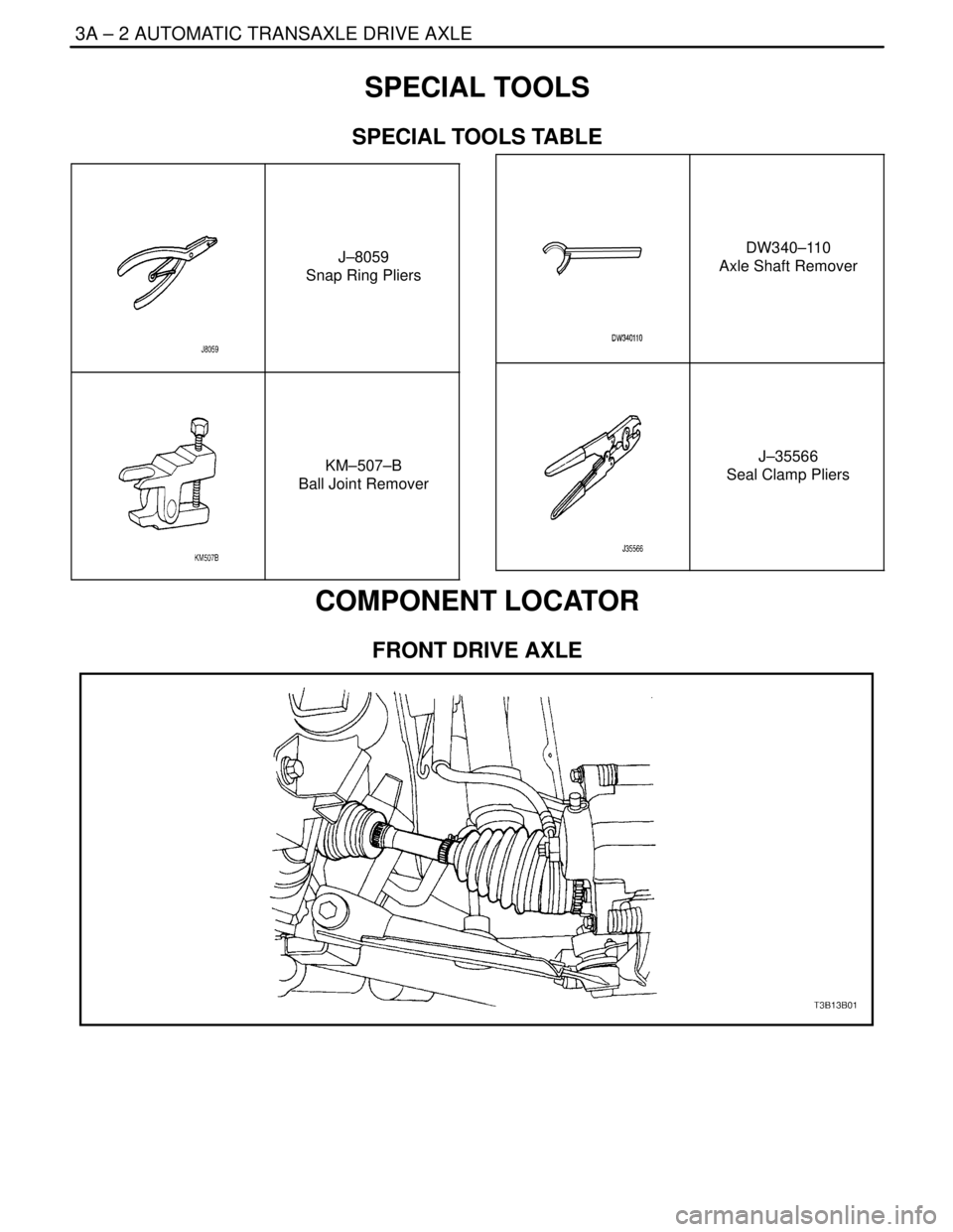
SPECIAL TOOLS
SPECIAL TOOLS TABLE
J–8059
Snap Ring Pliers
KM–507–B
Ball Joint Remover
DW340–110
Axle Shaft Remover
J–35566
Seal Clamp Pliers
COMPONENT LOCATOR
FRONT DRIVE AXLE
Page 992 of 2643
AUTOMATIC TRANSAXLE DRIVE AXLE 3A – 3
DAEWOO V–121 BL4
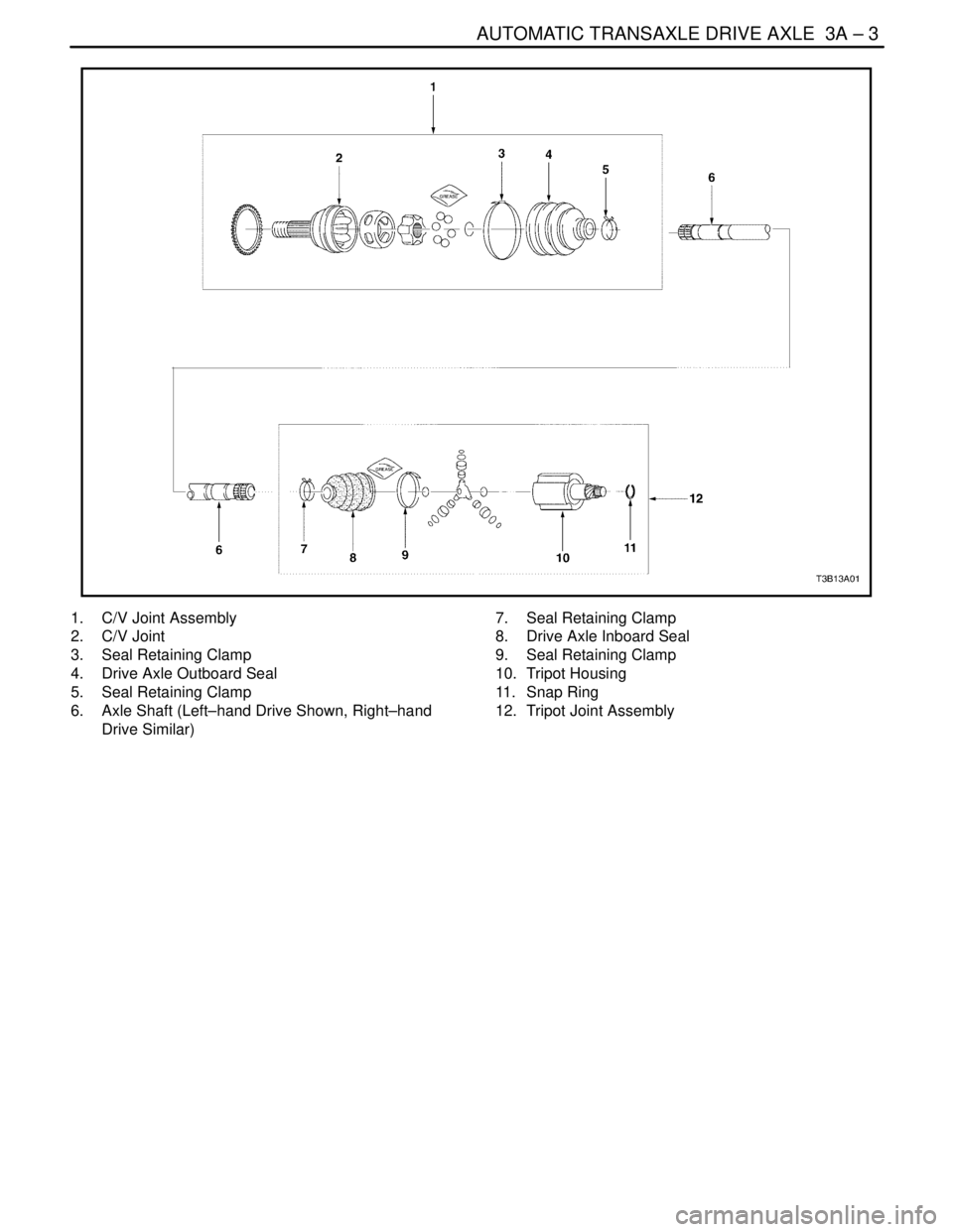
1. C/V Joint Assembly
2. C/V Joint
3. Seal Retaining Clamp
4. Drive Axle Outboard Seal
5. Seal Retaining Clamp
6. Axle Shaft (Left–hand Drive Shown, Right–hand
Drive Similar)7. Seal Retaining Clamp
8. Drive Axle Inboard Seal
9. Seal Retaining Clamp
10. Tripot Housing
11. Snap Ring
12. Tripot Joint Assembly