2004 DAEWOO LACETTI Front brakes
[x] Cancel search: Front brakesPage 1056 of 2643
4D – 8IFRONT DISC BRAKES
DAEWOO V–121 BL4
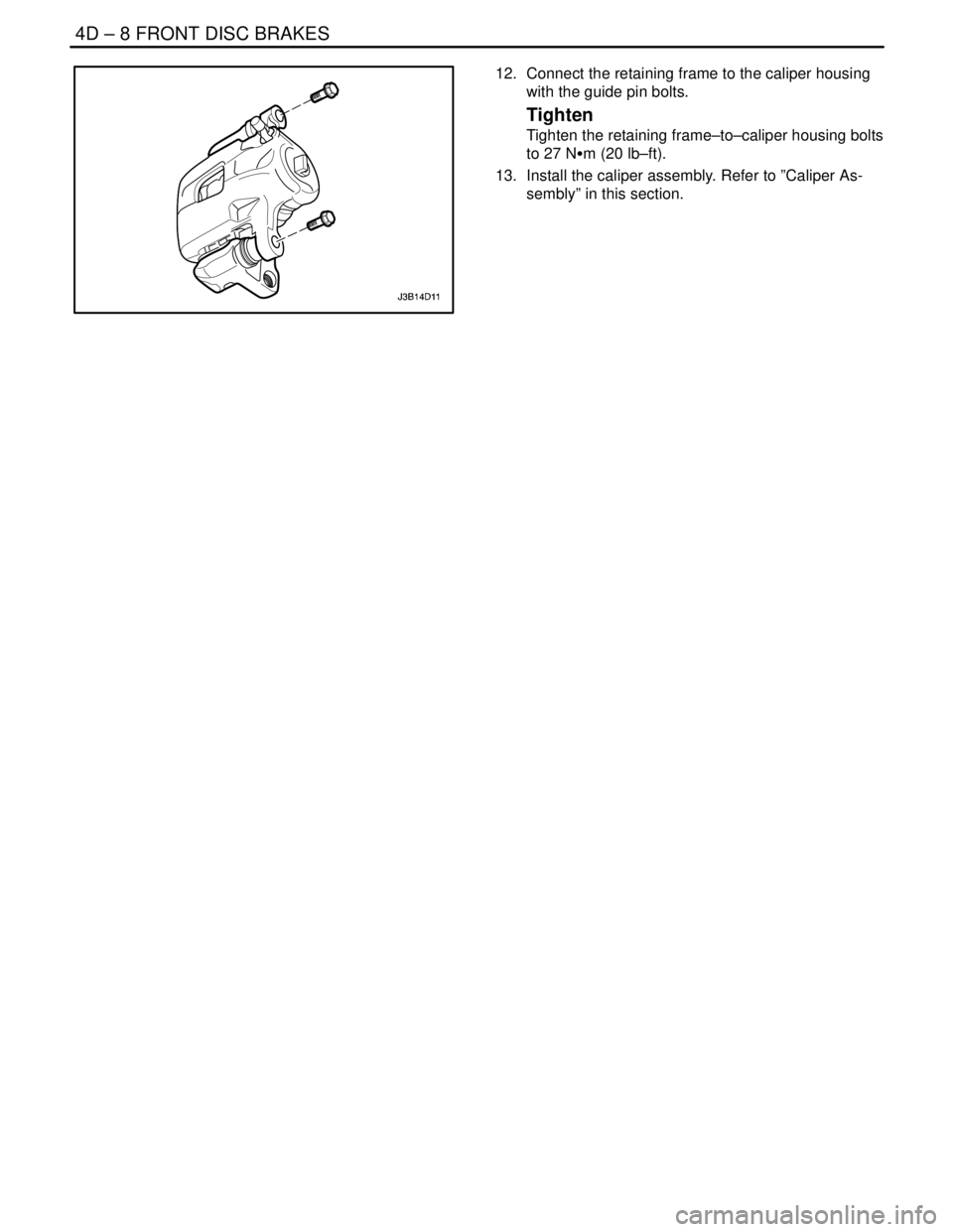
12. Connect the retaining frame to the caliper housing
with the guide pin bolts.
Tighten
Tighten the retaining frame–to–caliper housing bolts
to 27 NSm (20 lb–ft).
13. Install the caliper assembly. Refer to ”Caliper As-
sembly” in this section.
Page 1057 of 2643

FRONT DISC BRAKES 4D – 9
DAEWOO V–121 BL4
GENERAL DESCRIPTION
AND SYSTEM OPERATION
DISC BRAKE CALIPER ASSEMBLY
This caliper has a single bore and is mounted to the steer-
ing knuckle with two mounting bolts. Hydraulic pressure,
created by applying the brake pedal, is converted by the
caliper to a stopping force. This force acts equally against
the piston and the bottom of the caliper bore to move the
piston outward and to slide the caliper inward, resulting in
a clamping action on the rotor. This clamping action forces
the linings against the rotor, creating friction to stop the ve-
hicle.Important :
S Replace all components included in the repair kits
used to service this caliper.
S Lubricate the rubber parts with clean brake fluid to
ease assembly.
S Do not use lubricated shop air on brake parts, as
damage to the rubber components may result.
S If any hydraulic component is removed or discon-
nected, it may be necessary to bleed all or part of
the brake system.
S Replace the pads in axle sets only.
S The torque values specified are for dry, unlubri-
cated fasteners.
S Perform the service operations on a clean bench,
free from all mineral oil materials.
Page 1059 of 2643
4E1 – 2IREAR DISC BRAKES
DAEWOO V–121 BL4
pulsation and/or front end vibration during braking. Thick-
ness can be measured with a commercially available mi-
crometer and should be 10 mm(0.39 inch) or over.
Light scoring of the rotor surfaces is acceptable if it does
not exceed 0.40 mm (0.016 inch) in depth. Scoring mea-
surements can be made with a commercially available
brake micrometer.
Lateral runout cannot exceed 0.8 mm (0.03 inch). If lateral
runout exceeds the specification, make sure that there is
no dirt between the rotor and the hub and that hub–to–ro-
tor contact surfaces are smooth and free from burrs. Use
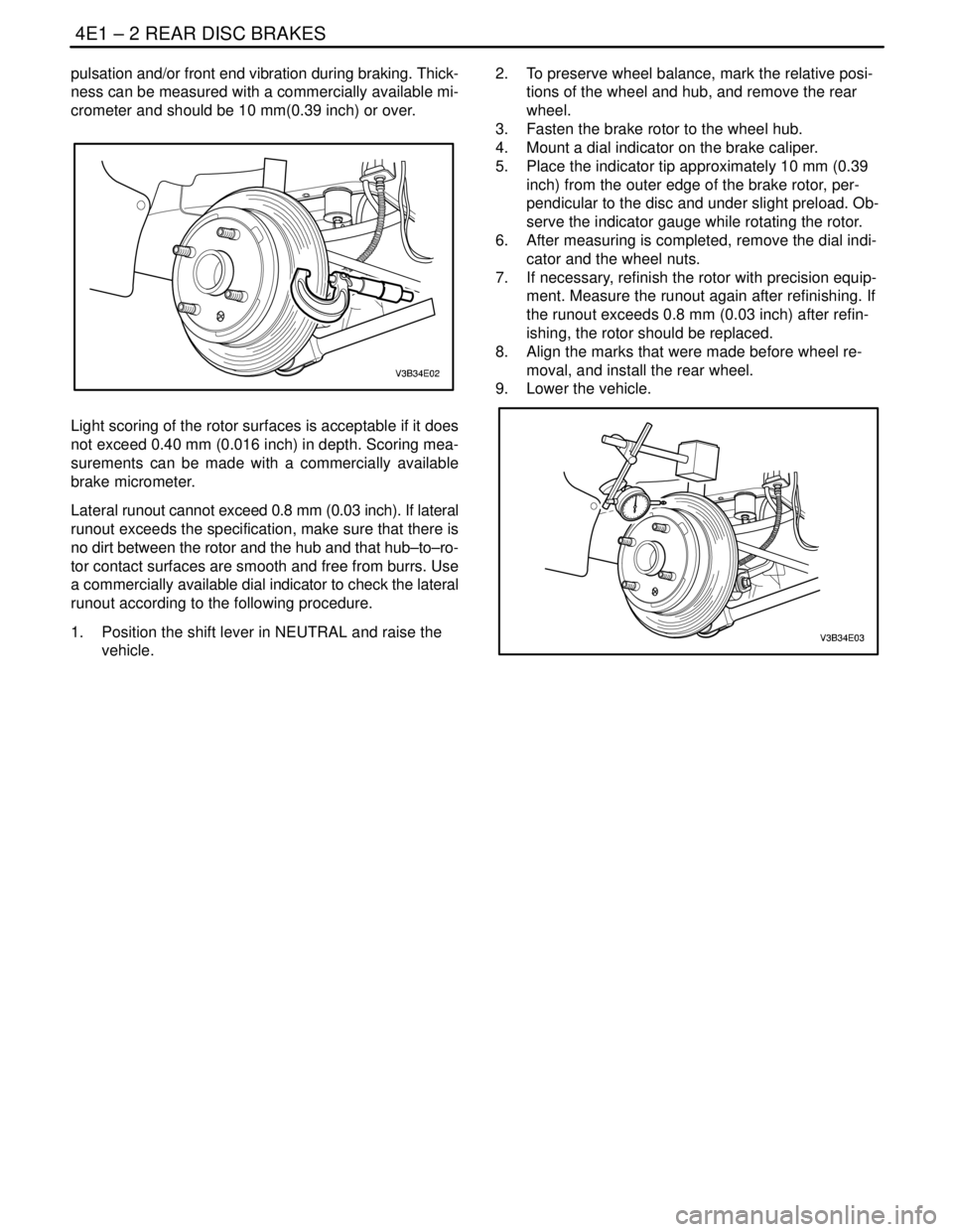
a commercially available dial indicator to check the lateral
runout according to the following procedure.
1. Position the shift lever in NEUTRAL and raise the
vehicle.2. To preserve wheel balance, mark the relative posi-
tions of the wheel and hub, and remove the rear
wheel.
3. Fasten the brake rotor to the wheel hub.
4. Mount a dial indicator on the brake caliper.
5. Place the indicator tip approximately 10 mm (0.39
inch) from the outer edge of the brake rotor, per-
pendicular to the disc and under slight preload. Ob-
serve the indicator gauge while rotating the rotor.
6. After measuring is completed, remove the dial indi-
cator and the wheel nuts.
7. If necessary, refinish the rotor with precision equip-
ment. Measure the runout again after refinishing. If
the runout exceeds 0.8 mm (0.03 inch) after refin-
ishing, the rotor should be replaced.
8. Align the marks that were made before wheel re-
moval, and install the rear wheel.
9. Lower the vehicle.
Page 1062 of 2643
REAR DISC BRAKES 4E1 – 5
DAEWOO V–121 BL4
2. Connect the brake hose with the bolt and ring
seals.
Tighten
Tighten the brake hose inlet bolt and ring seals to 32
NSm (24 lb–ft).
3. Install the rear wheels. Refer to Section 2E, Tires
and Wheels.
4. Lower the vehicle.
5. Fill the master cylinder to the proper level with
clean brake fluid.
6. Bleed the caliper. Refer to Section 4F, Antilock
Brake System and Traction Control System.
ROTOR
Removal Procedure
1. Remove the caliper. Refer to ”Caliper” in this sec-
tion.
2. Remove the brake shoes.
3. Remove the caliper mounting bracket.
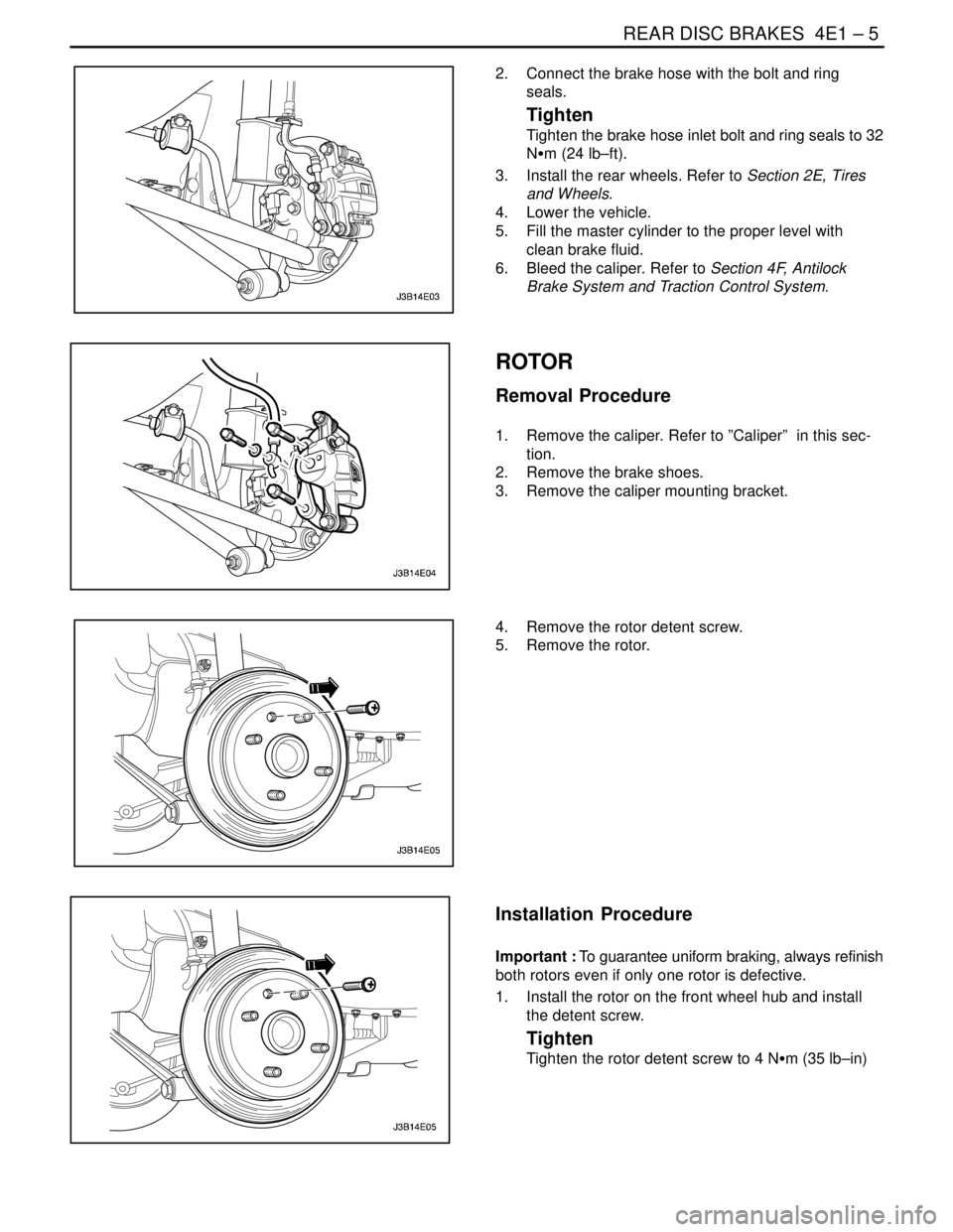
4. Remove the rotor detent screw.
5. Remove the rotor.
Installation Procedure
Important : To guarantee uniform braking, always refinish
both rotors even if only one rotor is defective.
1. Install the rotor on the front wheel hub and install
the detent screw.
Tighten
Tighten the rotor detent screw to 4 NSm (35 lb–in)
Page 1146 of 2643

ANTILOCK BRAKE SYSTEM 4F – 65
DAEWOO V–121 BL4
GENERAL DESCRIPTION AND SYSTEM
OPERATION
BASIC KNOWLEDGE REQUIRED
Before using this section, it is important that you have a ba-
sic knowledge of the following items. Without this knowl-
edge, it will be difficult to use the diagnostic procedures
contained in this section.
S Basic Electrical Circuits : You should understand
the basic theory of electricity and know the mean-
ing of voltage, current (amps), and resistance
(ohms). You should understand what happens in a
circuit with an open or shorted wire. You should be
able to read and understand a wiring diagram.
S Use of Circuit Testing Tools : You should know how
to use a test light and how to bypass components
to test circuits using fused jumper wires. You should
be familiar with a digital multimeter. You should be
able to measure voltage, resistance, and current,
and be familiar with the controls and how to use
them correctly.
ABS SYSTEM COMPONENTS
The ABS 5.3 Antilock Braking System (ABS) consists of
a conventional hydraulic brake system plus antilock com-
ponents. The conventional brake system includes a vacu-
um booster, master cylinder, front disc brakes, rear lead-
ing/trailing drum brakes, interconnecting hydraulic brake
pipes and hoses, brake fluid level sensor and the BRAKE
indicator.
The ABS components include a hydraulic unit, an elec-
tronic brake control module (EBCM), two system fuses,
four wheel speed sensors (one at each wheel), intercon-
necting wiring, the ABS indicator, the EBD indicator (which
is connected to the parking lamp) and the rear disk brakes.
See “ABS Component Locator” in this section for the gen-
eral layout of this system.
The hydraulic unit with the attached EBCM is located be-
tween the surge tank and the fire wall on the left side of the
vehicle.
The basic hydraulic unit configuration consists of hydraulic
check valves, two solenoid valves for each wheel, a hy-
draulic pump, two accumulators, and two damper. The hy-
draulic unit controls hydraulic pressure to the front calipers
and rear wheel cylinders by modulating hydraulic pressure
to prevent wheel lockup.
Nothing in the hydraulic unit or the EBCM is serviceable.
In the event of any failure, the entire ABS unit with at-
tached EBCM must be replaced. For more information, re-
fer to ”Base Braking Mode” and ”Antilock Braking Mode”
in this section.
BASE BRAKING MODE
The baseline braking mode of the ABS 5.3 system used
in this vehicle is a diagonal split system. In this system,
one master cylinder circuit supplies pressure to the right
front and the left rear brakes; the other circuit supplies
pressure to the left front and the right rear brakes. All
valves in the hydraulic modulator are in their normal, non–
energized positions as shown in the drawings found in
”ABS System Components” in this section.
Page 1150 of 2643

ANTILOCK BRAKE SYSTEM 4F – 69
DAEWOO V–121 BL4
EBD (ELECTRONIC BRAKE FORCE
DISTRIBUTION) SYSTEM
As an add–on logic to the ABS base algorithm, EBD works
in a range in which the intervention thresholds for ABS
control are not reached yet.
EBD ensures that the rear wheels are sensitively moni-
tored for slip with respect to the front axle. If slip is de-
tected, the inlet valves for the rear wheels are switched to
pressure hold to prevent a further increase in pressure at
the rear–wheel breaks, thus electronically reproducing a
pressure–reduction function at the rear–wheel brakes.
THE BENEFITS OF EBD
S Elimination of conventional proportioning valve.
S EBD utilizes the existing rear axle wheel speed
sensor to monitor rear wheel slip.
S Based on many variables in algorithm a pressure
hold, increase and/or decrease pulsetrain may be
triggered at the rear wheels insuring vehicle stabil-
ity.
S Vehicle approaches the ideal brake force distribu-
tion. (front to rear)
S Constant brake force distribution during vehicle life-
time.
S EBD function is monitored via ABS safety logic.
(conventional proportioning valves are not monitor-
able)
S ”Keep alive” function.
Page 1582 of 2643
ZF 4 HP 16 AUTOMATIC TRANSAXLE 5A1 – 233
DAEWOO V–121 BL4
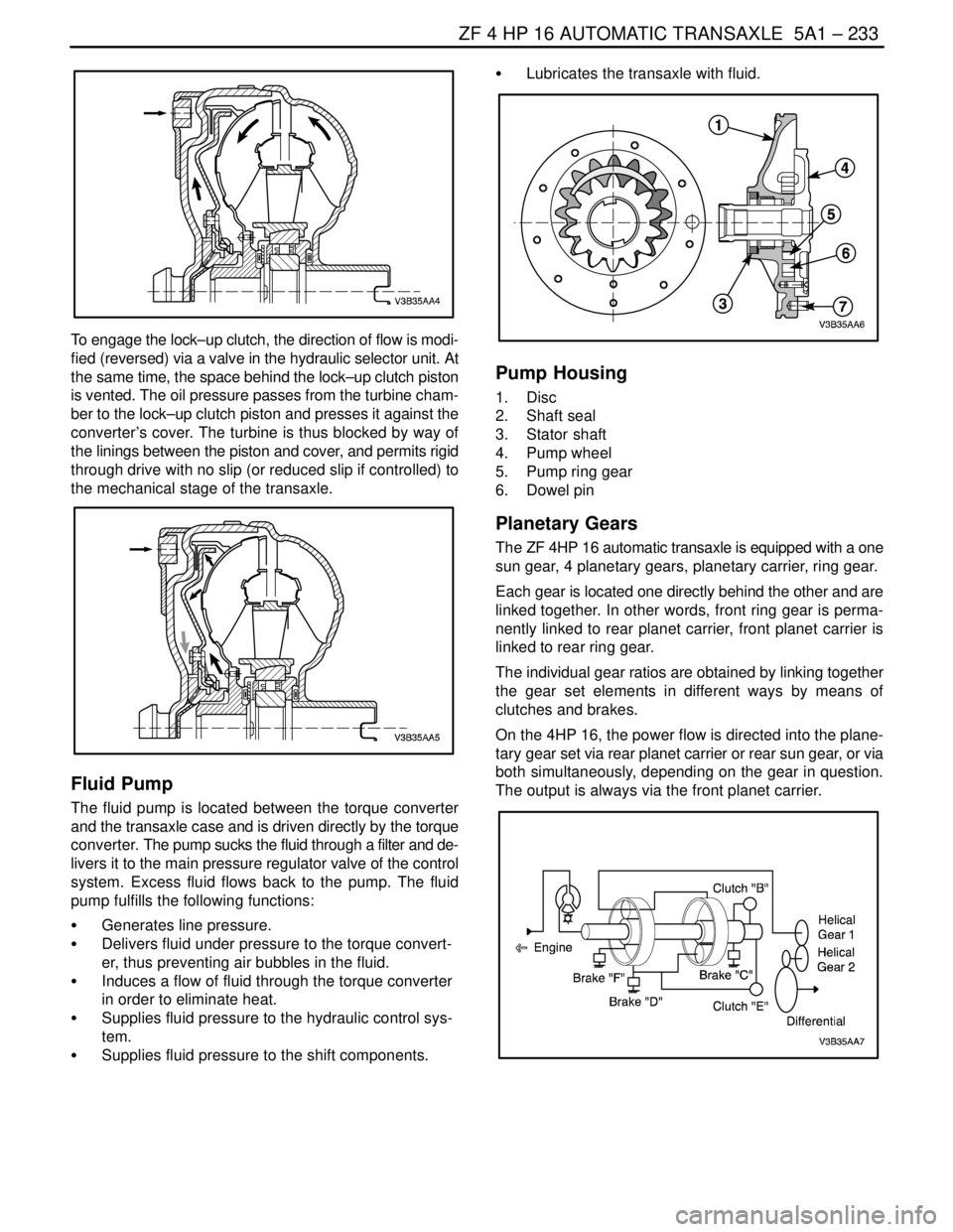
To engage the lock–up clutch, the direction of flow is modi-
fied (reversed) via a valve in the hydraulic selector unit. At
the same time, the space behind the lock–up clutch piston
is vented. The oil pressure passes from the turbine cham-
ber to the lock–up clutch piston and presses it against the
converter’s cover. The turbine is thus blocked by way of
the linings between the piston and cover, and permits rigid
through drive with no slip (or reduced slip if controlled) to
the mechanical stage of the transaxle.
Fluid Pump
The fluid pump is located between the torque converter
and the transaxle case and is driven directly by the torque
converter. The pump sucks the fluid through a filter and de-
livers it to the main pressure regulator valve of the control
system. Excess fluid flows back to the pump. The fluid
pump fulfills the following functions:
S Generates line pressure.
S Delivers fluid under pressure to the torque convert-
er, thus preventing air bubbles in the fluid.
S Induces a flow of fluid through the torque converter
in order to eliminate heat.
S Supplies fluid pressure to the hydraulic control sys-
tem.
S Supplies fluid pressure to the shift components.S Lubricates the transaxle with fluid.
Pump Housing
1. Disc
2. Shaft seal
3. Stator shaft
4. Pump wheel
5. Pump ring gear
6. Dowel pin
Planetary Gears
The ZF 4HP 16 automatic transaxle is equipped with a one
sun gear, 4 planetary gears, planetary carrier, ring gear.
Each gear is located one directly behind the other and are
linked together. In other words, front ring gear is perma-
nently linked to rear planet carrier, front planet carrier is
linked to rear ring gear.
The individual gear ratios are obtained by linking together
the gear set elements in different ways by means of
clutches and brakes.
On the 4HP 16, the power flow is directed into the plane-
tary gear set via rear planet carrier or rear sun gear, or via
both simultaneously, depending on the gear in question.
The output is always via the front planet carrier.
Page 1583 of 2643
5A1 – 234IZF 4 HP 16 AUTOMATIC TRANSAXLE
DAEWOO V–121 BL4
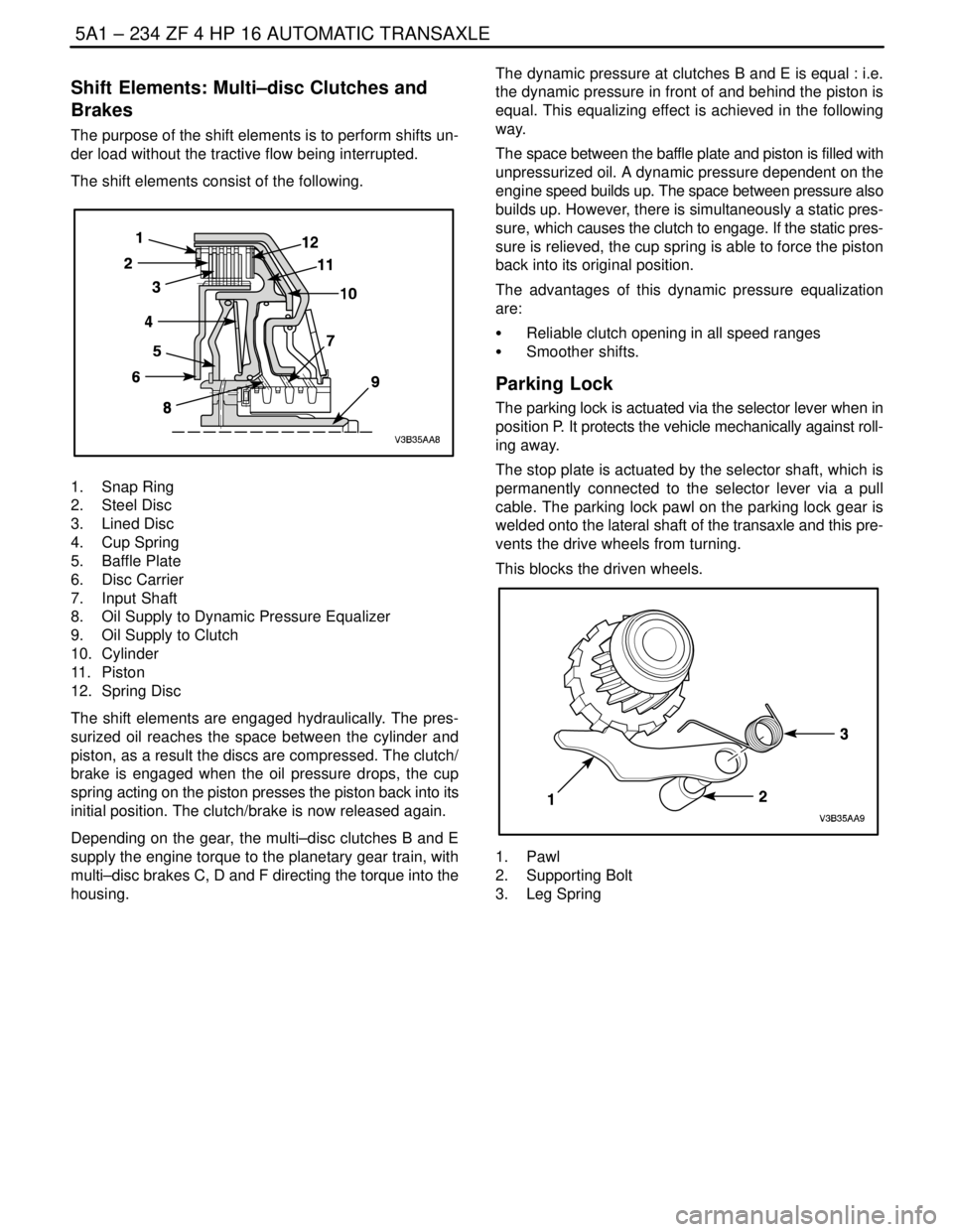
Shift Elements: Multi–disc Clutches and
Brakes
The purpose of the shift elements is to perform shifts un-
der load without the tractive flow being interrupted.
The shift elements consist of the following.
1. Snap Ring
2. Steel Disc
3. Lined Disc
4. Cup Spring
5. Baffle Plate
6. Disc Carrier
7. Input Shaft
8. Oil Supply to Dynamic Pressure Equalizer
9. Oil Supply to Clutch
10. Cylinder
11. Piston
12. Spring Disc
The shift elements are engaged hydraulically. The pres-
surized oil reaches the space between the cylinder and
piston, as a result the discs are compressed. The clutch/
brake is engaged when the oil pressure drops, the cup
spring acting on the piston presses the piston back into its
initial position. The clutch/brake is now released again.
Depending on the gear, the multi–disc clutches B and E
supply the engine torque to the planetary gear train, with
multi–disc brakes C, D and F directing the torque into the
housing.The dynamic pressure at clutches B and E is equal : i.e.
the dynamic pressure in front of and behind the piston is
equal. This equalizing effect is achieved in the following
way.
The space between the baffle plate and piston is filled with
unpressurized oil. A dynamic pressure dependent on the
engine speed builds up. The space between pressure also
builds up. However, there is simultaneously a static pres-
sure, which causes the clutch to engage. If the static pres-
sure is relieved, the cup spring is able to force the piston
back into its original position.
The advantages of this dynamic pressure equalization
are:
S Reliable clutch opening in all speed ranges
S Smoother shifts.
Parking Lock
The parking lock is actuated via the selector lever when in
position P. It protects the vehicle mechanically against roll-
ing away.
The stop plate is actuated by the selector shaft, which is
permanently connected to the selector lever via a pull
cable. The parking lock pawl on the parking lock gear is
welded onto the lateral shaft of the transaxle and this pre-
vents the drive wheels from turning.
This blocks the driven wheels.
1. Pawl
2. Supporting Bolt
3. Leg Spring