9L – 14IGLASS AND MIRRORS
DAEWOO V–121 BL4
5. Buff the grid lines that are to be repaired with steel
wool. Wipe the lines clean using a cloth dampened
with alcohol. Buff and clean about 6 mm (0.25 inch)
beyond each side of the break in the grid line.
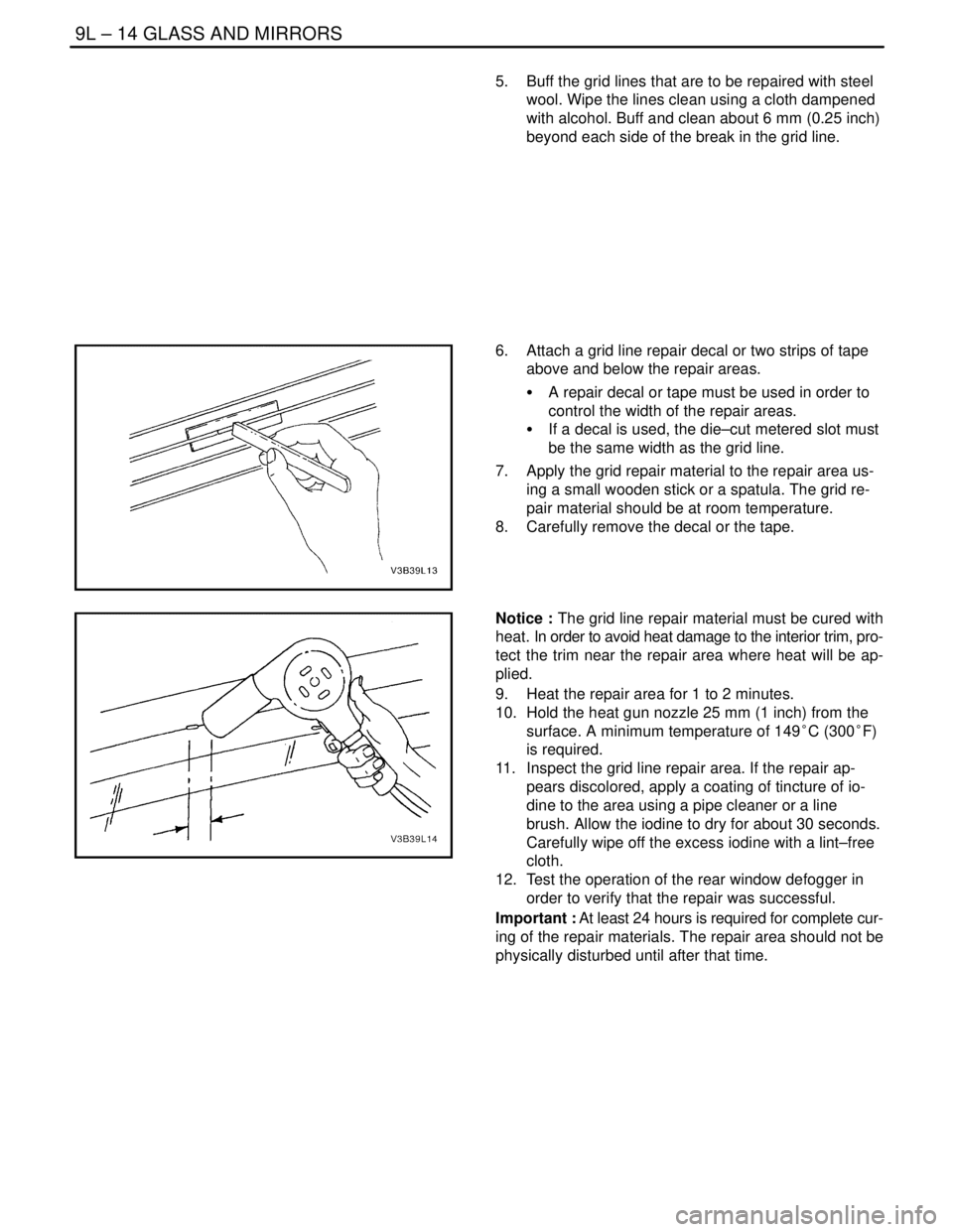
6. Attach a grid line repair decal or two strips of tape
above and below the repair areas.
S A repair decal or tape must be used in order to
control the width of the repair areas.
S If a decal is used, the die–cut metered slot must
be the same width as the grid line.
7. Apply the grid repair material to the repair area us-
ing a small wooden stick or a spatula. The grid re-
pair material should be at room temperature.
8. Carefully remove the decal or the tape.
Notice : The grid line repair material must be cured with
heat. In order to avoid heat damage to the interior trim, pro-
tect the trim near the repair area where heat will be ap-
plied.
9. Heat the repair area for 1 to 2 minutes.
10. Hold the heat gun nozzle 25 mm (1 inch) from the
surface. A minimum temperature of 149°C (300°F)
is required.
11. Inspect the grid line repair area. If the repair ap-
pears discolored, apply a coating of tincture of io-
dine to the area using a pipe cleaner or a line
brush. Allow the iodine to dry for about 30 seconds.
Carefully wipe off the excess iodine with a lint–free
cloth.
12. Test the operation of the rear window defogger in
order to verify that the repair was successful.
Important : At least 24 hours is required for complete cur-
ing of the repair materials. The repair area should not be
physically disturbed until after that time.
4–12 FRONTNUBIRA/LACETTI
Note : Use of jigs is recommended for correct positions
and check that the both front longitudinal and wheel-
house are parallel.
S Tack weld the clamped section for temporary installa-
tion.
7. Perform the main welding.
S Weld as much as possible with the jig still mounted.
S Make MIG or gas welds at the butt joints at the front lon-
gitudinal, carefully.
Fig. 19
S Spot weld the wheelhouse with the front longitudinal
flange areas and front panel.
CAUTION : To prevent eye injury and burns when
welding, wear an approved welding helmet, gloves
and safety shoes.
S Perform a trial welding first, and check the welding con-
dition.
S Increase the number of spot by 20% for areas to be spot
welded.
Fig. 20
S Level the weld beads at the longitudinal butt joints area
with disc sander.
S Make the stiffener(Thickness: 2.8 mm Min., Width: 80
mm) according to the form of longitudinal butt joint areasand weld the stiffener at the longitudinal butt joint areas
with MIG welder.
Fig. 21
8. Finish the welding areas.
S Level the gas or MIG welded areas with disc sander.
S Use a hammer and dolly to even out the wheelhouse and
longitudinal flanges for a close fit.
9. Apply the sealer.
S Apply the sealer to the joint areas of the dash panel lower
and floor panel areas.
10. Apply the undercoat.
S Undercoat to the joint and overlapped areas of the front
floor, longitudinal under side and the inside of front, rear
wheelhouse.
11. Apply the paint.
CAUTION
S Ventilate when spraying paint. Most paint contains sub-
stances that are harmful if inhaled or swallowed. Read
the paint label before opening paint container.
S Avoid contact with skin. Wear an approved respirator,
gloves, eye protection and appropriate clothing when
painting.
S Paint is flammable. Store in a safe place, and keep it
away from sparks, flames or cigarettes.
12. Coating the anti–rust agents.
S Coating the anti–rust agents to the end of front panel
side and the front door hinge areas.
13. Install the related parts.
S Clean the passenger compartment.
S Wiring harness, instrument panel and related parts.
S Parts of the passenger compartment.
S Chassis components.
S Engine, radiator and related parts.
S Aircon condenser and related parts.
S Head lamps and fenders.
S Heed, radiator grill, and bumper.
S Others.
S Install in the reverse order in which they were removed.