2004 DAEWOO LACETTI transaxle
[x] Cancel search: transaxlePage 197 of 2643
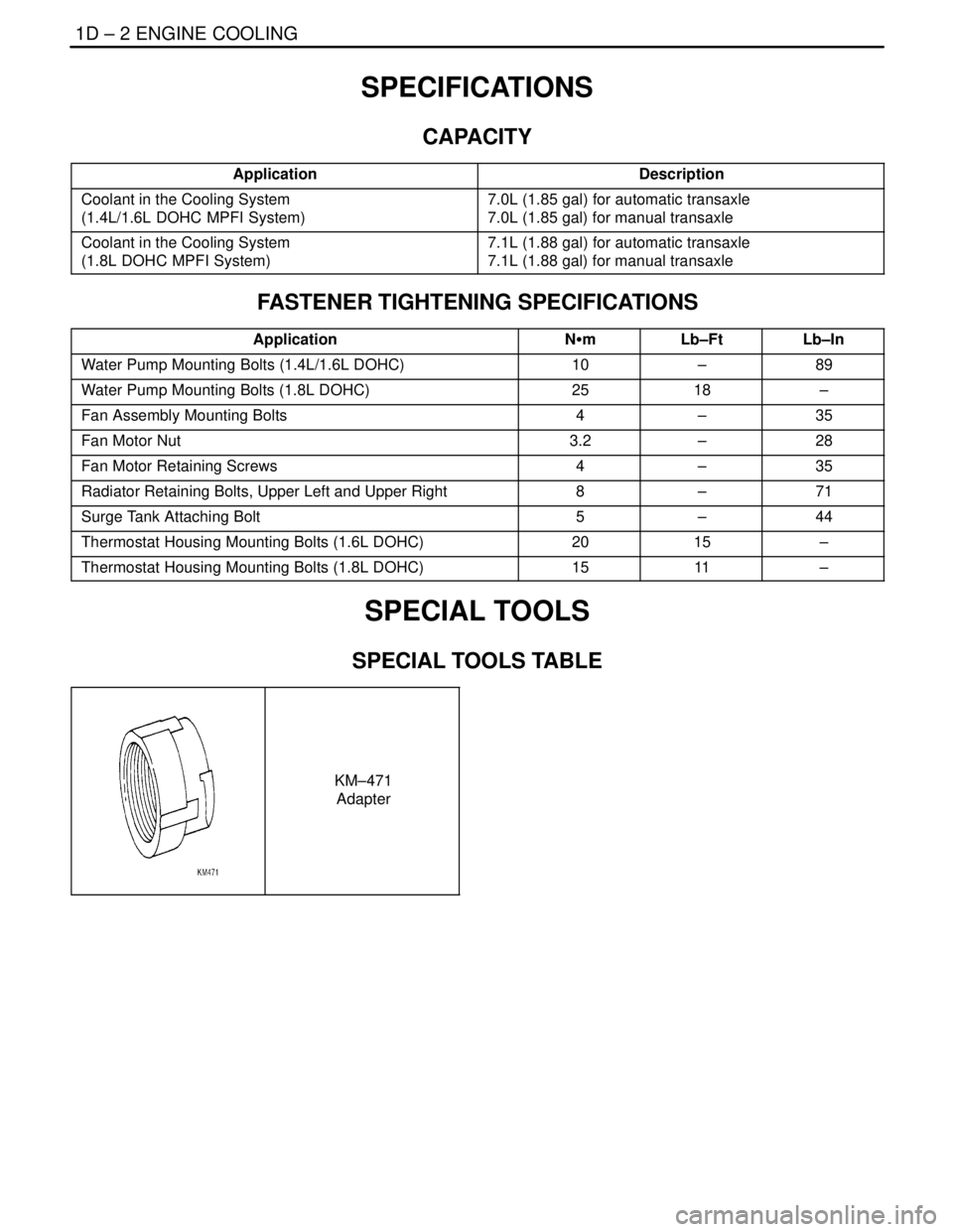
1D – 2IENGINE COOLING
DAEWOO V–121 BL4
SPECIFICATIONS
CAPACITY
ApplicationDescription
Coolant in the Cooling System
(1.4L/1.6L DOHC MPFI System)7.0L (1.85 gal) for automatic transaxle
7.0L (1.85 gal) for manual transaxle
Coolant in the Cooling System
(1.8L DOHC MPFI System)7.1L (1.88 gal) for automatic transaxle
7.1L (1.88 gal) for manual transaxle
FASTENER TIGHTENING SPECIFICATIONS
ApplicationNSmLb–FtLb–In
Water Pump Mounting Bolts (1.4L/1.6L DOHC)10–89
Water Pump Mounting Bolts (1.8L DOHC)2518–
Fan Assembly Mounting Bolts4–35
Fan Motor Nut3.2–28
Fan Motor Retaining Screws4–35
Radiator Retaining Bolts, Upper Left and Upper Right8–71
Surge Tank Attaching Bolt5–44
Thermostat Housing Mounting Bolts (1.6L DOHC)2015–
Thermostat Housing Mounting Bolts (1.8L DOHC)1511–
SPECIAL TOOLS
SPECIAL TOOLS TABLE
KM–471
Adapter
Page 211 of 2643
1D – 16IENGINE COOLING
DAEWOO V–121 BL4
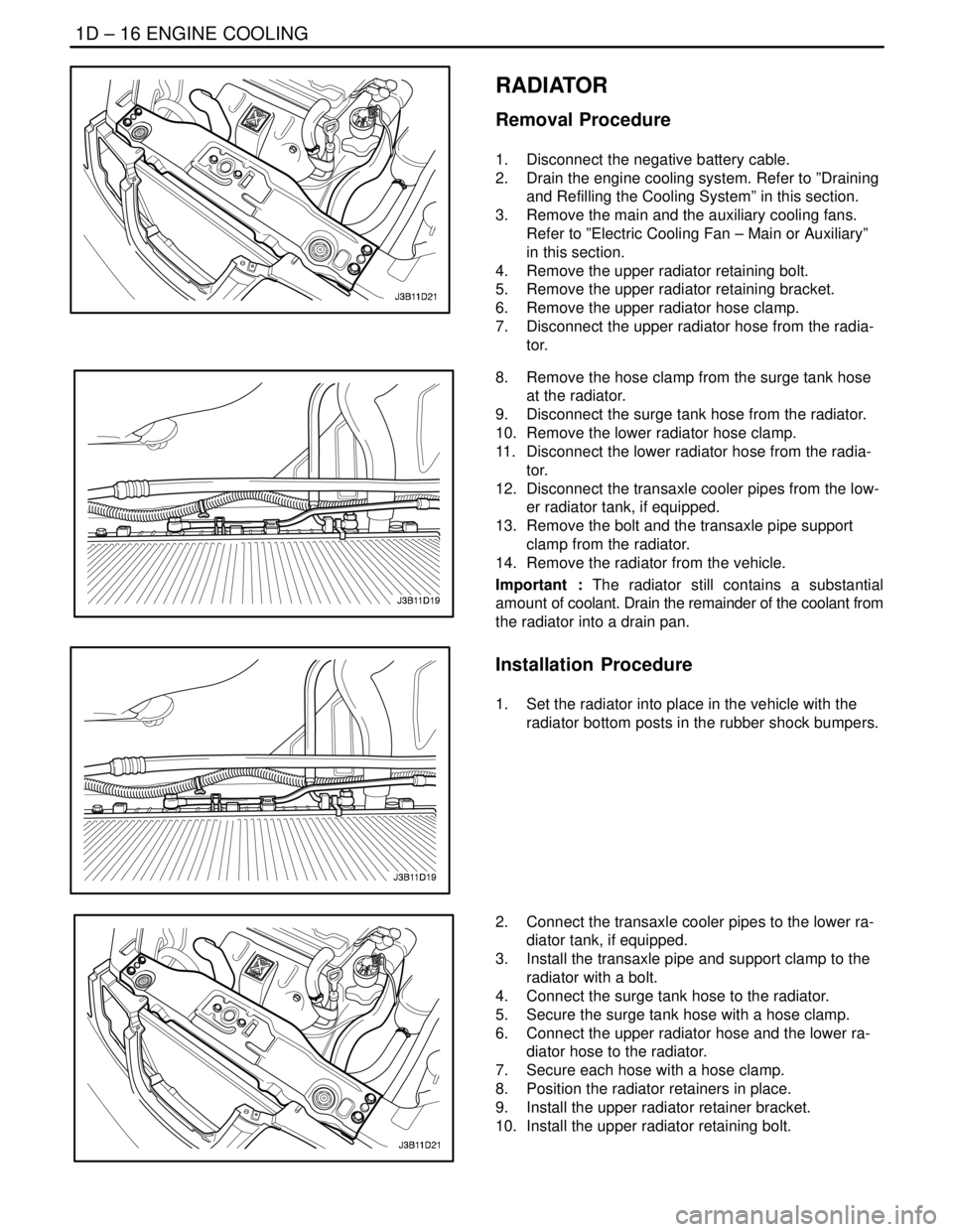
RADIATOR
Removal Procedure
1. Disconnect the negative battery cable.
2. Drain the engine cooling system. Refer to ”Draining
and Refilling the Cooling System” in this section.
3. Remove the main and the auxiliary cooling fans.
Refer to ”Electric Cooling Fan – Main or Auxiliary”
in this section.
4. Remove the upper radiator retaining bolt.
5. Remove the upper radiator retaining bracket.
6. Remove the upper radiator hose clamp.
7. Disconnect the upper radiator hose from the radia-
tor.
8. Remove the hose clamp from the surge tank hose
at the radiator.
9. Disconnect the surge tank hose from the radiator.
10. Remove the lower radiator hose clamp.
11. Disconnect the lower radiator hose from the radia-
tor.
12. Disconnect the transaxle cooler pipes from the low-
er radiator tank, if equipped.
13. Remove the bolt and the transaxle pipe support
clamp from the radiator.
14. Remove the radiator from the vehicle.
Important : The radiator still contains a substantial
amount of coolant. Drain the remainder of the coolant from
the radiator into a drain pan.
Installation Procedure
1. Set the radiator into place in the vehicle with the
radiator bottom posts in the rubber shock bumpers.
2. Connect the transaxle cooler pipes to the lower ra-
diator tank, if equipped.
3. Install the transaxle pipe and support clamp to the
radiator with a bolt.
4. Connect the surge tank hose to the radiator.
5. Secure the surge tank hose with a hose clamp.
6. Connect the upper radiator hose and the lower ra-
diator hose to the radiator.
7. Secure each hose with a hose clamp.
8. Position the radiator retainers in place.
9. Install the upper radiator retainer bracket.
10. Install the upper radiator retaining bolt.
Page 213 of 2643

1D – 18IENGINE COOLING
DAEWOO V–121 BL4
GENERAL DESCRIPTION
AND SYSTEM OPERATION
GENERAL DESCRIPTION
The cooling system maintains the engine temperature at
an efficient level during all engine operating conditions.
When the engine is cold, the cooling system cools the en-
gine slowly or not at all. This slow cooling of the engine al-
lows the engine to warm up quickly.
The cooling system includes a radiator and recovery sub-
system, cooling fans, a thermostat and housing, a coolant
pump, and a coolant pump drive belt. The timing belt
drives the coolant pump.
All components must function properly in order for the
cooling system to operate. The coolant pump draws the
coolant from the radiator. The coolant then circulates
through water jackets in the engine block, the intake man-
ifold, and the cylinder head. When the coolant reaches the
operating temperature of the thermostat, the thermostat
opens. The coolant then goes back to the radiator where
it cools.
This system directs some coolant through the hoses to the
heater core. This provides for heating and defrosting. The
surge tank is connected to the radiator to recover the cool-
ant displaced by expansion from the high temperatures.
The surge tank maintains the correct coolant level.
The cooling system for this vehicle has no radiator cap or
filler neck. The coolant is added to the cooling system
through the surge tank.
RADIATOR
This vehicle has a lightweight tube–and–fin aluminum ra-
diator. Plastic tanks are mounted on the right and the left
sides of the radiator core.
On vehicles equipped with automatic transaxles, the
transaxle fluid cooler lines run through the left radiator
tank. A radiator drain cock is on this radiator.
To drain the cooling system, open the drain cock.
SURGE TANK
The surge tank is a transparent plastic reservoir, similar to
the windshield washer reservoir.
The surge tank is connected to the radiator by a hose and
to the engine cooling system by another hose. As the ve-
hicle is driven, the engine coolant heats and expands. The
portion of the engine coolant displaced by this expansion
flows from the radiator and the engine into the surge tank.
The air trapped in the radiator and the engine is degassed
into the surge tank.When the engine stops, the engine coolant cools and con-
tracts. The displaced engine coolant is then drawn back
into the radiator and the engine. This keeps the radiator
filled with the coolant to the desired level at all times and
increases the cooling efficiency.
Maintain the coolant level between the MIN and the MAX
marks on the surge tank when the system is cold.
WATER PUMP
The belt–driven centrifugal water pump consists of an im-
peller, a drive shaft, and a belt pulley. The water pump is
mounted on the front of the transverse–mounted engine,
and is driven by the timing belt.
The impeller is supported by a completely sealed bearing.
The water pump is serviced as an assembly and, there-
fore, cannot be disassembled.
THERMOSTAT
A wax pellet–type thermostat controls the flow of the en-
gine coolant through the engine cooling system. The ther-
mostat is mounted in the thermostat housing to the front
of the cylinder head.
The thermostat stops the flow of the engine coolant from
the engine to the radiator in order to provide faster warm–
up, and to regulate the coolant temperature. The thermo-
stat remains closed while the engine coolant is cold, pre-
venting circulation of the engine coolant through the
radiator. At this point, the engine coolant is allowed to cir-
culate only throughout the heater core to warm it quickly
and evenly.
As the engine warms, the thermostat opens. This allows
the engine coolant to flow through the radiator, where the
heat is dissipated through the radiator. This opening and
closing of the thermostat permits enough engine coolant
to enter the radiator to keep the engine within proper en-
gine temperature operating limits.
The wax pellet in the thermostat is hermetically sealed in
a metal case. The wax element of the thermostat expands
when it is heated and contracts when it is cooled.
As the vehicle is driven and the engine warms, the engine
coolant temperature increases. When the engine coolant
reaches a specified temperature, the wax pellet element
in the thermostat expands and exerts pressure against the
metal case, forcing the valve open. This allows the engine
coolant to flow through the engine cooling system and cool
the engine.
As the wax pellet cools, the contraction allows a spring to
close the valve.
The thermostat begins to open at 87°C (189°F) and is fully
open at 102°C (216°F). The thermostat closes at 86°C
(187°F).
Page 217 of 2643

ENGINE ELECTRICAL 1E – 3
DAEWOO V–121 BL4
FASTENER TIGHTENING SPECIFICATIONS
ApplicationNSmLb–FtLb–In
Battery Cable Nuts5–44
Battery Carrier Tray Lower, Side and Upper Bolts2015–
Battery Retainer Clamp–to–Battery Rod Nuts5–44
Generator Drive End Bearing Nut8160–
Generator Lower Bracket–to–Engine Block Bolts (1.8L Engine)3727–
Generator Lower Bracket–to–Generator Nut (1.4L/1.6L Engine)2518–
Generator Through–Bolts10–89
Generator–to–Intake Manifold and Cylinder Head Support
Bracket Bolts (1.8L Engine)3727–
Generator–to–Intake Manifold Strap Bracket Bolt (1.8L Engine)2216–
Generator Upper Support Bracket Bolt (1.4L/1.6L Engine)2015–
Intake Manifold–to–Cylinder Body Strap Bracket Bolts (Over
Starter)2216–
Starter Field Connector Nut12–106
Starter Lower Mounting Stud Ground Wire Nut12–106
Starter Mounting Studs/Nuts (1.4L/1.6L Engine)2518–
Starter Solenoid Assembly Screws8–71
Starter Solenoid Terminal–to–Battery Cable Terminal Nut5.5–49
Starter Solenoid Terminal–to–Ignition Solenoid Terminal Nut5.5–49
Starter Through–Bolts6–53
Starter–to–Engine Block Mounting Bolt (1.8L Engine)4533–
Starter–to–Engine Transaxle Mounting Bolt (1.8L Engine)5037–
Page 220 of 2643

1E – 6IENGINE ELECTRICAL
DAEWOO V–121 BL4
DIAGNOSIS
NO CRANK
StepActionValue(s)YesNo
11. Turn the headlamps ON.
2. Turn the dome lamps ON.
3. Turn the ignition to START.
Did the lights dim or go out?–Go to Step 2Go to Step 8
2Check the battery state of charge.
Is the green eye showing from the built–in hydrome-
ter?–Go to Step 3Go to
”Charging Pro-
cedure”
31. Connect the voltmeter positive lead to the posi-
tive battery terminal.
2. Connect the voltmeter negative lead to the
negative battery terminal.
3. Turn the ignition to START.
Does the voltmeter indicate the value specified?< 9.6 vGo to
”Charging Pro-
cedure”Go to Step 4
41. Connect the voltmeter negative lead to the
negative battery terminal.
2. Connect the positive voltmeter lead to the en-
gine block.
Does the voltmeter indicate the value specified?> 0.5 vGo to Step 5Go to Step 6
5Clean, tighten, or replace the negative battery cable.
Is the repair complete?–System OK–
61. Connect the voltmeter positive lead to the start-
er ”B+” terminal.
2. Connect the voltmeter negative lead to the
negative battery terminal.
Does the voltmeter indicate the value specified?< 9 vGo to Step 7Go to Step 13
7Clean, tighten, or replace the positive battery cable.
Is the repair complete?–System OK–
8Inspect the engine fuse block fuse Ef5.
Is the fuse OK?–Go to Step 10Go to Step 9
9Inspect the engine fuse block fuse Ef4.
Is the fuse OK?–System OK–
10Check the connection at the starter ”ST” terminal.
Is the connection OK?–Go to Step 12Go to Step 11
11Clean or tighten the connection as needed.
Is the repair complete?–System OK–
121. Connect the voltmeter positive lead to the start-
er ”ST” terminal.
2. Connect the voltmeter negative lead to the
negative battery terminal.
3. Turn the ignition to START.
Does the voltmeter indicate the value specified?< 7 vGo to Step 13Go to Step 14
13Repair or replace the starter as needed.
Is the repair complete?–System OK–
14Determine the type of transaxle on the vehicle.
Is the vehicle equipped with an automatic transaxle?–Go to Step 15Go to Step 32
Page 228 of 2643
1E – 14IENGINE ELECTRICAL
DAEWOO V–121 BL4
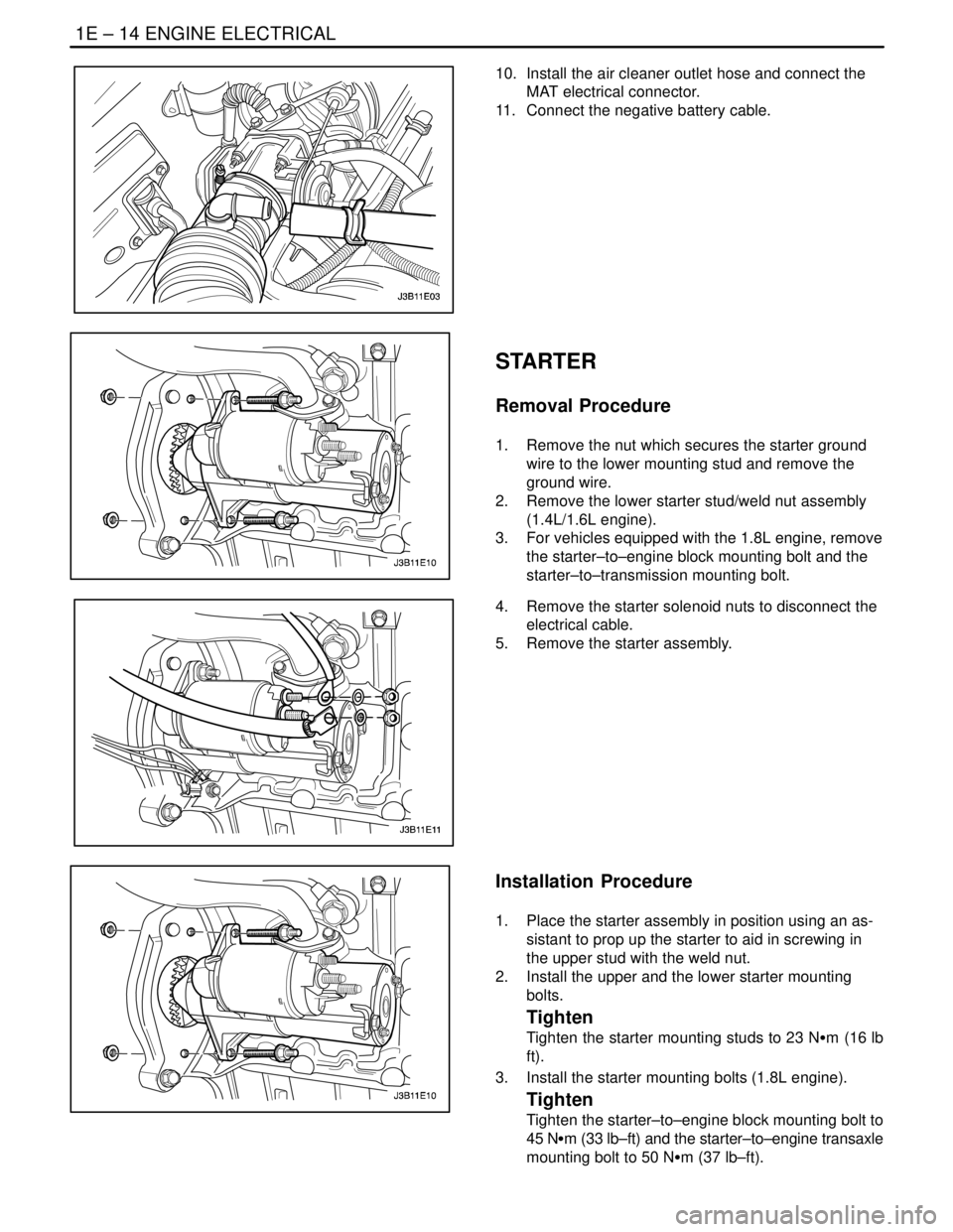
10. Install the air cleaner outlet hose and connect the
MAT electrical connector.
11. Connect the negative battery cable.
STARTER
Removal Procedure
1. Remove the nut which secures the starter ground
wire to the lower mounting stud and remove the
ground wire.
2. Remove the lower starter stud/weld nut assembly
(1.4L/1.6L engine).
3. For vehicles equipped with the 1.8L engine, remove
the starter–to–engine block mounting bolt and the
starter–to–transmission mounting bolt.
4. Remove the starter solenoid nuts to disconnect the
electrical cable.
5. Remove the starter assembly.
Installation Procedure
1. Place the starter assembly in position using an as-
sistant to prop up the starter to aid in screwing in
the upper stud with the weld nut.
2. Install the upper and the lower starter mounting
bolts.
Tighten
Tighten the starter mounting studs to 23 NSm (16 lb
ft).
3. Install the starter mounting bolts (1.8L engine).
Tighten
Tighten the starter–to–engine block mounting bolt to
45 NSm (33 lb–ft) and the starter–to–engine transaxle
mounting bolt to 50 NSm (37 lb–ft).
Page 245 of 2643

ENGINE ELECTRICAL 1E – 31
DAEWOO V–121 BL4
trolyte and the plates are at room temperature. A
battery that is extremely cold may not accept cur-
rent for several hours after starting the charger.
3. Charge the battery until the green dot appears. The
battery should be checked every half–hour while
charging. Tipping or shaking the battery may be
necessary to make the green dot appear.
4. After charging, the battery should be load tested.
Refer to ”Starter Motor” in this section.
CHARGING TIME REQUIRED
The time required to charge a battery will vary depending
upon the following factors:
S Size of Battery – A completely discharged large
heavy–duty battery requires more than twice the re-
charging time as a completely discharged small pas-
senger car battery.
S Temperature – A longer time will be needed to
charge any battery at –18°C (0°F) than at 27°C
(80°F). When a fast charger is connected to a cold
battery, the current accepted by the battery will be
very low at first. The battery will accept a higher cur-
rent rate as the battery warms.
S Charger Capacity – A charger which can supply only
5 amperes will require a much longer charging period
than a charger that can supply 30 amperes or more.
S State–of–Charge – A completely discharged battery
requires more than twice as much charge as a one–
half charged battery. Because the electrolyte is nearly
pure water and a poor conductor in a completely dis-
charged battery, the current accepted by the battery
is very low at first. Later, as the charging current
causes the electrolyte acid content to increase, the
charging current will likewise increase.
CHARGING A COMPLETELY
DISCHARGED BATTERY (OFF THE
VEHICLE)
Unless this procedure is properly followed, a perfectly
good battery may need to be replaced.
The following procedure should be used to recharge a
completely discharged battery:
1. Measure the voltage at the battery terminals with
an accurate voltmeter. If the reading is below 10
volts, the charge current will be very low, and it
could take some time before the battery accepts
the current in excess of a few milliamperes. Refer
to ””Charging Time Required” in this section, which
focuses on the factors affecting both the charging
time required and the rough estimates in the table
below. Such low current may not be detectable on
ammeters available in the field.
2. Set the battery charger on the high setting.Important : Some chargers feature polarity protection cir-
cuitry, which prevents charging unless the charger leads
are correctly connected to the battery terminals. A com-
pletely discharged battery may not have enough voltage
to activate this circuitry, even though the leads are con-
nected properly, making it appear that the battery will not
accept charging current. Therefore, follow the specific
charger manufacturer’s instruction for bypassing or over-
riding the circuitry so that the charger will turn on and
charge a low–voltage battery.
3. Continue to charge the battery until the charge cur-
rent is measurable. Battery chargers vary in the
amount of voltage and current provided. The time
required for the battery to accept a measurable
charge current at various voltages may be as fol-
lows:
Voltage
Hours
16.0 or moreUp to 4 hours
14.0–15.9Up to 8 hours
13.9 or lessUp to 16 hours
S If the charge current is not measurable at the
end of the above charging times, the battery
should be replaced.
S If the charge current is measurable during the
charging time, the battery is good, and charging
should be completed in the normal manner.
Important : It is important to remember that a completely
discharged battery must be recharged for a sufficient num-
ber of ampere hours (AH) to restore the battery to a usable
state. As a general rule, using the reserve capacity rating
(RC) as the number of ampere hours of charge usually
brings the green dot into view.
S If the charge current is still not measurable after
using the charging time calculated by the above
method, the battery should be replaced.
JUMP STARTING PROCEDURE
1. Position the vehicle with the good (charged) battery
so that the jumper cables will reach.
2. Turn off the ignition, all the lights, and all the electri-
cal loads in both vehicles. Leave the hazard flasher
on if jump starting where there may be other traffic
and any other lights needed for the work area.
3. In both vehicles, apply the parking brake firmly.
Notice : To avoid vehicle damage,Make sure the cables
are not on or near pulleys, fans, or other parts that will
move when the engine starts.
4. Shift an automatic transaxle to PARK, or a manual
transaxle to NEUTRAL.
CAUTION : In order to avoid injury, do not use cables
that have loose or missing insulation.
5. Clamp one end of the first jumper cable to the posi-
tive terminal on the battery. Make sure it does not
touch any other metal parts. Clamp the other end of
Page 250 of 2643

1F – 4IENGINE CONTROLS
DAEWOO V–121 BL4
DTC P0203 Injector 3 Circuit Fault 1F–414. . . . . . . . .
DTC P0204 Injector 4 Circuit Fault 1F–417. . . . . . . . .
DTC P0300 Multiple Cylinder Misfire Detected 1F–421
DTC P0301 Cylinder 1 Misfire 1F–426. . . . . . . . . . . . .
DTC P0302 Cylinder 2 Misfire 1F–431. . . . . . . . . . . . .
DTC P0303 Cylinder 3 Misfire 1F–436. . . . . . . . . . . . .
DTC P0304 Cylinder 4 Misfire 1F–441. . . . . . . . . . . . .
DTC P0317 Rough Road Sensor Source Not
Detected 1F–445. . . . . . . . . . . . . . . . . . . . . . . . . . . . . .
DTC P0325 Knock Sensor Internal
Malfunction 1F–447. . . . . . . . . . . . . . . . . . . . . . . . . . .
DTC P0327 Knock Sensor Circuit Fault 1F–449. . . . .
DTC P0336 58X Crank Position Extra/Missing
Pulses 1F–452. . . . . . . . . . . . . . . . . . . . . . . . . . . . . . . .
DTC P0337 58X Crank Position Sensor No
Signal 1F–455. . . . . . . . . . . . . . . . . . . . . . . . . . . . . . . .
DTC P0341 Camshaft Position Sensor
Rationality 1F–458. . . . . . . . . . . . . . . . . . . . . . . . . . . .
DTC P0342 Camshaft Position Sensor No
Signal 1F–461. . . . . . . . . . . . . . . . . . . . . . . . . . . . . . . .
DTC P0351 Ignition Control Circuit A Fault
(Cylinder 1 and 4) 1F–464. . . . . . . . . . . . . . . . . . . . . .
DTC P0352 Ignition Control Circuit B Fault
(Cylinder 2 and 3) 1F–466. . . . . . . . . . . . . . . . . . . . . .
DTC P0401 Exhaust Gas Recirculation Insufficient
Flow 1F–468. . . . . . . . . . . . . . . . . . . . . . . . . . . . . . . . .
DTC P0402 Exhaust Gas Recirculation Excessive
Flow 1F–470. . . . . . . . . . . . . . . . . . . . . . . . . . . . . . . . .
DTC P0404 Exhaust Gas Recirculation Open
Valve Position Error 1F–474. . . . . . . . . . . . . . . . . . . .
DTC P0405 Exhaust Gas Recirculation Pintle
Position Low Voltage 1F–478. . . . . . . . . . . . . . . . . . .
DTC P0406 Exhaust Gas Recirculation Pintle
Position High Voltage 1F–481. . . . . . . . . . . . . . . . . . .
DTC P0420 Catalyst Oxygen Sensor Low
Efficiency 1F–484. . . . . . . . . . . . . . . . . . . . . . . . . . . . .
DTC P0443 Evaporative Emission System Purge
Solenoid Control Circuit 1F–486. . . . . . . . . . . . . . . . .
DTC P0461 Fuel Level Struck 1F–489. . . . . . . . . . . . .
DTC P0462 Fuel Level Low Voltage 1F–492. . . . . . . .
DTC P0463 Fuel Level High Voltage 1F–495. . . . . . .
DTC P0502 Vehicle Speed Sensor No Signal
(Engine Side) 1F–498. . . . . . . . . . . . . . . . . . . . . . . . . .
DTC P0506 Idle Speed RPM Lower Than Desired
Idle Speed 1F–501. . . . . . . . . . . . . . . . . . . . . . . . . . . .
DTC P0507 Idle Speed RPM Higher Than Desired
Idle Speed 1F–504. . . . . . . . . . . . . . . . . . . . . . . . . . . .
DTC P0532 A/C Pressure Sensor Low Voltage 1F–507
DTC P0533 A/C Pressure Sensor High
Voltage 1F–510. . . . . . . . . . . . . . . . . . . . . . . . . . . . . . . DTC P0562 System Voltage Too Low
(Engine Side) 1F–513. . . . . . . . . . . . . . . . . . . . . . . . . .
DTC P0563 System Voltage Too High
(Engine Side) 1F–515. . . . . . . . . . . . . . . . . . . . . . . . . .
DTC P0601 ECM Checksum Fault
(Engine Side) 1F–517. . . . . . . . . . . . . . . . . . . . . . . . . .
DTC P0602 ECM Reprogrom Error 1F–518. . . . . . . .
DTC P0607 Lower Power Counter Error 1F–519. . . .
DTC P0700 Transaxle Control Module
Malfunction 1F–520. . . . . . . . . . . . . . . . . . . . . . . . . . .
DTC P1106 Manifold Abosolute Pressure
Intermittent High Voltage 1F–522. . . . . . . . . . . . . . . .
DTC P1107 Manifold Abosolute Pressure
Intermittent Low Voltage 1F–524. . . . . . . . . . . . . . . .
DTC P1111 Intake Air Temperature Intermittent
High Voltage 1F–526. . . . . . . . . . . . . . . . . . . . . . . . . .
DTC P1112 Intake Air Temperature Intermittent
Low Voltage 1F–529. . . . . . . . . . . . . . . . . . . . . . . . . . .
DTC P1114 Engine Coolant Temperature
Intermittent Low Voltage 1F–531. . . . . . . . . . . . . . . .
DTC P1115 Engine Coolant Temperature
Intermittent High Voltage 1F–533. . . . . . . . . . . . . . . .
DTC P1121 Throttle Position Sensor Intermittent
High Voltage 1F–535. . . . . . . . . . . . . . . . . . . . . . . . . .
DTC P1122 Throttle Position Sensor Intermittent
Low Voltage 1F–537. . . . . . . . . . . . . . . . . . . . . . . . . . .
DTC P1133 Front Heated Oxyzen Sensor
(HO2S1) Too Few Transitions 1F–539. . . . . . . . . . .
DTC P1134 Front Heated Oxyzen Sensor
(HO2S1) Transitions Ratio 1F–543. . . . . . . . . . . . . .
DTC P1167 Front Heated Oxyzen Sensor
(HO2S1) Rich in Decel Fuel Cutoff (DFCO) 1F–546
DTC P1171 Fuel Trim System Lean During Power
Enrichment 1F–548. . . . . . . . . . . . . . . . . . . . . . . . . . . .
DTC P1336 58X Crank Position Tooth Error Not
Learned 1F–550. . . . . . . . . . . . . . . . . . . . . . . . . . . . . .
DTC P1391 G Sensor Rough Road Rationality 1F–552
DTC P1392 G Sensor Rough Low Voltage 1F–555. .
DTC P1393 G Sensor Rough High Voltage 1F–558. .
DTC P1396 ABS WSS Signal Variation 1F–561. . . . .
DTC P1397 ABS WSS No Signal 1F–563. . . . . . . . . .
DTC P1404 Exhaust Gas Recirculation Closed
Valve Pintle Error 1F–565. . . . . . . . . . . . . . . . . . . . . .
DTC P1601 SPI Communications Between
ECM and TCM 1F–568. . . . . . . . . . . . . . . . . . . . . . . .
DTC P1607 Lower Power Counter Reset 1F–569. . .
DTC P1626 Immobilizer No Response 1F–570. . . . . .
DTC P1631 Immobilizer Invalid Response 1F–571. .
DTC P1650 SPI Communications Between Error
with SIDM Chip 1F–572. . . . . . . . . . . . . . . . . . . . . . . .
DTC P1655 SPI Communications Between Error
with PSVI Chip 1F–573. . . . . . . . . . . . . . . . . . . . . . . .