2004 DAEWOO LACETTI service
[x] Cancel search: servicePage 171 of 2643
1.8L DOHC ENGINE MECHANICAL 1C2 – 51
DAEWOO V–121 BL4
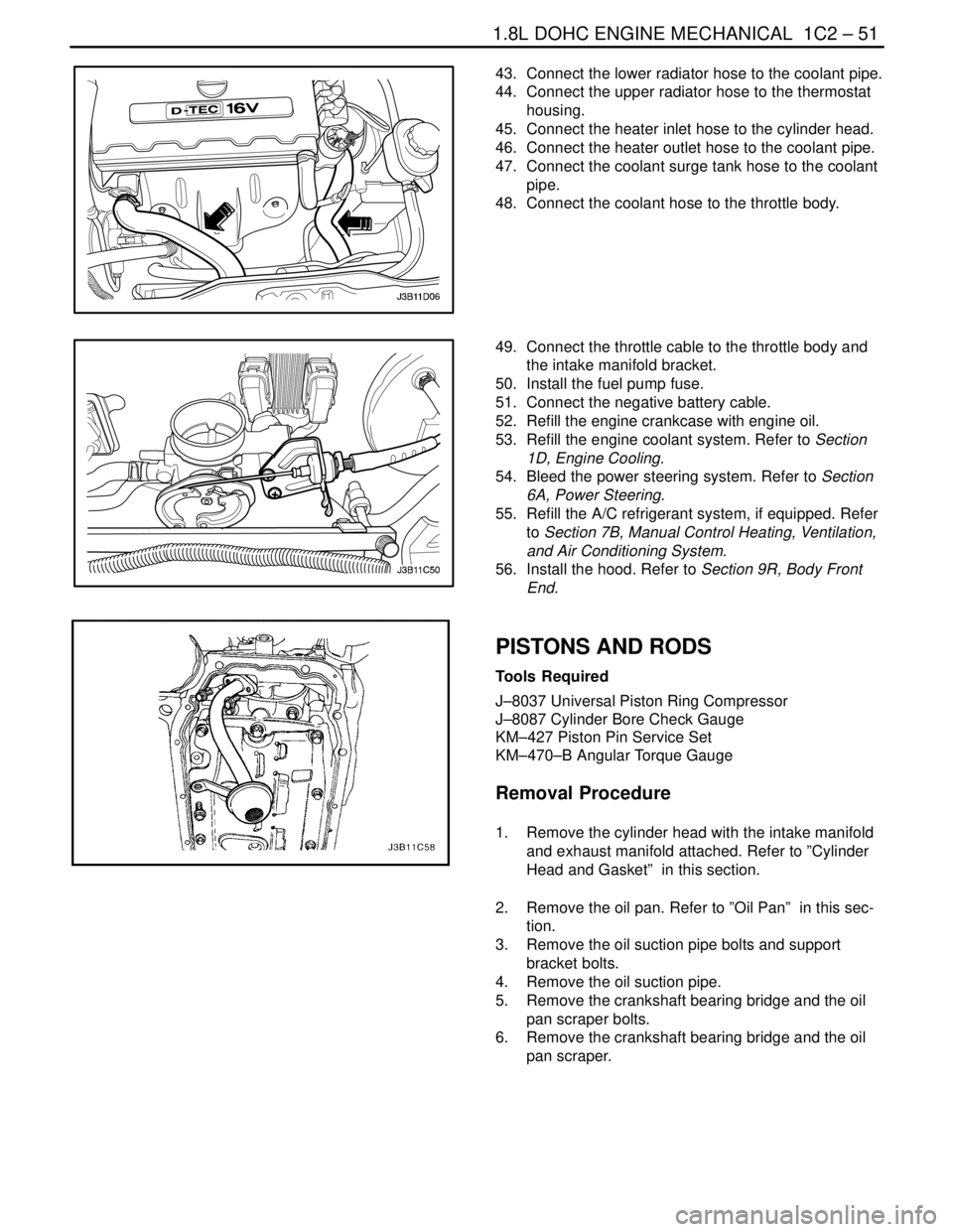
43. Connect the lower radiator hose to the coolant pipe.
44. Connect the upper radiator hose to the thermostat
housing.
45. Connect the heater inlet hose to the cylinder head.
46. Connect the heater outlet hose to the coolant pipe.
47. Connect the coolant surge tank hose to the coolant
pipe.
48. Connect the coolant hose to the throttle body.
49. Connect the throttle cable to the throttle body and
the intake manifold bracket.
50. Install the fuel pump fuse.
51. Connect the negative battery cable.
52. Refill the engine crankcase with engine oil.
53. Refill the engine coolant system. Refer to Section
1D, Engine Cooling.
54. Bleed the power steering system. Refer to Section
6A, Power Steering.
55. Refill the A/C refrigerant system, if equipped. Refer
to Section 7B, Manual Control Heating, Ventilation,
and Air Conditioning System.
56. Install the hood. Refer to Section 9R, Body Front
End.
PISTONS AND RODS
Tools Required
J–8037 Universal Piston Ring Compressor
J–8087 Cylinder Bore Check Gauge
KM–427 Piston Pin Service Set
KM–470–B Angular Torque Gauge
Removal Procedure
1. Remove the cylinder head with the intake manifold
and exhaust manifold attached. Refer to ”Cylinder
Head and Gasket” in this section.
2. Remove the oil pan. Refer to ”Oil Pan” in this sec-
tion.
3. Remove the oil suction pipe bolts and support
bracket bolts.
4. Remove the oil suction pipe.
5. Remove the crankshaft bearing bridge and the oil
pan scraper bolts.
6. Remove the crankshaft bearing bridge and the oil
pan scraper.
Page 172 of 2643
1C2 – 52I1.8L DOHC ENGINE MECHANICAL
DAEWOO V–121 BL4
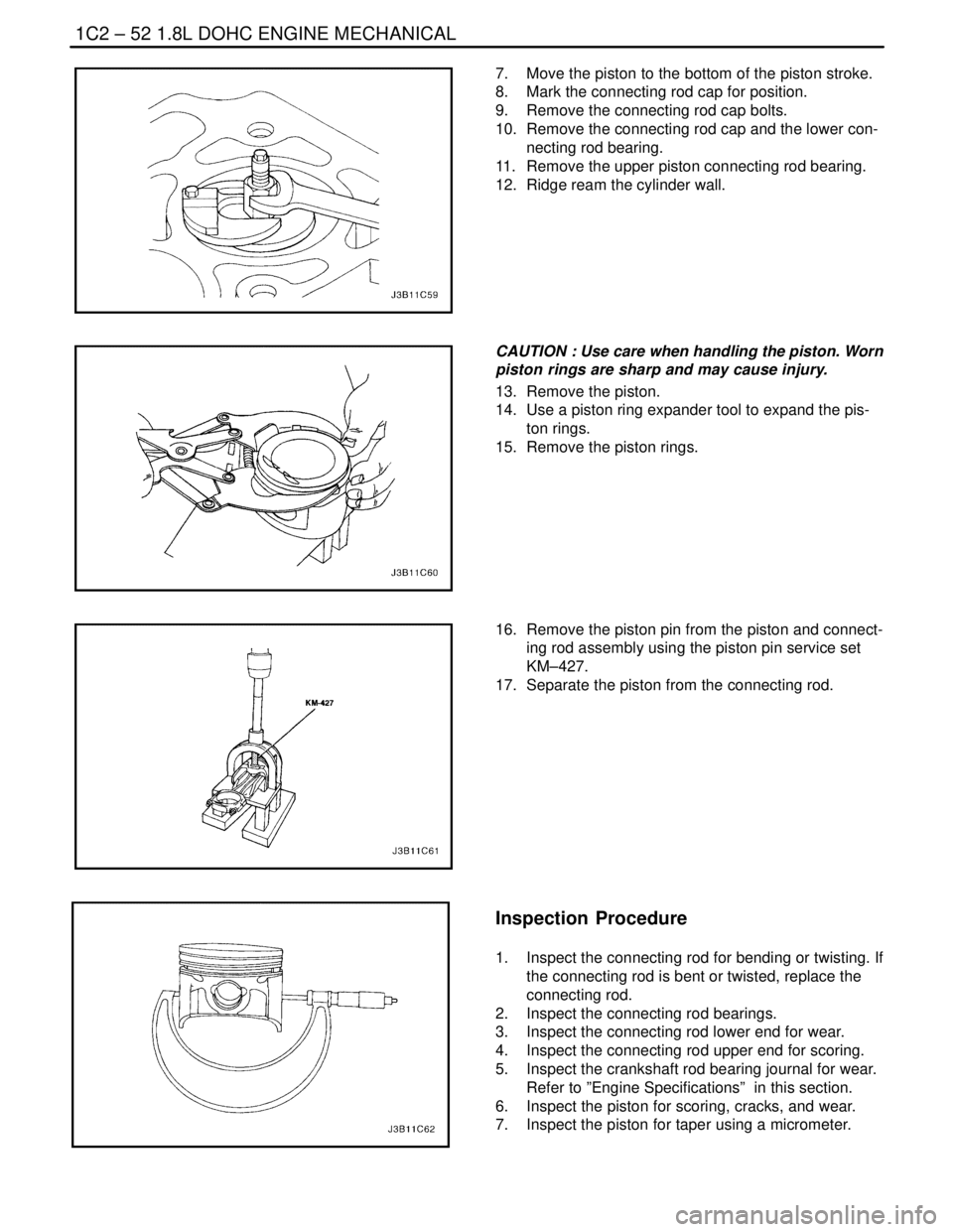
7. Move the piston to the bottom of the piston stroke.
8. Mark the connecting rod cap for position.
9. Remove the connecting rod cap bolts.
10. Remove the connecting rod cap and the lower con-
necting rod bearing.
11. Remove the upper piston connecting rod bearing.
12. Ridge ream the cylinder wall.
CAUTION : Use care when handling the piston. Worn
piston rings are sharp and may cause injury.
13. Remove the piston.
14. Use a piston ring expander tool to expand the pis-
ton rings.
15. Remove the piston rings.
16. Remove the piston pin from the piston and connect-
ing rod assembly using the piston pin service set
KM–427.
17. Separate the piston from the connecting rod.
Inspection Procedure
1. Inspect the connecting rod for bending or twisting. If
the connecting rod is bent or twisted, replace the
connecting rod.
2. Inspect the connecting rod bearings.
3. Inspect the connecting rod lower end for wear.
4. Inspect the connecting rod upper end for scoring.
5. Inspect the crankshaft rod bearing journal for wear.
Refer to ”Engine Specifications” in this section.
6. Inspect the piston for scoring, cracks, and wear.
7. Inspect the piston for taper using a micrometer.
Page 173 of 2643
1.8L DOHC ENGINE MECHANICAL 1C2 – 53
DAEWOO V–121 BL4
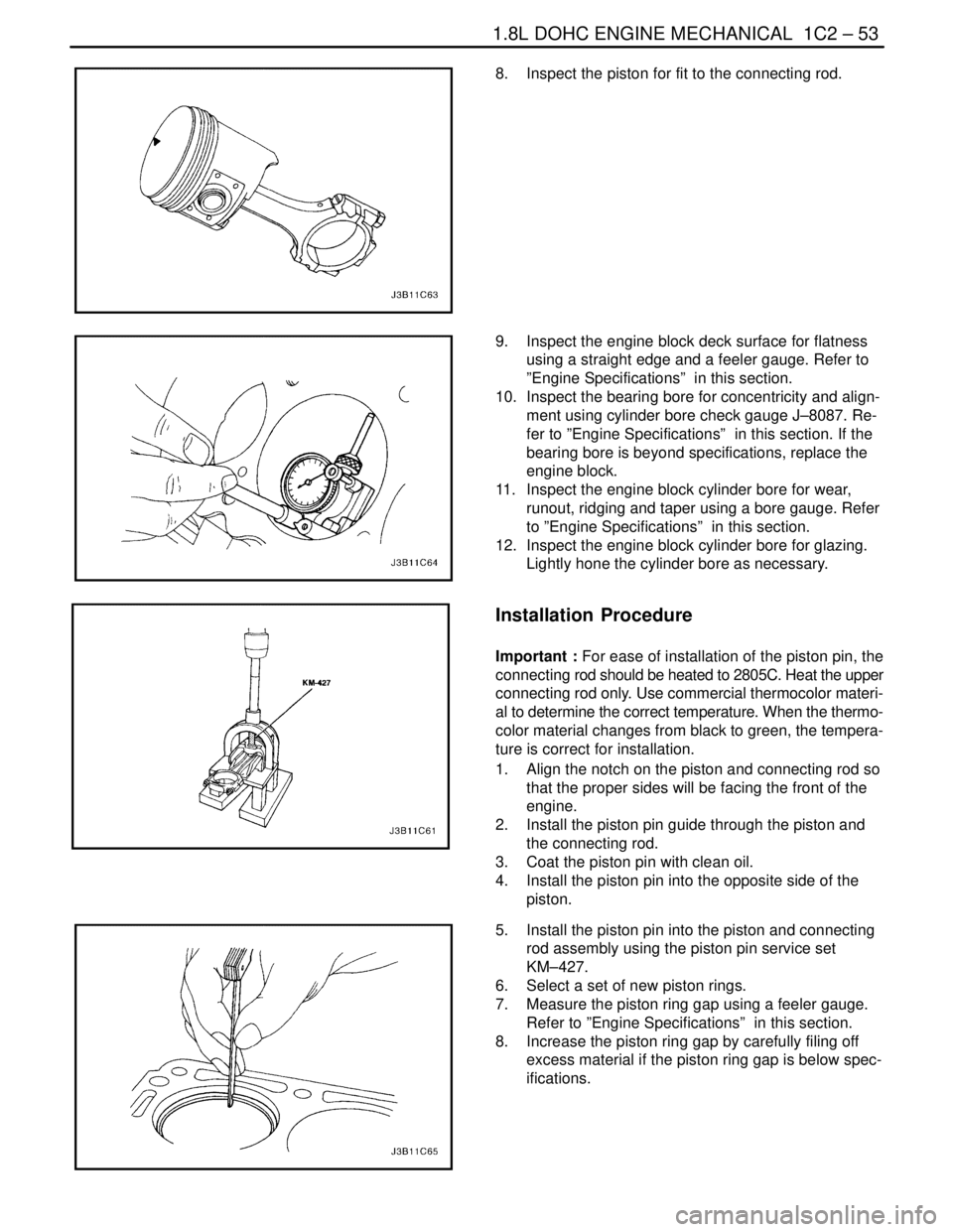
8. Inspect the piston for fit to the connecting rod.
9. Inspect the engine block deck surface for flatness
using a straight edge and a feeler gauge. Refer to
”Engine Specifications” in this section.
10. Inspect the bearing bore for concentricity and align-
ment using cylinder bore check gauge J–8087. Re-
fer to ”Engine Specifications” in this section. If the
bearing bore is beyond specifications, replace the
engine block.
11. Inspect the engine block cylinder bore for wear,
runout, ridging and taper using a bore gauge. Refer
to ”Engine Specifications” in this section.
12. Inspect the engine block cylinder bore for glazing.
Lightly hone the cylinder bore as necessary.
Installation Procedure
Important : For ease of installation of the piston pin, the
connecting rod should be heated to 2805C. Heat the upper
connecting rod only. Use commercial thermocolor materi-
al to determine the correct temperature. When the thermo-
color material changes from black to green, the tempera-
ture is correct for installation.
1. Align the notch on the piston and connecting rod so
that the proper sides will be facing the front of the
engine.
2. Install the piston pin guide through the piston and
the connecting rod.
3. Coat the piston pin with clean oil.
4. Install the piston pin into the opposite side of the
piston.
5. Install the piston pin into the piston and connecting
rod assembly using the piston pin service set
KM–427.
6. Select a set of new piston rings.
7. Measure the piston ring gap using a feeler gauge.
Refer to ”Engine Specifications” in this section.
8. Increase the piston ring gap by carefully filing off
excess material if the piston ring gap is below spec-
ifications.
Page 180 of 2643
1C2 – 60I1.8L DOHC ENGINE MECHANICAL
DAEWOO V–121 BL4
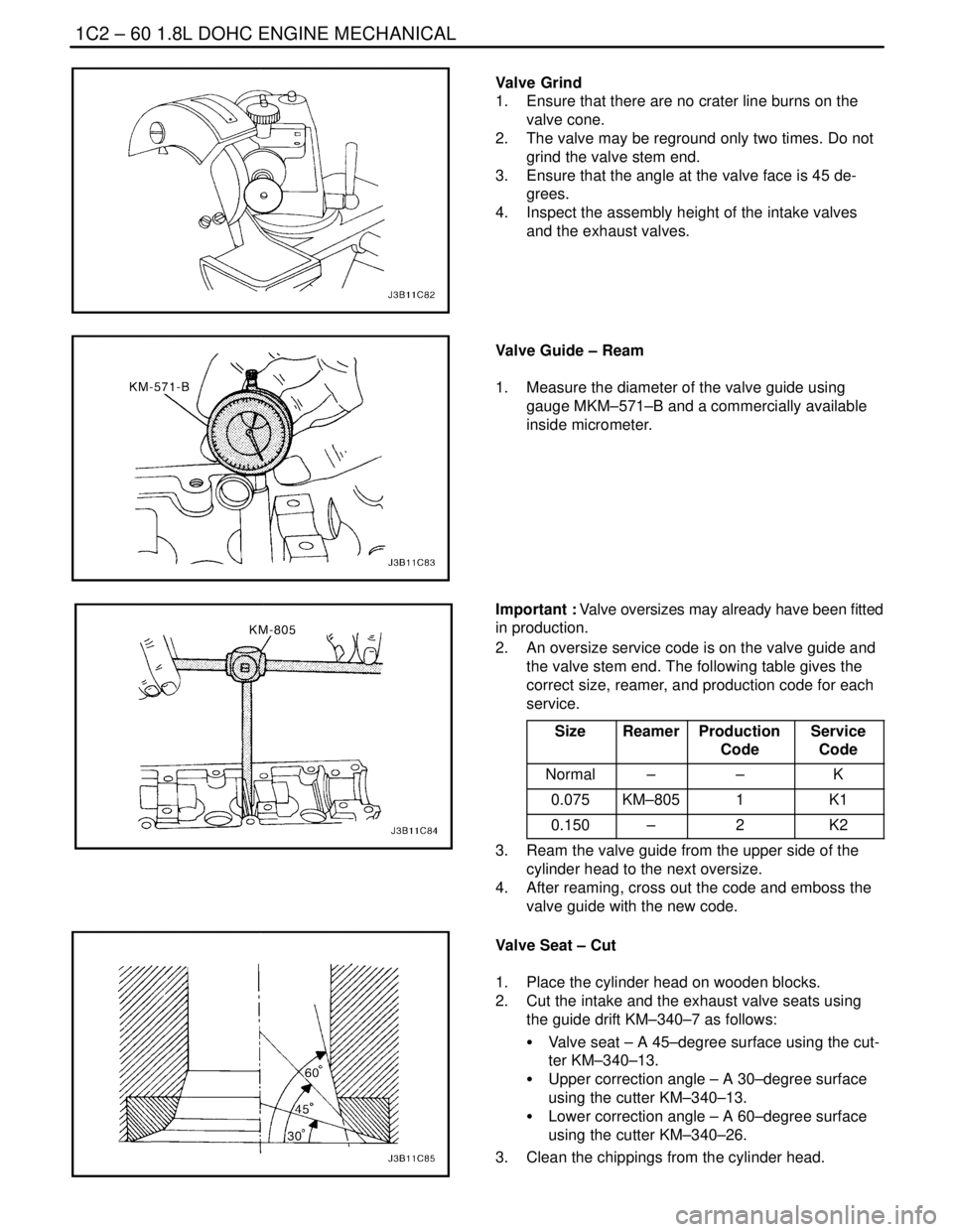
Valve Grind
1. Ensure that there are no crater line burns on the
valve cone.
2. The valve may be reground only two times. Do not
grind the valve stem end.
3. Ensure that the angle at the valve face is 45 de-
grees.
4. Inspect the assembly height of the intake valves
and the exhaust valves.
Valve Guide – Ream
1. Measure the diameter of the valve guide using
gauge MKM–571–B and a commercially available
inside micrometer.
Important : Valve oversizes may already have been fitted
in production.
2. An oversize service code is on the valve guide and
the valve stem end. The following table gives the
correct size, reamer, and production code for each
service.
Size
ReamerProduction
CodeService
Code
Normal––K
0.075KM–8051K1
0.150–2K2
3. Ream the valve guide from the upper side of the
cylinder head to the next oversize.
4. After reaming, cross out the code and emboss the
valve guide with the new code.
Valve Seat – Cut
1. Place the cylinder head on wooden blocks.
2. Cut the intake and the exhaust valve seats using
the guide drift KM–340–7 as follows:
S Valve seat – A 45–degree surface using the cut-
ter KM–340–13.
S Upper correction angle – A 30–degree surface
using the cutter KM–340–13.
S Lower correction angle – A 60–degree surface
using the cutter KM–340–26.
3. Clean the chippings from the cylinder head.
Page 196 of 2643

SECTION : 1D
ENGINE COOLING
CAUTION : Disconnect the negative battery cable before removing or installing any electrical unit or when a tool
or equipment could easily come in contact with exposed electrical terminals. Disconnecting this cable will help
prevent personal injury and damage to the vehicle. The ignition must also be in LOCK unless otherwise noted.
TABLE OF CONTENTS
SPECIFICATIONS1D–2 . . . . . . . . . . . . . . . . . . . . . . . . . .
Capacity 1D–2. . . . . . . . . . . . . . . . . . . . . . . . . . . . . . . . . .
Fastener Tightening Specifications 1D–2. . . . . . . . . . .
SPECIAL TOOLS1D–2 . . . . . . . . . . . . . . . . . . . . . . . . . . .
Special Tools Table 1D–2. . . . . . . . . . . . . . . . . . . . . . . .
DIAGNOSIS1D–3 . . . . . . . . . . . . . . . . . . . . . . . . . . . . . . . .
Thermostat Test 1D–3. . . . . . . . . . . . . . . . . . . . . . . . . . .
Surge Tank Cap Test 1D–3. . . . . . . . . . . . . . . . . . . . . . .
Cooling System Diagnosis 1D–4. . . . . . . . . . . . . . . . . .
COMPONENT LOCATOR1D–5 . . . . . . . . . . . . . . . . . . . .
Radiator/Fan 1D–5. . . . . . . . . . . . . . . . . . . . . . . . . . . . . .
Water Pump/Thermostat (1.4L/1.6L DOHC) 1D–6. . .
Water Pump/Thermostat (1.8L DOHC) 1D–7. . . . . . .
MAINTENANCE AND REPAIR1D–8 . . . . . . . . . . . . . . .
ON–VEHICLE SERVICE 1D–8. . . . . . . . . . . . . . . . . . . . . Draining and Refilling the Cooling System 1D–8. . . . .
Thermostat (1.4L/1.6L DOHC) 1D–9. . . . . . . . . . . . . . .
Thermostat (1.8L DOHC) 1D–10. . . . . . . . . . . . . . . . . .
Water Pump 1D–11. . . . . . . . . . . . . . . . . . . . . . . . . . . . .
Electric Cooling Fan – Main or Auxiliary 1D–13. . . . . .
Surge Tank 1D–14. . . . . . . . . . . . . . . . . . . . . . . . . . . . . .
Radiator 1D–16. . . . . . . . . . . . . . . . . . . . . . . . . . . . . . . . .
GENERAL DESCRIPTION AND SYSTEM
OPERATION1D–18 . . . . . . . . . . . . . . . . . . . . . . . . . . . . .
General Description 1D–18. . . . . . . . . . . . . . . . . . . . . . .
Radiator 1D–18. . . . . . . . . . . . . . . . . . . . . . . . . . . . . . . . .
Surge Tank 1D–18. . . . . . . . . . . . . . . . . . . . . . . . . . . . . .
Water Pump 1D–18. . . . . . . . . . . . . . . . . . . . . . . . . . . . .
Thermostat 1D–18. . . . . . . . . . . . . . . . . . . . . . . . . . . . . .
Electric Cooling Fan 1D–19. . . . . . . . . . . . . . . . . . . . . . .
Engine Block Heater 1D–19. . . . . . . . . . . . . . . . . . . . . .
Page 203 of 2643
1D – 8IENGINE COOLING
DAEWOO V–121 BL4
MAINTENANCE AND REPAIR
ON–VEHICLE SERVICE
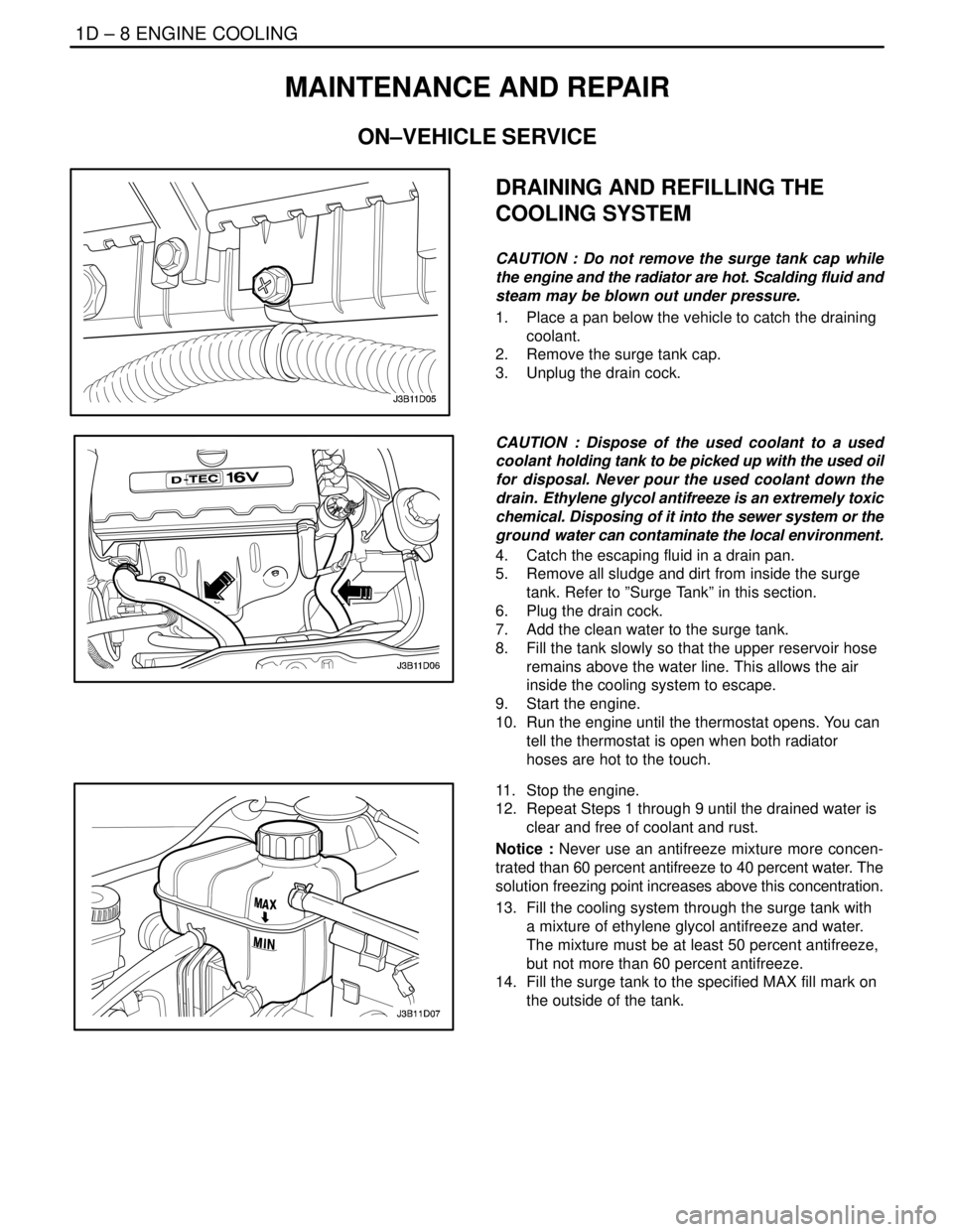
DRAINING AND REFILLING THE
COOLING SYSTEM
CAUTION : Do not remove the surge tank cap while
the engine and the radiator are hot. Scalding fluid and
steam may be blown out under pressure.
1. Place a pan below the vehicle to catch the draining
coolant.
2. Remove the surge tank cap.
3. Unplug the drain cock.
CAUTION : Dispose of the used coolant to a used
coolant holding tank to be picked up with the used oil
for disposal. Never pour the used coolant down the
drain. Ethylene glycol antifreeze is an extremely toxic
chemical. Disposing of it into the sewer system or the
ground water can contaminate the local environment.
4. Catch the escaping fluid in a drain pan.
5. Remove all sludge and dirt from inside the surge
tank. Refer to ”Surge Tank” in this section.
6. Plug the drain cock.
7. Add the clean water to the surge tank.
8. Fill the tank slowly so that the upper reservoir hose
remains above the water line. This allows the air
inside the cooling system to escape.
9. Start the engine.
10. Run the engine until the thermostat opens. You can
tell the thermostat is open when both radiator
hoses are hot to the touch.
11. Stop the engine.
12. Repeat Steps 1 through 9 until the drained water is
clear and free of coolant and rust.
Notice : Never use an antifreeze mixture more concen-
trated than 60 percent antifreeze to 40 percent water. The
solution freezing point increases above this concentration.
13. Fill the cooling system through the surge tank with
a mixture of ethylene glycol antifreeze and water.
The mixture must be at least 50 percent antifreeze,
but not more than 60 percent antifreeze.
14. Fill the surge tank to the specified MAX fill mark on
the outside of the tank.
Page 213 of 2643

1D – 18IENGINE COOLING
DAEWOO V–121 BL4
GENERAL DESCRIPTION
AND SYSTEM OPERATION
GENERAL DESCRIPTION
The cooling system maintains the engine temperature at
an efficient level during all engine operating conditions.
When the engine is cold, the cooling system cools the en-
gine slowly or not at all. This slow cooling of the engine al-
lows the engine to warm up quickly.
The cooling system includes a radiator and recovery sub-
system, cooling fans, a thermostat and housing, a coolant
pump, and a coolant pump drive belt. The timing belt
drives the coolant pump.
All components must function properly in order for the
cooling system to operate. The coolant pump draws the
coolant from the radiator. The coolant then circulates
through water jackets in the engine block, the intake man-
ifold, and the cylinder head. When the coolant reaches the
operating temperature of the thermostat, the thermostat
opens. The coolant then goes back to the radiator where
it cools.
This system directs some coolant through the hoses to the
heater core. This provides for heating and defrosting. The
surge tank is connected to the radiator to recover the cool-
ant displaced by expansion from the high temperatures.
The surge tank maintains the correct coolant level.
The cooling system for this vehicle has no radiator cap or
filler neck. The coolant is added to the cooling system
through the surge tank.
RADIATOR
This vehicle has a lightweight tube–and–fin aluminum ra-
diator. Plastic tanks are mounted on the right and the left
sides of the radiator core.
On vehicles equipped with automatic transaxles, the
transaxle fluid cooler lines run through the left radiator
tank. A radiator drain cock is on this radiator.
To drain the cooling system, open the drain cock.
SURGE TANK
The surge tank is a transparent plastic reservoir, similar to
the windshield washer reservoir.
The surge tank is connected to the radiator by a hose and
to the engine cooling system by another hose. As the ve-
hicle is driven, the engine coolant heats and expands. The
portion of the engine coolant displaced by this expansion
flows from the radiator and the engine into the surge tank.
The air trapped in the radiator and the engine is degassed
into the surge tank.When the engine stops, the engine coolant cools and con-
tracts. The displaced engine coolant is then drawn back
into the radiator and the engine. This keeps the radiator
filled with the coolant to the desired level at all times and
increases the cooling efficiency.
Maintain the coolant level between the MIN and the MAX
marks on the surge tank when the system is cold.
WATER PUMP
The belt–driven centrifugal water pump consists of an im-
peller, a drive shaft, and a belt pulley. The water pump is
mounted on the front of the transverse–mounted engine,
and is driven by the timing belt.
The impeller is supported by a completely sealed bearing.
The water pump is serviced as an assembly and, there-
fore, cannot be disassembled.
THERMOSTAT
A wax pellet–type thermostat controls the flow of the en-
gine coolant through the engine cooling system. The ther-
mostat is mounted in the thermostat housing to the front
of the cylinder head.
The thermostat stops the flow of the engine coolant from
the engine to the radiator in order to provide faster warm–
up, and to regulate the coolant temperature. The thermo-
stat remains closed while the engine coolant is cold, pre-
venting circulation of the engine coolant through the
radiator. At this point, the engine coolant is allowed to cir-
culate only throughout the heater core to warm it quickly
and evenly.
As the engine warms, the thermostat opens. This allows
the engine coolant to flow through the radiator, where the
heat is dissipated through the radiator. This opening and
closing of the thermostat permits enough engine coolant
to enter the radiator to keep the engine within proper en-
gine temperature operating limits.
The wax pellet in the thermostat is hermetically sealed in
a metal case. The wax element of the thermostat expands
when it is heated and contracts when it is cooled.
As the vehicle is driven and the engine warms, the engine
coolant temperature increases. When the engine coolant
reaches a specified temperature, the wax pellet element
in the thermostat expands and exerts pressure against the
metal case, forcing the valve open. This allows the engine
coolant to flow through the engine cooling system and cool
the engine.
As the wax pellet cools, the contraction allows a spring to
close the valve.
The thermostat begins to open at 87°C (189°F) and is fully
open at 102°C (216°F). The thermostat closes at 86°C
(187°F).
Page 215 of 2643

SECTION : 1E
ENGINE ELECTRICAL
CAUTION : Disconnect the negative battery cable before removing or installing any electrical unit or when a tool
or equipment could easily come in contact with exposed electrical terminals. Disconnecting this cable will help
prevent personal injury and damage to the vehicle. The ignition must also be in LOCK unless otherwise noted.
TABLE OF CONTENTS
SPECIFICATIONS1E–2 . . . . . . . . . . . . . . . . . . . . . . . . . .
Starter Specifications 1E–2. . . . . . . . . . . . . . . . . . . . . .
Battery Specifications 1E–2. . . . . . . . . . . . . . . . . . . . . .
Fastener Tightening Specifications 1E–3. . . . . . . . . .
SCHEMATIC AND ROUTING DIAGRAMS1E–4 . . . . .
Startimg System 1E–4. . . . . . . . . . . . . . . . . . . . . . . . . .
Charging System 1E–5. . . . . . . . . . . . . . . . . . . . . . . . . .
DIAGNOSIS1E–6 . . . . . . . . . . . . . . . . . . . . . . . . . . . . . . . .
No Crank 1E–6. . . . . . . . . . . . . . . . . . . . . . . . . . . . . . . .
Starter Motor Noise 1E–9. . . . . . . . . . . . . . . . . . . . . . .
Battery Load Test 1E–9. . . . . . . . . . . . . . . . . . . . . . . . .
Genrator Output Test 1E–10. . . . . . . . . . . . . . . . . . . . .
Generator System Check 1E–10. . . . . . . . . . . . . . . . .
MAINTENANCE AND REPAIR1E–11 . . . . . . . . . . . . . .
ON–VEHICLE SERVICE 1E–11. . . . . . . . . . . . . . . . . . . .
Generator 1E–11. . . . . . . . . . . . . . . . . . . . . . . . . . . . . . .
Starter 1E–14. . . . . . . . . . . . . . . . . . . . . . . . . . . . . . . . . .
Battery and Battery Tray 1E–15. . . . . . . . . . . . . . . . . . . UNIT REPAIR 1E–17. . . . . . . . . . . . . . . . . . . . . . . . . . . . .
Starter Motor 1E–17. . . . . . . . . . . . . . . . . . . . . . . . . . . . .
Generator 1E–25. . . . . . . . . . . . . . . . . . . . . . . . . . . . . . .
GENERAL DESCRIPTION AND SYSTEM
OPERATION1E–30 . . . . . . . . . . . . . . . . . . . . . . . . . . . . .
Battery 1E–30. . . . . . . . . . . . . . . . . . . . . . . . . . . . . . . . . .
Ratings 1E–30. . . . . . . . . . . . . . . . . . . . . . . . . . . . . . . . . .
Reserve Capacity 1E–30. . . . . . . . . . . . . . . . . . . . . . . . .
Cold Cranking Amperage 1E–30. . . . . . . . . . . . . . . . . .
Built–In Hydrometer 1E–30. . . . . . . . . . . . . . . . . . . . . . .
Charging Procedure 1E–30. . . . . . . . . . . . . . . . . . . . . . .
Charging Time Required 1E–31. . . . . . . . . . . . . . . . . . .
Charging a Completely Discharged Battery
(OFF the Vehicle) 1E–31. . . . . . . . . . . . . . . . . . . . . . .
Jump Starting Procedure 1E–31. . . . . . . . . . . . . . . . . .
Generator 1E–32. . . . . . . . . . . . . . . . . . . . . . . . . . . . . . .
Charging System 1E–32. . . . . . . . . . . . . . . . . . . . . . . . .
Starter 1E–32. . . . . . . . . . . . . . . . . . . . . . . . . . . . . . . . . .
Starting System 1E–32. . . . . . . . . . . . . . . . . . . . . . . . . .