2004 DAEWOO LACETTI transaxle oil
[x] Cancel search: transaxle oilPage 1811 of 2643
AISIN AUTOMATIC TRANSAXLE 5A2 – 221
DAEWOO V–121 BL4
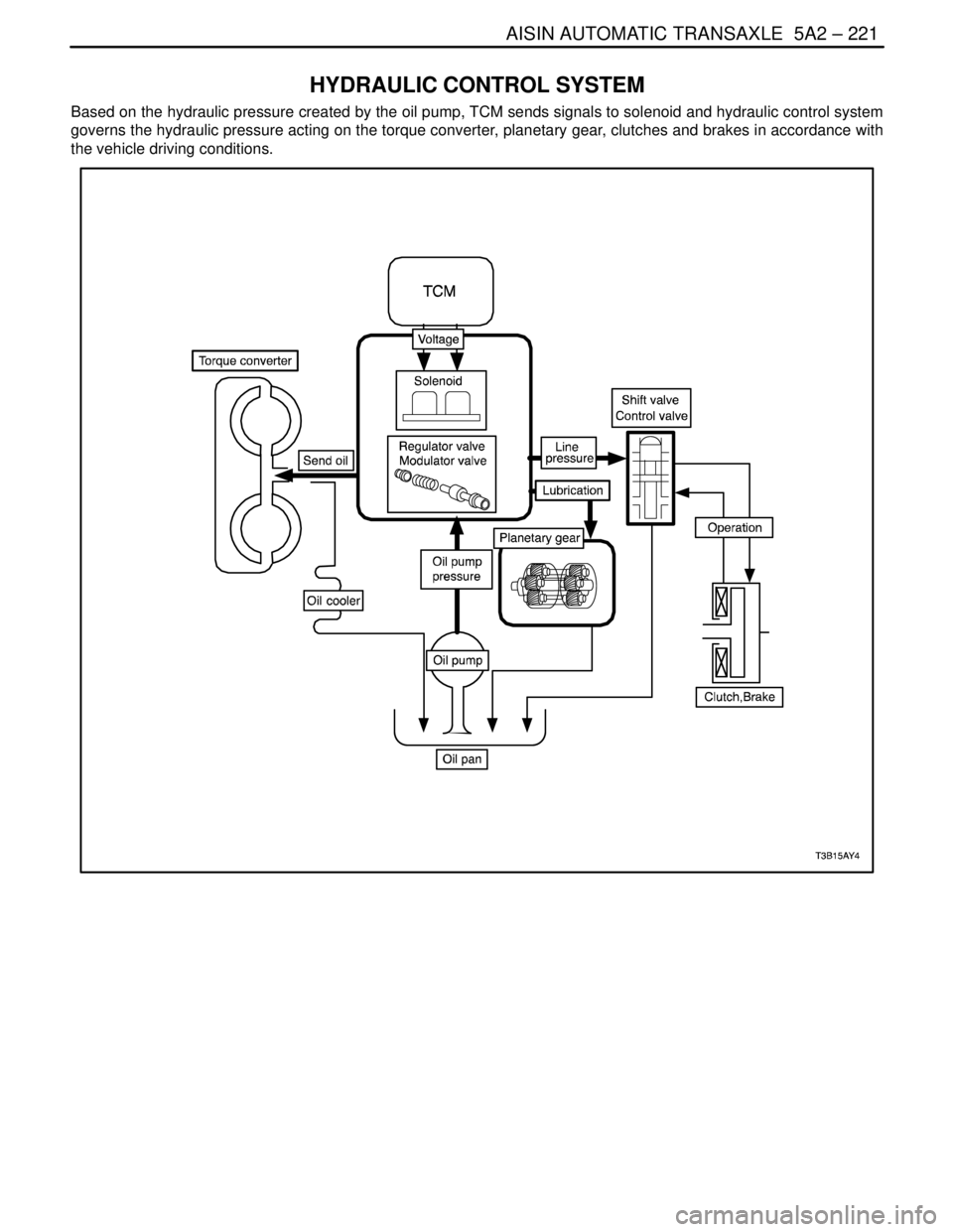
HYDRAULIC CONTROL SYSTEM
Based on the hydraulic pressure created by the oil pump, TCM sends signals to solenoid and hydraulic control system
governs the hydraulic pressure acting on the torque converter, planetary gear, clutches and brakes in accordance with
the vehicle driving conditions.
Page 1829 of 2643

FIVE–SPEED MANUAL TRANSAXLE 5B – 5
DAEWOO V–121 BL4
DIAGNOSIS
ISOLATE NOISE
Identify the cause of any noise before attempting to repair
the clutch, the transaxle, or their related link–ages.
Symptoms of trouble with the clutch or the manual trans-
axle include:
S A great effort required to shift gears.
S The sound of gears clashing and grinding.
S Gear blockout.
Any of these conditions requires a careful analysis. Make
the following checks before disassembling the clutch or
the transaxle for repairs.
Road Travel Noise
Many noises that appear to come from the transaxle may
actually originate with other sources such as the:
S Tires.
S Road surfaces.
S Wheel bearings.
S Engine.
S Exhaust system.
These noises may vary according to the:
S Size of the vehicle.
S Type of the vehicle.
S Amount of insulation used in the body of the ve-
hicle.
Transaxle Noise
Transaxle gears, like any mechanical device, are not ab-
solutely quiet and will make some noise during normal op-
eration.
To verify suspected transaxle noises:
1. Select a smooth, level asphalt road to reduce tire
and resonant body noise.
2. Drive the vehicle far enough to warm up all the lu-
bricants thoroughly.
3. Record the speed and the gear range of the trans-
axle when the noise occurs.
4. Check for noises with the vehicle stopped, but with
the engine running.
5. Determine if the noise occurs while the vehicle op-
erates in:
S Drive – under a light acceleration or a heavy
pull.
S Float – maintaining a constant speed with a light
throttle on a level road.
S Coast – with the transaxle in gear and the
throttle partly or fully closed.
S All of the above.
Bearing Noise
Differential Side Bearing Noise
Differential side bearing noise and wheel bearing noise
can be confused easily. Since side bearings are pre–
loaded, a differential side bearing noise should not dimin-
ish much when the differential/transaxle is run with the
wheels off the ground.
Wheel Bearing Noise
Wheel bearings produce a rough growl or grating sound
that will continue when the vehicle is coasting and the
transaxle is in NEUTRAL. Since wheel bearings are not
pre–loaded, a wheel bearing noise should diminish con-
siderably when the wheels are off the ground.
Other Noise
Brinelling
A brinelled bearing causes a ”knock” or ”click” approxi-
mately every second revolution of the wheel because the
bearing rollers do not travel at the same speed as the
wheel. In operation, the effect is characterized by a low–
pitched noise.
A brinelled bearing is caused by excessive thrust which
pushes the balls up on the pathway and creates a triangu-
lar–shaped spot in the bearing race. A brinelled bearing
can also be caused from pressing one race into position
by applying pressure on the other race.
A false indication of a brinelled bearing occurs as a result
of vibration near the area where the bearing is mounted.
Brinelling is identified by slight indentations, resulting in a
washboard effect in the bearing race.
Lapping
Lapped bearing noise occurs when fine particles of abra-
sive materials such as scale, sand, or emery circulate
through the oil in the vehicle, causing the surfaces of the
roller and the race to wear away. Bearings that wear loose
but remain smooth, without spalling or pitting, are the re-
sult of dirty oil.
Locking
Large particles of foreign material wedged between the
roller and the race usually causes one of the races to turn,
creating noise from a locked bearing. Pre–loading regular
taper roller bearings to a value higher than that specified
also can result in locked bearings
Pitting
Pitting on the rolling surface comes from normal wear and
the introduction of foreign materials.
Spalling
Spalled bearings have flaked or pitted rollers or races
caused by an overload or an incorrect assembly that re-
sults in a misalignment, a cocking of bearings, or adjust-
ments that are too tight.
After completing these checks, refer to the ”Diagnosis
Chart” in this section.
Page 1839 of 2643
FIVE–SPEED MANUAL TRANSAXLE 5B – 15
DAEWOO V–121 BL4
MAINTENANCE AND REPAIR
ON–VEHICLE SERVICE
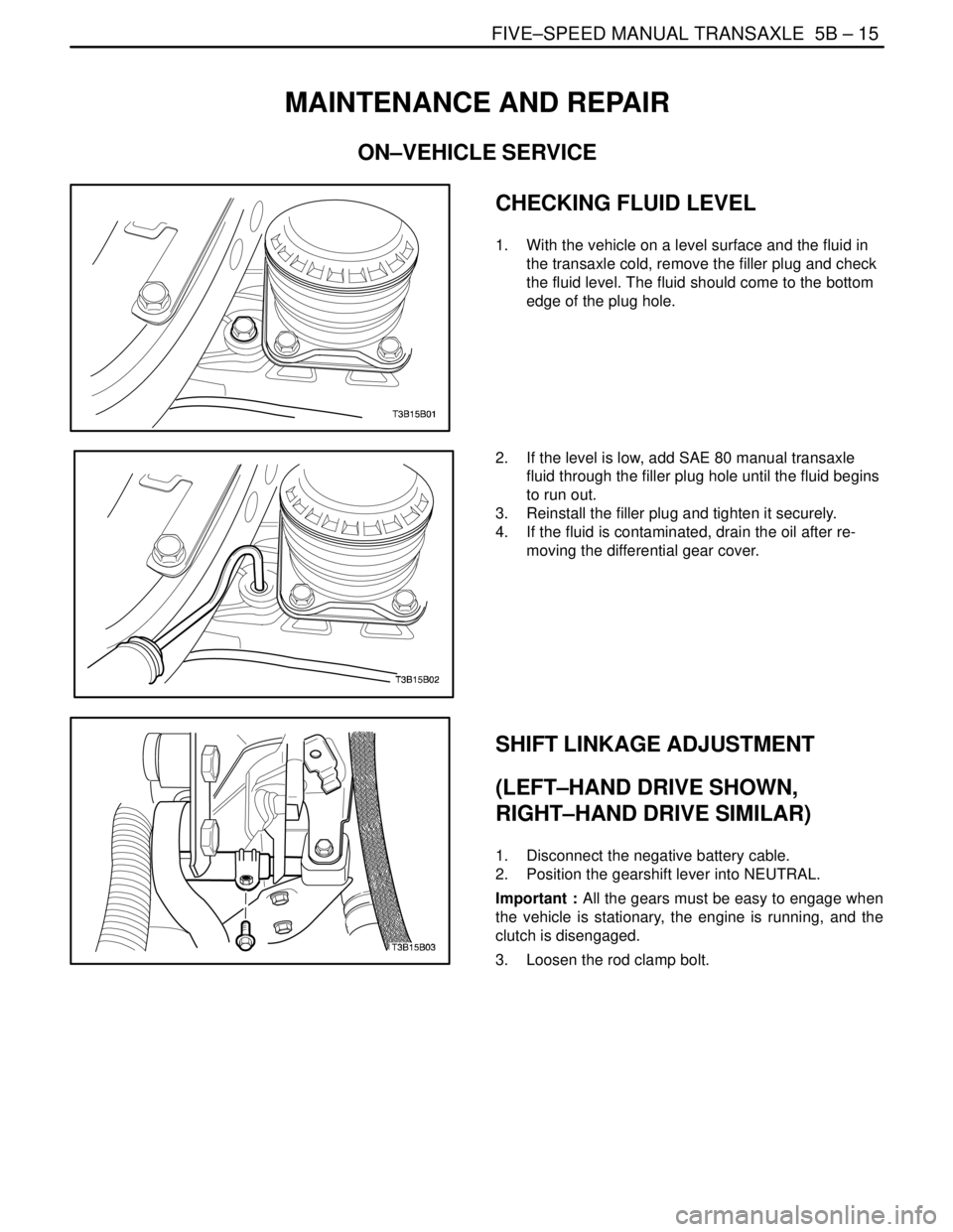
CHECKING FLUID LEVEL
1. With the vehicle on a level surface and the fluid in
the transaxle cold, remove the filler plug and check
the fluid level. The fluid should come to the bottom
edge of the plug hole.
2. If the level is low, add SAE 80 manual transaxle
fluid through the filler plug hole until the fluid begins
to run out.
3. Reinstall the filler plug and tighten it securely.
4. If the fluid is contaminated, drain the oil after re-
moving the differential gear cover.
SHIFT LINKAGE ADJUSTMENT
(LEFT–HAND DRIVE SHOWN,
RIGHT–HAND DRIVE SIMILAR)
1. Disconnect the negative battery cable.
2. Position the gearshift lever into NEUTRAL.
Important : All the gears must be easy to engage when
the vehicle is stationary, the engine is running, and the
clutch is disengaged.
3. Loosen the rod clamp bolt.
Page 1899 of 2643

5C – 12ICLUTCH
DAEWOO V–121 BL4
5. Install the push rod fixing pin and push rod.
6. Install the locking clip.
7. Bleed the air. Refer to ”Air Bleeding” in this section.
8. Adjust the clutch pedal. Refer to ”Clutch Pedal Ad-
justment” in this section.
9. Fill the reservoir with clutch/brake fluid up to the
proper level.
CONCENTRIC SLAVE CYLINDER
Removal Procedure
1. Remove the transaxle from the vehicle. Refer to
Section 5B, Five–Speed Manual Transaxle.
2. Remove the concentric slave cylinder retaining
bolts.
3. Disconnect the concentric slave cylinder pipe from
the concentric slave cylinder.
Notice : When removing the bushing, Make sure not to re-
move it with excessive force.
4. Remove the bushing from the concentric slave cyl-
inder pipe in the transaxle housing.
5. Remove the concentric slave cylinder pipe.
Notice : For removal or installation, Make sure not to sep-
arate oil seal fixing spring from the back side of the con-
centric slave cylinder.
6. Remove the O–ring and the concentric slave cylin-
der.
Page 2301 of 2643

9E – 2IINSTRUMENTATION/DRIVER INFORMATION
DAEWOO V–121 BL4
SPECIFICATIONS
FASTENER TIGHTENING SPECIFICATIONS
ApplicationNSmLb–FtLb–In
Air Deflector Screws2–18
Chime Module Screws4–35
Clock Screws2–18
Cupholder Screws2.5–22
Deposit Box Screws2.5–22
Driver Knee Bolster Bolts10–89
Floor Console Brace Bolts4–35
Floor Console Brace Nuts4–35
HVAC Controls Screws4–35
Instrument Cluster Screws4–35
Instrument Cluster Trim Panel Screws4–35
Instrument Panel End Bolts2015–
Instrument Panel End Screws4–35
Instrument Panel Nuts Above the Steering Column2015–
Instrument Panel Bolts Behind the HVAC Controls4–35
Steering Column Bracket Nut2216–
Steering Column Lower Trim Cover Screws2.5–22
Steering Column U–Clamp Nuts2216–
Steering Column Upper Trim Cover Screws3–27
INSTRUMENT CLUSTER INDICATOR LAMPS
SPECIFICATIONS
Indicator LampColorBulb
ABS WarningAmber14 v 1.4 W
Airbag WarningRed14 v 1.4 W
Battery Charge IndicatorRed14 v 1.4 W
Check EngineAmber14 v 1.4 W
Door Open WarningRed14 v 1.4 W
Engine OverheatRed14 v 1.4 W
Fasten Seat Belt WarningRed14 v 1.4 W
High Beam IndicatorBlue14 v 1.4 W
Low Fuel Level WarningAmber14 v 4 W
Oil Pressure WarningRed14 v 1.4 W
Parking Brake Indicator and Brake Fluid WarningRed14 v 1.4 W
Service Engine Soon WarningAmber14 v 1.4 W
Transaxle Power Mode IndicatorAmber14 v 1.4 W
Turn Signal IndicatorsGreen14 v 1.4 W
Page 2378 of 2643

9K – 2ISQUEAKS AND RATTLES
DAEWOO V–121 BL4
Glass Knock Coming From the Rear of the Vehicle When Driving
Over Bumps
ChecksAction
Check for an out–of–adjustment hatchback latch.S Test drive the vehicle in order to verify this condition.
S Loosen the latch nuts and adjust the latch downward.
Rattle Coming From Door
Checks Action
Check the door lock solenoid.S Remove the door trim panel and check if the sole-
noid is loose.
S Tighten the solenoid bolts.
Check for rattling electrical connectors inside the door trim
panel.S Tap on the trim panel and listen for a rattle.
S Remove the trim panel and wrap foam padding
around the connectors as required.
Squeak When Operating Doors
ChecksAction
Check for a lack of lubrication of the door hinge pins.S Operate the doors and listen for squeaks.
S Lubricate the door hinge pins with light oil and coat
with lithium grease.
Squeak Coming From Console When Shifting Manual Transaxle
(Condition Occurs In Cold Weather with a Cold Engine)
Checks Action
Check the manual transaxle control lever lower boot.S Move the control lever between gears and listen for
squeaks.
S Remove the floor console and replace the lower shift
boot or apply talcum powder to the lower shift boot.
Buzz From the Left Side of Instrument Panel
ChecksAction
Check for vibration of the fuse box cover against the instru-
ment panel side trim.S Tap on the cover with a finger and listen for a buzz.
S Apply 6.35 mm (0.250 inch) by 25.4 mm (1.00 inch)
felt pads to the side trim where the cover makes con-
tact.
Squeak Coming From Instrument Cluster Trim Plate
Checks Action
Check for rubbing of the cluster trim plate on the instru-
ment panel.S Test drive the vehicle in order to verify this condition.
S Remove the instrument cluster trim plate and install
felt tape to the edges.