2004 DAEWOO LACETTI run flat
[x] Cancel search: run flatPage 915 of 2643
2B – 8IWHEEL ALIGNMENT
DAEWOO V–121 BL4
PRELIMINARY INSPECTION
ChecksAction
Check the tires for proper inflation pressures and normal
tread wear.Inflate the tires to the proper tire pressure. Replace the
tires as needed.
Check the wheel bearings for looseness.Tighten the axle nut to the proper specification. Replace
the strut wheel bearing as needed.
Check for loose ball joints and tie rod ends.Tighten the ball joints and the tie rods.
Check the runout of the wheels and the tires.Measure and correct the tire runout.
Check the vehicle trim heights.Correct the trim heights. Make the correction before ad-
justing the toe.
Check for loose rack and pinion mounting.Tighten the mounting brackets for the rack and pinion as-
sembly.
Check for improperly operating struts.Replace the strut assembly.
Check for loose control arms.Tighten the control arm attachment bolts. Replace the con-
trol arm bushings as needed.
FRONT TOE ADJUSTMENT
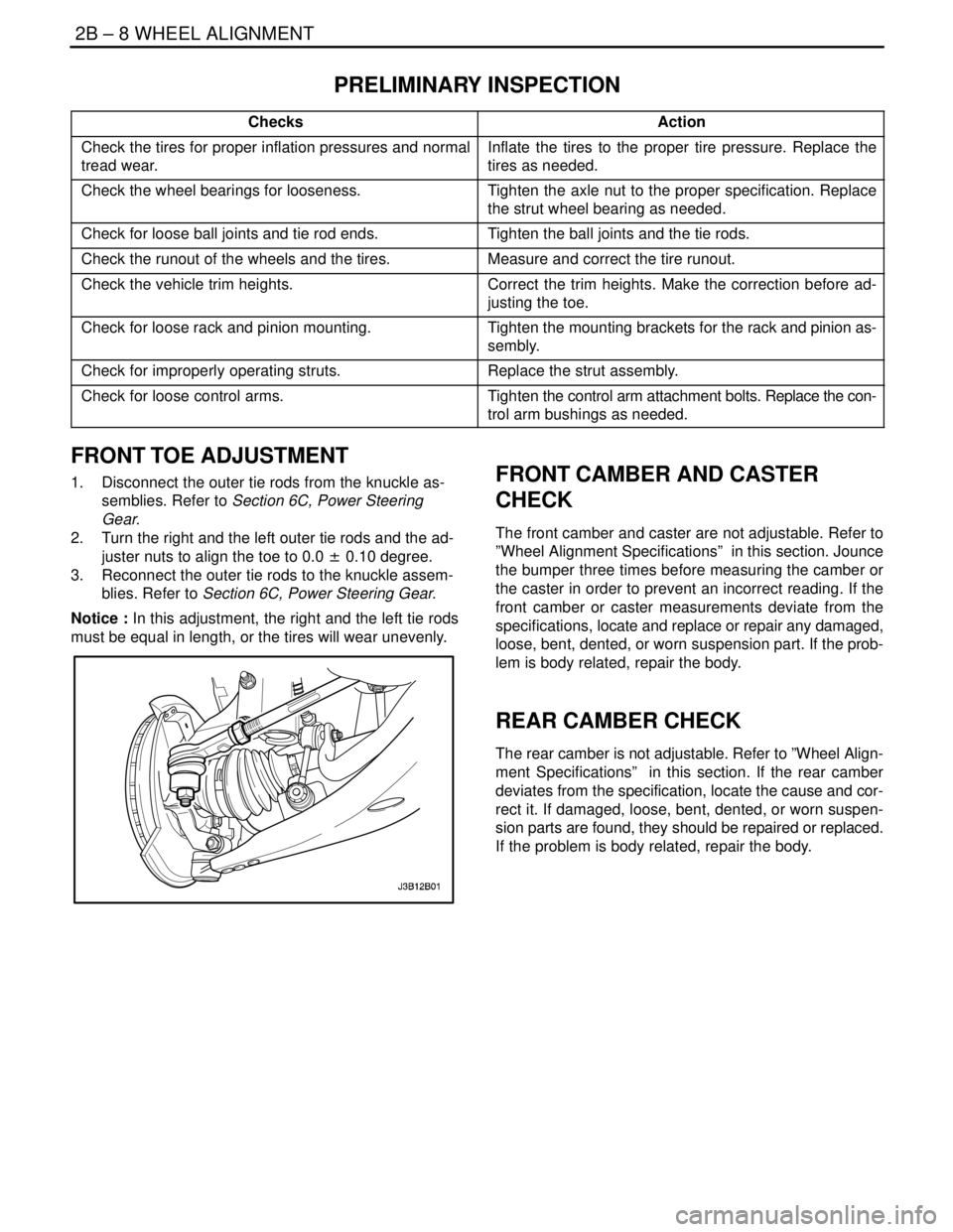
1. Disconnect the outer tie rods from the knuckle as-
semblies. Refer to Section 6C, Power Steering
Gear.
2. Turn the right and the left outer tie rods and the ad-
juster nuts to align the toe to 0.0 ± 0.10 degree.
3. Reconnect the outer tie rods to the knuckle assem-
blies. Refer to Section 6C, Power Steering Gear.
Notice : In this adjustment, the right and the left tie rods
must be equal in length, or the tires will wear unevenly.FRONT CAMBER AND CASTER
CHECK
The front camber and caster are not adjustable. Refer to
”Wheel Alignment Specifications” in this section. Jounce
the bumper three times before measuring the camber or
the caster in order to prevent an incorrect reading. If the
front camber or caster measurements deviate from the
specifications, locate and replace or repair any damaged,
loose, bent, dented, or worn suspension part. If the prob-
lem is body related, repair the body.
REAR CAMBER CHECK
The rear camber is not adjustable. Refer to ”Wheel Align-
ment Specifications” in this section. If the rear camber
deviates from the specification, locate the cause and cor-
rect it. If damaged, loose, bent, dented, or worn suspen-
sion parts are found, they should be repaired or replaced.
If the problem is body related, repair the body.
Page 963 of 2643

SECTION : 2E
TIRES AND WHEELS
TABLE OF CONTENTS
SPECIFICATIONS2E–1 . . . . . . . . . . . . . . . . . . . . . . . . . .
Tire Size and Pressure Specifications 2E–1. . . . . . . .
Inflation Pressure Conversion Specifications 2E–2. .
Fastener Tightening Specifications 2E–2. . . . . . . . . . .
DIAGNOSIS2E–2 . . . . . . . . . . . . . . . . . . . . . . . . . . . . . . . .
Wheel Runout 2E–2. . . . . . . . . . . . . . . . . . . . . . . . . . . . .
MAINTENANCE AND REPAIR2E–3 . . . . . . . . . . . . . . .
ON–VEHICLE SERVICE 2E–3. . . . . . . . . . . . . . . . . . . . .
Wheel 2E–3. . . . . . . . . . . . . . . . . . . . . . . . . . . . . . . . . . . .
On–Vehicle Balancing 2E–4. . . . . . . . . . . . . . . . . . . . . .
UNIT REPAIR 2E–5. . . . . . . . . . . . . . . . . . . . . . . . . . . . . .
Alloy Wheel Porosity 2E–5. . . . . . . . . . . . . . . . . . . . . . .
Alloy Wheel Refinishing 2E–5. . . . . . . . . . . . . . . . . . . . .
Off–Vehicle Balancing 2E–7. . . . . . . . . . . . . . . . . . . . . . Correcting Non–Uniform Tires 2E–7. . . . . . . . . . . . . . .
Tire and Wheel Match–Mounting 2E–8. . . . . . . . . . . . .
Tire Mounting and Dismounting 2E–8. . . . . . . . . . . . . .
GENERAL DESCRIPTION AND SYSTEM
OPERATION 2E–9 . . . . . . . . . . . . . . . . . . . . . . . . . . . . .
Tire and Wheel Balancing 2E–9. . . . . . . . . . . . . . . . . . .
Tire Chain Usage 2E–9. . . . . . . . . . . . . . . . . . . . . . . . . .
Replacement Tires 2E–10. . . . . . . . . . . . . . . . . . . . . . . .
All Season Tires 2E–10. . . . . . . . . . . . . . . . . . . . . . . . . .
Passenger Metric Sized Tires 2E–10. . . . . . . . . . . . . .
Tire Label 2E–10. . . . . . . . . . . . . . . . . . . . . . . . . . . . . . . .
Spare Tire 2E–10. . . . . . . . . . . . . . . . . . . . . . . . . . . . . . .
Wheels 2E–10. . . . . . . . . . . . . . . . . . . . . . . . . . . . . . . . . .
Inflation o Tires 2E–11. . . . . . . . . . . . . . . . . . . . . . . . . . .
SPECIFICATIONS
TIRE SIZE AND PRESSURE SPECIFICATIONS
Inflation Pressure at Full Load
TiresWheelFrontRear
kPapsikPapsi
175 / 70R145.5J x 14(Steel)2053020530
175 / 70R145.5J x 14(Alloy)2053020530
T125 / 70D154T x 154156041560
185 / 65R145.5J x 14(Steel)2053020530
185 / 65R145.5J x 14(Alloy)2053020530
T125 / 70D154T x 154156041560
195 / 55R156J x 15(Steel)2053020530
195 / 55R156J x 15(Alloy)2053020530
195 / 55R156J x 15
(Alloy, Sporty)2053020530
T125 / 70D154T x 154156041560
Page 964 of 2643
2E – 2ITIRES AND WHEELS
DAEWOO V–121 BL4
INFLATION PRESSURE CONVERSION SPECIFICATIONS
kPaPsikPaPsikPaPsi
140201852723534
145211902824035
155222002925036
160232053027540
165242153131045
170252203234550
FASTENER TIGHTENING SPECIFICATIONS
ApplicationNSmLb–FtLb–In
Wheel Bolt (Alloy Wheel)10074–
Wheel Bolt (Steel Wheel)10074–
DIAGNOSIS
WHEEL RUNOUT
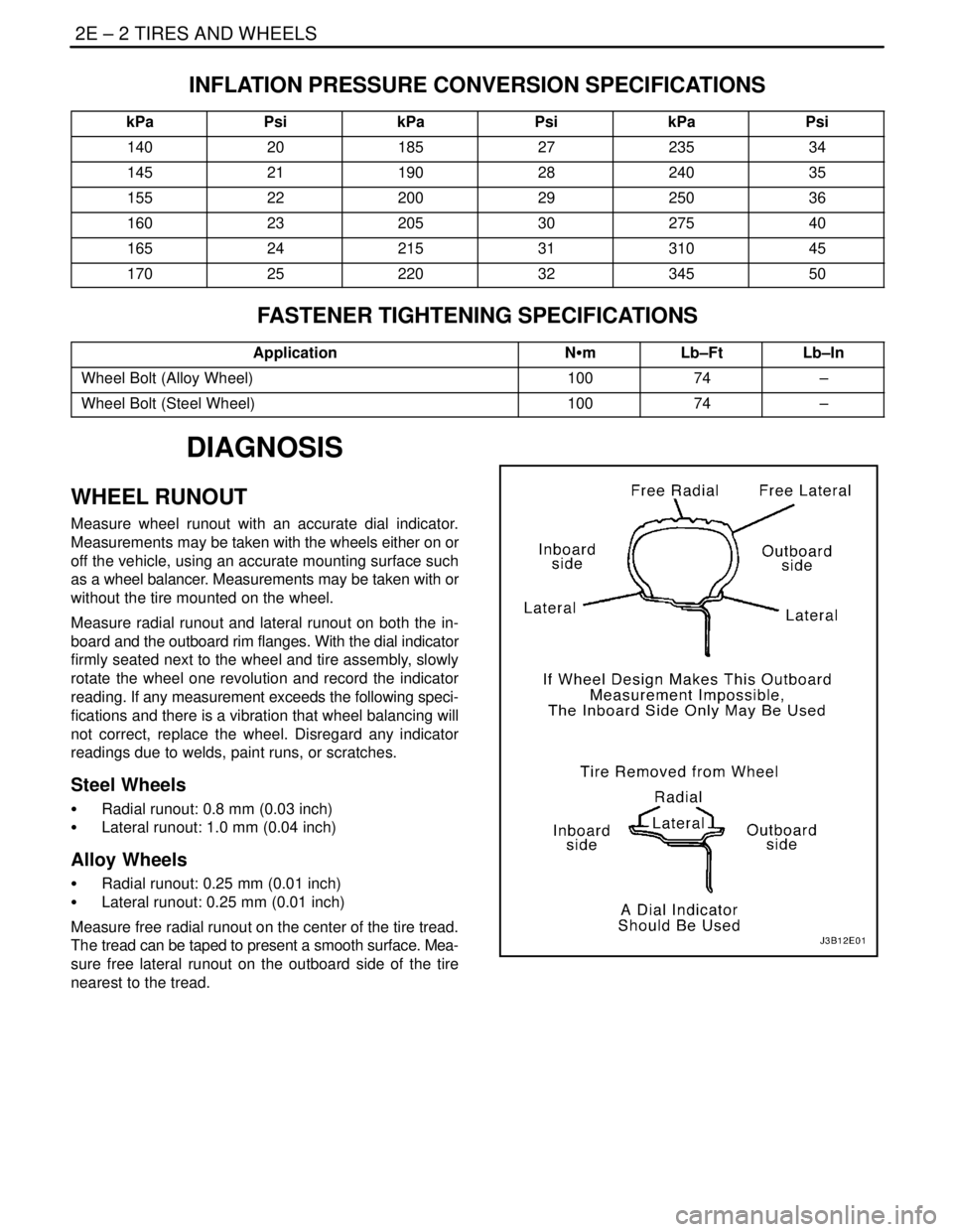
Measure wheel runout with an accurate dial indicator.
Measurements may be taken with the wheels either on or
off the vehicle, using an accurate mounting surface such
as a wheel balancer. Measurements may be taken with or
without the tire mounted on the wheel.
Measure radial runout and lateral runout on both the in-
board and the outboard rim flanges. With the dial indicator
firmly seated next to the wheel and tire assembly, slowly
rotate the wheel one revolution and record the indicator
reading. If any measurement exceeds the following speci-
fications and there is a vibration that wheel balancing will
not correct, replace the wheel. Disregard any indicator
readings due to welds, paint runs, or scratches.
Steel Wheels
S Radial runout: 0.8 mm (0.03 inch)
S Lateral runout: 1.0 mm (0.04 inch)
Alloy Wheels
S Radial runout: 0.25 mm (0.01 inch)
S Lateral runout: 0.25 mm (0.01 inch)
Measure free radial runout on the center of the tire tread.
The tread can be taped to present a smooth surface. Mea-
sure free lateral runout on the outboard side of the tire
nearest to the tread.
Page 972 of 2643

2E – 10ITIRES AND WHEELS
DAEWOO V–121 BL4
turers of tire chains have a specific chain size for each tire
size to ensure a proper fit when the chain is installed. Be
sure to purchase the correct chains for the tires on which
they are to be used. Use rubber adjusters to take up any
slack or clearance in loose chains.
Use of chains may adversely affect vehicle handling.
When tire chains are installed, follow these precautions:
S Adjust speed to road conditions.
S Avoid sharp turns.
S Avoid locked–wheel braking.
To prevent chain damage to the vehicle, install the chains
on the front tires as tightly as possible. Tighten them again
after driving 0.4 to 0.8 kilometer (0.3 to 0.5 mile). The use
of chains on the rear tires is not recommended because
they may contact the vehicle and possibly damage it. If
chains must be used on the rear tires, be sure there is suffi-
cient clearance between the chains and the body. Do not
exceed 70 km/h (45 mph) or the chain manufacturer’s
speed limit, if lower. Avoid large bumps, potholes, severe
turns and any other maneuvers which could cause the
tires to bounce. Follow any other instructions of the chain
manufacturer which do not disagree with the above in-
structions.
REPLACEMENT TIRES
A tire performance criteria (TPC) specification number is
molded in the sidewall near the tire size of all original
equipment tires. This specification number assures that
the tire meets performance standards for traction, endur-
ance, dimensions, noise, handling and rolling resis–tance.
Usually a specific TPC number is assigned to each tire
size.
CAUTION : Do not mix different types of tires on the
same vehicle such as radial, bias and bias–belted
tires except in emergencies, because vehicle han-
dling may be seriously affected and may result in loss
of control.
Use only replacement tires with the same size, load range,
and construction as the original. The use of any other tire
size or construction type may seriously affect ride, han-
dling, speedometer/odometer calibration, vehicle ground
clearance, and tire clearance to the body and the chassis.
This does not apply to the spare tire furnished with the ve-
hicle.
It is recommended that new tires be installed in pairs on
the same axle.
If it is necessary to replace only one tire, pair it with the tire
having the most tread to equalize the braking action.
Although they may appear different in tread design, tires
built by different manufacturers with identical TPC specifi-
cations may be used on the same vehicle.
ALL SEASON TIRES
Most vehicles are now equipped with steel–belted all sea-
son radial tires as standard equipment. These tires qualify
as snow tires, with a 37 percent higher average rating for
snow traction than the non–all season radial tires pre-
viously used. Other performance areas, such as wet trac-
tion, rolling resistance, tread life, and air retention, have
also been improved. This was done by improvements in
both tread design and tread compounds. These tires are
identified by an ”M + S” molded in the tire sidewall following
the size number. The suffix ”MS” is also molded in the side-
wall after the TPC specification number.
The optional handling tires used on some vehicles are not
all season tires. These will not have the ”MS” marking after
the tire size or the TPC specification number.
PASSENGER METRIC SIZED TIRES
All Daewoo vehicles now use Passenger (P) metric sized
tires. P–metric tires are available in two load ranges: stan-
dard load (35 psi maximum) and extra load (41 psi maxi-
mum). Most passenger vehicle tires are standard load.
Most P–metric tire sizes do not have exact corresponding
alphanumeric tire sizes. For example, a P175/70R13 is
not exactly equal in size and load–carrying capacity to an
FR70–13. For this reason, replacement tires should be of
the same TPC specification number as the originals. If P–
metric tires must be replaced with other sizes, consult a
tire dealer. Tire companies can best recommend the clos-
est match of alphanumeric to P–metric sizes within their
own tire lines.
The metric term for measuring tire inflation pressure is the
kilopascal (kPa). Tire pressure may be printed in both kPa
and psi. One psi equals 6.895 kPa.
See the tire label or refer to ”Tire Size and Pressure Speci-
fications” in this section for tire inflation pressures.
TIRE LABEL
The tire label is permanently located on the rear face of the
driver’s door and should be referred to for tire information.
It lists the maximum vehicle load, the tire size (including
the spare tire), and the cold inflation pressure (including
the spare tire).
SPARE TIRE
The notchback and the wagon come equipped with a full–
sized tire on a steel wheel. The hatchback comes
equipped with a reduced–sized temporary tire on a steel
wheel.
WHEELS
Wheels must be replaced if they are bent, dented, have
excessive lateral or radial runout, leak air through welds,
have elongated bolt holes, or if the wheel bolts won’t stay
tight or are heavily rusted. Wheels with excessive runout
may cause vehicle vibration. Replacement wheels must
be equivalent to the original equipment wheels in load ca-
Page 1021 of 2643

HYDRAULIC BRAKES 4A – 5
DAEWOO V–121 BL4
DIAGNOSIS
BRAKE SYSTEM TESTING
Brakes should be tested on a dry, clean, reasonably
smooth and level roadway. A true test of brake perfor-
mance cannot be made if the roadway is wet, greasy, or
covered with loose dirt whereby all tires do not grip the
road equally. Testing will also be adversely affected if the
roadway is crowned so as to throw the weight so roughly
that the wheels tend to bounce.
Test the brakes at different vehicle speeds with both light
and heavy pedal pressure; however, avoid locking the
brakes and sliding the tires. Locked brakes and sliding
tires do not indicate brake efficiency since heavily braked,
but turning, wheels will stop the vehicle in less distance
than locked brakes. More tire–to–road friction is present
with a heavily–braked, turning tire than with a sliding tire.
Because of the high deceleration capability, a firmer pedal
may be felt at higher deceleration levels.
There are three major external conditions that affect brake
performance:
S Tires having unequal contact and grip of the road
will cause unequal braking. Tires must be equally
inflated, and the tread pattern of the right and the
left tires must be approximately equal.
S Unequal loading of the vehicle can affect the brake
performance since the most heavily loaded wheels
require more braking power, and thus more braking
effort, than the others.
S Misalignment of the wheels, particularly conditions
of excessive camber and caster, will cause the
brakes to pull to one side.
To check for brake fluid leaks, hold constant foot pressure
on the pedal with the engine running at idle and the shift
lever in NEUTRAL. If the pedal gradually falls away with
the constant pressure, the hydraulic system may be leak-
ing. Perform a visual check to confirm any suspected
leaks.
Check the master cylinder fluid level. While a slight drop
in the reservoir level results from normal lining wear, an ab-
normally low level indicates a leak in the system. The hy-
draulic system may be leaking either internally or external-
ly. Refer to the procedure below to check the master
cylinder. Also, the system may appear to pass this test
while still having a slight leak. If the fluid level is normal,
check the vacuum booster pushrod length. If an incorrect
pushrod length is found, adjust or replace the rod.
Check the master cylinder using the following procedure:
S Check for a cracked master cylinder casting or
brake fluid leaking around the master cylinder.
Leaks are indicated only if there is at least one drop
of fluid. A damp condition is not abnormal.S Check for a binding pedal linkage and for an incor-
rect pushrod length. If both of these parts are in
satisfactory condition, disassemble the master cyl-
inder and check for an elongated or swollen primary
cylinder or piston seals. If swollen seals are found,
substandard or contaminated brake fluid should be
suspected. If contaminated brake fluid is found, all
the components should be disassembled and
cleaned, and all the rubber components should be
replaced. All of the pipes must also be flushed.
Improper brake fluid, or mineral oil or water in the fluid,
may cause the brake fluid to boil or cause deterioration of
the rubber components. If the primary piston cups in the
master cylinder are swollen, then the rubber parts have
deteriorated. This deterioration may also be evidenced by
swollen wheel cylinder piston seals on the drum brake
wheels.
If deterioration of rubber is evident, disassemble all the hy-
draulic parts and wash the parts with alcohol. Dry these
parts with compressed air before reassembly to keep alco-
hol out of the system. Replace all the rubber parts in the
system, including the hoses. Also, when working on the
brake mechanisms, check for fluid on the linings. If exces-
sive fluid is found, replace the linings.
If the master cylinder piston seals are in satisfactory condi-
tion, check for leaks or excessive heat conditions. If these
conditions are not found, drain the fluid, flush the master
cylinder with brake fluid, refill the master cylinder, and
bleed the system. Refer to ”Manual Bleeding the Brakes”
or”Pressure Bleeding the Brakes” in this section.
BRAKE HOSE INSPECTION
The hydraulic brake hoses should be inspected at least
twice a year. The brake hose assembly should be checked
for road hazard damage, cracks, chafing of the outer cov-
er, and for leaks or blisters. Inspect the hoses for proper
routing and mounting. A brake hose that rubs on a suspen-
sion component will wear and eventually fail. A light and
a mirror may be needed for an adequate inspection. If any
of the above conditions are observed on the brake hose,
adjust or replace the hose as necessary.
WARNING LAMP OPERATION
This brake system uses a BRAKE warning lamp located
in the instrument panel cluster. When the ignition switch
is in the START position, the BRAKE warning lamp should
glow and go OFF when the ignition switch returns to the
RUN position.
The following conditions will activate the BRAKE lamp:
S Parking brake applied. The light should be ON
whenever the parking brake is applied and the igni-
tion switch is ON.
S Low fluid level. A low fluid level in the master cylin-
der will turn the BRAKE lamp ON.
S EBD system is disabled. The light should be ON
when the EBD system is malfunctioning.
Page 1050 of 2643
4D – 2IFRONT DISC BRAKES
DAEWOO V–121 BL4
During manufacturing, the brake rotor and the tolerances
of the braking surface regarding flatness, thickness varia-
tion, and lateral runout are held very close. The mainte-
nance of close tolerances on the shape of the braking sur-
faces is necessary to prevent brake roughness.
In addition to these tolerances, the surface finish must be
held to a specified range. The control of the braking sur-
face finish is necessary to avoid pulls and erratic perfor-
mance and to extend lining life.
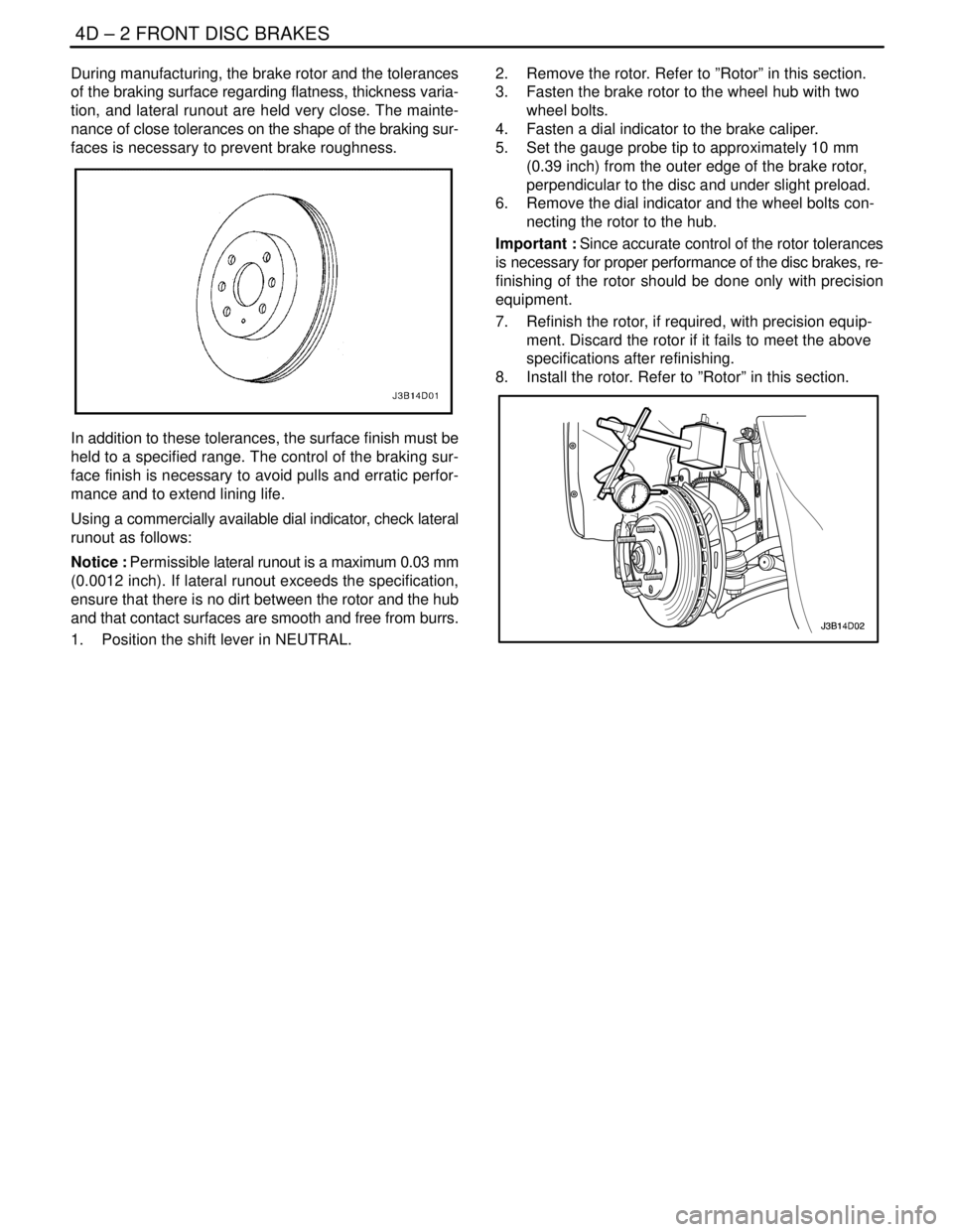
Using a commercially available dial indicator, check lateral
runout as follows:
Notice : Permissible lateral runout is a maximum 0.03 mm
(0.0012 inch). If lateral runout exceeds the specification,
ensure that there is no dirt between the rotor and the hub
and that contact surfaces are smooth and free from burrs.
1. Position the shift lever in NEUTRAL.2. Remove the rotor. Refer to ”Rotor” in this section.
3. Fasten the brake rotor to the wheel hub with two
wheel bolts.
4. Fasten a dial indicator to the brake caliper.
5. Set the gauge probe tip to approximately 10 mm
(0.39 inch) from the outer edge of the brake rotor,
perpendicular to the disc and under slight preload.
6. Remove the dial indicator and the wheel bolts con-
necting the rotor to the hub.
Important : Since accurate control of the rotor tolerances
is necessary for proper performance of the disc brakes, re-
finishing of the rotor should be done only with precision
equipment.
7. Refinish the rotor, if required, with precision equip-
ment. Discard the rotor if it fails to meet the above
specifications after refinishing.
8. Install the rotor. Refer to ”Rotor” in this section.
Page 1058 of 2643

SECTION : 4E1
REAR DISC BRAKES
TABLE OF CONTENTS
SPECIFICATIONS4E1–1 . . . . . . . . . . . . . . . . . . . . . . . . .
Fastener Tightening Specifications 4E1–1. . . . . . . . . .
DIAGNOSIS4E1–1 . . . . . . . . . . . . . . . . . . . . . . . . . . . . . . .
Lining Inspection 4E1–1. . . . . . . . . . . . . . . . . . . . . . . . .
Rotor Inspection 4E1–1. . . . . . . . . . . . . . . . . . . . . . . . . .
MAINTENANCE AND REPAIR4E1–3 . . . . . . . . . . . . . .
ON–VEHICLE SERVICE 4E1–3. . . . . . . . . . . . . . . . . . . .
Shoe and Lining 4E1–3. . . . . . . . . . . . . . . . . . . . . . . . . . Caliper 4E1–4. . . . . . . . . . . . . . . . . . . . . . . . . . . . . . . . . .
Rotor 4E1–5. . . . . . . . . . . . . . . . . . . . . . . . . . . . . . . . . . .
Hub and Parking Brake Shoe/Backplate 4E1–6. . . . .
UNIT REPAIR 4E1–10. . . . . . . . . . . . . . . . . . . . . . . . . . . .
Caliper Overhaul 4E1–10. . . . . . . . . . . . . . . . . . . . . . . .
GENERAL DESCRIPTION AND SYSTEM
OPERATION4E1–12 . . . . . . . . . . . . . . . . . . . . . . . . . . . .
Disc Brake Caliper Assembly 4E1–12. . . . . . . . . . . . . .
SPECIFICATIONS
FASTENER TIGHTENING SPECIFICATIONS
ApplicationNSmLb–FtLb–In
Brake Hose Inlet Bolt and Ring Seals3224–
Caliper Mounting Bolts5641–
Lower Caliper Mounting Bolt2720–
Parking Brake Shoe Hold–Down Spring As-
sembly Screw4–35
Rotor Detent Screw4–35
Hub Bolts6548–
DIAGNOSIS
LINING INSPECTION
1. Raise and suitably support the vehicle.
2. Remove the rear wheels. Refer to Section 2E, Tires
and Wheels.
3. Visually check the brake shoe linings for minimum
thickness and wear.
4. Measure the thickness.
Important : The minimum discard thickness of the brake
shoe lining is 2 mm (0.08 inch).
5. Install the shoes in axle sets only.
6. Install the rear wheels. Refer to Section 2E, Tires
and Wheels.
7. Lower the vehicle.
ROTOR INSPECTION
Brake rotors are manufactured with close tolerances for
thickness variation, flatness, and lateral runout, but pits
and grooves are created in rotors during usage. Lack of
uniformity of the braking surfaces of the rotor can cause
inadequate braking and a pulsating pedal during braking.
The surface finish of the rotor is also important because
an unsuitable surface finish can cause pulling and rapid
wear of the brake shoe lining. If a rotor does not meet the
specification, it should be refinished to specification or re-
placed. Refinishing of the rotor should only be done with
precision equipment.
Thickness variation can be checked by measuring the
thickness of the rotor at four or more points around the cir-
cumference of the rotor. All measurements must be made
at the same distance from the edge of the rotor. A rotor that
varies by more than. 1.0 mm (0.04 inch) can cause pedal
Page 1394 of 2643

ZF 4 HP 16 AUTOMATIC TRANSAXLE 5A1 – 45
DAEWOO V–121 BL4
CLUTCH PLATE DIAGNOSIS
Composition Plates
Dry the plate and inspect the plates for the following condi-
tions :
S Pitting
S Flaking
S Wear
S Glazing
S Cracking
S Charring
Chips or metal particles embedded in the lining
Replace a composition plate which shows any of these
conditions.
Steel Plates
Wipe the plates dry and check the plates for heat discolor-
ation. If the surfaces are smooth, even if colorsmear is in-
dicated, you can reuse the plate. If the plate is discolored
with hot spots or if the surface is scuffed, replace the plate.
Important : If the clutch shows evidence or extreme heat
or burning, replace the springs.
Causes of Burned Clutch Plates
The following conditions can result in a burned clutch
plate:
S Incorrect usage of clutch plates.
S Engine coolant in the transaxle fluid.
S A cracked clutch piston.
S Damaged or missing seals.
S Low line pressure.
S Valve problems.
– The valve body face is not flat
– Porosity between channels
– The valve bushing clips are improperly installed.
– The check balls are misplaced.
S The seal rings are worn or damaged
Engine Coolant in Transaxle
Notice : Antifreeze will deteriorate the O–ring seals and
the glue used to bond the clutch material to the pressure
plate. Both conditions may cause transaxle damage.
Perform the following steps if the transaxle oil cooler has
developed a leak, allowing engine coolant to enter the
transaxle:
1. Because the coolant will attach to the seal material
causing leakage, disassemble the transaxle and
replace all rubber type seals.
2. Because the facing material may become sepa-
rated from the steel center portion, replace the
composition faced clutch plate assemblies.
3. Replace all nylon parts including washers.
4. Replace the torque converter.
5. Thoroughly clean and rebuild the transaxle, using
new gaskets and oil filter.6. Flush the cooler lines after you have properly re-
paired or replaced the transaxle.
COOLER FLUSHING AND FLOW
TEST
Notice : You must flush the cooler whenever you receive
a transaxle for service. Cooler flushing is essential for
SRTA installation, major overhaul, whenever you replace
a pump or torque converter, or whenever you suspect that
the fluid has been contaminated.
After filling the transaxle with fluid, start the engine and run
for 30 seconds. This will remove any residual moisture
from the oil cooler. Disconnect the return line at the trans-
axle and observe the flow with the engine running. If the
fluid flow is insufficient, check the fluid flow by disconnect-
ing the feed line at the cooler. Observe the flow with the
engine running.
S If the flow from the cooler return line at the trans-
axle is insufficient, check the flow rate from the feed
line to the cooler. BLockage exists in the transaxle
or the cooler.
S If the flow from the transaxle feed line to the cooler
is insufficient, the transaxle is the cause of the fluid
flow problem.
S If the flow the transaxle feed line to the cooler is
insufficient, but flow from the cooler return line to
the transaxle is insufficient, inspect the cooler pipes
and fittings. Then repeat the cooler flushing proce-
dure. If the flow is still insufficient, replace the cool-
er.
TRANSAXLE FLUID LEVEL SERVICE
PROCEDURE
This procedure is to be used when checking a concern
with the fluid level in a vehicle. A low fluid level will result
in slipping and loss of drive/ reverse or delay on engage-
ment of drive/ reverse when the vehicle is cold.
The vehicle is first checked for transaxle diagnostic mes-
sages on the scan tool. If the oil level is low, it is possible
to register a vehicle speed signal fault.
The vehicle is to be test driven to determine if there is an
abnormal delay when selecting drive or reverse, or loss of
drive. One symptom of low fluid level is a momentary loss
of drive when driving the vehicle around a corner. Also
when the transaxle fluid level is low, a loss of drive may oc-
cur when the transaxle fluid temperature is low.
When adding or changing transaxle fluid use only ESSO
LT 71141 automatic transaxle fluid or other approved
fluids. The use of incorrect fluid will cause the performance
and durability of the transaxle to be severely degraded.
Fluid Level Diagnosis Procedure
1. If the vehicle is at operating temperature allow the
vehicle to cool down for two hours, but no greater
than four hours. Or if the vehicle is at cool status,
start the engine and allow the engine to idle for
approximately 5 minutes (825~875 rpm), if pos-