2004 DAEWOO LACETTI Hub
[x] Cancel search: HubPage 917 of 2643

2B – 10IWHEEL ALIGNMENT
DAEWOO V–121 BL4
GENERAL DESCRIPTION
AND SYSTEM OPERATION
FOUR WHEEL ALIGNMENT
The first responsibility of engineering is to design safe
steering and suspension systems. Each component must
be strong enough to withstand and absorb extreme pun-
ishment. Both the steering system and the front and the
rear suspension must function geometrically with the body
mass.
The steering and the suspension systems require that the
front wheels self–return and that the tire rolling effort and
the road friction be held to a negligible force in order to al-
low the customer to direct the vehicle with the least effort
and the most comfort.
A complete wheel alignment check should include mea-
surements of the rear toe and camber.
Four–wheel alignment assures that all four wheels will be
running in precisely the same direction.
When the vehicle is geometrically aligned, fuel economy
and tire life are at their peak, and steering and perfor-
mance are maximized.
TOE
Toe–in is the turning in of the tires, while toe–out is the
turning out of the tires from the geometric centerline or
thrust line. The toe ensures parallel rolling of the wheels.
The toe serves to offset the small deflections of the wheel
support system which occur when the vehicle is rolling for-
ward. The specified toe angle is the setting which achieves
0 degrees of toe when the vehicle is moving.
Incorrect toe–in or toe–out will cause tire wear and re-
duced fuel economy. As the individual steering and sus-
pension components wear from vehicle mileage, addition-
al toe will be needed to compensate for the wear.
Always correct the toe dimension last.
CASTER
Caster is the tilting of the uppermost point of the steering
axis either forward or backward from the vertical when
viewed from the side of the vehicle. A backward tilt is posi-
tive, and a forward tilt is negative. Caster influences direc-
tional control of the steering but does not affect tire wear.
Weak springs or overloading a vehicle will affect caster.
One wheel with more positive caster will pull toward the
center of the car. This condition will cause the car to move
or lean toward the side with the least amount of positive
caster. Caster is measured in degrees and is not adjust-
able.
CAMBER
Camber is the tilting of the top of the tire from the vertical
when viewed from the front of the vehicle. When the tires
tilt outward, the camber is positive. When the tires tilt in-
ward, the camber is negative. The camber angle is mea-
sured in degrees from the vertical. Camber influences
both directional control and tire wear.
If the vehicle has too much positive camber, the outside
shoulder of the tire will wear. If the vehicle has too much
negative camber, the inside shoulder of the tire will wear.
Camber is not adjustable.
STEERING AXIS INCLINATION
Steering Axis Inclination (SAI) is the tilt at the top of the
steering knuckle from the vertical. Measure the SAI angle
from the true vertical to a line through the center of the strut
and the lower ball joint as viewed from the front of the ve-
hicle.
SAI helps the vehicle track straight down the road and as-
sists the wheel back into the straight ahead position. SAI
on front wheel drive vehicles should be negative.
INCLUDED ANGLE
The included angle is the angle measured from the cam-
ber angle to the line through the center of the strut and the
lower ball joint as viewed from the front of the vehicle.
The included angle is calculated in degrees. Most align-
ment racks will not measure the included angle directly. To
determine the included angle, subtract the negative or add
the positive camber readings to the Steering Axis Inclina-
tion (SAI).
SCRUB RADIUS
The scrub radius is the distance between true vertical and
the line through the center of the strut and lower ball joint
to the road surface. Scrub radius is built into the design of
the vehicle. Scrub radius is not adjustable.
SETBACK
The setback is the distance in which one front hub and
bearing assembly may be rearward of the other front hub
and bearing assembly. Setback is primarily caused by a
road hazard or vehicle collision.
TURNING ANGLE
The turning angle is the angle of each front wheel to the
vertical when the vehicle is making a turn.
Page 918 of 2643

SECTION : 2C
FRONT SUSPENSION
CAUTION : Disconnect the negative battery cable before removing or installing any electrical unit or when a tool
or equipment could easily come in contact with exposed electrical terminals. Disconnecting this cable will help
prevent personal injury and damage to the vehicle. The ignition must also be in LOCK unless otherwise noted.
TABLE OF CONTENTS
SPECIFICATIONS2C–2 . . . . . . . . . . . . . . . . . . . . . . . . . .
General Specifications 2C–2. . . . . . . . . . . . . . . . . . . . .
Fastener Tightening Specifications 2C–2. . . . . . . . . . .
SPECIAL TOOLS2C–3 . . . . . . . . . . . . . . . . . . . . . . . . . . .
Special Tools Table 2C–3. . . . . . . . . . . . . . . . . . . . . . . .
DIAGNOSIS2C–5 . . . . . . . . . . . . . . . . . . . . . . . . . . . . . . . .
Strut Dampener 2C–5. . . . . . . . . . . . . . . . . . . . . . . . . . .
Ball Joint and Knuckle 2C–6. . . . . . . . . . . . . . . . . . . . . .
Excessive Friction Check 2C–6. . . . . . . . . . . . . . . . . . .
COMPONENT LOCATOR2C–7 . . . . . . . . . . . . . . . . . . . .
Front Suspension 2C–7. . . . . . . . . . . . . . . . . . . . . . . . . .
MAINTENANCE AND REPAIR2C–9 . . . . . . . . . . . . . . .
ON–VEHICLE SERVICE 2C–9. . . . . . . . . . . . . . . . . . . . .
Stabilizer Shaft and Insulators 2C–9. . . . . . . . . . . . . . . Stabilizer Link 2C–10. . . . . . . . . . . . . . . . . . . . . . . . . . . .
Knuckle Assembly 2C–10. . . . . . . . . . . . . . . . . . . . . . . .
Hub and Bearing 2C–13. . . . . . . . . . . . . . . . . . . . . . . . .
Control Arm 2C–14. . . . . . . . . . . . . . . . . . . . . . . . . . . . . .
Strut Assembly 2C–16. . . . . . . . . . . . . . . . . . . . . . . . . . .
Crossmember Assembly 2C–18. . . . . . . . . . . . . . . . . . .
UNIT REPAIR 2C–21. . . . . . . . . . . . . . . . . . . . . . . . . . . . .
Ball Joint 2C–21. . . . . . . . . . . . . . . . . . . . . . . . . . . . . . . .
Control Arm Bushings 2C–21. . . . . . . . . . . . . . . . . . . . .
Front Strut Assembly 2C–22. . . . . . . . . . . . . . . . . . . . . .
Knuckle 2C–23. . . . . . . . . . . . . . . . . . . . . . . . . . . . . . . . .
GENERAL DESCRIPTION AND SYSTEM
OPERATION 2C–25 . . . . . . . . . . . . . . . . . . . . . . . . . . . .
Front Suspension 2C–25. . . . . . . . . . . . . . . . . . . . . . . . .
Page 919 of 2643

2C – 2IFRONT SUSPENSION
DAEWOO V–121 BL4
SPECIFICATIONS
GENERAL SPECIFICATIONS
ApplicationTrim Height
Center of Front Wheel to Bottom of Front Wheel Well368 mm (14.4 in.)
Center of Rear Wheel to Bottom of Rear Wheel Well367 mm (14.4 in.)
* CONDITION : Full Fuel in the Tank
FASTENER TIGHTENING SPECIFICATIONS
ApplicationNSmLb–FtLb–In
Ball Joint Pinch Bolt Nut6044–
Ball Joint–to–Control Arm Nuts10074–
Front Control Arm–to–Crossmember Bolt12592–
Rear Contral Arm–to–Crossmember Bolt11 081–
Crossmember Link–to–Crossmember Bolt11 484–
Crossmember Link–to–Transaxle Bracket Nut169125–
Drive Axle–to–Hub Caulking Nut300221–
Front Crossmember–to–Body Bolts13096–
Piston Rod Nut7555–
Rear Crossmember–to–Body Bolts196145–
Stabilizer Link–to–Strut Assembly Nut4735–
Stabilizer Shaft–to–Crossmember Clamp Bolts2518–
Stabilizer Shaft–to–Stabilizer Link Nut4735–
Steering Knuckle–to–Strut Assembly Nuts/Bolts12089–
Strut Assembly–to–Body Nut6548–
Page 920 of 2643
FRONT SUSPENSION 2C – 3
DAEWOO V–121 BL4
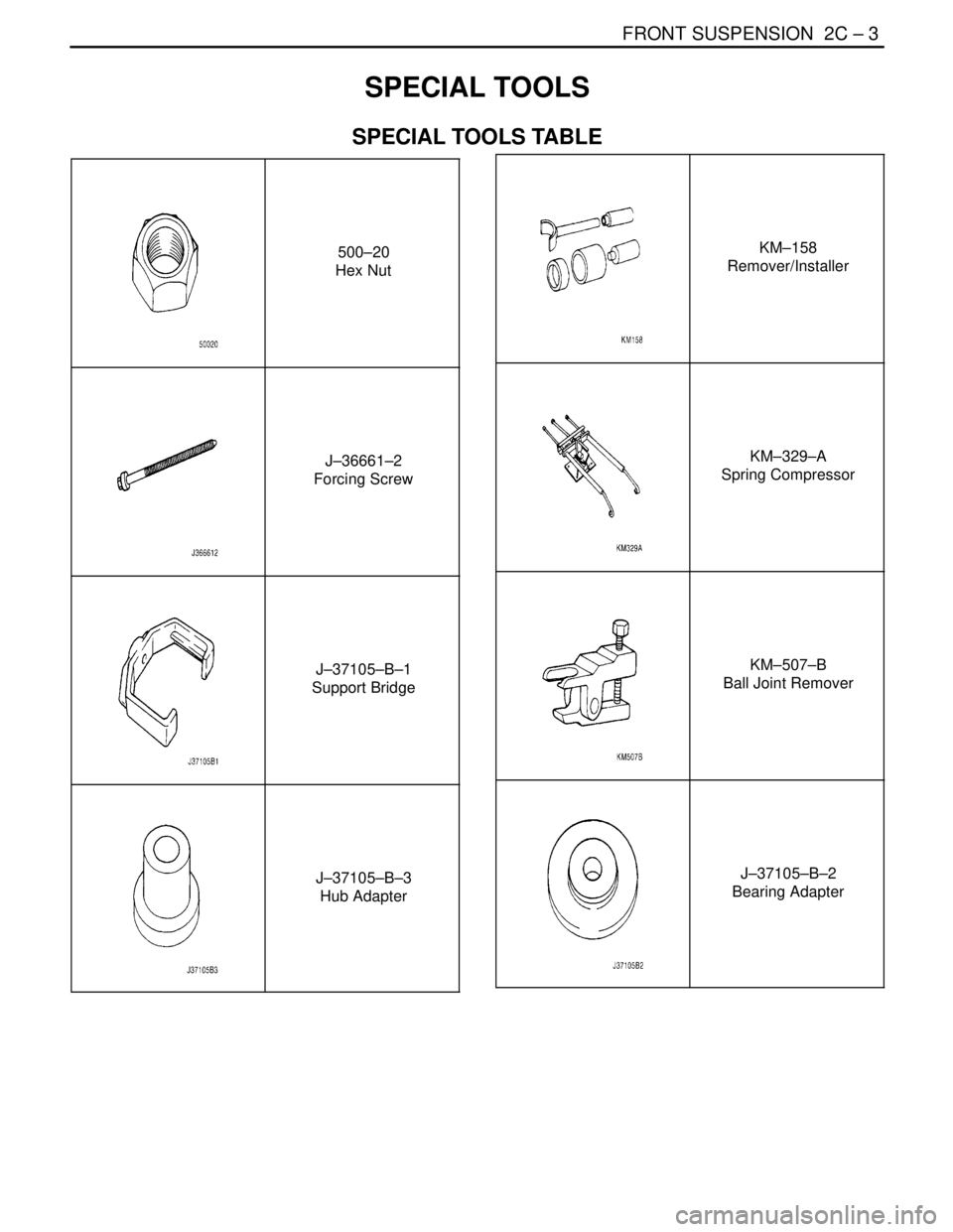
SPECIAL TOOLS
SPECIAL TOOLS TABLE
500–20
Hex Nut
J–36661–2
Forcing Screw
J–37105–B–1
Support Bridge
J–37105–B–3
Hub Adapter
KM–158
Remover/Installer
KM–329–A
Spring Compressor
KM–507–B
Ball Joint Remover
J–37105–B–2
Bearing Adapter
Page 925 of 2643

2C – 8IFRONT SUSPENSION
DAEWOO V–121 BL4
1. Cap
2. Strut Upper Nut
3. Piston Rod Nut
4. Strut Mount
5. Strut Bearing
6. Washer
7. Upper Spring Seat
8. Front Spring Locator
9. Upper Spring Insulator
10. Hollow Bumper
11. Front Coil Spring
12. Lower Spring Insulator
13. Front Strut
14. Steering Knuckle–to–Strut Assembly
15. Nut
16. Steering Knuckle
17. Brake Shield
18. Front Hub Bearing19. Outer Snap Ring
20. Front Hub
21. Front Brake Disc
22. Washer
23. Caulking Nut
24. Stabilizer Clamp Bolt
25. Stabilizer Clamp
26. Stabilizer Clamp Insulator
27. Stabilizer
28. Stabilizer Link Nut
29. Stabilizer Link
30. Front Suspension Crossmember
31. Crossmember Cover
32. Crossmember Cover Bolt
33. Crossmember Bolt
34. Crossmember Nut
35. Control Arm
36. Ball Joint
Page 929 of 2643

2C – 12IFRONT SUSPENSION
DAEWOO V–121 BL4
Notice : Do not over extend the axle joints. When either
end of the shaft is disconnected, overextension of the joint
can result in separation of internal components and pos-
sible joint failure. Use drive axle joint seal protectors when-
ever performing service on or near the drive axles. Failure
to do so can cause internal joint or seal damage and result
in possible joint failure.
10. Support the drive axle.
11. Separate the drive axle shaft from the wheel hub.
12. Remove the bolts that connect the knuckle assem-
bly to the strut assembly.
13. Remove the knuckle assembly from the vehicle.
Installation Procedure
1. Install the knuckle assembly onto the vehicle.
2. Install the steering knuckle–to–strut assembly nuts.
Tighten
Tighten the steering knuckle–to–strut assembly nuts
to 120 NSm (89 lb–ft).
3. Connect the drive axle to the front wheel hub.
4. Connect the ball joint to the knuckle assembly.
5. Install the ball joint pinch bolt and the nut.
Tighten
Tighten the ball joint pinch bolt nut to 60 NSm (44 lb–
ft).
6. Connect the ABS speed sensor electrical connec-
tion.
Page 930 of 2643
FRONT SUSPENSION 2C – 13
DAEWOO V–121 BL4
7. Connect the outer tie rod to the knuckle assembly.
Refer to Section 6C, Power Steering Gear.
8. Install the brake caliper onto the rotor. Refer to
Section 4D, Front Disc Brakes.
9. Install the caulking nut onto the axle shaft.
Tighten
Tighten the drive axle–to–hub caulking nut to 150
NSm (111 lb–ft). Loosen the nut, then retighten it to
275 NSm (126 lb–ft).
10. Install the wheel. Refer to Section 2E, Tires and
Wheels.
11. Lower the vehicle.
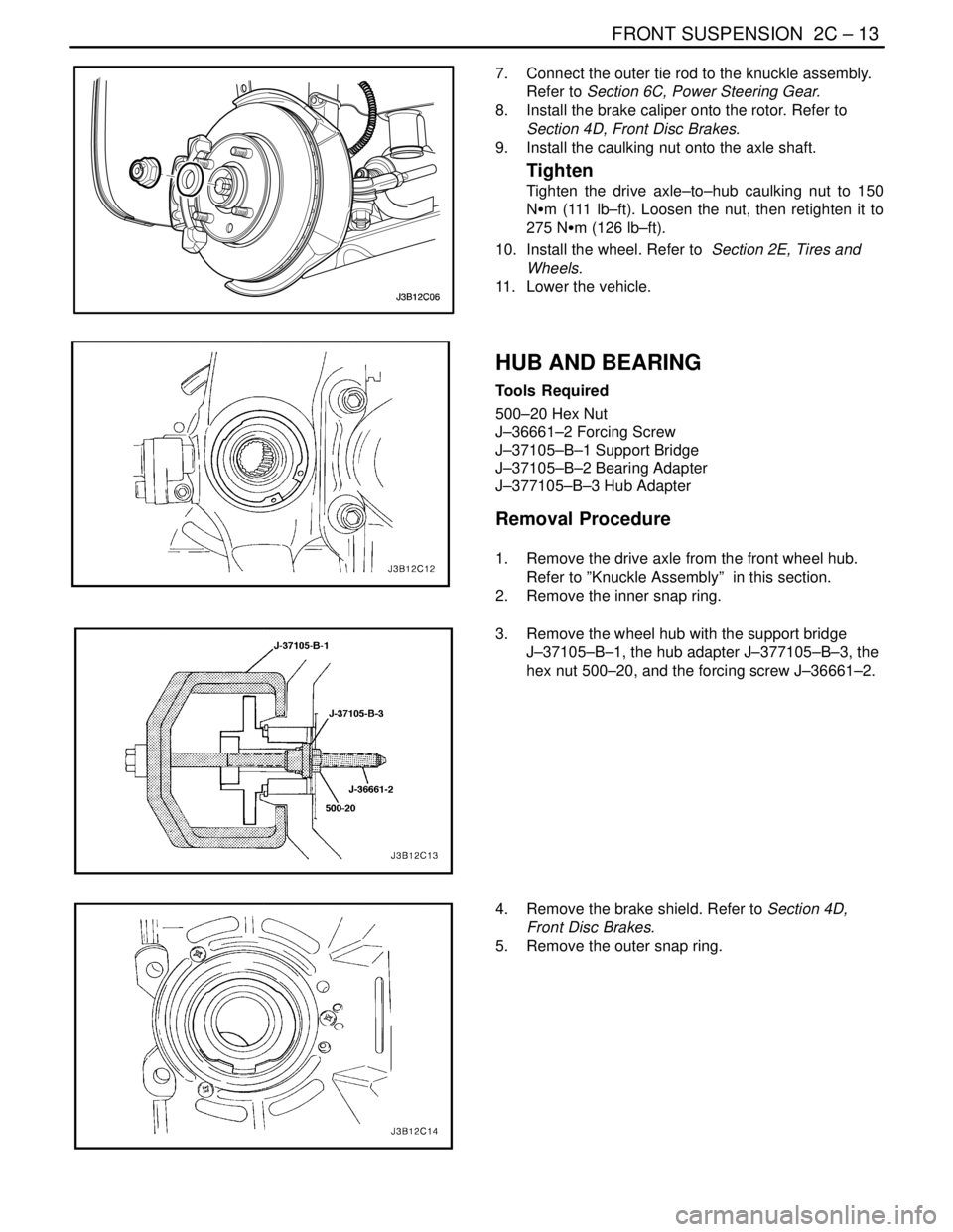
HUB AND BEARING
Tools Required
500–20 Hex Nut
J–36661–2 Forcing Screw
J–37105–B–1 Support Bridge
J–37105–B–2 Bearing Adapter
J–377105–B–3 Hub Adapter
Removal Procedure
1. Remove the drive axle from the front wheel hub.
Refer to ”Knuckle Assembly” in this section.
2. Remove the inner snap ring.
3. Remove the wheel hub with the support bridge
J–37105–B–1, the hub adapter J–377105–B–3, the
hex nut 500–20, and the forcing screw J–36661–2.
4. Remove the brake shield. Refer to Section 4D,
Front Disc Brakes.
5. Remove the outer snap ring.
Page 931 of 2643
2C – 14IFRONT SUSPENSION
DAEWOO V–121 BL4
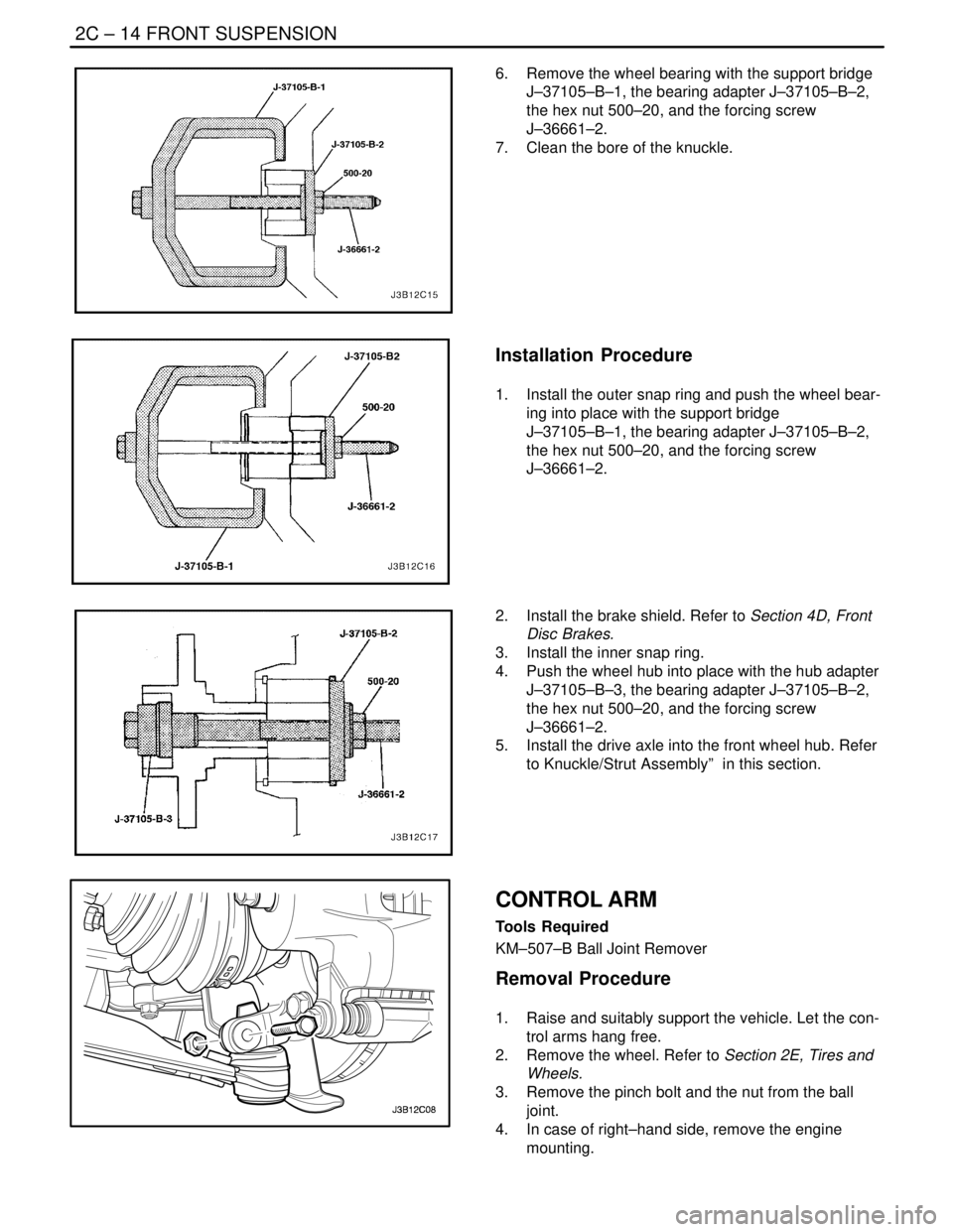
6. Remove the wheel bearing with the support bridge
J–37105–B–1, the bearing adapter J–37105–B–2,
the hex nut 500–20, and the forcing screw
J–36661–2.
7. Clean the bore of the knuckle.
Installation Procedure
1. Install the outer snap ring and push the wheel bear-
ing into place with the support bridge
J–37105–B–1, the bearing adapter J–37105–B–2,
the hex nut 500–20, and the forcing screw
J–36661–2.
2. Install the brake shield. Refer to Section 4D, Front
Disc Brakes.
3. Install the inner snap ring.
4. Push the wheel hub into place with the hub adapter
J–37105–B–3, the bearing adapter J–37105–B–2,
the hex nut 500–20, and the forcing screw
J–36661–2.
5. Install the drive axle into the front wheel hub. Refer
to Knuckle/Strut Assembly” in this section.
CONTROL ARM
Tools Required
KM–507–B Ball Joint Remover
Removal Procedure
1. Raise and suitably support the vehicle. Let the con-
trol arms hang free.
2. Remove the wheel. Refer to Section 2E, Tires and
Wheels.
3. Remove the pinch bolt and the nut from the ball
joint.
4. In case of right–hand side, remove the engine
mounting.