2004 DAEWOO LACETTI Air Conditioning System
[x] Cancel search: Air Conditioning SystemPage 170 of 2643
1C2 – 50I1.8L DOHC ENGINE MECHANICAL
DAEWOO V–121 BL4
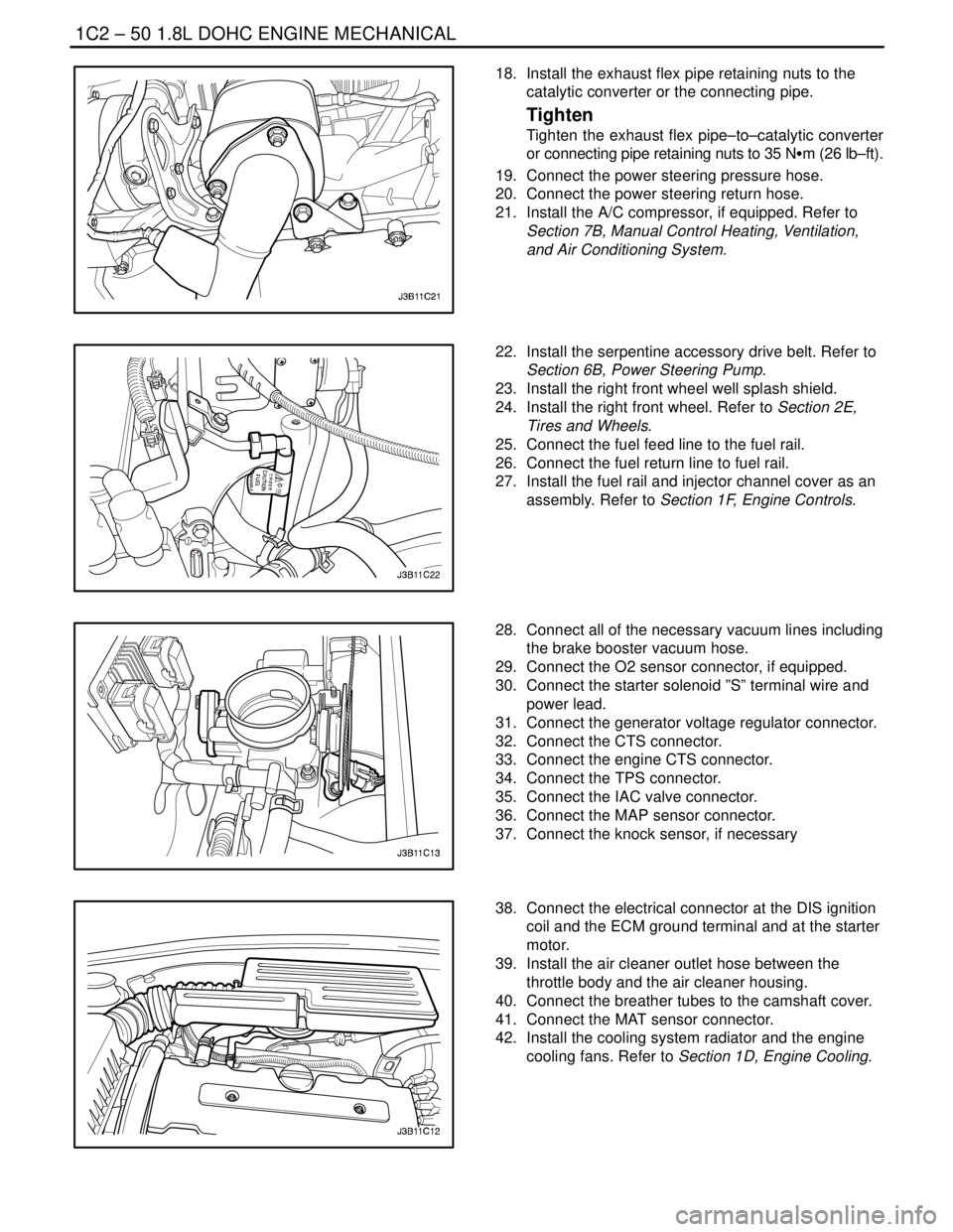
18. Install the exhaust flex pipe retaining nuts to the
catalytic converter or the connecting pipe.
Tighten
Tighten the exhaust flex pipe–to–catalytic converter
or connecting pipe retaining nuts to 35 NSm (26 lb–ft).
19. Connect the power steering pressure hose.
20. Connect the power steering return hose.
21. Install the A/C compressor, if equipped. Refer to
Section 7B, Manual Control Heating, Ventilation,
and Air Conditioning System.
22. Install the serpentine accessory drive belt. Refer to
Section 6B, Power Steering Pump.
23. Install the right front wheel well splash shield.
24. Install the right front wheel. Refer to Section 2E,
Tires and Wheels.
25. Connect the fuel feed line to the fuel rail.
26. Connect the fuel return line to fuel rail.
27. Install the fuel rail and injector channel cover as an
assembly. Refer to Section 1F, Engine Controls.
28. Connect all of the necessary vacuum lines including
the brake booster vacuum hose.
29. Connect the O2 sensor connector, if equipped.
30. Connect the starter solenoid ”S” terminal wire and
power lead.
31. Connect the generator voltage regulator connector.
32. Connect the CTS connector.
33. Connect the engine CTS connector.
34. Connect the TPS connector.
35. Connect the IAC valve connector.
36. Connect the MAP sensor connector.
37. Connect the knock sensor, if necessary
38. Connect the electrical connector at the DIS ignition
coil and the ECM ground terminal and at the starter
motor.
39. Install the air cleaner outlet hose between the
throttle body and the air cleaner housing.
40. Connect the breather tubes to the camshaft cover.
41. Connect the MAT sensor connector.
42. Install the cooling system radiator and the engine
cooling fans. Refer to Section 1D, Engine Cooling.
Page 171 of 2643
1.8L DOHC ENGINE MECHANICAL 1C2 – 51
DAEWOO V–121 BL4
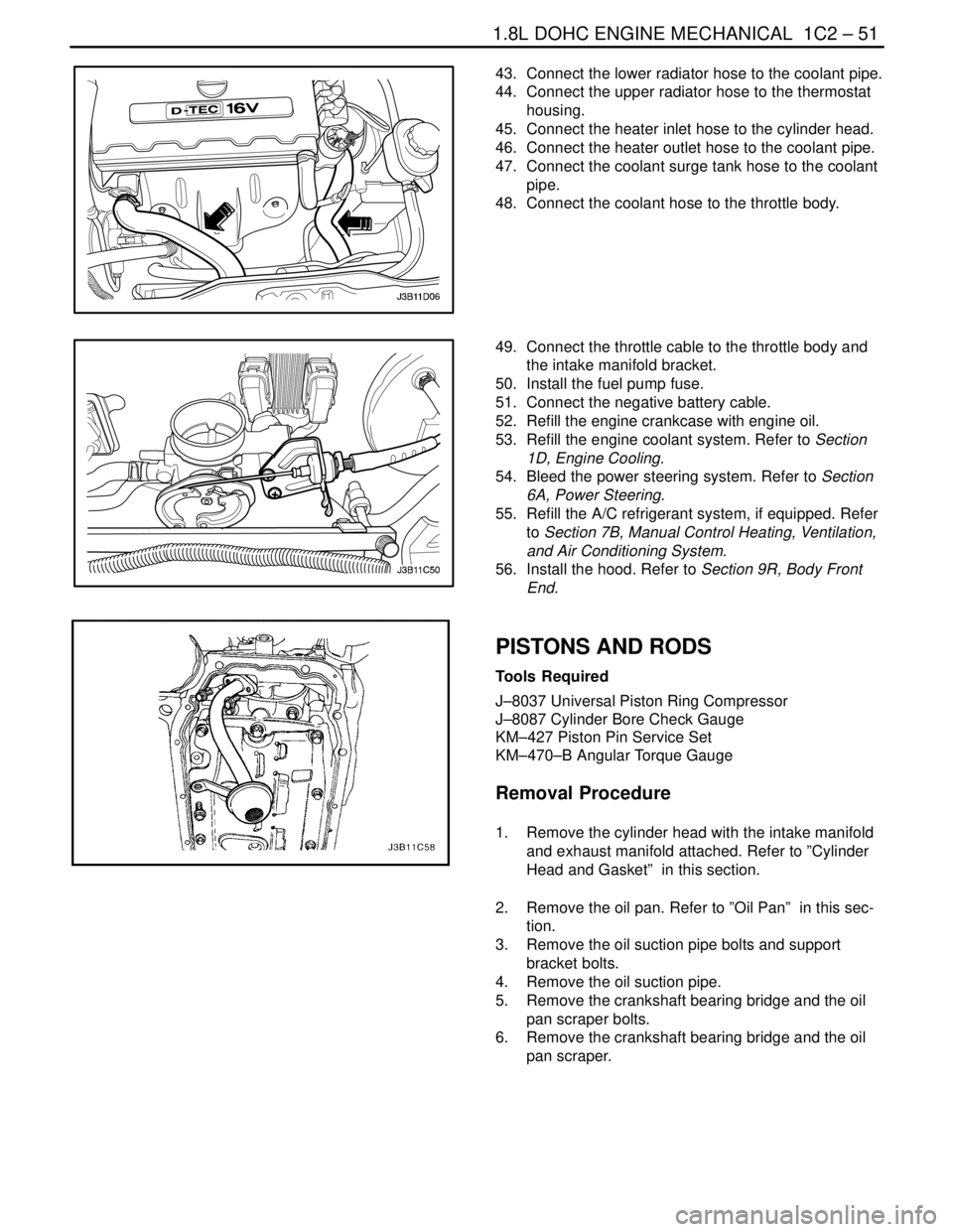
43. Connect the lower radiator hose to the coolant pipe.
44. Connect the upper radiator hose to the thermostat
housing.
45. Connect the heater inlet hose to the cylinder head.
46. Connect the heater outlet hose to the coolant pipe.
47. Connect the coolant surge tank hose to the coolant
pipe.
48. Connect the coolant hose to the throttle body.
49. Connect the throttle cable to the throttle body and
the intake manifold bracket.
50. Install the fuel pump fuse.
51. Connect the negative battery cable.
52. Refill the engine crankcase with engine oil.
53. Refill the engine coolant system. Refer to Section
1D, Engine Cooling.
54. Bleed the power steering system. Refer to Section
6A, Power Steering.
55. Refill the A/C refrigerant system, if equipped. Refer
to Section 7B, Manual Control Heating, Ventilation,
and Air Conditioning System.
56. Install the hood. Refer to Section 9R, Body Front
End.
PISTONS AND RODS
Tools Required
J–8037 Universal Piston Ring Compressor
J–8087 Cylinder Bore Check Gauge
KM–427 Piston Pin Service Set
KM–470–B Angular Torque Gauge
Removal Procedure
1. Remove the cylinder head with the intake manifold
and exhaust manifold attached. Refer to ”Cylinder
Head and Gasket” in this section.
2. Remove the oil pan. Refer to ”Oil Pan” in this sec-
tion.
3. Remove the oil suction pipe bolts and support
bracket bolts.
4. Remove the oil suction pipe.
5. Remove the crankshaft bearing bridge and the oil
pan scraper bolts.
6. Remove the crankshaft bearing bridge and the oil
pan scraper.
Page 253 of 2643

ENGINE CONTROLS 1F – 7
DAEWOO V–121 BL4
Parameter ValueScaling
A/C RequestYes/NoNo
A/C ClutchOn/OffOff
Fuel Pump CommandOn/OffOn
Closed LoopYes/NoYe s
Throttle At IdleYes/NoNo
O2 Ready (B1–S1)Yes/NoYe s
Knock PresentYes/NoNo
Fan LowOn/OffOn/Off
Fan HighOn/OffOn/Off
TCC Engaged (Only AT)Yes/NoYe s
Park/Neutral (Only AT)P/N and R/N/DP/N
Fuel Level InputVvaries
Fuel Level Output%varies
Fuel Trim Cell–18
G–SensorV1.1 – 3.7 V (Non–ABS Only)
Engine RuntimeHH:MM:SSHours:Minutes:Seconds
* Condition: Warmed up, idle, park or neutral, A/C off
ENGINE DATA DISPLAY TABLE
DEFINITIONS
ECM Data Description
The following information will assist in diagnosing emis-
sion or driveability problems. A first technician can view
the displays while the vehicle is being driven by second
technician. Refer to Powertrain On–Board Diagnostic
(EOBD) System Check for addition information.
A/C Clutch
The A/C Relay represents the commanded state of the
A/C clutch control relay. The A/C clutch should be en-
gaged when the scan tool displays ON.
A/C Pressure
The A/C High Side displays the pressure value of the A/C
refrigerant pressure sensor. The A/C High Side helps to
diagnose the diagnostic trouble code (DTC) P0533.
A/C Request
The A/C Request represents whether the air conditioning
is being requested from the HVAC selector. The input is re-
ceived by the instrument panel cluster and then sent serial
data to the ECM and finally to the scan tool over KWP 2000
serial data.
Air Fuel Ratio
The Air Fuel Ration indicates the air to fuel ratio based on
the Front Heated Oxygen Sensor (HO2S1) inputs. The
ECM uses the fuel trims to adjust fueling in order to at-
tempt to maintain an air fuel ratio of 14.7:1.BARO
The Barometric Pressure (BARO) sensor measures the
change in the intake manifold pressure which results from
altitude changes. This value is updated at ignition ON and
also at Wide Open Throttle (WOT).
Base Injection PWM
Indicates the base Pulse Width Modulation (PWM) or ON
time of the indicated cylinder injector in milliseconds.
When the engine load is increased, the injector pulse width
will increase.
Calculated Air Flow
The calculated air flow is a calculation based on manifold
absolute pressure. The calculation is used in several diag-
nostics to determine when to run the diagnostics.
Desired Idle Speed
The ECM commands the idle speed. The ECM compen-
sates for various engine loads in order to maintain the de-
sired idle speed. The actual engine speed should remain
close to the desired idle under the various engine loads
with the engine idling.
Engine Coolant Temperature
The Engine Coolant Temperature (ECT) sensor sends en-
gine temperature information to the ECM. The ECM sup-
plies 5 volts to the engine coolant temperature sensor cir-
cuit. The sensor is a thermistor which changes internal
resistance as temperature changes. When the sensor is
cold (internal resistance high), the ECM monitors a high
voltage which it interprets as a cold engine. As the sensor
warms (internal resistance decreases), the voltage signal
will decrease and the ECM will interpret the lower voltage
as a warm engine.
Page 339 of 2643

ENGINE CONTROLS 1F – 93
DAEWOO V–121 BL4
ENGINE COOLING FAN CIRCUIT CHECK – DUAL FAN
(1.4L/1.6L DOHC)
Circuit Description
The engine cooling fan circuit operates the main cooling
fan and the auxiliary cooling fan. The cooling fans are con-
trolled by the engine control module (ECM) based on in-
puts from the Engine Coolant Temperature (ECT) sensor
and the Air Conditioning Pressure (ACP) sensor. The
ECM controls the low speed cooling fan operation by inter-
nally grounding the ECM connector terminal 10. This ener-
gizes the low speed cooling fan relay and operates the
main cooling fan and the auxiliary cooling fan at low speed
as the cooling fans are connected in a series circuit. The
ECM controls the high speed cooling fan operation by in-
ternally grounding the ECM connector terminal 10 and the
ECM connector terminal 9 at the same time. This ener-
gizes the low speed cooling fan relay, the high speed cool-
ing fan relay, and the series/parallel cooling fan relay re-
sulting in high speed fan operation as the cooling fans are
now connected in a parallel circuit.
Diagnostic Aids
S If the owner complained of an overheating problem,
it must be determined if the complaint was due to
an actual boil over, or the engine coolant tempera-
ture gauge indicated overheating. If the engine is
overheating and the cooling fans are on, the cooling
system should be checked.
S If the engine fuse block fuses Ef11 become open
(blown) immediately after installation, inspect for a
short to ground in the wiring of the appropriate cir-
cuit. If the fuses become open (blown) when the
cooling fans are to be turned on by the ECM, sus-
pect a faulty cooling fan motor.
S The ECM will turn the cooling fans on at low speed
when the coolant temperature is 97°C (207°F). The
ECM will turn the cooling fans off when the coolant
temperature is 94°C(201°F).
S The ECM will turn the cooling fans on at high speed
when the coolant temperature is 101°C (214°F).
The ECM will change the cooling fans from high
speed to low speed when the coolant temperature
is 98°C (208°F).S The ECM will turn the cooling fans on at low speed
when the A/C system is on. The ECM will change
the cooling fans from low speed to high speed
when the high side A/C pressure is 1882 kPa (273
psi) then return to low speed when the high side
A/C pressure is 1448 kPa (210 psi). When the A/C
system is on, the ECM will change the cooling fans
from low to high speed when the coolant tempera-
ture reaches 117°C (244°F) then return to low
speed when the coolant temperature reaches
11 4°C (237°F).
S The cooling fan circuit can be checked quickly by
disconnecting the ECM connector 2 and grounding
the connector terminal 10. This should create low
speed cooling fan operation with the ignition ON. By
grounding the ECM connector terminals 10 and 9
and turning the ignition ON, high speed cooling fan
operation should be achieved.
Test Description
The number(s) below refer to step(s) on the diagnostic
table.
4. This step, along with step 5, checks for the ability of
the ECM to operate the cooling fans.
8. This step, along with step 9, checks for the ability of
the ECM to operate the cooling fans in response to
A/C pressure readings.
16. After confirming battery voltage and the ECM sup-
plying a ground to the coil side of the cooling fan
relay A, by jumpering connector terminals 30 and
87 it will be determined if the relay is at fault or a
wiring problem is present.
31. This step checks for the presence of battery volt-
age to the main cooling fan when the A/C is on. If
battery voltage is present and the cooling fans are
not operating, the problem is in the ground side of
the cooling fan circuit.
37. By directly grounding the ECM connector terminals
10 and 9, the main and auxiliary cooling fans
should run at high speed.
Engine Cooling Fan Circuit Check – Dual Fan (1.4L/1.6L DOHC)
StepActionValue(s)YesNo
1Perform an On–Board Diagnostic (EOBD) system
check.
Is the check completed?–Go to Step 2Go to
”On–Board
Diagnostic Sys-
tem Check”
21. Check the engine fuse block fuse Ef11.
2. Replace the fuse as needed.
Is the fuse OK?–Go to Step 3Go to
”Diagnostic
Aids”
Page 346 of 2643

1F – 100IENGINE CONTROLS
DAEWOO V–121 BL4
ENGINE COOLING FAN CIRCUIT CHECK – DUAL FAN
(1.8L DOHC)
Circuit Description
The engine cooling fan circuit operates the main cooling
fan and the auxiliary cooling fan. The cooling fans are con-
trolled by the engine control module (ECM) based on in-
puts from the Engine Coolant Temperature (ECT) sensor
and the Air Conditioning Pressure (ACP) sensor. The
ECM controls the low speed cooling fan operation by inter-
nally grounding the ECM connector terminal K28. This en-
ergizes the low speed cooling fan relay and operates the
main cooling fan and the auxiliary cooling fan at low speed
as the cooling fans are connected in a series circuit. The
ECM controls the high speed cooling fan operation by in-
ternally grounding the ECM connector terminal K28 and
the ECM connector terminal K12 at the same time. This
energizes the low speed cooling fan relay, the high speed
cooling fan relay, and the series/parallel cooling fan relay
resulting in high speed fan operation as the cooling fans
are now connected in a parallel circuit.
Diagnostic Aids
S If the owner complained of an overheating problem,
it must be determined if the complaint was due to
an actual boil over, or the engine coolant tempera-
ture gauge indicated overheating. If the engine is
overheating and the cooling fans are on, the cooling
system should be checked.
S If the engine fuse block fuses Ef21, Ef6, Ef8 be-
come open (blown) immediately after installation,
inspect for a short to ground in the wiring of the ap-
propriate circuit. If the fuses become open (blown)
when the cooling fans are to be turned on by the
ECM, suspect a faulty cooling fan motor.
S The ECM will turn the cooling fans on at low speed
when the coolant temperature is 97°C (207°F). The
ECM will turn the cooling fans off when the coolant
temperature is 94°C(201°F).
S The ECM will turn the cooling fans on at high speed
when the coolant temperature is 101°C (214°F).
The ECM will change the cooling fans from high
speed to low speed when the coolant temperature
is 98°C (208°F).S The ECM will turn the cooling fans on at low speed
when the A/C system is on. The ECM will change
the cooling fans from low speed to high speed
when the high side A/C pressure is 1882 kPa (273
psi) then return to low speed when the high side
A/C pressure is 1448 kPa (210 psi). When the A/C
system is on, the ECM will change the cooling fans
from low to high speed when the coolant tempera-
ture reaches 117°C (244°F) then return to low
speed when the coolant temperature reaches
11 4°C (237°F).
S The cooling fan circuit can be checked quickly by
disconnecting the ECM connector 2 and grounding
the connector terminal K28. This should create low
speed cooling fan operation with the ignition ON. By
grounding the ECM connector terminals K28 and
K12 and turning the ignition ON, high speed cooling
fan operation should be achieved.
Test Description
The number(s) below refer to step(s) on the diagnostic
table.
4. This step, along with step 5, checks for the ability of
the ECM to operate the cooling fans.
8. This step, along with step 9, checks for the ability of
the ECM to operate the cooling fans in response to
A/C pressure readings.
16. After confirming battery voltage and the ECM sup-
plying a ground to the coil side of the cooling fan
relay A, by jumpering connector terminals 30 and
87 it will be determined if the relay is at fault or a
wiring problem is present.
31. This step checks for the presence of battery volt-
age to the main cooling fan when the A/C is on. If
battery voltage is present and the cooling fans are
not operating, the problem is in the ground side of
the cooling fan circuit.
37. By directly grounding the ECM connector terminals
K28 and K12, the main and auxiliary cooling fans
should run at high speed.
Engine Cooling Fan Circuit Check – Dual Fan (1.8L DOHC)
StepActionValue(s)YesNo
1Perform an On–Board Diagnostic (EOBD) system
check.
Is the check completed?–Go to Step 2Go to
”On–Board
Diagnostic Sys-
tem Check”
21. Check the I/P fuse block fuse F2.
2. Replace the fuse as needed.
Is the fuse OK?–Go to Step 3Go to
”Diagnostic
Aids”
Page 510 of 2643

1F – 264IENGINE CONTROLS
DAEWOO V–121 BL4
DIAGNOSTIC TROUBLE CODE (DTC) P0532
A/C PRESSURE SENSOR LOW VOLTAGE
Circuit Description
The Air Conditioning (A/C) system uses an A/C refrigerant
pressure sensor mounted in the high pressure side of the
A/C refrigerant system to monitor A/C refrigerant pres-
sure. The Engine Control Module (ECM) uses this infor-
mation to turn ON the engine coolant fans when the A/C
refrigerant pressure is high and to keep the compressor
disengaged when A/C refrigerant pressure is excessively
high or low.
The Air Conditioning Pressure (ACP) sensor operates like
other 3–wire sensors. The ECM applies a 5.0 volt refer-
ence and a sensor ground to the sensor. Changes in the
A/C refrigerant pressure will cause the ACP sensor input
to the ECM to vary. The ECM monitors the ACP sensor
signal circuit and can determine when the signal is outside
of the possible range of the sensor. When the signal is out
of range for a prolonged period of time, the ECM will not
allow the A/C compressor clutch to engage. This is done
to protect the compressor.
Conditions for Setting the DTC
S A/C pressure is less than 12.16 kpa.
Action Taken When the DTC Sets
S The Malfunction Indicator Lamp (MIL) will not illumi-
nate.
S The ECM will record operating conditions at the
time the diagnostic fails. This information will be
stored in the Failure Records buffers.S A history DTC is stored.
S The A/C compressor operation will be disabled
while the low voltage indication exists.
Conditions for Clearing the MIL/DTC
S A history DTC will clear after 40 consecutive warm–
up cycles without a fault.
S DTC(s) can be cleared by using the scan tool.
S Disconnecting the ECM battery feed for more than
10 seconds.
Diagnostic Aids
Inspect harness connectors for backed–out terminals, im-
proper mating, broken locks, improperly formed or dam-
aged terminals, and poor terminal–to–wire connection at
the ECM.
Inspect the wiring harness for damage. If the harness ap-
pears to be OK, observe the A/C pressure display on the
scan tool while moving the connectors and wiring har-
nesses related to the A/C Pressure sensor. A change in
the A/C pressure display will indicate the location of the
fault.
If DTC P0532 cannot be duplicated, reviewing the Fail Re-
cords vehicle mileage since the diagnostic test last failed
may help determine how often the condition that caused
the DTC to set occurs. This may assist in diagnosing the
condition.
Page 511 of 2643

ENGINE CONTROLS 1F – 265
DAEWOO V–121 BL4
DTC P0532 – A/C Pressure Sensor Low Voltage
StepActionValue(s)YesNo
1Perform an On–Board Diagnostic (EOBD) System
Check.
Was the check performed? –Go to Step 2Go to
”On–Board
Diagnostic Sys-
tem Check”
21. Install a scan tool to the Data Link Connector
(DLC).
2. Idle the engine.
Does the scan tool display Air Conditioning Pressure
(ACP) sensor voltage below the specified value?0.06 VGo to Step 3Go to Step 4
31. Turn the ignition OFF.
2. Disconnect the ACP sensor connector.
3. Jumper the ACP signal circuit, terminal 2 to the
5 volt reference circuit, terminal 1.
4. Turn the ignition switch on.
Does the ACP voltage read more than the specified
value?4.9 VGo to Step 5Go to Step 6
41. Turn the ignition ON, with the engine OFF.
2. Operate the vehicle within the Failure Record
conditions and Conditions For Setting the DTC
as noted.
Does the scan tool display ACP voltage below the
specified value?0.06 VGo to Step 3Go to
”Diagnostic
Aids”
5Inspect the ACP sensor harness connector termi-
nals for the following conditions:
S Poor connections
S Proper contact tension
S Poor terminal–to–wire connection
Is a problem found?–Go to Step 8Go to Step 9
61. Turn the ignition OFF.
2. Remove the jumper wire.
3. Probe the ACP sensor signal circuit terminal 2
with a test light to B+.
4. Turn the ignition ON.
Does the scan tool read over the specified value?4 VGo to Step 7Go to Step 11
7Check the ACP sensor 5 volt reference circuit for an
open or short to ground and repair as needed.
Is the repair complete?–Go to Step 13Go to Step 10
8Repair the connection terminals as necessary.
Is the repair complete?–Go to Step 13–
91. Turn the ignition OFF.
2. Replace the ACP sensor.
Is the repair complete?–Go to Step 13–
101. Turn the ignition OFF.
2. Replace the engine control module (ECM).
Is the repair complete?–Go to Step 13–
Page 513 of 2643

ENGINE CONTROLS 1F – 267
DAEWOO V–121 BL4
DIAGNOSTIC TROUBLE CODE (DTC) P0533
A/C PRESSURE SENSOR HIGH VOLTAGE
Circuit Description
The Air Conditioning (A/C) system uses an A/C refrigerant
pressure sensor mounted in the high pressure side of the
A/C refrigerant system to monitor A/C refrigerant pres-
sure. The Engine Control Module (ECM) uses this infor-
mation to turn ON the engine coolant fans when the A/C
refrigerant pressure is high and to keep the compressor
disengaged when A/C refrigerant pressure is excessively
high or low.
The Air Conditioning Pressure (ACP) sensor operates like
other 3–wire sensors. The ECM applies a 5.0 volt refer-
ence and a sensor ground to the sensor. Changes in the
A/C refrigerant pressure will cause the ACP sensor input
to the ECM to vary. The ECM monitors the ACP sensor
signal circuit and can determine when the signal is outside
of the possible range of the sensor. When the signal is out
of range for a prolonged period of time, the ECM will not
allow the A/C compressor clutch to engage. This is done
to protect the compressor.
Conditions for Setting the DTC
S A/C pressure is greater than 293 kpa.
S Engine is running.
Action Taken When the DTC Sets
S The Malfunction Indicator Lamp (MIL) will not illumi-
nate.S The ECM will record operating conditions at the
time the diagnostic fails. This information will be
stored in the Failure Records buffers.
S A history DTC is stored.
S The A/C compressor operation will be disabled
while the high voltage indication exists.
Conditions for Clearing the MIL/DTC
S A history DTC will clear after 40 consecutive warm–
up cycles without a fault.
S DTC(s) can be cleared by using the scan tool.
S Disconnecting the ECM battery feed for more than
10 seconds.
Diagnostic Aids
Inspect harness connectors for backed–out terminals, im-
proper mating, broken locks, improperly formed or dam-
aged terminals, and poor terminal–to–wire connection at
the ECM.
Inspect the wiring harness for damage. If the harness ap-
pears to be OK, observe the A/C pressure display on the
scan tool while moving the connectors and wiring har-
nesses related to the ACP sensor. A change in the A/C
pressure display will indicate the location of the fault.
If DTC P0533 cannot be duplicated, reviewing the Fail Re-
cords vehicle mileage since the diagnostic test last failed
may help determine how often the condition that caused
the DTC to set occurs. This may assist in diagnosing the
condition.