Page 327 of 401

Coolant Checks
Coolant protection checks should be made every 12
months (prior to the onset of freezing weather, where
applicable). If coolant is dirty or rusty in appearance, the
system should be drained, flushed and refilled with fresh
coolant. Check the front of the A/C condenser for any
accumulation of bugs, leaves, etc. If dirty, clean by
removing the upper grill support and gently spraying
water from a garden hose vertically down the face of the
condenser.
Check the coolant recovery bottle tubing for brittle rub-
ber, cracking, tears, cuts and tightness of the connection
at the bottle and radiator. Inspect the entire system for
leaks.
With the engine at normal operating temperature (but
not running), check the coolant pressure cap for proper
vacuum sealing by draining a small amount of coolantfrom the radiator drain cock. If the cap is sealing prop-
erly, the coolant will begin to drain from the coolant
recovery bottle. DO NOT REMOVE THE COOLANT
PRESSURE CAP WHEN THE COOLING SYSTEM IS
HOT.
Cooling System Ð Drain, Flush and Refill
At the intervals shown in the maintenance schedules, the
system should be drained, flushed and refilled.
If the solution is dirty or contains a considerable amount
of sediment, clean and flush with a reliable cooling
system cleaner. Follow with a thorough rinsing to remove
all deposits and chemicals. Properly dispose of old
antifreeze solution.
Selection Of Coolant
Use only the manufacturers recommended coolant, refer
to Recommended Fluids, Lubricants and Genuine Parts
for correct coolant type.
MAINTAINING YOUR VEHICLE 327
7
Page 329 of 401
Coolant Pressure Cap
The coolant pressure cap must be fully tightened to
prevent loss of coolant, and to insure that coolant will
return to the radiator from the coolant recovery bottle.
The coolant pressure cap should be inspected and
cleaned if there is any accumulation of foreign material
on the sealing surfaces.
WARNING!
The warning words ªDO NOT OPEN HOTº on the
coolant pressure cap are a safety precaution. Never add
coolant to the radiator when the engine is overheated.
Do not loosen or remove the coolant pressure cap to
cool an overheated engine. Heat causes pressure to
build up in the cooling system. To prevent scalding or
injury, do not remove the coolant pressure cap while the
system is hot or under pressure.
Disposal of Used Engine Coolant
Used ethylene glycol based engine coolant is a regulated
substance requiring proper disposal. Check with your
local authorities to determine the disposal rules for your
community. To prevent ingestion by animals or children
do not store ethylene glycol based engine coolant in open
containers or allow it to remain in puddles on the
ground. If ingested by a child, contact a physician
immediately. Clean up any ground spills immediately.
Coolant Level
The coolant recovery bottle provides a quick visual
method for determining that the coolant level is ad-
equate. With the engine cold, the level of the coolant in
the coolant recovery bottle should be between the
ªMAXº and ªMINº marks. The radiator normally re-
mains completely full, so there is no need to remove the
radiator cap except for checking coolant freeze point or
replacement with new antifreeze coolant. Your service
attendant should be advised of this. So long as the engine
MAINTAINING YOUR VEHICLE 329
7
Page 330 of 401

operating temperature is satisfactory, the coolant recov-
ery bottle need only be checked once a month.
When additional coolant is needed to maintain the
proper level, it should be added to the coolant recovery
bottle. Do not overfill.
Points to Remember
NOTE:When the vehicle is stopped after a few miles of
operation, you may observe vapor coming from the front
of the engine compartment. This is normally a result of
moisture from rain, snow, or high humidity accumulat-
ing on the radiator and being vaporized when the
thermostat opens, allowing hot water to enter the radia-
tor.
If an examination of your engine compartment shows no
evidence of radiator or hose leaks, the vehicle may be
safely driven. The vapor will soon dissipate.
²Do not overfill the coolant recovery bottle.
²Check coolant freeze point in the radiator and in the
coolant recovery bottle. If antifreeze needs to be
added, contents of coolant recovery bottle must also be
protected against freezing.
²If frequent coolant additions are required, or if the
level in the coolant recovery bottle does not drop when
the engine cools, the cooling system should be pres-
sure tested for leaks.
²Maintain coolant concentration at 50% ethylene glycol
antifreeze (minimum) in water for proper corrosion
protection of your engine which contains aluminum
components.
²Make sure that the radiator and coolant recovery
bottle overflow hoses are not kinked or obstructed.
²Keep the front of the radiator clean. If your vehicle is
equipped with air conditioning, keep the front of the
condenser clean, also.
330 MAINTAINING YOUR VEHICLE
Page 336 of 401

Procedure For Checking Fluid Level
The fluid level in the automatic transmission should be
checked whenever the vehicle is serviced. Operation with
an improper fluid level will greatly reduce the life of the
transmission and of the fluid.
To properly check the automatic transmission fluid level,
the following procedure must be used:
1. The vehicle must be on level ground.
2. The engine should be running at curb idle speed for a
minimum of 60 seconds.
3. Fully apply parking brake.
4. Place the gear selector momentarily in each gear
position ending with the lever in P (PARK). Wipe the area
around the dipstick clean to eliminate the possibility of
dirt entering the transmission.5. Remove the dipstick and determine if the fluid is hot
or warm. Hot fluid is approximately 180ÉF (82ÉC), which
is the normal operating temperature after the vehicle has
been driven at least 15 miles (24 km). The fluid cannot be
comfortably held between the finger tips. Cold is when
the fluid is below 27ÉC (80ÉF).
6. Wipe the dipstick clean and reinsert until seated.
Remove dipstick and note reading.
a. If the fluid is hot, the reading should be in the
crosshatched area marked ªHOTº (between the upper
two holes in the dipstick).
b. If the fluid is cold, the fluid level should be between
the lower two holes in the area marked ªCOLDº.
If the fluid level indicates low, add sufficient fluid to
bring to the proper level.
336 MAINTAINING YOUR VEHICLE
Page 357 of 401
²Taxi, police, or delivery service (commercial ser-
vice).L
²Off-road or desert operation.
NOTE:Most vehicles are operated under the conditions
listed for Schedule9B9.
Second is ScheduleªAº. It is for vehicles that are not
operated under any of the conditions listed under Sched-
ule9B9.
Use the schedule that best describes your driving condi-
tions. Where time and mileage are listed, follow the
interval that occurs first.
CAUTION!
Failure to perform the required maintenance items
may result in damage to the vehicle.
At Each Stop for Fuel
²Check the engine oil level about 5 minutes after a fully
warmed engine is shut off. Checking the oil level while
the vehicle is on level ground will improve the accu-
racy of the oil level reading. Add oil only when the
level is at or below the ADD or MIN mark.
²Check the windshield washer solvent and add if required.
Once a Month
²Check tire pressure and look for unusual wear or
damage.
²Inspect the battery and clean and tighten the terminals
as required.
²Check the fluid levels of coolant reservoir, brake
master cylinder and transmission, add as needed.
²Check all lights and all other electrical items for correct
operation.
MAINTENANCE SCHEDULES 357
8
M
A
I
N
T
E
N
A
N
C
E
S
C
H
E
D
U
L
E
S
Page 358 of 401
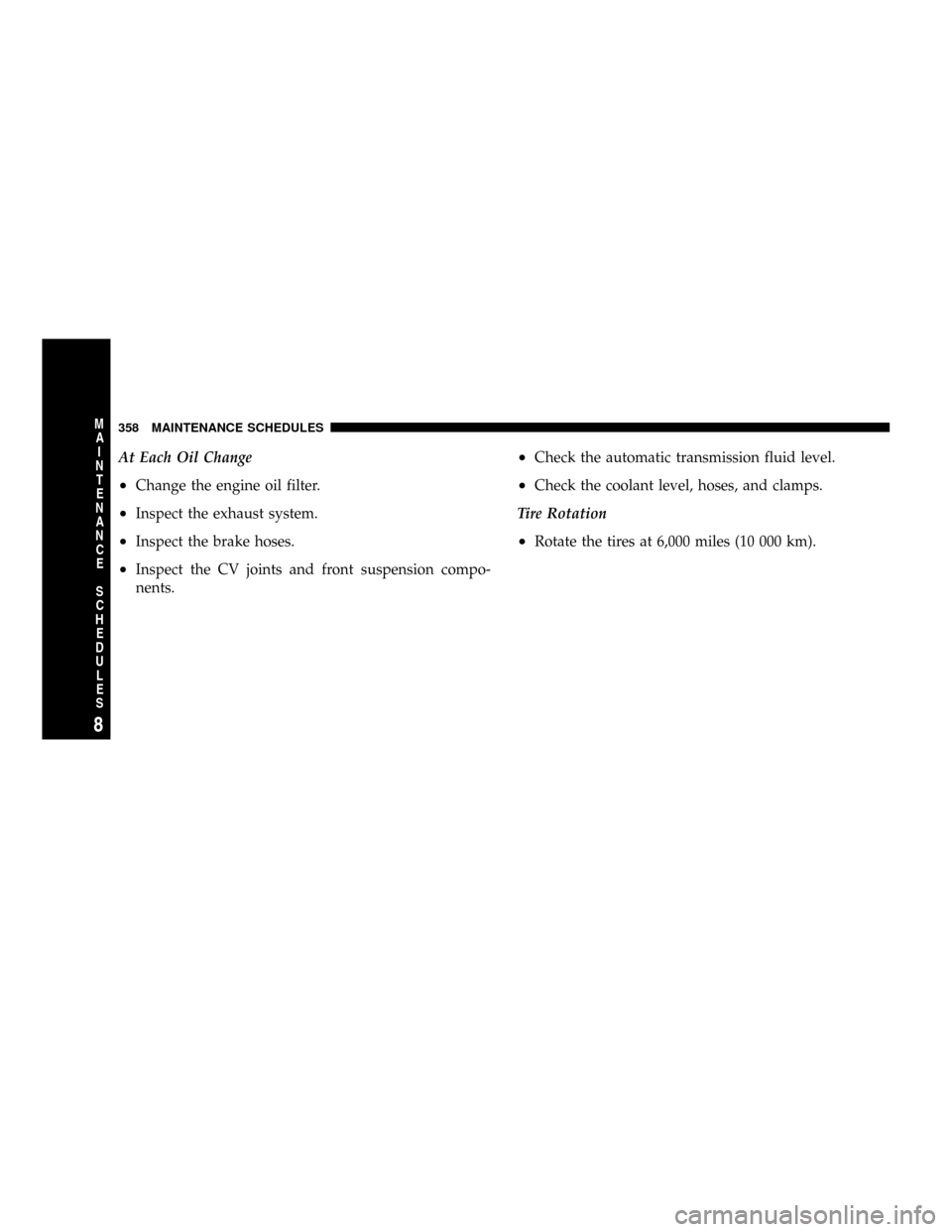
At Each Oil Change
²Change the engine oil filter.
²Inspect the exhaust system.
²Inspect the brake hoses.
²Inspect the CV joints and front suspension compo-
nents.
²Check the automatic transmission fluid level.
²Check the coolant level, hoses, and clamps.
Tire Rotation
²Rotate the tires at 6,000 miles (10 000 km).
358 MAINTENANCE SCHEDULES
8
M
A
I
N
T
E
N
A
N
C
E
S
C
H
E
D
U
L
E
S
Page 364 of 401
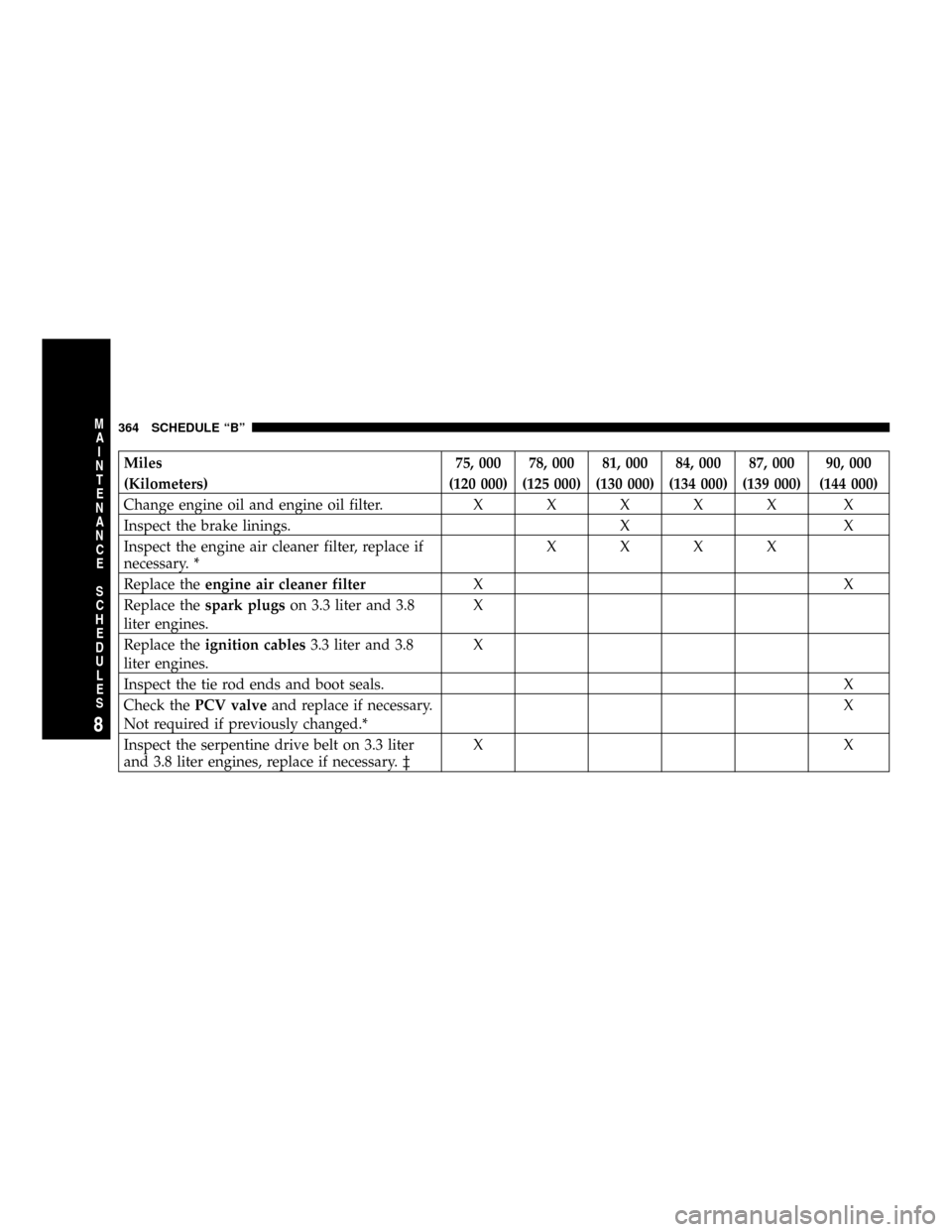
Miles 75, 000 78, 000 81, 000 84, 000 87, 000 90, 000
(Kilometers) (120 000) (125 000) (130 000) (134 000) (139 000) (144 000)
Change engine oil and engine oil filter.XXXXX X
Inspect the brake linings. X X
Inspect the engine air cleaner filter, replace if
necessary. *XXXX
Replace theengine air cleaner filterXX
Replace thespark plugson 3.3 liter and 3.8
liter engines.X
Replace theignition cables3.3 liter and 3.8
liter engines.X
Inspect the tie rod ends and boot seals. X
Check thePCV valveand replace if necessary.
Not required if previously changed.*X
Inspect the serpentine drive belt on 3.3 liter
and 3.8 liter engines, replace if necessary. ³XX
364 SCHEDULE ªBº
8
M
A
I
N
T
E
N
A
N
C
E
S
C
H
E
D
U
L
E
S
Page 370 of 401
Miles 42, 000 48, 000 54, 000 60, 000 66, 000 72, 000
(Kilometers) (67 000) (77 000) (86 000) (96 000) (106 000) (115 000)
[Months] [42] [48] [54] [60] [66] [72]
Change engine oil and engine oil filter. X XXXXX
Inspect the brake linings. X X
Inspect the engine air cleaner filter, replace if
necessary. *XXX XX
Replace theengine air cleaner filter.X
Inspect the tie rod ends and boot seals. X
Check thePCV valveand replace, if neces-
sary.*X
Inspect the serpentine drive belt on 3.3 liter
and 3.8 liter engines, replace if necessary. ³XX
Flush and replace the engine coolant at 60
months, regardless of mileage.X
Replace the air conditioning filter. X X X
370 SCHEDULE ªAº
8
M
A
I
N
T
E
N
A
N
C
E
S
C
H
E
D
U
L
E
S
![CHRYSLER TOWN AND COUNTRY 2004 4.G Owners Manual Miles 42, 000 48, 000 54, 000 60, 000 66, 000 72, 000
(Kilometers) (67 000) (77 000) (86 000) (96 000) (106 000) (115 000)
[Months] [42] [48] [54] [60] [66] [72]
Change engine oil and engine oil filte](/manual-img/25/8553/w960_8553-369.png "CHRYSLER TOWN AND COUNTRY 2004 4.G Owners Manual Miles 42, 000 48, 000 54, 000 60, 000 66, 000 72, 000
(Kilometers) (67 000) (77 000) (86 000) (96 000) (106 000) (115 000)
[Months] [42] [48] [54] [60] [66] [72]
Change engine oil and engine oil filte")