Page 184 of 277
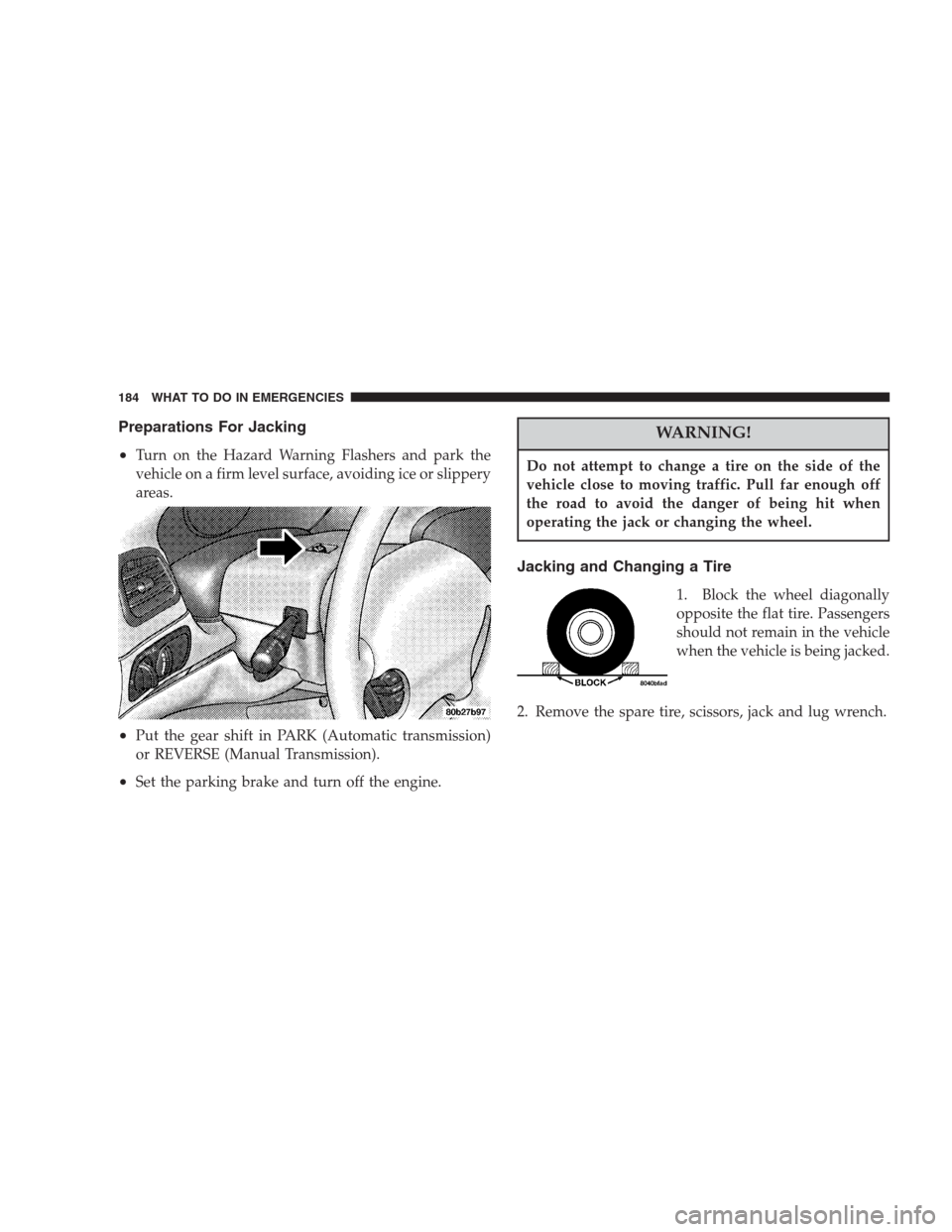
Preparations For Jacking
•
Turn on the Hazard Warning Flashers and park the
vehicle on a firm level surface, avoiding ice or slippery
areas.
•Put the gear shift in PARK (Automatic transmission)
or REVERSE (Manual Transmission).
•Set the parking brake and turn off the engine.
WARNING!
Do not attempt to change a tire on the side of the
vehicle close to moving traffic. Pull far enough off
the road to avoid the danger of being hit when
operating the jack or changing the wheel.
Jacking and Changing a Tire
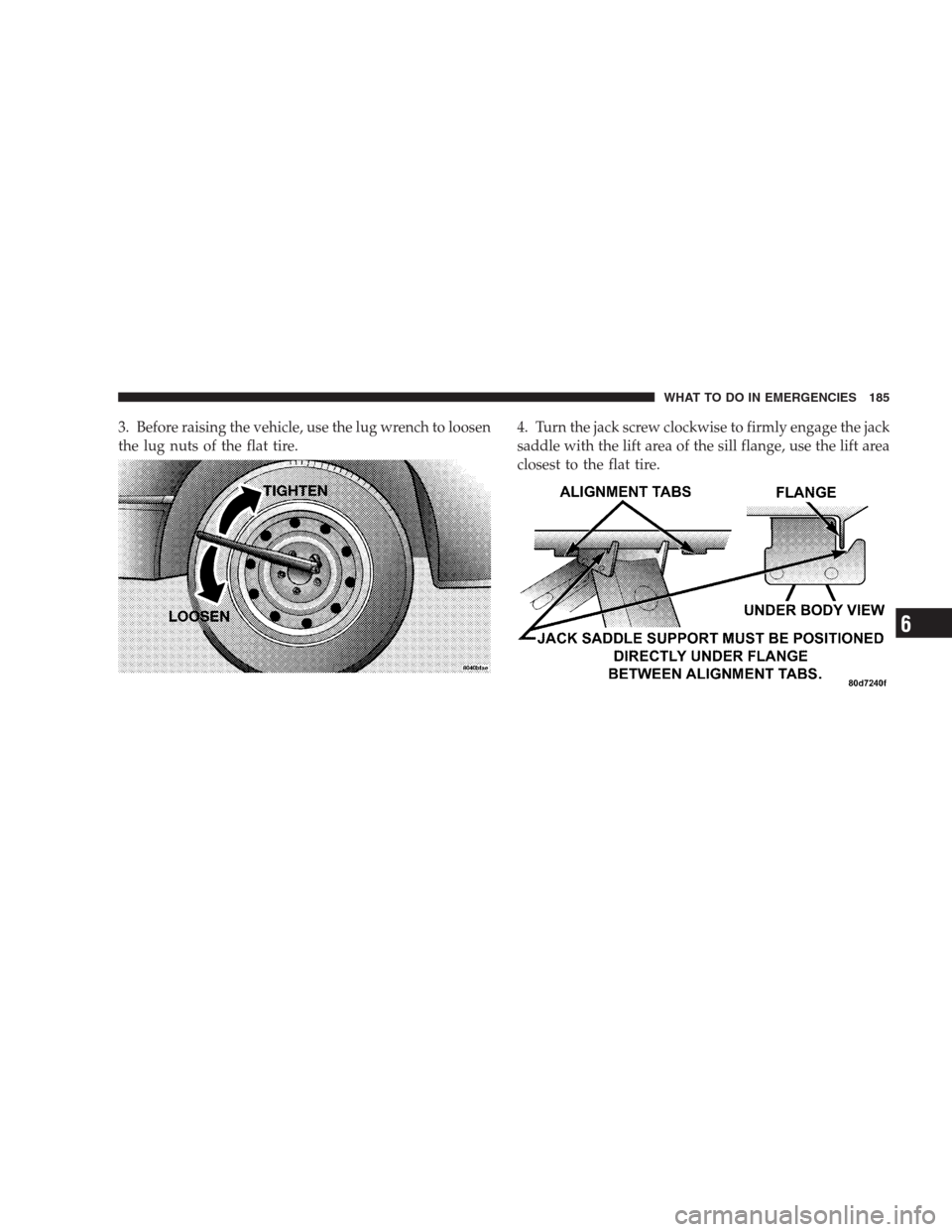
1. Block the wheel diagonally
opposite the flat tire. Passengers
should not remain in the vehicle
when the vehicle is being jacked.
2. Remove the spare tire, scissors, jack and lug wrench.
184 WHAT TO DO IN EMERGENCIES
Page 185 of 277
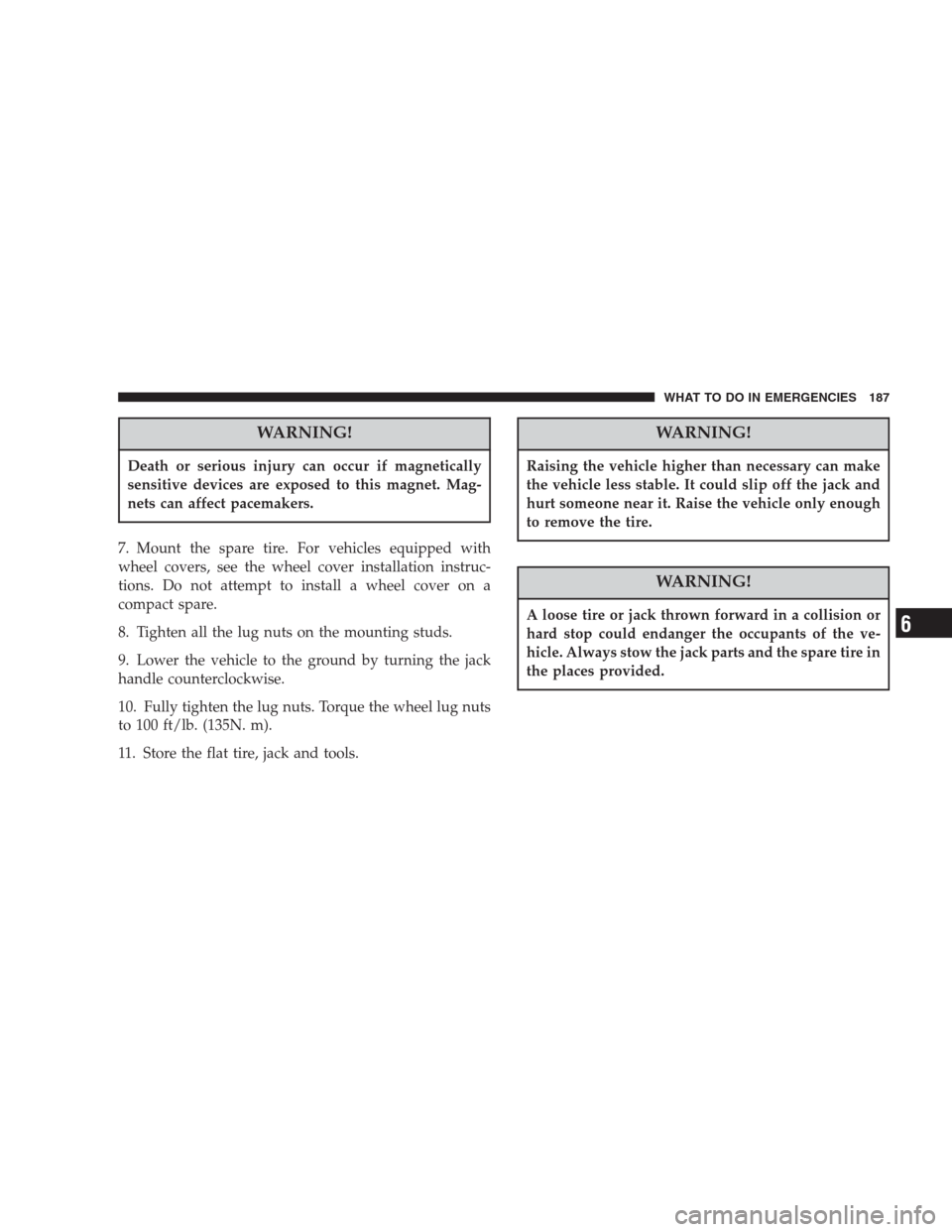
3. Before raising the vehicle, use the lug wrench to loosen
the lug nuts of the flat tire.4. Turn the jack screw clockwise to firmly engage the jack
saddle with the lift area of the sill flange, use the lift area
closest to the flat tire.
WHAT TO DO IN EMERGENCIES 185
6
Page 187 of 277
WARNING!
Death or serious injury can occur if magnetically
sensitive devices are exposed to this magnet. Mag-
nets can affect pacemakers.
7. Mount the spare tire. For vehicles equipped with
wheel covers, see the wheel cover installation instruc-
tions. Do not attempt to install a wheel cover on a
compact spare.
8. Tighten all the lug nuts on the mounting studs.
9. Lower the vehicle to the ground by turning the jack
handle counterclockwise.
10. Fully tighten the lug nuts. Torque the wheel lug nuts
to 100 ft/lb. (135N. m).
11. Store the flat tire, jack and tools.
WARNING!
Raising the vehicle higher than necessary can make
the vehicle less stable. It could slip off the jack and
hurt someone near it. Raise the vehicle only enough
to remove the tire.
WARNING!
A loose tire or jack thrown forward in a collision or
hard stop could endanger the occupants of the ve-
hicle. Always stow the jack parts and the spare tire in
the places provided.
WHAT TO DO IN EMERGENCIES 187
6
Page 195 of 277
MAINTAINING YOUR VEHICLE
CONTENTS
�3.5L Engine..........................197
�Onboard Diagnostic System (OBD II).......198
�Emissions Inspection And Maintenance
Programs
............................199
�Replacement Parts.....................200
�Dealer Service........................200
�Maintenance Procedures.................201
▫Engine Oil..........................201
▫Chassis Lubrication....................210
▫Drive Shaft Universal Joints..............211
▫Body Lubrication.....................211
▫Windshield Wiper Blades................212▫Windshield Washers...................213
▫Exhaust System......................213
▫Cooling System.......................214
▫Hoses And Vacuum/Vapor Harnesses.......218
▫Brakes.............................218
▫Fuel System Hoses....................220
▫Automatic Transaxle...................221
▫Appearance Care And Protection From
Corrosion...........................223
�Fuses...............................227
▫Fuse Block Relays.....................227
▫Underhood Fuses.....................228
7
Page 211 of 277
Drive Shaft Universal Joints
Your vehicle has four constant velocity universal joints.
Periodic lubrication of these joints is not required. How-
ever, the joint boots should be inspected for external
leakage or damage when other maintenance is per-
formed.
If leakage or damage is evident, replace the universal
joint boot and grease immediately.
Continued operation could result in failure of the univer-
sal joint due to water and dirt contamination of the
grease. This would require complete replacement of the
joint assembly.
Body Lubrication
Body and other operating mechanisms and linkages
should be inspected, cleaned, and lubricated, as required,
to maintain ease of operation and to provide protection
against rust and wear.
Before the application of any lubricant, the parts con-
cerned should be wiped clean to remove dust and grit;
after lubricating, excess oil or grease should be removed.
Hood Latch
When performing other under hood services, the hood
latch release mechanism and safety catch should be
inspected, cleaned, and lubricated.
It is important to maintain proper lubrication to insure
that the hood mechanisms work properly and safely.
Multi-Purpose Lubricant, NLGI Grade 2, should be ap-
plied sparingly to all pivot and sliding contact areas.
External Lock Cylinders
Lubricate the external lock cylinders twice a year, prefer-
ably in the fall and spring. Apply a small amount of
lubricant, such as Mopar Lock Cylinder Lubricant, di-
rectly into the lock cylinder (avoid excess lubricant).
Insert the key into the lock cylinder and rotate from the
unlocked to the locked position; without adding more
lubricant. Repeat this procedure three or four times. Wipe
all the lubricant off the key with a clean cloth, to avoid
soiling clothing.
If you use a lubricant that cannot be dispensed directly
into the lock cylinder, apply a small amount of the
lubricant to the key. Insert the key into the lock cylinder,
MAINTAINING YOUR VEHICLE 211
7
Page 212 of 277
then proceed as described above, to distribute the lubri-
cant within the lock cylinder. Pay attention to trunk
hinges, especially during cold weather, to ensure ease of
trunk operation.
Other Body Mechanisms
The following body mechanisms should be inspected
and, if necessary, all pivot and sliding contact areas of
these components should be lubricated with the lubricant
specified as follows:
Engine Oil
•
Door hinges
•Hood hinges
•Trunk hinges
Smooth White Body Lubricant - Such as Mopar
Spray White Lube:
•
Hood hinge springs and links
•Lock cylinders
•Parking brake mechanism
•Trunk latches
•Ash tray
•Door check straps
Windshield Wiper Blades
Clean the rubber edges of the wiper blades and the
windshield periodically with a sponge or soft cloth and a
mild non abrasive cleaner. This will remove accumula-
tions of salt or road film.
Operation of the wipers on dry glass for long periods
may cause deterioration of the wiper blades. Always use
washer fluid when using the wipers to remove salt or dirt
from a dry windshield. Avoid using the wiper blades to
remove frost or ice from the windshield. Keep the blade
rubber out of contact with petroleum products such as
engine oil, gasoline, etc.
212 MAINTAINING YOUR VEHICLE
Page 227 of 277
protectants or other products which may cause undesir-
able reflections. Use soap and warm water to restore the
low glare surface.
Cleaning Plastic Instrument Cluster Lenses
The lenses in front of the instruments in this vehicle are
molded in clear plastic. When cleaning the lenses, care
must be taken to avoid scratching the plastic.
•Clean with a wet soft rag. A mild soap solution may be
used, but do not use high alcohol content or abrasive
cleaners. If soap is used, wipe clean with a clean damp
rag.
•Dry with a soft tissue.
Seat Belt Maintenance
Do not bleach, dye or clean the belts with chemical
solvents or abrasive cleaners. This will weaken the fabric.
If the belts need cleaning, use a mild soap solution or
lukewarm water. Do not remove the belts from the
vehicle to wash them.
Replace the belts if they appear frayed or worn or if the
buckles do not work properly.
FUSES
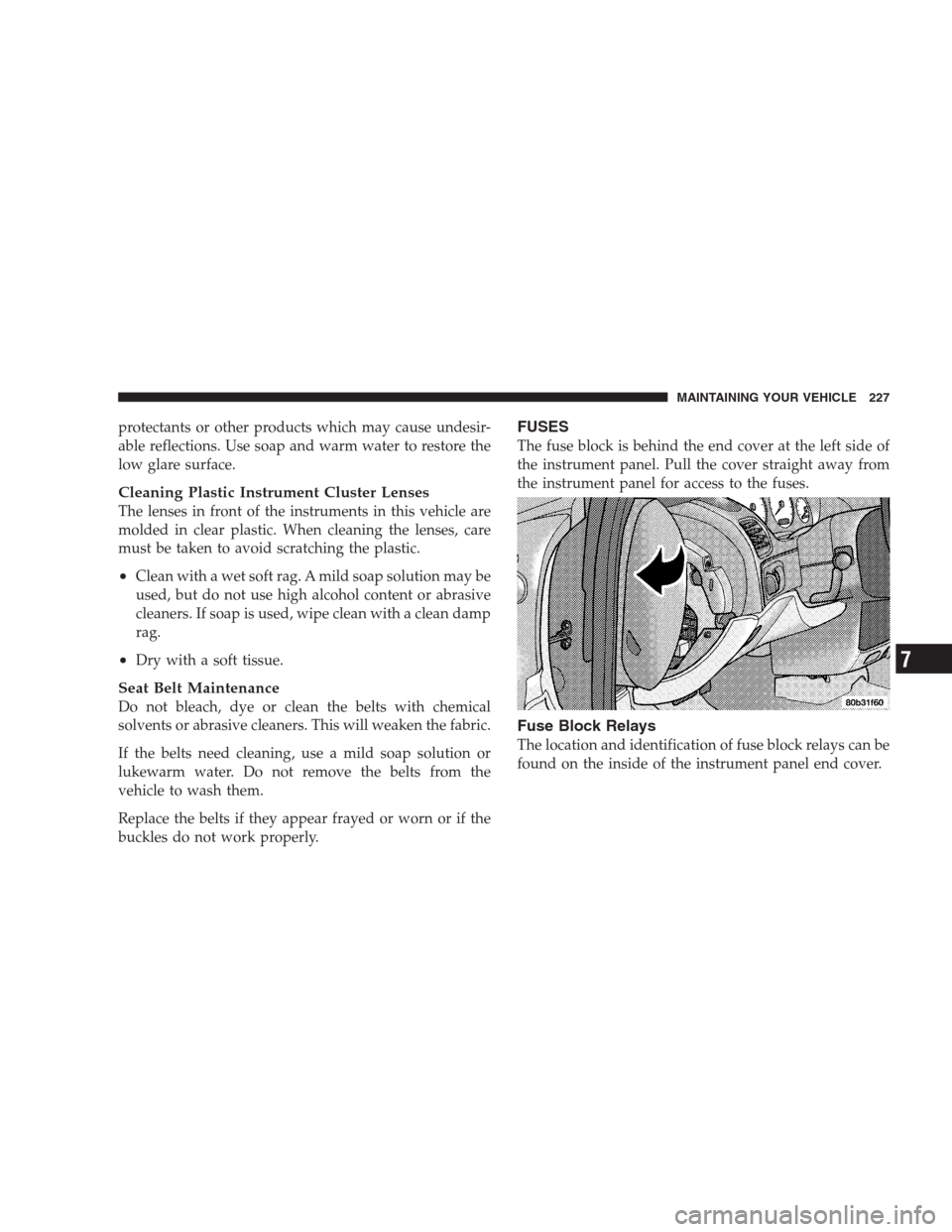
The fuse block is behind the end cover at the left side of
the instrument panel. Pull the cover straight away from
the instrument panel for access to the fuses.
Fuse Block Relays
The location and identification of fuse block relays can be
found on the inside of the instrument panel end cover.
MAINTAINING YOUR VEHICLE 227
7
Page 229 of 277
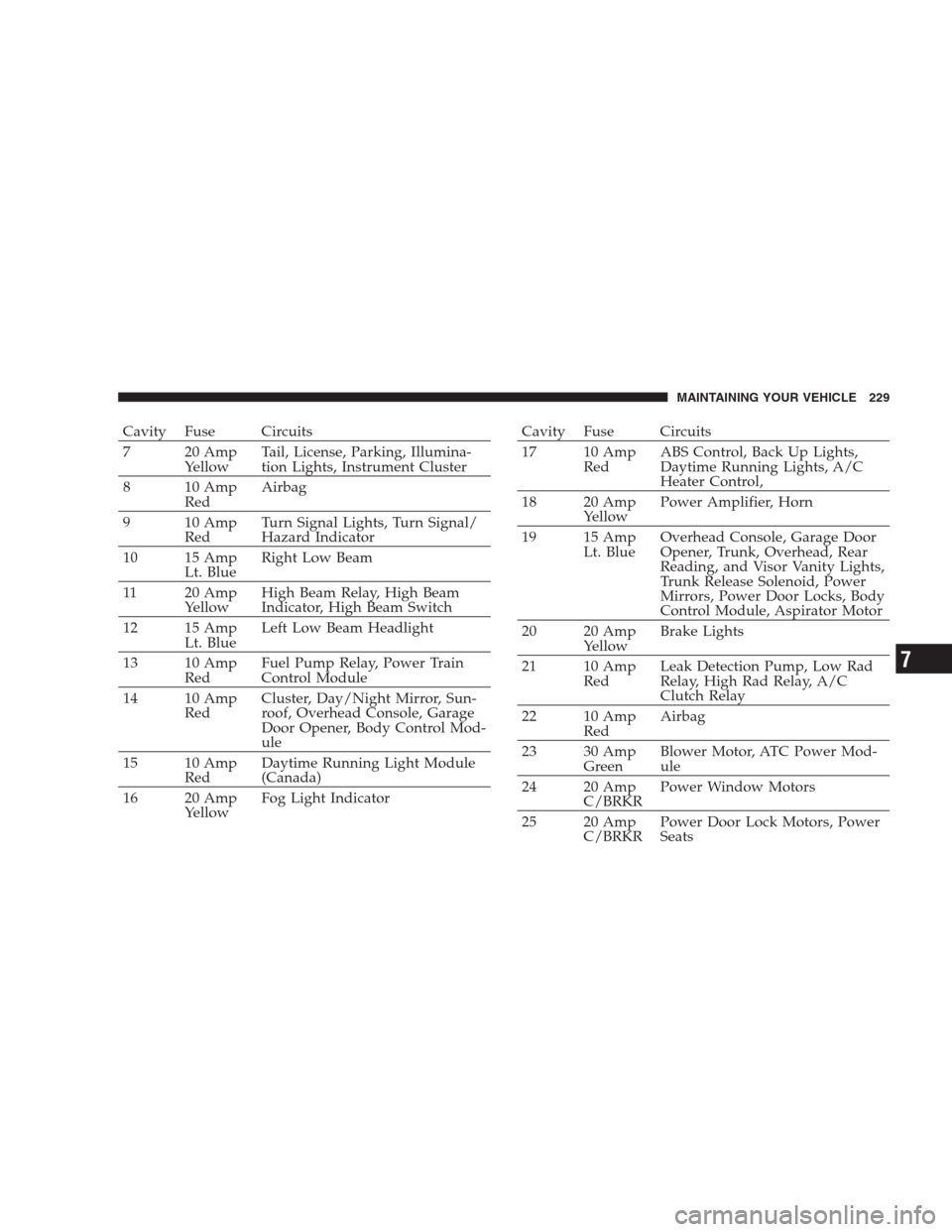
Cavity Fuse Circuits
7 20 Amp
YellowTail, License, Parking, Illumina-
tion Lights, Instrument Cluster
8 10 Amp
RedAirbag
9 10 Amp
RedTurn Signal Lights, Turn Signal/
Hazard Indicator
10 15 Amp
Lt. BlueRight Low Beam
11 20 Amp
YellowHigh Beam Relay, High Beam
Indicator, High Beam Switch
12 15 Amp
Lt. BlueLeft Low Beam Headlight
13 10 Amp
RedFuel Pump Relay, Power Train
Control Module
14 10 Amp
RedCluster, Day/Night Mirror, Sun-
roof, Overhead Console, Garage
Door Opener, Body Control Mod-
ule
15 10 Amp
RedDaytime Running Light Module
(Canada)
16 20 Amp
YellowFog Light IndicatorCavity Fuse Circuits
17 10 Amp
RedABS Control, Back Up Lights,
Daytime Running Lights, A/C
Heater Control,
18 20 Amp
YellowPower Amplifier, Horn
19 15 Amp
Lt. BlueOverhead Console, Garage Door
Opener, Trunk, Overhead, Rear
Reading, and Visor Vanity Lights,
Trunk Release Solenoid, Power
Mirrors, Power Door Locks, Body
Control Module, Aspirator Motor
20 20 Amp
YellowBrake Lights
21 10 Amp
RedLeak Detection Pump, Low Rad
Relay, High Rad Relay, A/C
Clutch Relay
22 10 Amp
RedAirbag
23 30 Amp
GreenBlower Motor, ATC Power Mod-
ule
24 20 Amp
C/BRKRPower Window Motors
25 20 Amp
C/BRKRPower Door Lock Motors, Power
Seats
MAINTAINING YOUR VEHICLE 229
7