Page 152 of 277
Outside Air Intake
Make sure that the air intake directly in front of the
windshield is free of obstructions. Leaves, snow, etc.,
could block air flow into the vehicle.
152 UNDERSTANDING YOUR INSTRUMENT PANEL
Page 153 of 277

STARTING AND OPERATING
CONTENTS
�Starting Procedures....................155
▫Normal Starting......................155
▫Extremely Cold Weather
(Below -20°F Or -29°C).................155
▫If Engine Fails To Start.................156
▫After Starting........................157
�Engine Block Heater — Optional U.S. And
Standard Canada
......................157
�Automatic Transaxle....................157
▫Brake/Transmission Interlock.............157
▫Transaxle Reset Mode..................158
▫Gear Ranges.........................158
�Autostick............................159
▫Autostick Operation...................159
▫Autostick General Information............160
�Parking Brake.........................161
�Brake System.........................162
▫Anti-Lock Brake System (ABS)............163
�Power Steering........................163
�Traction Control.......................163
�Ti re s................................164
▫Tire Inflation Pressures.................165
▫Tire Pressure Monitor System — If Equipped . . 166
▫High Speed Operation..................168
5
Page 155 of 277

STARTING PROCEDURES
WARNING!
Do not leave children or animals inside parked
vehicles in hot weather. Interior heat build up may
cause serious injury or death.
The gear selector must be in the NEUTRAL or PARK
position before you can start the engine. Apply the brakes
before shifting to any driving gear.
Normal Starting
Normal Starting of either a cold or a warm engine does
not require pumping or depressing the accelerator pedal.
Simply turn the key to the “START” position and release
when the engine starts. If the engine has not started
within 3 seconds, slightly depress the accelerator pedal
while continuing to crank. If the engine fails to start
within 15 seconds, turn the key to the “OFF” position,
wait 10 to 15 seconds, then repeat the normal starting
procedure.
Extremely Cold Weather (below -20°F or -29°C)
For reliable starting at these temperatures, use externally
powered battery and electric engine block heaters that
are available from your dealer.
STARTING AND OPERATING 155
5
Page 157 of 277

After Starting
The idle speed will automatically decrease as the engine
warms up.
ENGINE BLOCK HEATER — Optional U.S. and
Standard Canada
These heaters use a common power cord which is stored
under the hood, behind the Air Cleaner housing. Plug the
cord into any 110 volt AC outlet and both heaters will be
energized. Use the heaters when temperatures below 0°F
(-18°C) are expected to last for several days.
AUTOMATIC TRANSAXLE
Brake/Transmission Interlock
This interlock system prevents you from moving the gear
selector out of the Park position unless the brake pedal is
pressed. This system is active only while the key is in the
RUN position.
CAUTION!
Damage to the transaxle may occur if the following
precautions are not observed:
•Shift into PARK only after the vehicle has come to a
complete stop.
•Shift into or out of REVERSE only after the vehicle has
come to a complete stop and the engine is at idle
speed.
•Do not shift from REVERSE, PARK or NEUTRAL into
any forward gear when the engine is above idle speed.
•Before shifting into any gear, make sure your foot is
firmly on the brake pedal.
The electronically controlled transaxle provides a precise
shift schedule. The transaxle electronics are self-
calibrating. Therefore, the first few shifts on a new
vehicle may be somewhat abrupt. This is a normal
condition, and precision shifts will develop within a few
shift cycles.
STARTING AND OPERATING 157
5
Page 158 of 277

Transaxle Reset Mode
The transaxle is monitored for abnormal conditions. If a
condition is detected that could cause damage, the trans-
axle automatically shifts into second gear. The transaxle
remains in second gear despite the forward gear selected.
Park (P), Reverse (R), and Neutral (N) will continue to
operate. This Reset feature allows the vehicle to be driven
to a dealer for service without damaging the transaxle.
If the problem has been momentary, the transaxle can be
reset to regain all forward gears.
•Stop the vehicle and shift into PARK (P).
•Turn the key to OFF then start the engine.
•Shift into “D” and resume driving.
NOTE:Even if the transaxle can be reset, we recom-
mend that you visit a dealer at your earliest possible
convenience. Your dealer has diagnostic equipment to
determine if the problem could recur.
If the transaxle cannot be reset, dealer service is required.
Gear Ranges
“P” Park
NOTE:
If the key is in the RUN position, you must
press the brake pedal to shift out of the “P” Park position.
Supplements the parking brake by locking the transaxle.
Engine can be started in this range. Never attempt to use
PARK while vehicle is in motion.
Apply parking brake when leaving vehicle in this range.
“R” Reverse
Shift into this range only after the vehicle has come to a
complete stop.
“N” Neutral
The engine may be started in this range. Use this range
for starting your vehicle if it is moving or is being towed.
“D” Overdrive
This range should be used for most city and highway
driving. It provides smoothest up shifts and down shifts
and best fuel economy.
158 STARTING AND OPERATING
Page 161 of 277
PARKING BRAKE
When the parking brake is applied with the ignition on,
the red Brake light in the instrument cluster will come on.
NOTE:This light only shows that the parking brake is
applied. It does not show the degree of brake application.
Before leaving the vehicle, make sure that the parking
brake is fully applied and place the gear selector in the
Park position.
To release the parking brake, pull the release lever
located on the lower edge of the instrument panel.When parking on a hill, you must set the parking brake
beforeplacing the gear selector in Park. If you don’t, the
load on the transmission locking mechanism may make it
difficult to move the selector out of Park. As an added
precaution, turn the front wheels toward the curb on a
downhill grade and away from the curb on an uphill
grade.
The parking brake should always be applied when the
driver is not in the vehicle.
STARTING AND OPERATING 161
5
Page 163 of 277

Anti-Lock Brake System (ABS)
The ABS gives increased vehicle stability and brake
performance under most braking conditions. The system
automatically “pumps” the brakes during severe braking
conditions to prevent wheel lock-up.
All vehicle wheels and tires must be the same size and
tires must be properly inflated to produce accurate
signals for the ABS computer. However, the system will
compensate when the compact spare is in use.
During stops where ABS is activated, a vibration of the
brake pedal may be felt and associated system noises
may be heard.
WARNING!
Pumping of the brake pedal will diminish the effec-
tiveness of Anti-lock brakes and may lead to an
accident. Pumping makes the stopping distance
longer. Just press firmly on your brake pedal when
you need to slow down or stop.
POWER STEERING
Your vehicle is equipped with power assisted steering as
standard equipment. The power assisted steering system
of your vehicle provides mechanical steering capability
in the event power assist is lost.
If for some reason the hydraulic pressure is interrupted,
it will still be possible to steer your vehicle. Under these
conditions you will observe a substantial increase in
steering effort.
TRACTION CONTROL
The Traction Control System reduces wheel slip and
maintains traction at the driving (front) wheels. The
system reduces wheel slip by engaging the brake on the
wheel that is losing traction while spinning. The traction
system operates at speeds below 35 mph (56 km/h).
The system is always in the “stand by” mode unless:
•The Traction Control switch has been used to turn the
system off;
•There is a Anti-Lock Brake System malfunction;
•There is a Traction Control System malfunction;
STARTING AND OPERATING 163
5
Page 182 of 277
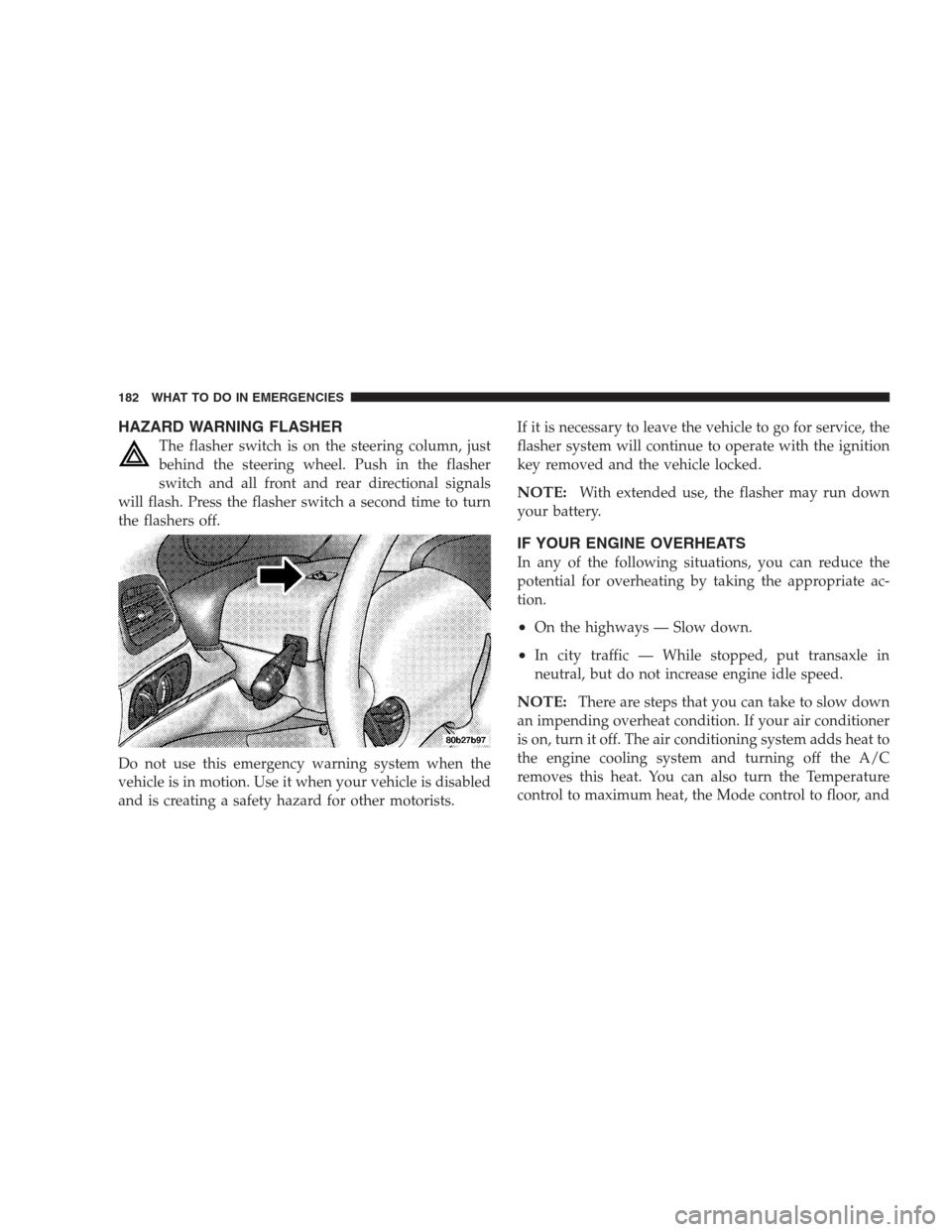
HAZARD WARNING FLASHER
The flasher switch is on the steering column, just
behind the steering wheel. Push in the flasher
switch and all front and rear directional signals
will flash. Press the flasher switch a second time to turn
the flashers off.
Do not use this emergency warning system when the
vehicle is in motion. Use it when your vehicle is disabled
and is creating a safety hazard for other motorists.If it is necessary to leave the vehicle to go for service, the
flasher system will continue to operate with the ignition
key removed and the vehicle locked.
NOTE:With extended use, the flasher may run down
your battery.
IF YOUR ENGINE OVERHEATS
In any of the following situations, you can reduce the
potential for overheating by taking the appropriate ac-
tion.
•On the highways — Slow down.
•In city traffic — While stopped, put transaxle in
neutral, but do not increase engine idle speed.
NOTE:There are steps that you can take to slow down
an impending overheat condition. If your air conditioner
is on, turn it off. The air conditioning system adds heat to
the engine cooling system and turning off the A/C
removes this heat. You can also turn the Temperature
control to maximum heat, the Mode control to floor, and
182 WHAT TO DO IN EMERGENCIES