Page 196 of 374
Dinghy Towing
To tow your vehicle from the front (four-wheel-drive
only), do the following:
Notice:If you tow a two-wheel-drive vehicle with all
four wheels on the ground, the transmission
could be damaged. The repairs would not be
covered by your warranty. Do not tow a
two-wheel-drive vehicle with all four wheels on the
ground.
Follow these steps:
1. Set the parking brake.
2. Shift your automatic transmission into PARK (P), or
your manual transmission to SECOND (2).
3. With the ignition key in the ON position, move the
transfer case to NEUTRAL and make sure the
4WD light on the instrument panel cluster is off.
See
Four-Wheel Drive on page 5-49.
4. Turn the ignition key to ACC.
5. Release the parking brake.
4-48
Page 198 of 374

Dolly Towing
To tow your vehicle from the rear, do the following:
The best way to tow your vehicle is from the rear.
Follow these steps:
1. Put the rear wheels on a dolly.
Notice:If you tow a two-wheel-drive vehicle with
the rear wheels on the ground, the transmission
could be damaged. The repairs would not be
covered by your warranty. Never tow your vehicle
with the rear wheels on the ground.2. If your vehicle is a four-wheel-drive vehicle, turn the
ignition key to ON, move the transfer case lever
into NEUTRAL and make sure the 4WD light on the
instrument panel cluster is turned off. See
Four-Wheel Drive on page 5-49.
3. Turn the ignition key to ACC.
4. Make sure the front wheels are facing straight
forward and secure the steering wheel with a
steering wheel clamping device designed for towing.
Notice:If you exceed 55 mph (90 km/h) while
towing your vehicle, it could be damaged. Never
exceed 55 mph (90 km/h) while towing your vehicle.
{CAUTION:
Shifting a four-wheel-drive vehicle's transfer
case into NEUTRAL can cause your vehicle to
roll even if the transmission is in Park (P) for
an automatic transmission, or if your vehicle is
in gear, for a manual transmission. You or
others could be injured. Make sure the parking
brake is ®rmly set before you shift the transfer
case to NEUTRAL.
4-50
Page 210 of 374

Making Turns
Notice:Making very sharp turns while trailering
could cause the trailer to come in contact with the
vehicle. Your vehicle could be damaged. Avoid
making very sharp turns while trailering.
When you're turning with a trailer, make wider turns
than normal. Do this so your trailer won't strike
soft shoulders, curbs, road signs, trees or other objects.
Avoid jerky or sudden maneuvers. Signal well in
advance.
Turn Signals When Towing a Trailer
When you tow a trailer, your vehicle has to have extra
wiring.
The arrows on your instrument panel will ¯ash whenever
you signal a turn or lane change. Properly hooked up,
the trailer lamps will also ¯ash, telling other drivers
you're about to turn, change lanes or stop.When towing a trailer, the arrows on your instrument
panel may ¯ash for turns even if the bulbs on the trailer
are burned out. Thus, you may think drivers behind
you are seeing your signal when they are not. It's
important to check occasionally to be sure the trailer
bulbs are still working.
Driving On Grades
Reduce speed and shift to a lower gearbeforeyou start
down a long or steep downgrade. If you don't shift
down, you might have to use your brakes so much that
they would get hot and no longer work well.
If you are towing a trailer and you have a manual
transmission with FIFTH (5) gear, you may prefer not to
use FIFTH (5). Just drive in FOURTH (4) (or, as you
need to, a lower gear).
4-62
Page 222 of 374
Checking Things Under
the Hood
{CAUTION:
An electric fan under the hood can start up
and injure you even when the engine is not
running. Keep hands, clothing and tools away
from any underhood electric fan. Do not reach
through the grille to release the underhood
lever.
{CAUTION:
Things that burn can get on hot engine parts
and start a ®re. These include liquids like fuel,
oil, coolant, brake ¯uid, windshield washer and
other ¯uids, and plastic or rubber. You or
others could be burned. Be careful not to drop
or spill things that will burn onto a hot engine.
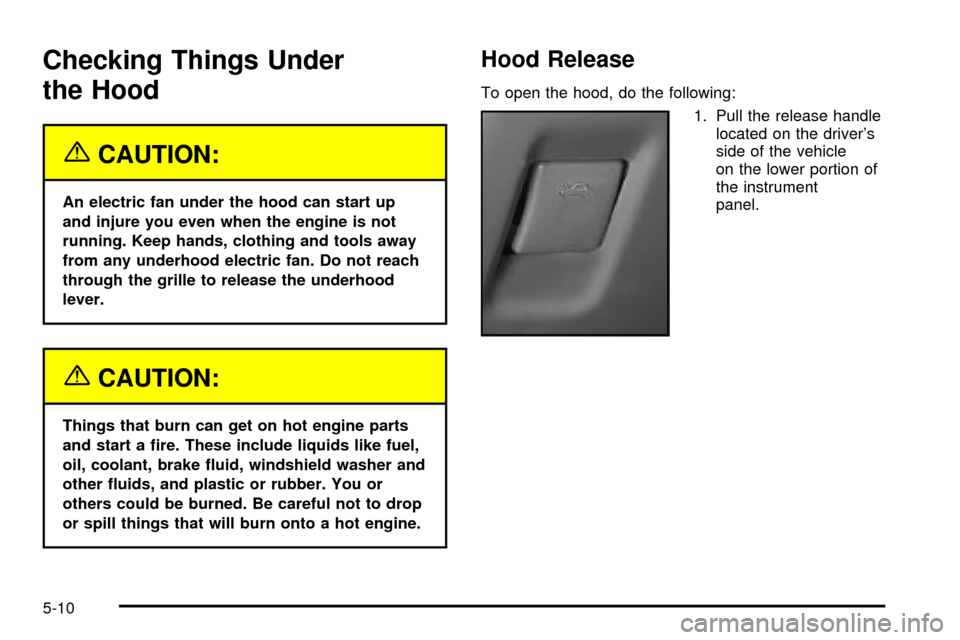
Hood Release
To open the hood, do the following:
1. Pull the release handle
located on the driver's
side of the vehicle
on the lower portion of
the instrument
panel.
5-10
Page 240 of 374
Radiator Pressure Cap
SeeEngine Compartment Overview on page 5-12for
information on location.
Notice:If the pressure cap is not tightly installed,
coolant loss and possible engine damage may
occur. Be sure the cap is properly and tightly
secured.
Engine Overheating
You will ®nd a coolant temperature gage on your
vehicle's instrument panel cluster. SeeEngine Coolant
Temperature Gage on page 3-32.
5-28
Page 300 of 374

Cleaning the Top of the Instrument
Panel
Use only mild soap and water to clean the top surfaces
of the instrument panel. Sprays containing silicones
or waxes may cause annoying re¯ections in the
windshield and even make it difficult to see through the
windshield under certain conditions.
Cleaning Interior Plastic Components
Use only a mild soap and water solution on a soft cloth
or sponge. Commercial cleaners may affect the
surface ®nish.
Cleaning Glass Surfaces
Glass should be cleaned often. GM Glass Cleaner or a
liquid household glass cleaner will remove normal
tobacco smoke and dust ®lms on interior glass. See
Vehicle Care/Appearance Materials on page 5-92.
Notice:If you use abrasive cleaners when cleaning
glass surfaces on your vehicle, you could scratch
the glass and/or cause damage to the rear window
defogger and the integrated radio antenna. When
cleaning the glass on your vehicle, use only a soft
cloth and glass cleaner.
Care of Safety Belts
Keep belts clean and dry.
{CAUTION:
Do not bleach or dye safety belts. If you do, it
may severely weaken them. In a crash, they
might not be able to provide adequate
protection. Clean safety belts only with mild
soap and lukewarm water.
Weatherstrips
Silicone grease on weatherstrips will make them last
longer, seal better, and not stick or squeak. Apply
silicone grease with a clean cloth at least every
six months. During very cold, damp weather more
frequent application may be required. See
Part
D: Recommended Fluids and Lubricants on page 6-30.
5-88
Page 305 of 374

Vehicle Identi®cation
Vehicle Identi®cation Number (VIN)
This is the legal identi®er for your vehicle. It appears on
a plate in the front corner of the instrument panel, on
the driver's side. You can see it if you look through the
windshield from outside your vehicle. The VIN also
appears on the Vehicle Certi®cation and Service Parts
labels and the certi®cates of title and registration.
Engine Identi®cation
The 8th character in your VIN is the engine code. This
code will help you identify your engine, speci®cations
and replacement parts.
Service Parts Identi®cation Label
You'll ®nd this label inside the glove box on the door. It's
very helpful if you ever need to order parts. On this
label is:
·your VIN,
·the model designation,
·paint information and
·a list of all production options and special
equipment.
Be sure that this label is not removed from the vehicle.
Electrical System
Add-On Electrical Equipment
Notice:Don't add anything electrical to your
vehicle unless you check with your dealer ®rst.
Some electrical equipment can damage your vehicle
and the damage wouldn't be covered by your
warranty. Some add-on electrical equipment can
keep other components from working as they
should.
Your vehicle has an air bag system. Before attempting
to add anything electrical to your vehicle, see
Servicing Your Air Bag-Equipped Vehicle on page 1-58.
5-93
Page 306 of 374

Fuses and Circuit Breakers
The wiring circuits in your vehicle are protected from
short circuits by fuses, circuit breakers and thermal links
in the wiring itself. This greatly reduces the chance of
®res caused by electrical problems.
Look at the metallic band inside the fuse. If the band is
broken or melted, replace the fuse. Be sure you
replace a bad fuse with a new one of the correct size.
If you ever have a problem on the road and don't have a
spare fuse, you can borrow one. Just pick some
feature of your vehicle that you can get along
without Ð like the radio or cigarette lighter Ð and use
its fuse, if it is the size you need. Replace it as soon as
you can.
Before replacing a fuse, turn every vehicle electrical
switch off.
There are two fuse blocks in your vehicle: the instrument
panel fuse block and the engine compartment fuse
block.
Instrument Panel Fuse Block
This fuse block is located under the driver's side of the
instrument panel. The fuses here protect each
separate circuit including headlamps. There are spare
fuses inside the fuse box. If you have electrical
failure, check here ®rst.
5-94