Page 319 of 398

Wheel Alignment and Tire Balance
The wheels on your vehicle were aligned and balanced
carefully at the factory to give you the longest tire life
and best overall performance.
Scheduled wheel alignment and wheel balancing are
not needed. However, if you notice unusual tire wear or
your vehicle pulling one way or the other, the alignment
may need to be reset. If you notice your vehicle
vibrating when driving on a smooth road, your wheels
may need to be rebalanced.
Wheel Replacement
Replace any wheel that is bent, cracked, or badly rusted
or corroded. If wheel nuts keep coming loose, the
wheel, wheel bolts and wheel nuts should be replaced.
If the wheel leaks air, replace it (except some
aluminum wheels, which can sometimes be repaired).
See your dealer if any of these conditions exist.
Your dealer will know the kind of wheel you need.
Each new wheel should have the same load-carrying
capacity, diameter, width, offset and be mounted
the same way as the one it replaces.If you need to replace any of your wheels, wheel bolts
or wheel nuts, replace them only with new GM
original equipment parts. This way, you will be sure to
have the right wheel, wheel bolts and wheel nuts
for your vehicle.
{CAUTION:
Using the wrong replacement wheels, wheel
bolts or wheel nuts on your vehicle can be
dangerous. It could affect the braking and
handling of your vehicle, make your tires lose
air and make you lose control. You could have
a collision in which you or others could be
injured. Always use the correct wheel, wheel
bolts and wheel nuts for replacement.
Notice:The wrong wheel can also cause problems
with bearing life, brake cooling, speedometer or
odometer calibration, headlamp aim, bumper height,
vehicle ground clearance and tire clearance to the
body and chassis.
5-63
Page 320 of 398

{CAUTION:
Rust or dirt on a wheel, or on the parts to
which it is fastened, can make wheel nuts
become loose after a time. The wheel could
come off and cause a crash. When you change
a wheel, remove any rust or dirt from places
where the wheel attaches to the vehicle. In an
emergency, you can use a cloth or a paper
towel to do this; but be sure to use a scraper
or wire brush later, if you need to, to get all the
rust or dirt off.
{CAUTION:
Never use oil or grease on studs or the
threads of the wheel nuts. If you do, the wheel
nuts might come loose and the wheel could
fall off, causing a crash.
{CAUTION:
Incorrect wheel nuts or improperly tightened
wheel nuts can cause the wheel to become
loose and even come off. This could lead to a
crash. Be sure to use the correct wheel nuts.
If you have to replace them, be sure to get new
GM original equipment wheel nuts.
Notice:Improperly tightened wheel nuts can lead
to brake pulsation and rotor damage. To avoid
expensive brake repairs, evenly tighten the wheel
nuts in the proper sequence and to the proper
torque specication.
5-64
Page 321 of 398

Used Replacement Wheels
{CAUTION:
Putting a used wheel on your vehicle is
dangerous. You can’t know how it’s been used
or how far it’s been driven. It could fail
suddenly and cause a crash. If you have to
replace a wheel, use a new GM original
equipment wheel.
Tire Chains
{CAUTION:
Don’t use tire chains. There’s not enough
clearance. Tire chains used on a vehicle without
the proper amount of clearance can cause
damage to the brakes, suspension or other
vehicle parts. The area damaged by the tire
chains could cause you to lose control of your
vehicle and you or others may be injured in a
crash. Use another type of traction device only
if its manufacturer recommends it for use on
your vehicle and tire size combination and road
conditions. Follow that manufacturer’s
instructions. To help avoid damage to your
vehicle, drive slowly, readjust or remove the
device if it’s contacting your vehicle, and don’t
spin your wheels. If you do nd traction devices
that will t, install them on the rear tires.
5-65
Page 322 of 398

If a Tire Goes Flat
Your vehicle has no spare tire, no tire changing
equipment and no place to store a tire.
It’s unusual for a tire to “blow out” while you’re driving,
especially if you maintain your tires properly. See
Tires on page 5-51. If air goes out of a tire, it’s much
more likely to leak out slowly. But if you should
ever have a “blow out” here are a few tips about what to
expect and what to do:
If a front tire fails, the at tire will create a drag that
pulls the vehicle toward that side. Take your foot off the
accelerator pedal and grip the steering wheel rmly.
Steer to maintain lane position, and then gently brake to
a stop well out of the traffic lane.
A rear blow out, particularly on a curve, acts much like
a skid and may require the same correction you’d
use in a skid. In any rear blow out, remove your foot
from the accelerator pedal. Get the vehicle under control
by steering the way you want the vehicle to go. It may
be very bumpy and noisy, but you can still steer. Gently
brake to a stop, well off the road if possible.If a tire goes at, avoid further tire and wheel damage by
driving slowly to a level place and stopping. Then do this:
1. Turn on the hazard warning ashers.
2. Set the parking brake rmly.
3. Put the shift lever in PARK (P).
4. Turn off the engine.
5. Inspect the at tire.
If the tire has been separated from the wheel or has
damaged sidewalls or large tears that allow rapid
air loss, call a tire repair facility. SeeRoadside
Assistance Program on page 7-6.
If the at tire is due to a slow leak caused by a nail or
other similar road hazard, the tire inator kit may
be used to repair the damaged tire temporarily. The kit
uses a liquid tire sealant to seal small punctures in
the tread area of the tire. The at tire is then inated to
at least 26 psi (179 kPa) and driven to evenly distribute
the tire sealant. The tire pressure is checked after
driving for a maximum of 10 minutes to see if the
slow leak has been stopped. If the tire pressure is
19 psi (131 kPa) or more, inate the tire up to the
standard operating pressure as shown on the tire and
loading information label found on center pillar near the
door latch or on the rear edge of the driver’s door.
SeeInation - Tire Pressure on page 5-58.
5-66
Page 324 of 398
Accessing the Tire Inator Kit
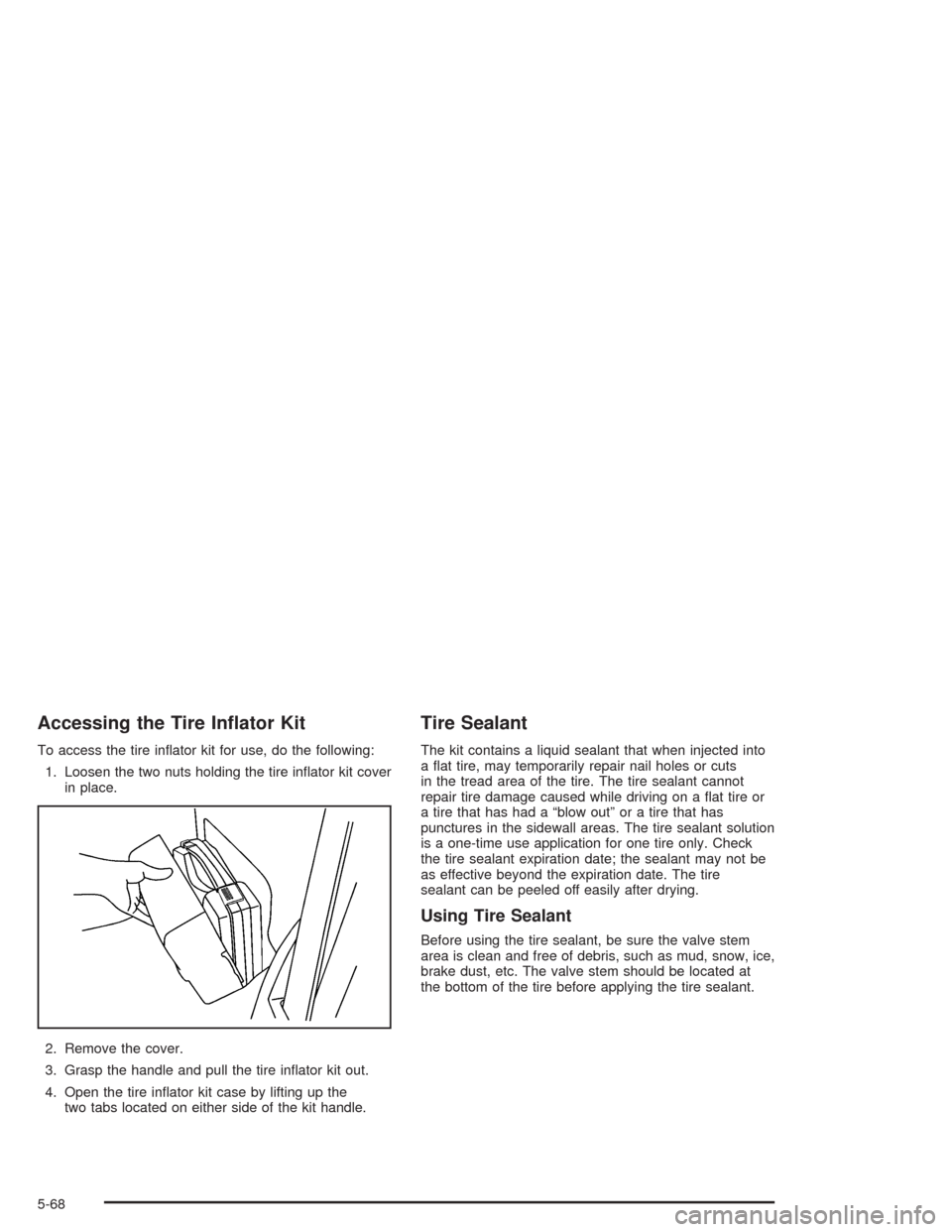
To access the tire inator kit for use, do the following:
1. Loosen the two nuts holding the tire inator kit cover
in place.
2. Remove the cover.
3. Grasp the handle and pull the tire inator kit out.
4. Open the tire inator kit case by lifting up the
two tabs located on either side of the kit handle.
Tire Sealant
The kit contains a liquid sealant that when injected into
a at tire, may temporarily repair nail holes or cuts
in the tread area of the tire. The tire sealant cannot
repair tire damage caused while driving on a at tire or
a tire that has had a “blow out” or a tire that has
punctures in the sidewall areas. The tire sealant solution
is a one-time use application for one tire only. Check
the tire sealant expiration date; the sealant may not be
as effective beyond the expiration date. The tire
sealant can be peeled off easily after drying.
Using Tire Sealant
Before using the tire sealant, be sure the valve stem
area is clean and free of debris, such as mud, snow, ice,
brake dust, etc. The valve stem should be located at
the bottom of the tire before applying the tire sealant.
5-68
Page 326 of 398
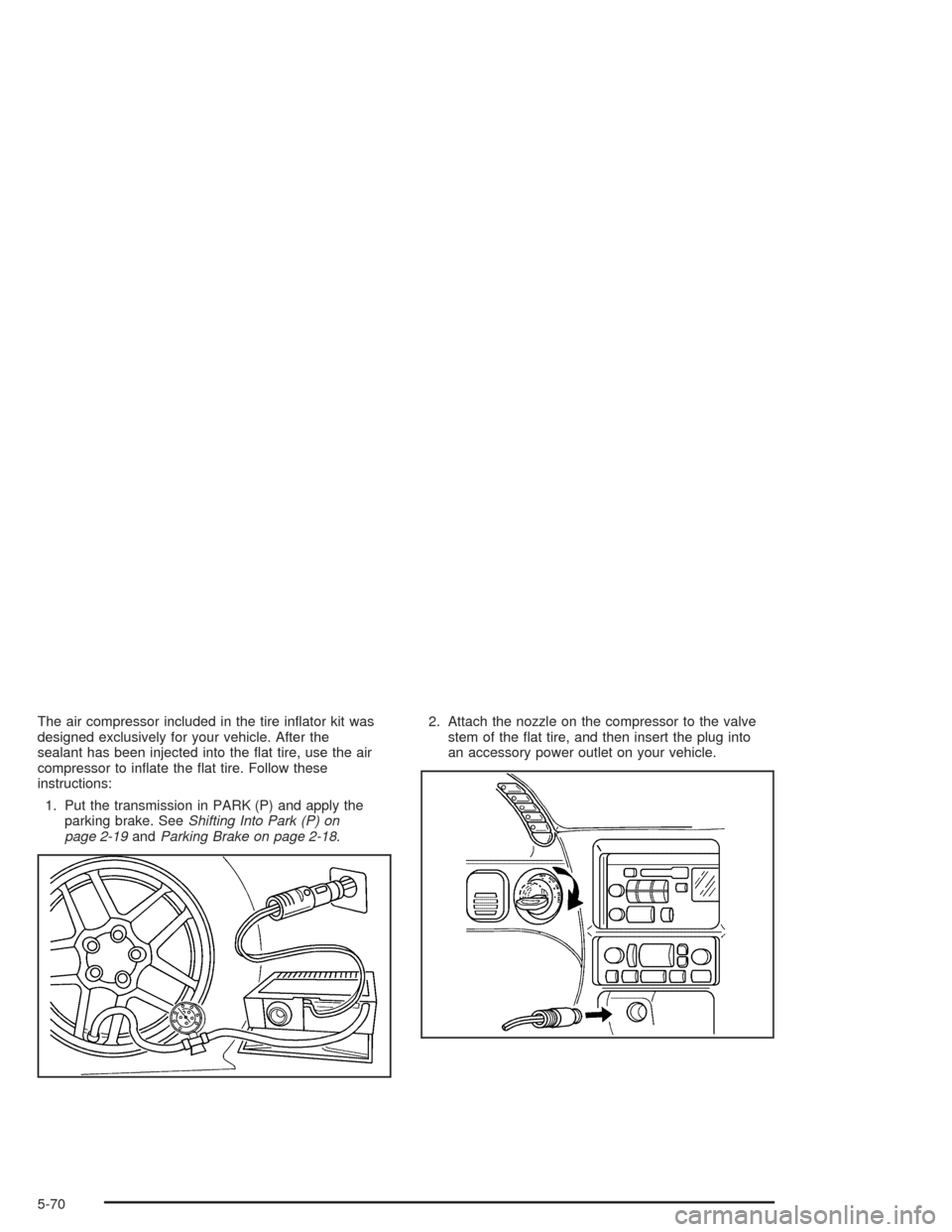
The air compressor included in the tire inator kit was
designed exclusively for your vehicle. After the
sealant has been injected into the at tire, use the air
compressor to inate the at tire. Follow these
instructions:
1. Put the transmission in PARK (P) and apply the
parking brake. SeeShifting Into Park (P) on
page 2-19andParking Brake on page 2-18.2. Attach the nozzle on the compressor to the valve
stem of the at tire, and then insert the plug into
an accessory power outlet on your vehicle.
5-70
Page 342 of 398
Fuses Usage
28 Roof Door Module
29 Blank
31 Truck Body Controller
32 Remote Keyless Entry (RKE)
33 Windshield Wipers
34 Stoplamps
35 Blank
36Climate Control System, Driver’s
Door Unlock
37 Front Parking Lamps
38 Driver’s Side Turn Signal
39 Climate Control System
40 Truck Body Controller
41 Radio
42 Trailer Parking Lamps
43 Passenger’s Side Turn Signal
44 Blank
46 Accessory Power Outlets
47 Ignition
48 BlankFuses Usage
49 Blank
50 Truck Body Controller, Ignition
51 Brakes
52 Blank
Relays Usage
18 Locks
24 Unlock
30 Parking Lamps
45Rear Window Defogger, Outside
Power Heated Mirrors
Circuit
BreakersUsage
01 Roof & Door Module
02 Roof Pump
08 Power Seats
5-86
Page 344 of 398
Fuses Usage
5 Starter
6 Ignition
7 Driver’s Side High Beam Headlamp
8Passenger’s Side High Beam
Headlamp
9 Ignition
10Instrument Panel Cluster, Driver
Information Center (DIC)
11 Driver’s Side Low Beam Headlamp
12Passenger’s Side Low Beam
Headlamp
13 Powertrain Control Module (PCM)
14 Air Bag System
15 Truck Body Controller
16 Truck Body Control, Ignition
17 Driver’s Side Stoplamp/Turn Signals
18Passenger’s Side Stoplamp/Turn
Signals
19 Back-up Lamps
20 Throttle Actuator Control (TAC)Fuses Usage
21 Fog Lamps
22 Horn
23 Injector A
24 Injector B
25 Oxygen Sensor A
26 Oxygen Sensor B
27 Windshield Washer
28 Cigarette Lighter
29 Powertrain Control Module (PCM)
30 Blank
31 Cargo Cover Release
32 Hazard Warning Flashers
33 Stoplamps
44 Engine Cooling Fan
45 Climate Control Fan
46 Ignition A
47 Ignition B
48 Anti-lock Brake System (ABS)
49 Body Fuse
5-88