2004 CHEVROLET SSR automatic transmission
[x] Cancel search: automatic transmissionPage 63 of 398

Keys...............................................................2-2
Remote Keyless Entry System.........................2-3
Remote Keyless Entry System Operation...........2-4
Doors and Locks.............................................2-6
Door Locks....................................................2-6
Power Door Locks..........................................2-7
Programmable Automatic Door Locks................2-8
Leaving Your Vehicle......................................2-8
Tailgate........................................................2-8
Windows.........................................................2-9
Power Windows............................................2-10
Sun Visors...................................................2-11
Theft-Deterrent Systems..................................2-11
Content Theft-Deterrent.................................2-11
Passlock
®....................................................2-13
Starting and Operating Your Vehicle................2-13
New Vehicle Break-In....................................2-13
Ignition Positions..........................................2-14
Starting Your Engine.....................................2-15
Automatic Transmission Operation...................2-16
Parking Brake..............................................2-18
Shifting Into Park (P).....................................2-19
Shifting Out of Park (P).................................2-20
Parking Over Things That Burn.......................2-21Engine Exhaust............................................2-21
Running Your Engine While You Are Parked. . . .2-22
Mirrors...........................................................2-23
Manual Rearview Mirror.................................2-23
Automatic Dimming Rearview Mirror with
HomeLink
®...............................................2-23
Outside Power Heated Mirrors........................2-24
Outside Convex Mirror...................................2-25
Outside Automatic Dimming Heated Mirror........2-25
HomeLink
®Transmitter...................................2-26
Programming the HomeLink®Transmitter.........2-27
Storage Areas................................................2-30
Glove Box...................................................2-30
Cupholder(s)................................................2-30
Instrument Panel Storage Area.......................2-30
Center Console Storage Area.........................2-30
Map Pocket.................................................2-30
Cargo Cover................................................2-31
Floor Tracks................................................2-35
Cargo Net System........................................2-36
Side-Saddle Storage.....................................2-41
Convertible Top..............................................2-45
Vehicle Personalization...................................2-52
Memory Seat...............................................2-52
Section 2 Features and Controls
2-1
Page 77 of 398

Starting Your Engine
Move your shift lever to PARK (P) or NEUTRAL (N).
Your engine won’t start in any other position — that’s a
safety feature. To restart when you’re already moving,
use NEUTRAL (N) only.
Notice:Do not try to shift to PARK (P) if your
vehicle is moving. If you do, you could damage the
transmission. Shift to PARK (P) only when your
vehicle is stopped.
1. With your foot off the accelerator pedal, turn the
ignition key to START. When the engine starts,
let go of the key. The idle speed will go down as
your engine gets warm.
Notice:Holding your key in START for longer than
15 seconds at a time will cause your battery to
be drained much sooner. And the excessive heat
can damage your starter motor. At 15 seconds, the
starter will automatically be disengaged. Wait
about 15 seconds between each try to help avoid
draining your battery or damaging your starter.
2. If it doesn’t start within 10 seconds, push the
accelerator pedal all the way to the oor, while you
hold the ignition key in START. When the engine
starts, let go of the key and let up on the accelerator
pedal. Wait about 15 seconds between each try.When starting your engine in very cold weather (below
0°F or 18 °C), do this:
1. With your foot off the accelerator pedal, turn the
ignition key to START and hold it there up to
15 seconds. When the engine starts, let go of
the key.
2. If your engine still won’t start (or starts but then
stops), it could be ooded with too much gasoline.
Try pushing your accelerator pedal all the way to the
oor and holding it there as you hold the key in
START for about three seconds. When the engine
starts, let go of the key and accelerator. If the
vehicle starts briey but then stops again, do the
same thing, but this time keep the pedal down
for ve or six seconds. This clears the extra
gasoline from the engine.
Notice:Your engine is designed to work with the
electronics in your vehicle. If you add electrical
parts or accessories, you could change the way the
engine operates. Before adding electrical equipment,
check with your dealer. If you do not, your engine
might not perform properly.
2-15
Page 78 of 398

Automatic Transmission Operation
Your automatic transmission has a shift lever located on
the center console.
There are several different positions for your shift lever.
PARK (P):This position locks your rear wheels. It’s
the best position to use when you start your engine
because your vehicle can’t move easily.
{CAUTION:
It is dangerous to get out of your vehicle if the
shift lever is not fully in PARK (P) with the
parking brake rmly set. Your vehicle can roll.
Do not leave your vehicle when the engine is
running unless you have to. If you have left the
engine running, the vehicle can move
suddenly. You or others could be injured.
To be sure your vehicle will not move, even
when you are on fairly level ground, always set
your parking brake and move the shift lever to
PARK (P). SeeShifting Into Park (P) on
page 2-19. If you are pulling a trailer, see
Towing a Trailer on page 4-39.
2-16
Page 79 of 398

Ensure the shift lever is fully in PARK (P) before starting
the engine. Your vehicle has an automatic transmission
shift lock control system. You have to fully apply
your regular brakes before you can shift from PARK (P)
when the ignition key is in RUN. If you cannot shift
out of PARK (P), ease pressure on the shift lever, and
push the shift lever all the way into PARK (P) (press the
button in on the console shift lever) as you maintain
brake application. Then move the shift lever into
the gear you wish. SeeShifting Out of Park (P) on
page 2-20.
REVERSE (R):Use this gear to back up.
Notice:Shifting to REVERSE (R) while your vehicle
is moving forward could damage the transmission.
The repairs would not be covered by your warranty.
Shift to REVERSE (R) only after your vehicle is
stopped.
To rock your vehicle back and forth to get out of snow,
ice or sand without damaging your transmission,
see If You Are Stuck: In Sand, Mud, Ice or Snow on
page 4-31.
NEUTRAL (N):In this position, your engine doesn’t
connect with the wheels. To restart when you’re already
moving, use NEUTRAL (N) only.
{CAUTION:
Shifting into a drive gear while your engine is
running at high speed is dangerous. Unless
your foot is rmly on the brake pedal, your
vehicle could move very rapidly. You could
lose control and hit people or objects. Do not
shift into a drive gear while your engine is
running at high speed.
Notice:Shifting out of PARK (P) or NEUTRAL (N)
with the engine running at high speed may damage
the transmission. The repairs would not be
covered by your warranty. Be sure the engine is not
running at high speed when shifting your vehicle.
DRIVE (D):This position is for normal driving.
If you need more power for passing, and you’re:
Going less than about 35 mph (55 km/h), push your
accelerator pedal about halfway down.
Going about 35 mph (55 km/h) or more, push the
accelerator all the way down.
You’ll shift down to the next gear and have more power.
2-17
Page 82 of 398
Leaving Your Vehicle With the Engine
Running
{CAUTION:
It can be dangerous to leave your vehicle with
the engine running. Your vehicle could move
suddenly if the shift lever is not fully in
PARK (P) with the parking brake rmly set.
And, if you leave the vehicle with the engine
running, it could overheat and even catch re.
You or others could be injured. Do not leave
your vehicle with the engine running.
If you have to leave your vehicle with the engine
running, be sure your vehicle is in PARK (P) and your
parking brake is rmly set before you leave it. After
you’ve moved the shift lever into PARK (P), hold down
the regular brake pedal. See if you can move the
shift lever away from PARK (P) without rst pulling it
toward you. If you can, it means that the shift lever
wasn’t fully locked into PARK (P).
Torque Lock
If you are parking on a hill and you don’t shift your
transmission into PARK (P) properly, the weight of the
vehicle may put too much force on the parking pawl
in the transmission. You may nd it difficult to pull the
shift lever out of PARK (P). This is called “torque
lock.” To prevent torque lock, set the parking brake and
then shift into PARK (P) properly before you leave
the driver’s seat. To nd out how, see “Shifting
Into PARK (P)” listed previously in this section.
When you are ready to drive, move the shift lever out of
PARK (P)beforeyou release the parking brake.
Shifting Out of Park (P)
Your vehicle has an automatic transmission shift lock
control system You have to fully apply your regular
brake before you can shift from PARK (P) when
the ignition is in RUN. SeeAutomatic Transmission
Operation on page 2-16.
If you cannot shift out of PARK (P), ease pressure on
the shift lever, push the shift lever all the way into
PARK (P), and release the shift lever button as you
maintain brake application. Then press the shift
lever button and move the shift lever into the gear
you wish.
2-20
Page 119 of 398
A. Climate Control Vents. SeeClimate Control System
on page 3-19.
B. Instrument Panel Cluster. SeeInstrument Panel
Cluster on page 3-24.
C. Turn Signal/Multifunction Lever. SeeTurn
Signal/Multifunction Lever on page 3-5.
D. Exterior and Interior Lamps Control. SeeExterior
Lamps on page 3-12andInterior Lamps on
page 3-15.
E. Driver Information Center (DIC) buttons. SeeDriver
Information Center (DIC) on page 3-44.
F. Audio Steering Wheel Controls. SeeAudio Steering
Wheel Controls on page 3-86.
G. Storage Tray. SeeInstrument Panel Storage Area
on page 2-30.
H. Audio System. SeeAudio System(s) on page 3-61.
I. Climate Control System. SeeClimate Control
System on page 3-19.
J. Transmission Shift Lever. SeeAutomatic
Transmission Operation on page 2-16.
K. Cupholder. SeeCupholder(s) on page 2-30.
L. Glovebox. SeeGlove Box on page 2-30.Hazard Warning Flashers
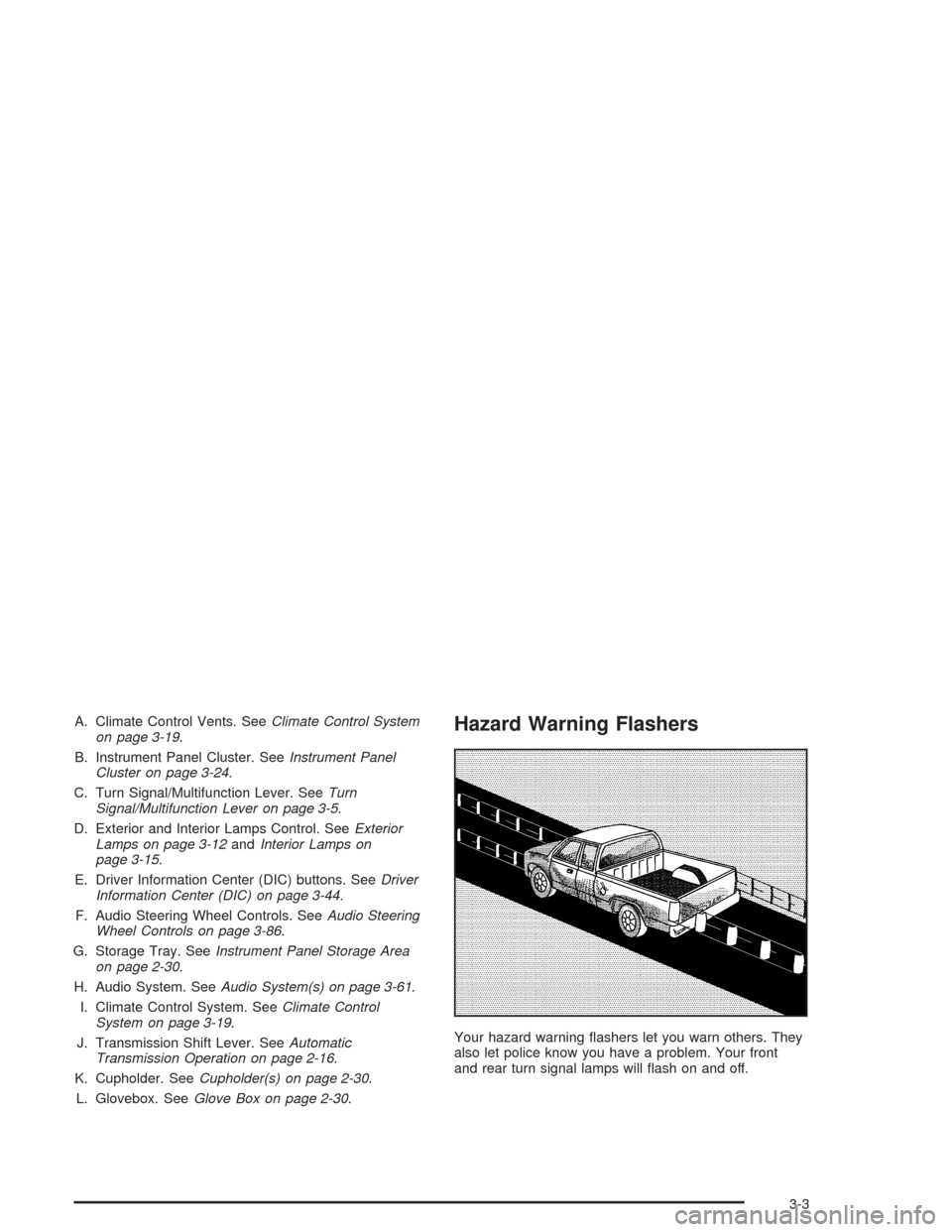
Your hazard warning ashers let you warn others. They
also let police know you have a problem. Your front
and rear turn signal lamps will ash on and off.
3-3
Page 130 of 398

Daytime Running Lamps
Daytime Running Lamps (DRL) can make it easier for
others to see the front of your vehicle during the
day. DRL can be helpful in many different driving
conditions, but they can be especially helpful in the short
periods after dawn and before sunset. Fully functional
daytime running lamps are required on all vehicles
rst sold in Canada.
The DRL system will make your headlamps come on
at reduced brightness when the following conditions
are met:
The ignition is on.
The exterior lamps knob is in AUTO.
The light sensor detects daytime light.
The transmission is not in PARK (P).
When the DRL are on, only your headlamps will be on.
The taillamps, sidemarker and other lamps won’t be
on. The instrument panel won’t be lit up either.
When it begins to get dark, the headlamps will
automatically switch from DRL to the regular headlamps.
To idle your vehicle with the DRL off, put your vehicle’s
transmission in PARK (P). The DRL will stay off until
you shift out of PARK (P).
Fog Lamps
Use your fog lamps for better vision in foggy or misty
conditions. Your ignition must be in RUN for your
fog lamps to work.
-(Fog Lamps):Press this button located on the
exterior lamps control to turn the fog lamps on or off.
The fog lamps will go off whenever you turn on the
high-beam headlamps. When the high beams are turned
off, the fog lamps will come on again.
O(Fog Lamp Indicator Light):This light located on
the exterior lamps control illuminates when the fog
lamps are turned on.
3-14
Page 165 of 398

Battery Voltage Too High
This message will be displayed when the battery
voltage is higher than normal and you try to raise or
lower the convertible top. The charging system light may
also be displayed on the instrument panel cluster.
SeeCharging System Light on page 3-29for more
information. Press the select button to acknowledge the
message and clear it from the DIC display.
Battery Voltage Too Low
This message will be displayed when the battery
voltage is lower than normal and you try to raise or
lower the convertible top. The charging system light may
also be displayed on the instrument panel cluster.
SeeCharging System Light on page 3-29for more
information. Press the select button to acknowledge the
message and clear it from the DIC display.
Cargo Cover Ajar
This message will be displayed when trying to open or
close the convertible top while the cargo cover is
open. Make sure the cargo cover is fully closed before
trying to open or close the convertible top. This
message will clear itself from the DIC once the cargo
cover is closed.
Change Trans (Transmission) Fluid
If your transmission uid in your vehicle needs to be
changed, this message will appear on the DIC.
SeeAutomatic Transmission Fluid on page 5-20and
Scheduled Maintenance on page 6-4for more
information.
Check Oil Level
If the oil level in the vehicle is low this message will
appear on the DIC. Check the oil level and add oil as
necessary. SeeEngine Oil on page 5-13for more
information. Press the select button to acknowledge this
message and clear it from the DIC display.
Depress Brake
This message will be displayed on the DIC when you try
to raise or lower the convertible top without rst
pressing the brake pedal. The brake pedal must be
pressed in order to operate the convertible top.
SeeConvertible Top on page 2-45for more information.
Pressing the brake pedal will clear the message, or
you can press the select button to acknowledge
and clear the message from the DIC display.
3-49